
A strong customer experience strategy helps you reduce churn, increase loyalty, and grow revenue without competing on price. This guide shows you what a customer experience strategy really is, why it matters, and how to build one step by step—practical, clear, and ready to apply.
Основные выводы
Most businesses lose customers they could have kept. Not because of bad products or poor service—but because of friction at moments that nobody was watching.
A customer experience strategy fixes this. It’s your company’s playbook for delivering consistent, valuable interactions at every stage of the customer journey—from first click to long-term loyalty.
What you’ll learn:
- How CX strategy differs from customer service (and why that matters)
- The business case: retention rates, lifetime value, and competitive advantage
- Step-by-step framework for building your first CX strategy
- Which metrics actually predict churn (and which ones mislead you)
- How to turn feedback into action that customers notice
Companies with documented CX strategies retain 89% of customers compared to 33% for those without (Temkin Group). Let’s build yours.
What Is a Customer Experience Strategy?
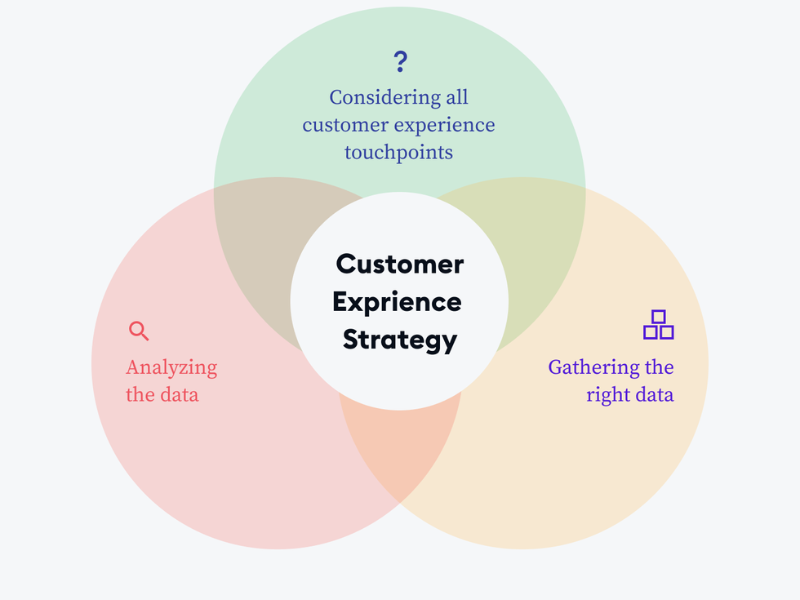
A customer experience strategy is your company’s shared playbook for creating consistent, positive interactions at every touchpoint—before, during, and after purchase.
Think about the last frustrating customer experience you had. You contacted support via chat, got passed to email, repeated your issue to three different people, and finally gave up. That’s what happens без a CX strategy—teams work in silos, nobody owns the end-to-end experience, and customers feel it immediately.
A strong CX strategy answers four questions:
- Who are we serving? Not just demographics—actual pain points, goals, and behaviors
- Where is friction? Specific moments where customers get confused, frustrated, or give up
- How do we fix it? Which teams own which touchpoints, and how they coordinate
- What does success look like? Metrics connecting experience to business outcomes (retention, expansion, referrals)
It’s not a collection of random fixes. Improving support response times helps. Redesigning your checkout page helps. But without a shared direction, one team optimizes while another creates new friction. Results stay inconsistent. Customers notice.
A B2B SaaS company discovers 40% of trial users never complete setup. Their CX strategy focuses on three fixes:
- Simplified first-login flow (Product team)
- Proactive check-in emails on day 2 and day 5 (Marketing)
- Live chat offer during setup (Support)
Result: Trial-to-paid conversion increases 23% in 90 days.
That’s the difference between reactive problem-solving and strategic experience design.
What a CX strategy typically includes:
- Clear experience goals tied to business outcomes.
- Defined customer journeys and key touchpoints.
- Ownership across teams, not just support.
- Ongoing measurement and improvement loops.
Customer Experience vs. Customer Service
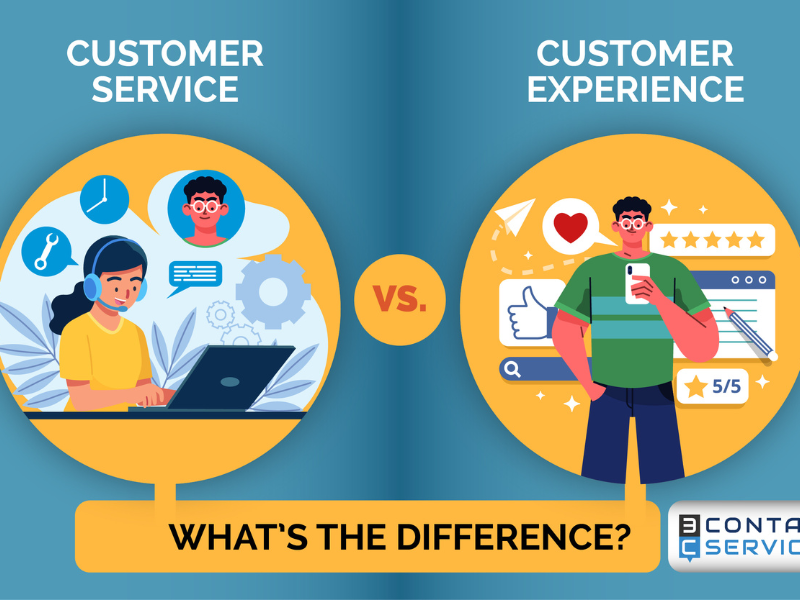
What Is Customer Service?
Customer service focuses on helping customers solve specific issues, usually after a problem occurs.
- Reactive by nature.
- Owned mainly by support teams.
- Measured by resolution speed and satisfaction after an interaction.
[Ảnh: Support agent handling a ticket]
What Is Customer Experience?
Customer experience is the customer’s overall perception of your brand, shaped by every interaction—before, during, and after a purchase.
It includes:
- Marketing messages and website clarity.
- Sales interactions and onboarding.
- Product usability and reliability.
- Support quality and follow-up.
Customer experience is proactive and cross-functional. It requires marketing, product, sales, and support to work toward shared experience goals.
CX vs. Customer Service
| Обслуживание клиентов | Опыт клиентов |
|---|---|
| Solves individual issues | Shapes the full journey |
| One team owns it | Everyone owns it |
| Реактивный | Проактивный |
| Short-term focus | Долгосрочные отношения |
Why Confusing CX and Customer Service Hurts Results
-
Your support team hits 95% satisfaction scores while customer churn stays at 8% monthly. Why? Because you’re measuring support interactions, not the full experience.
Customers cancel because onboarding was confusing, not because support was slow. You’re solving the wrong problem.
Why a Customer Experience Strategy Matters for Businesses
Why CX Is Your Most Defensible Advantage
Your competitor can copy your features in 6 months. They can match your pricing in 6 weeks. But they can’t replicate the trust built through consistent, positive experiences over time.
The business case in numbers:
- Retention compounds: A 5% increase in retention grows revenue by 25-95% (Bain & Company). For a $1M ARR business, reducing monthly churn from 5% to 4% adds $180K annual revenue—without acquiring a single new customer.
- Lower acquisition cost: Customers acquired through referrals have 16% higher lifetime value and 37% higher retention (Wharton). Strong CX creates word-of-mouth that paid ads can’t buy.
- Pricing power: Companies with superior CX charge 16% premium on average (Gartner). When experiences consistently exceed expectations, customers tolerate price increases your competitors can’t justify.
Your best support agent instinctively delivers amazing experiences. Customers love her. When she goes on vacation, complaints spike. When she leaves the company, your CSAT drops 12 points.
That’s the “hero employee” problem. A CX strategy documents what great looks like and makes it repeatable across your team—regardless of who’s working that day.
Key business benefits:
- Reduced churn through early friction removal.
- Better alignment between teams and priorities.
- Smarter decisions based on customer feedback, not assumptions.
Core Elements of an Effective Customer Experience Strategy
Understanding Your Customers and Their Pain Points
Understanding Your Customers Beyond Demographics
Two “Operations Directors at 100-person BPOs” look identical on paper. But one runs outbound sales campaigns, the other handles inbound support. Completely different pain points. Completely different needs.
Demographics tell you who customers are. Behavior tells you what they actually struggle with.
Three ways to understand real customer problems:
1. Analyze behavior, not surveys:
- Which features do customers who stay 12+ months use in their first 30 days? (Check product analytics)
- What questions appear most in support tickets during onboarding? (Pull last 100 tickets)
- Which marketing messages drive trials vs. paid conversions? (Review campaign data)
2. Build pain-point-driven personas:
Вместо: “Sarah, 35, Operations Director, manages 50 agents”
Попробуйте: “Sarah runs seasonal campaigns for crypto clients. Her pain points: clients launch with 3 days notice, she needs agents operational same week, per-seat pricing kills margins on 60-day campaigns, compliance requirements (TCPA) with no in-house legal team.”
The second version tells you what to build.
3. Use empathy mapping to understand emotions:
For Sarah above:
- Thinks: “I can’t commit to annual licenses when my clients give me 30-day contracts”
- Feels: Frustrated by vendor lock-in, anxious about compliance penalties
- Says: “I need flexibility and transparent pricing”
- Does: Requests demos from 3+ vendors, asks detailed questions about deployment timelines
This reveals what drives decisions—not just what customers say they want.
Common pain points across industries:
- Confusing onboarding.
- Slow or repetitive support.
- Inconsistent information across channels.
Mapping the Customer Journey
Map the Journey to Find Hidden Friction
Customer journey mapping shows where people get stuck, confused, or frustrated—the moments you didn’t know were breaking the experience.
Typical journey stages:
- Awareness → How they first hear about you
- Consideration → Comparing you to alternatives
- Purchase → Signup or checkout
- Onboarding → First use and setup
- Ongoing use → Daily/regular interaction
- Renewal or advocacy → Decision to stay or leave
Don’t map every touchpoint. Focus on moments that matter—the 3-5 interactions that most strongly influence whether customers stay or leave.
Пример: A SaaS company maps their journey and discovers 35% of trial users abandon during “connect your CRM” step. That’s not a feature problem—it’s an onboarding friction point. They simplify the integration UI, add pre-built templates, and proactively reach out to users who stall. Abandonment drops to 18%.
Three rules for effective journey mapping:
1. Map from customer perspective, not yours
Wrong: “Step 3: Customer fills out form, data enters Salesforce, email triggers”
Right: “Step 3: Customer confused by ‘Company EIN’ field—what if I’m freelance? Abandons form.”
2. Capture emotions, not just actions
Don’t just write “Customer contacts support.” Write “Customer frustrated after searching FAQ for 10 minutes, contacts support hoping for quick answer.”
Emotions predict churn better than actions.
3. Prioritize fixes by business impact
Fix onboarding friction affecting 35% of trials before fixing renewal experience affecting 2% of customers. High-volume, high-impact first.
Designing a Customer-Centric Approach Across Teams
The biggest CX failures happen when teams optimize different goals:
- Marketing promises “setup in 10 minutes” to drive signups
- Product knows it actually takes 45 minutes for first-time users
- Support gets flooded with “this doesn’t work” tickets
- Marketing blames Product for bad UX. Product blames Marketing for overpromising
Customers lose. Churn increases.
How to align teams around CX:
1. Set shared goals everyone owns
Bad: Marketing owns “trial signups,” Support owns “ticket resolution time”
Good: Marketing, Product, and Support all own “trial-to-paid conversion rate”
When everyone’s measured on the same outcome, silos dissolve naturally.
2. Make customer insights accessible to all teams
Support hears problems first. If that knowledge stays in tickets, Product keeps building the wrong things.
Solution: Weekly “Voice of Customer” summary shared with Product, Marketing, and Sales. Five minutes. Top 3 themes. What changed.
3. Require CX input on customer-facing decisions
Simple rule: If it affects customers, CX reviews it before launch. This includes:
- Pricing changes (affects renewals)
- Feature releases (affects onboarding)
- Marketing campaigns (sets expectations)
- Policy updates (affects support volume)
Creating Consistent Omnichannel Experiences
Omnichannel vs. Multichannel (Most Companies Get This Wrong)
You offer email, phone, chat, and social media. That’s multichannel. But is it omnichannel?
Test: Customer contacts chat at 10pm about a billing issue. Chat agent creates ticket. Customer calls at 8am the next day. Does your phone agent know about yesterday’s chat?
- If no: You’re multichannel. Customer repeats themselves. Frustration increases.
- If yes: You’re omnichannel. Conversation continues seamlessly.
What makes omnichannel work:
1. Unified customer data (CRM)
Every interaction—chat, email, phone, purchase history—lives in one system. Any agent on any channel sees the full context.
Without this, you’re running separate channels, not omnichannel.
2. Consistent policies across channels
Example failure: Website says “24-hour response time.” Email auto-reply says “48-72 hours.” Chat says “we don’t handle billing via chat.”
Customer gets three different answers. Trust breaks.
3. Smooth handoffs between channels
When customer switches from chat to email, include chat transcript. Don’t make them re-explain.
Small detail. Massive impact on experience.
Step-by-Step: How to Build a Customer Experience Strategy
Step 1 – Set Clear CX Goals and Priorities
Strong CX goals connect directly to business outcomes.
Good goals:
- Reduce onboarding drop-off by 15%.
- Increase retention in the first 90 days.
Weak goals:
- Improve customer happiness.
- Deliver great service.
Prioritize goals based on impact and feasibility. Focus on fewer, meaningful improvements.
Step 2 – Gather and Use Customer Feedback
Feedback is only valuable when acted on.
Key feedback sources:
- Surveys after key interactions.
- Product usage signals.
- Reviews and support conversations.
Common metrics:
- NPS (Net Promoter Score – likelihood to recommend).
- CSAT (Customer Satisfaction Score – satisfaction after an interaction).
Always close the loop. Tell customers what changed because of their input.
Step 3 – Improve Key Touchpoints That Matter Most
Not all touchpoints are equal.
Focus on those that strongly influence decisions:
- Onboarding for new customers.
- Checkout or sign-up flows.
- First support interaction.
Reduce friction by simplifying steps, clarifying expectations, and removing unnecessary effort.
Step 4 – Enable Employees to Deliver Better Experiences
Employees shape customer experience every day.
Support them with:
- Clear guidelines and training.
- Authority to solve problems without escalation.
- Tools that reduce manual work.
Better employee experience leads to better customer outcomes.
Step 5 – Review, Adjust, and Continuously Improve
Customer expectations change. Your strategy must evolve.
- Review CX metrics regularly.
- Revisit journey maps as products change.
- Treat CX as a continuous improvement loop, not a one-time project.
Common Customer Experience Problems a CX Strategy Helps Solve
- Inconsistent experiences: A strategy aligns teams and channels.
- High churn: Journey mapping reveals hidden friction.
- Internal silos: Shared goals replace conflicting priorities.
- Unclear priorities: Data-driven insights guide focus.
How to Measure the Success of a Customer Experience Strategy
Key Customer Experience Metrics to Track
| Метрика | What It Tells You | Лучшее применение |
|---|---|---|
| NPS | Loyalty and advocacy | Long-term health |
| CSAT | Satisfaction after interactions | Support and service |
| Retention rate | Customer stickiness | Business impact |
| Churn rate | Experience failure points | Risk detection |
Metrics are signals, not answers. Always pair them with qualitative feedback.
Using KPIs to Guide CX Improvements
- Avoid vanity metrics without clear actions.
- Track trends over time, not single scores.
- Use KPIs to prioritize improvements, not punish teams.
Tools and Technology in Customer Experience Strategy
Tools support strategy. They do not replace it.
Common categories include:
- CRM platforms for shared customer data.
- Feedback and survey tools.
- Support and communication systems.
- Analytics and reporting dashboards.
Examples include Zendesk and Qualtrics. Choose tools that fit your maturity and goals.
Customer Experience Strategy FAQ
What is the main goal of a customer experience strategy?
The goal is to deliver consistent, valuable experiences that increase retention, loyalty, and long-term growth.
How long does it take to build a CX strategy?
A basic strategy can be defined in weeks. Meaningful improvement is ongoing.
Is a customer experience strategy only for large companies?
No. Small businesses benefit even more because small improvements have visible impact.
How often should a CX strategy be updated?
Review core assumptions at least quarterly or after major product or market changes.
Заключение
A customer experience strategy turns good intentions into consistent results. Start simple. Focus on the moments that matter. Listen to customers and act fast. Map your current journey, identify friction, and commit to continuous improvement. That’s how better customer journeys are built.
Вопросы и ответы

What is a customer experience strategy?
A customer experience strategy (CX strategy) is a blueprint for creating positive customer interactions at every touchpoint. It focuses on understanding customer needs, addressing pain points, and aligning business goals with customer expectations.
Why is a customer experience strategy important?
An effective CX strategy improves customer loyalty, increases retention, and strengthens brand differentiation. Studies show businesses with strong CX programs outperform competitors by building long-term customer relationships.
How do you create a customer experience strategy?
To create a CX strategy:
- Set clear goals aligned with business outcomes.
- Analyze customer feedback to identify pain points.
- Map the customer journey to uncover friction.
- Train employees and enable cross-team collaboration.
- Regularly review and improve touchpoints.
What are the core elements of a solid CX strategy?
Ключевые элементы включают:
- Deep understanding of customer personas and pain points.
- Clear journey mapping across all touchpoints.
- A customer-centric, omnichannel approach.
- Continuous feedback collection and implementation.
How is customer experience different from customer service?
Customer service focuses on resolving specific issues, while customer experience encompasses every interaction a customer has with your brand across their entire journey. CX is holistic and proactive, while customer service is typically reactive.
What are the key metrics to measure customer experience success?
The most common CX metrics include:
- Net Promoter Score (NPS): Measures customer loyalty.
- Customer Satisfaction Score (CSAT): Evaluates satisfaction with a specific interaction.
- Customer Retention Rate: Tracks repeat customer behavior.
How can a CX strategy help reduce churn?
By identifying pain points and improving critical touchpoints, a CX strategy enhances customer satisfaction. Proactive engagement, seamless support, and personalized interactions prevent customers from leaving.
How can small businesses implement a CX strategy?
Small businesses can start by:
- Collecting real-time feedback with simple surveys.
- Prioritizing high-impact touchpoints like onboarding or support channels.
- Training employees to deliver exceptional and consistent service.
What tools are useful for executing a CX strategy?
Tools that support CX strategies include:
- CRM platforms (e.g., Salesforce, HubSpot) for managing customer data.
- Survey tools (e.g., Qualtrics, Delighted) for feedback collection.
- Helpdesk software (e.g., Zendesk) for efficient support operations.
How do you continuously improve a CX strategy?
Regularly analyze feedback, monitor CX metrics, and adapt to evolving customer needs. Schedule reviews every quarter, implement customer suggestions, and invest in emerging technologies to stay competitive.
Читать далее:
Call Center KPIs for Customer Experience: What to Track
Best Outsourced Customer Support Providers Compared 2026



 English
  Russian
  Chinese