

Customer experience is getting worse, not better. Forrester’s 2025 Global CX Index found that 21% of brands declined in CX quality while only 6% improved — and in the US, 25% declined against 7% that improved, the second consecutive year of that pattern. Most of those brands were not neglecting customer experience. They were working on it without a strategy holding the work together.
That is the gap this guide addresses. A customer experience strategy is not a satisfaction target or a list of fixes: it is the decision about which moments in the journey you will improve, who owns each one, and how you will know it worked. Below: what a CX strategy actually contains, how it differs from customer service, the five steps to build one, how to measure it without fooling yourself, and where the data says most programmes go wrong.
Key Takeaways
- CX quality is declining across the market. Forrester’s 2025 index recorded 21% of brands falling and 6% improving, driven by weaker employee experience, waning customer obsession, disappointing technology implementations, and economic volatility. Three of those four are strategy problems, not budget problems.
- Customers will pay for a better experience. PwC’s Experience Is Everything study of 15,000 respondents found a price premium of up to 16% for good experience, and that 32% of consumers would walk away from a brand they love after a single bad one.
- Retention is where the money is. The Bain finding popularised through Harvard Business Review — a 5% increase in retention lifting profits by 25-95% — traces back to Reichheld and Sasser’s 1990 research, which measured 25-85% across the companies studied. Treat it as an order of magnitude, not a forecast.
- CX is not customer service. Service resolves individual issues after they occur. Experience is the whole journey, owned by product, marketing, and sales as much as by support. Confusing the two is why teams hit 95% satisfaction scores while churn stays flat.
- Effort predicts churn earlier than satisfaction does. A customer can be satisfied with every interaction and still leave. Read your metrics in pairs, not as a scorecard.
What Is a Customer Experience Strategy?
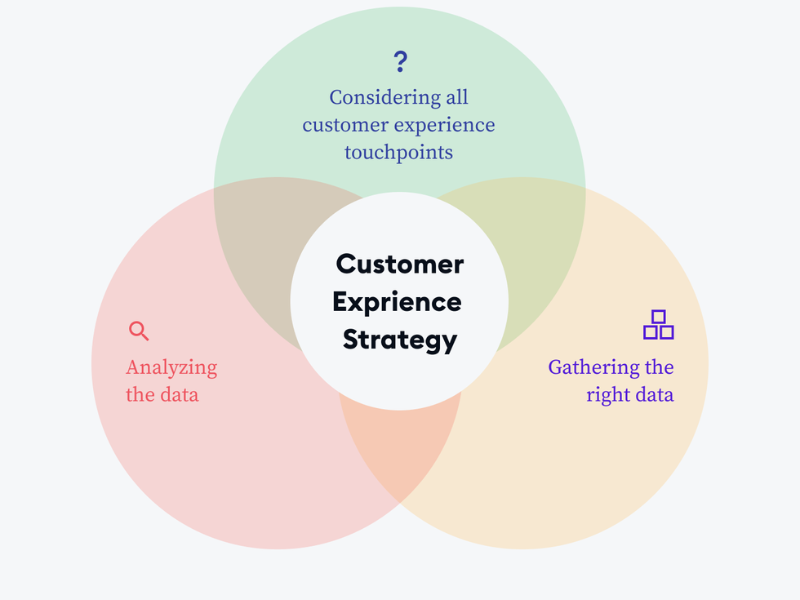
A customer experience strategy is your company’s shared plan for the interactions a customer has with you — before, during, and after purchase. It sets which experiences matter most to the business, which team owns each one, and what evidence will show whether they improved.
The test of whether one exists is simple. Ask three people in different departments which customer moment the company is currently trying to fix. If you get three answers, there is no strategy, only activity.
A working strategy answers four questions explicitly:
- Who are we serving? Not demographics — the actual jobs, constraints, and frustrations that drive their decisions.
- Where is the friction? The specific moments where customers hesitate, repeat themselves, or give up.
- Who fixes it? Which team owns which touchpoint, and how they hand off between them.
- What does success look like? Metrics that connect experience to retention, expansion, and referral rather than to a satisfaction number in isolation.
The distinction that matters is between a strategy and a collection of improvements. Improving support response times helps. Redesigning checkout helps. But without shared direction, one team removes friction while another quietly adds it — marketing promises setup in ten minutes, product knows it takes forty-five, and support absorbs the difference in ticket volume. Every team hits its own target and the customer’s experience gets worse.
A documented strategy also solves what might be called the hero-employee problem. Most companies have one person who instinctively delivers excellent experiences. When they are on holiday, complaints rise; when they leave, the standard leaves with them. Writing down what good looks like is what makes it survive a resignation.
What a CX strategy typically contains: experience goals tied to business outcomes, a mapped journey with the moments that matter identified, named ownership across teams rather than in support alone, and a measurement and review loop with a fixed cadence.
Customer Experience vs. Customer Service
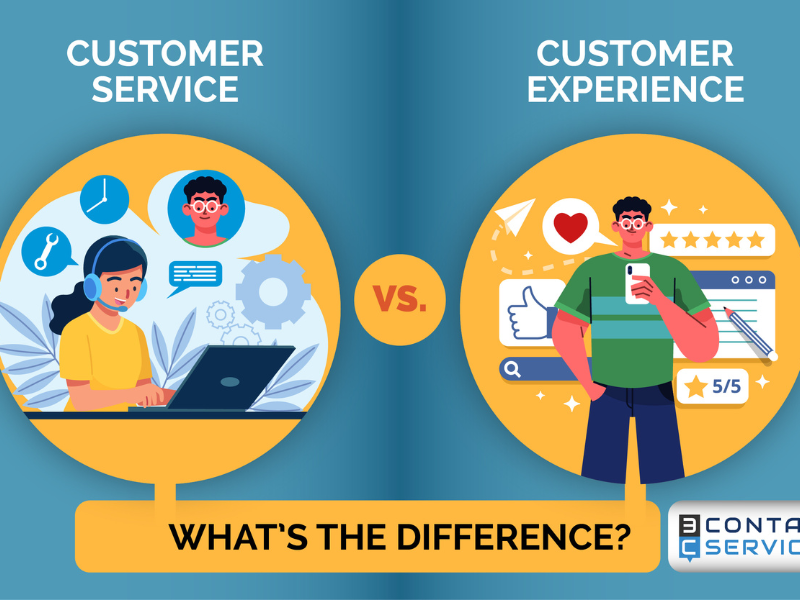
Customer service is what happens when a customer needs help. It is reactive by design, owned mainly by a support team, and measured on how quickly and how well an issue was resolved. Done well, it is one of the strongest components of experience — inbound support is often where a relationship is saved or lost.
Customer experience is the customer’s overall perception of the brand, formed by every interaction: the clarity of your marketing, the honesty of the sales conversation, how quickly onboarding delivers the first useful outcome, whether the product behaves as promised, and how failures are handled. It is proactive and cross-functional, which is precisely why it is harder to own.
| Customer service | Customer experience |
|---|---|
| Solves individual issues | Shapes the full journey |
| One team owns it | Ownership spans product, marketing, sales, support |
| Reactive — triggered by a customer | Proactive — designed in advance |
| Measured per interaction (CSAT, resolution time) | Measured across the relationship (retention, effort, referral) |
| Short-term: close this ticket | Long-term: keep this customer |
Confusing the two produces a specific and very common failure. A support team posts 95% satisfaction while monthly churn holds steady, and nobody can explain the contradiction. The explanation is usually that customers are not leaving because support was slow — they are leaving because onboarding was confusing, the product did not do what the website implied, or a renewal price arrived without warning. None of that appears in a post-ticket survey, because the customers who left never opened a ticket.
That is also why the fix is rarely more service. Adding agents to absorb contact volume treats the symptom and locks in the cost. Removing the reason for the contact is the CX move, and it usually belongs to a team other than support.
Why CX Strategy Matters — and Why Most Programmes Are Slipping
The commercial argument for customer experience is well evidenced. The uncomfortable part is that most organisations already accept it and are still going backwards.
What the money looks like. PwC’s study of 15,000 consumers put the price premium for good experience at up to 16%, with 43% saying they would pay more for greater convenience and 42% for a friendlier, more welcoming experience. Qualtrics XM Institute’s 2025 research found 72% of US consumers would pay more for a premium experience, rising to 84% in air travel and 77% for rideshare. On the retention side, the Reichheld and Sasser work behind the familiar Bain figure measured profit gains of 25-85% from a 5-point improvement in defection rate.
What the downside looks like. PwC found 32% of consumers would abandon a brand they love after one bad experience. Zendesk’s CX Trends research reports 61% switching to a competitor after a single bad experience and 76% after more than one. The asymmetry is the point: experience is bought incrementally and lost suddenly.
Why it is getting worse anyway. Forrester attributes the multi-year decline to four causes — weaker employee experience, waning customer obsession, disappointing technology implementations, and economic volatility. Notice what is not on that list: lack of tooling, or lack of data. Companies have more customer data than ever. What they lack is a decision about which parts of the experience they are willing to fund, staff, and defend when quarterly pressure arrives. Qualtrics found two-thirds of consumers say a recent experience they had could be improved, and in banking measured a 44-point NPS gap between customers who hit a service problem and those who did not.
The practical implication for a strategy is that technology is not the lever most teams think it is. Three of Forrester’s four causes are organisational: how supported your staff are, how seriously leadership takes customers, and whether the technology you did buy was implemented into a real process. A CX strategy that consists of purchasing a platform addresses one cause out of four. For a longer view of how these forces are reshaping expectations, see our overview of customer experience trends.
Step-by-Step: How to Build a Customer Experience Strategy

Five steps, in order. The sequence matters more than the sophistication of any one step — most failed programmes did step three well without ever completing step one, then could not explain to a finance director why the work deserved another year of funding.
Two things are worth settling before you begin. First, decide who signs off: a CX strategy that spans product, marketing, and support needs one executive who can arbitrate when those teams want different things, and appointing them afterwards never works. Second, agree the time horizon. Touchpoint fixes show movement within a quarter; retention and referral effects take two or three. Committing to a twelve-month horizon in advance prevents the programme being judged on a metric that had no chance to move yet — a common reason good CX work gets cancelled before it reports.
Expect the first cycle to be smaller than the framework implies. One goal, one owner, two metrics, and a monthly review beats a complete journey-mapping programme that arrives after the budget year has closed.
Step 1 — Set clear CX goals and priorities
Most CX strategies fail here, not later. “Improve the customer experience” is not a goal: it cannot be argued with, budgeted for, or shown to have worked.
A usable goal names three things — the outcome, the number, and the deadline. Cut first-response time on chat from four hours to one hour by the end of Q3 is a goal. Be more customer-centric is a slogan.
Start from a business problem, not a metric. Work backwards from something the company already cares about: customers leaving in month two, support costs rising faster than revenue, a launch generating more confusion than sales. CX work that begins from a business problem survives budget review; CX work that begins from a satisfaction score does not.
Pick fewer priorities than feel comfortable. Two or three for the year. A list of eight is a list of none, because every team will pick the one nearest its own targets and the rest will quietly lapse. If the list is long, rank it and draw a line after the third item.
Write down what you will not do. Teams skip this and regret it. Deciding in advance that you will not add a channel this year, or not rebuild the help centre, is what protects the two priorities you did choose.
Agree who owns each goal before you start. Not a department — a person. CX goals sit across support, product, and marketing, which means they belong to everyone and therefore to nobody unless a name is attached.
Step 2 — Understand customers and map the journey
Demographics tell you who customers are. Behaviour tells you what they struggle with, and only the second one is actionable.
Build personas around constraints, not attributes. “Operations director, 35, manages 50 agents” describes a person. “Runs seasonal campaigns where clients give three days’ notice, needs agents live the same week, cannot commit to annual licences on 60-day contracts, carries compliance obligations with no in-house legal team” describes a set of decisions. The second version tells you what to change.
Read behaviour before you read surveys. Which features do customers who stay past twelve months use in their first thirty days? What questions dominate support tickets during onboarding? Where do sessions end? Pull the last hundred tickets and tag them by reason — it is cheaper than a research project and usually more revealing.
Map the journey from the customer’s side. Not “customer completes form, record enters CRM, email triggers” but “customer hits a field asking for a company registration number, does not have one as a freelancer, abandons the form”. Capture the emotional state at each stage, because frustration predicts churn better than any action does.
Do not map everything. Six stages cover most businesses — awareness, consideration, purchase, onboarding, ongoing use, renewal or advocacy. Within them, find the three to five moments that most influence whether someone stays. Fixing a friction point that affects a third of trials matters more than perfecting a renewal flow that touches 2% of customers.
Step 3 — Improve the touchpoints that carry the most weight
Not all touchpoints deserve equal effort, and treating them as if they do is how CX budgets get spread too thin to change anything.
Score each touchpoint on two axes: how many customers pass through it, and how much damage it does when it fails. A checkout page scores high on both. An annual satisfaction survey scores low on both. Start where both numbers are high, regardless of which team owns it.
Three touchpoints carry disproportionate weight in most businesses. The first week after purchase is where the customer decides whether the thing they bought will work for them; problems here rarely produce complaints, they produce quiet non-renewal months later. The moment something goes wrong is remembered more vividly than smooth service — a well-handled failure often produces more loyalty than nothing going wrong at all. Any point where the customer has to repeat themselves — channel handoffs, escalations, a returning customer treated as new — is the most common and most avoidable damage in the entire journey.
That last one is worth a test. A customer starts a chat at 10pm about billing and calls at 8am the next morning. Does the phone agent see the chat? If not, you are running multiple channels, not an omnichannel experience, and the difference is entirely invisible on your channel-level dashboards.
Fix causes rather than symptoms. Heavy contact volume at a touchpoint usually originates upstream — a product page that set the wrong expectation, a delivery estimate that keeps slipping. Change one thing at a time where you can: three improvements landing in the same month cannot be attributed, and unattributed wins are the first to be cut.
Step 4 — Enable the people delivering the experience
A strategy that only changes processes and tooling will stall, because the people executing it hit limits nobody removed. Forrester names weaker employee experience as a leading cause of declining CX quality, which makes this step load-bearing rather than optional.
Authority is the constraint more often than skill. An agent who can see the problem but needs approval to fix it delivers a worse experience than a less capable agent who is trusted to act. Set a discretion limit — a refund value, a credit, a goodwill gesture — that frontline staff can apply without asking. Most companies set it far below the cost of the escalation it would prevent.
Give context, not just scripts. Staff who understand why a policy exists apply it sensibly at the edges. Staff who know only the wording apply it rigidly and generate exactly the complaints the policy was written to avoid.
Align the teams that create the experience, not just the one that repairs it. Shared goals dissolve silos faster than any workshop: when marketing, product, and support are all measured on trial-to-paid conversion rather than on signups, uptime, and ticket time separately, the arguments about who overpromised stop being useful to anyone. Circulate a weekly summary of the top three things customers raised, and require CX review on anything customer-facing before launch — pricing changes, feature releases, campaigns, policy updates.
Be careful what you measure people on. Metrics shape behaviour faster than values statements. Measure handle time alone and you will get shorter calls and more repeat contacts. Pair every efficiency metric with a quality one, or the efficiency metric wins.
Step 5 — Review, adjust, and keep improving
A CX strategy is not a document you finish. The version that survives contact with real customers is always different from the one that was approved.
Separate the two review rhythms. A monthly operational review looks at what moved and what broke — contact reasons, response times, the touchpoints in flight. A quarterly strategic review asks whether these are still the right priorities. Merging them means the urgent always crowds out the important.
Commit to the prediction before you ship. Name the metric, the size of the shift you expect, and the date you will check. Written down beforehand, a miss is information. Left unwritten, every outcome becomes arguable, and the team that shipped the change will always find a reading in which it succeeded.
Watch for metrics drifting apart. Satisfaction holding steady while effort scores rise, or contact volume falling while repeat contacts climb, usually means something was optimised in one place and pushed somewhere else. Divergence between two metrics is more informative than either one moving alone.
Retire things deliberately. Surveys nobody reads, dashboards nobody opens, tags nobody uses. CX programmes accumulate measurement debt, and maintaining it is effort not spent fixing anything.
Re-check assumptions annually. Expectations move, and the journey you mapped eighteen months ago may not be the journey people take now. A small annual round of customer conversations catches the drift before the metrics do.
Common Customer Experience Problems a CX Strategy Solves
A strategy earns its keep by fixing failure patterns that no individual team can fix alone. Four recur across almost every company.
Inconsistent experience between channels and teams. The website promises a 24-hour response, the email autoresponder says 48-72 hours, and chat says billing is not handled there. Each answer is defensible in isolation; together they teach the customer that nobody is in charge. A strategy fixes this by making one team accountable for the promise across every surface, rather than each channel owning its own wording.
Churn nobody saw coming. Customers rarely announce that they are leaving. They stop opening emails, log in less, and let a renewal lapse. Because none of that generates a ticket, it never reaches the team measuring satisfaction. Journey mapping surfaces the moments where quiet disengagement begins — most often in the first fortnight after purchase — so the intervention can happen while the account is still recoverable.
Silos that each hit their targets. This is the most expensive pattern, because every dashboard looks healthy. Marketing optimises signups, product optimises feature velocity, support optimises handle time, and the composite experience degrades while nobody is accountable for the composite. Shared outcome metrics are the only reliable fix; org-chart changes and cross-functional meetings without shared numbers do not survive the next quarter.
Improvement work with no priority order. Without a strategy, the loudest complaint wins — usually from the largest customer or the most senior internal stakeholder, neither of whom is representative. Scoring touchpoints by volume and by damage-when-broken replaces advocacy with arithmetic, and makes it possible to decline work without arguing about whether the customer matters.
Underneath all four sits the same root cause: experience is produced by several teams and owned by none. That is a structural problem, and a strategy is the structural answer to it.
How to Measure the Success of a Customer Experience Strategy
Measurement is where CX programmes most often lose their funding, and usually not because the work failed. It is because the number chosen to represent success was the wrong one, or was read in isolation, or moved for reasons nobody could explain.
Two principles prevent most of that. Measure the outcome you promised, not the one that is easiest to collect. If the goal was to reduce second-month churn, a rising satisfaction score is not evidence — it is a correlated signal at best, and a distraction at worst. Report every number with its cause attached. A movement without an explanation invites each stakeholder to supply their own, and the one with the most seniority usually wins.
It also helps to accept different speeds. Interaction-level metrics respond within weeks and tell you whether a specific fix worked. Relationship-level metrics respond across quarters and tell you whether the strategy is working. Judging the second kind on a monthly cadence produces noise that looks like failure, and pricing decisions made on that noise are how pricing and experience end up working against each other.
Key customer experience metrics to track
Four metrics cover most of what a CX strategy needs to know. The trap is treating them as a scorecard rather than as a diagnostic set — each answers a different question, and any single number read alone will mislead you.
| Metric | What it tells you | Best used for | Where it misleads |
|---|---|---|---|
| CSAT | How satisfied someone was with one specific interaction | Diagnosing a touchpoint; fast and specific enough to act on | Weak leading indicator — satisfied customers still leave when the product stops fitting |
| NPS | Whether someone would recommend you | Relationship-level trend across quarters | Misleading month to month at typical response volumes |
| CES | How much effort the customer had to expend | Earliest churn warning of the three | Not comparable across companies — scale and wording change the number |
| Retention / repeat rate | What customers actually did | Any CX business case; impossible to argue with | Slow to move, so it confirms rather than warns |
Read them in pairs rather than in isolation. CSAT holding steady while CES worsens is the classic pattern before churn appears in the numbers. For benchmark figures on what a good CSAT or NPS looks like in your sector, see our guide to customer experience analytics.
Using KPIs to guide improvements
A KPI earns its place only if a bad reading changes what somebody does next week. Anything else is reporting.
Tie each KPI to a decision. If first-response time crosses a threshold, what happens — staffing shifts, a triage rule changes, a self-service article gets written? Agree that in advance, while nothing is on fire.
Keep the set small enough to hold in your head. Three or four KPIs reviewed properly beat twelve reviewed superficially. Long dashboards produce the illusion of oversight and the reality of none.
Separate the KPI from the target. The metric should stay stable so trends remain readable; the target can tighten as you improve. Changing a definition mid-year destroys the only thing that made the number useful.
Report movement and cause together. “CSAT fell two points, driven by delivery delays in the northern region” is a management conversation. “CSAT fell two points” is a guessing game.
Tools and Technology in a CX Strategy
Tools support a strategy; they do not substitute for one. Forrester names disappointing technology implementations among the causes of declining CX quality, which is a precise way of saying that most CX technology fails at the process stage rather than the product stage.
Four categories cover the practical stack. A CRM or unified customer record is the foundation — without one system holding every interaction, agents on different channels cannot see the same customer, and omnichannel remains an aspiration. Feedback and survey tooling (Qualtrics, Delighted, or built-in survey features) collects solicited input, and matters less than what you do with it. Support and communication platforms (Zendesk, Intercom, a contact centre platform) handle the interactions themselves and generate most of the behavioural data worth reading. Analytics and reporting ties experience metrics to revenue outcomes, which is what makes the business case defensible at budget time.
Three rules keep tooling decisions from becoming the strategy. Buy for a defined problem. “We cannot see a customer’s history across channels” is a requirement; “we need better CX technology” is a purchase waiting to disappoint. Check the integration before the feature list. A platform that does not write back to your customer record recreates the silo it was bought to remove. Match the tool to your maturity. An enterprise experience-management suite in a company with no tagging discipline produces expensive dashboards nobody acts on; a shared inbox with disciplined tagging beats it comfortably.
The sequencing rule is simple: fix the process, then buy the tool that scales it. Reversing that order is how a technology implementation ends up on the list of reasons CX scores fell.
What Consistency Actually Looks Like

The clearest evidence that CX strategy is a discipline rather than a slogan comes from companies that hold their standard while growing. In the American Customer Satisfaction Index rankings based on surveys ending December 2025, Trader Joe’s scored 86 and took the top supermarket position, ahead of Publix at 84, while Costco placed sixth at 81.
What makes that result relevant to a strategy discussion is the context: the ranking rose during continued national expansion, the exact condition under which consistency usually breaks. Adding locations multiplies the number of people delivering the experience and dilutes the informal standards that held it together when the chain was small. Companies that survive that transition tend to have written down what the experience is supposed to be — the returns policy, the interaction style, the decisions a store employee can make without asking — rather than relying on culture to transmit it.
The transferable lesson is not the retailer or the sector. It is that experience quality holds up under growth only when it is specified, staffed, and measured, and degrades when it depends on individuals being good at their jobs. That is the difference between a CX strategy and a CX aspiration.
Where to Start
If you are building a first CX strategy, resist the urge to map everything. Take the last hundred support contacts and tag them by cause rather than by sentiment. The top three reasons will point at a specific stage of the journey, and that stage is where your first priority belongs.
From there, write one goal with an outcome, a number, and a date; name one person who owns it; agree the two metrics you will read in pairs; and set a monthly review that looks at contact reasons rather than at satisfaction averages. That is a complete strategy for a first cycle, and it is more likely to produce a measurable change than a full journey-mapping programme that arrives after the budget year ends.
For a broader operating model once the first cycle is running, see our guide to customer experience management, which covers the governance and cadence side in more depth.
Customer Experience Strategy FAQ
The questions below are the ones that come up most often when a CX strategy is being written, reviewed, or defended in a budget meeting. Where a figure is quoted, the source is linked in the section above rather than repeated here.

What is a customer experience strategy?
A customer experience strategy is your company’s plan for the interactions a customer has with you across the whole journey — before, during, and after purchase. It states which experiences the business will prioritise, which team owns each touchpoint, and what evidence will show the work succeeded. It is distinct from a list of improvements: the defining feature is that it sets priorities and ownership, so teams stop optimising their own metrics at each other’s expense.
Why is a customer experience strategy important?
Because experience now carries measurable commercial weight and is getting harder to deliver. PwC found consumers will pay up to a 16% premium for good experience, and that 32% would leave a brand they love after one bad interaction. Meanwhile Forrester’s 2025 index recorded 21% of brands declining in CX quality against 6% improving. A strategy is what stops improvement work from being reactive, uncoordinated, and the first thing cut when budgets tighten.
How do you create a customer experience strategy?
Five steps in order. Set goals with an outcome, a number, and a deadline, tied to a business problem rather than a satisfaction score. Understand customers through behaviour and map the journey to find the three to five moments that matter. Improve touchpoints scored by volume and by damage when they fail. Enable the staff delivering the experience with authority, context, and the right metrics. Then review monthly for operations and quarterly for priorities, adjusting as expectations move.
What are the core elements of a solid CX strategy?
Four elements do most of the work: a real understanding of customer constraints rather than demographics; a mapped journey with the highest-impact moments identified; explicit ownership spanning product, marketing, sales, and support rather than sitting with support alone; and a measurement loop with a fixed review cadence. A fifth element is often missing and matters as much — a written list of what you have decided not to do this year, which is what protects the priorities you chose.
How is customer experience different from customer service?
Customer service resolves specific issues, usually after something has gone wrong, and is measured per interaction on speed and satisfaction. Customer experience is the customer’s overall perception, shaped by marketing clarity, the sales conversation, onboarding, product reliability, and support quality together. Service is reactive and owned by one team; experience is proactive and owned across the company. The practical consequence is that a support team can score 95% satisfaction while churn stays flat, because the reasons customers leave never generated a ticket.
What are the key metrics to measure customer experience success?
Four metrics cover most needs, and each answers a different question. CSAT diagnoses a specific interaction. NPS tracks relationship-level sentiment across quarters, but is unreliable month to month at typical response volumes. Customer Effort Score is the earliest churn warning of the three. Retention or repeat rate is the hardest to argue with but slow to move, so it confirms rather than warns. Read them in pairs: CSAT holding steady while effort worsens is the classic pattern before churn shows up.
How can a CX strategy help reduce churn?
Churn is usually decided long before cancellation, most often in the first weeks after purchase, and it rarely produces a support ticket first. A strategy reduces it by locating the disengagement points through journey mapping and behavioural signals — stalled onboarding steps, repeat contacts, declining logins — and assigning an owner to fix the cause rather than absorb the symptom. Tracking effort alongside satisfaction gives you the earliest available warning, since rising effort precedes falling retention.
How can small businesses implement a CX strategy?
Start smaller than the frameworks suggest. Tag your last hundred customer contacts by cause rather than sentiment; the top three reasons will identify one journey stage to fix first. Write a single goal with an outcome, a number, and a date, and put one person’s name on it. Pick two metrics and review them monthly alongside contact reasons. That is a complete first cycle, and it will produce more change than a full journey-mapping exercise a small team cannot finish.
What tools are useful for executing a CX strategy?
Four categories: a CRM or unified customer record so every channel sees the same history; feedback and survey tools such as Qualtrics or Delighted; support platforms such as Zendesk or a contact centre system, which generate most of the behavioural data worth reading; and analytics that connect experience metrics to revenue. Buy for a defined problem, check the integration before the feature list, and match the tool to your maturity — Forrester names disappointing technology implementations among the causes of falling CX scores.
How do you continuously improve a CX strategy?
Run two separate rhythms: a monthly operational review of contact reasons, response times, and the touchpoints in flight, and a quarterly strategic review asking whether the priorities are still right. Commit to the expected result before shipping a change, so a miss produces information instead of an argument. Watch for metrics diverging, which usually means a problem was moved rather than solved. Retire surveys and dashboards nobody uses, and re-check your journey assumptions once a year.
Read more:
Call Center KPIs for Customer Experience: What to Track
Best Outsourced Customer Support Providers Compared 2026
More in Operations & CX Optimization
View all →
Customer Experience Transformation: Framework and Steps
A telecom customer calls support about a billing error. They explain the problem to the IVR system. Then to the first agent. Then get transferred and explain again. Then escalated—and explain a third time. Forty minutes later, they're exhausted and the problem still isn't solved. This is what broken customer experience looks like. And it's costing you customers. Customer experience…


Web Caller Meaning: JavaScript caller, Calling Tools or Portals
“Web caller” is one of those phrases where the search results and the searcher are frequently talking about different things. Three unrelated audiences use it: developers hitting an error on the legacy JavaScript caller property, buyers evaluating browser-based calling software, and people trying to reach a specific portal or training page whose exact name they cannot recall. That fragmentation is…

Predictive Dialer vs Auto Dialer: Key Differences and How to Choose
If you need faster outbound calling but are not sure which dialer fits, this guide gives you a clear answer fast. You and I will compare predictive dialer vs auto dialer in plain English, including how each one works, where each fits best, the trade-offs around call volume, personalization, and TCPA compliance, plus a simple framework to help you choose…



 English
  Russian
  Chinese