
Most call center managers have experienced this scenario: Monday morning arrives, call volume spikes 40% above Friday’s levels, and half your agents are still clearing weekend overflow. Queue times balloon to 8 minutes, abandonment hits 15%, and by 10 AM you’re already behind for the entire week.
The root cause? Inaccurate forecasting. Without reliable predictions of when calls will arrive and how long they’ll take, staffing becomes reactive guesswork—leading to either frustrated customers waiting in queue or idle agents browsing phones between calls. Using an программное обеспечение для автоматического распределения вызовов helps balance call flow in real time, ensuring calls are routed efficiently even when forecasts are imperfect.
Call center forecasting predicts future contact demand so you can match staffing capacity to actual customer needs. When executed properly, it reduces labor costs by 15-25%, protects service level agreements, and prevents the agent burnout that comes from chaotic scheduling. This guide explains how forecasting actually works in practice, which methods fit different operation types, and how to build forecasting processes that improve over time.
Основные выводы

- Call center forecasting predicts future call demand to balance cost, staffing, and customer experience.
- Accurate forecasts reduce wait times, abandonment, and agent burnout while controlling labor costs.
- Core metrics like call volume, AHT, and service level drive staffing decisions.
- Historical, seasonal, Erlang-based, and AI-assisted methods each fit different use cases.
- Clean data and regular review matter more than complex models.
- Forecasting improves over time through iteration, not one-time setup.
What Is Call Center Forecasting?
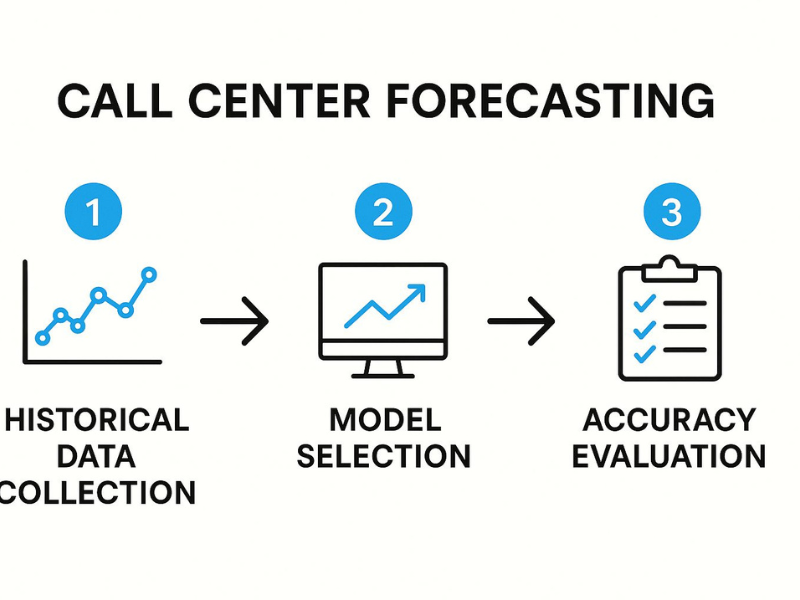
Call center forecasting is the process of predicting future contact demand so you can plan staffing and schedules accurately. The goal is simple: match agent capacity with customer demand.
Forecasting typically predicts:
- How many contacts will arrive.
- When they will arrive (by hour, day, week).
- How long agents will spend handling them.
This forecast feeds workforce management and scheduling decisions. Without it, staffing becomes reactive, leading to overstaffing, understaffing, or both.
Why Call Center Forecasting Matters for Operations and CX

Forecasting directly affects both cost and customer experience. When forecasts are wrong, the impact is immediate.
Understaffing creates a cascade of operational failures:
When you forecast demand at 400 calls but receive 500, the shortfall doesn’t just mean “busier agents”—it triggers measurable damage across every metric.
A 100-agent BPO underestimates Wednesday demand by 20%. That’s 20 missing agents during peak hours. The operational impact:
- Wait time explosion: Average hold time jumps from 45 seconds to 4+ minutes as calls pile up faster than agents can answer
- Abandonment surge: Abandonment rate spikes from 3% to 18%—meaning nearly one in five callers hangs up before reaching help, potentially switching to competitors
- Agent breaking point: Remaining agents handle back-to-back calls with zero recovery time between contacts, leading to errors, shortened interactions, and burnout
- SLA penalties: Service level agreement compliance drops from 80/20 (80% of calls answered within 20 seconds) to 45/20—triggering contractual penalties that can cost $15,000-30,000 monthly for BPO operations
The business cost is immediate: lower customer satisfaction scores, missed revenue opportunities from abandoned calls, and potential client contract violations.
Overstaffing wastes budget while damaging team morale:
The opposite error—overestimating demand—seems safer but carries its own costs. When you schedule 100 agents but only need 75, you’re not just paying for unused capacity.
A typical overstaffing scenario: Your forecast predicts 500 Friday calls, you schedule accordingly, but only 375 calls arrive. Now you have:
- Direct cost waste: 25 agents at 40-50% occupancy, meaning half their eight-hour shift is idle time waiting for calls. At $15/hour average labor cost, that’s $1,500 in wasted wages for a single day—$78,000 annually if the pattern repeats weekly
- Engagement collapse: Agents spending 50% of their shift idle start browsing phones, taking extended breaks, or asking to leave early. Productivity and focus erode when there’s no work to do
- Schedule instability: Managers face pressure to cut hours the following week to compensate, creating unpredictable schedules that hurt retention and make it harder to attract quality agents
- Opportunity cost: Budget allocated to unnecessary staffing could fund training, technology improvements, or service expansion
The hidden damage: overstaffing one day often leads to understaffing the next as managers overcorrect, creating a cycle of forecasting whiplash.
Accurate forecasting supports:
- Контроль затрат: Labor is the largest call center expense.
- Service level compliance: Enough agents to meet response-time goals.
- Удовлетворенность клиентов: Faster answers lead to better experiences.
- Agent well-being: Balanced occupancy (how busy agents are) reduces burnout.
Example: A retail support center underestimates Monday morning demand after a weekend promotion. Calls spike, queues grow, abandonment rises, and agents start the week overwhelmed. A small forecasting miss creates a full-day CX problem.
Key Data and Metrics Used in Call Center Forecasting
Core Volume and Demand Metrics
- Historical call volume: Past inbound contacts used to identify patterns.
- Time-based demand: Differences by hour, day of week, and day of month.
- Сезонность: Predictable spikes from holidays, promotions, or billing cycles.
- Channel mix: Distribution across phone, chat, email, and other channels.
- Channel mix: Distribution across phone, chat, email, and other channels. For outbound-heavy operations, understanding how исходящий дозвон systems impact call volume and agent workload is also important when building accurate forecasts.
Workforce and Performance Metrics
These metrics translate demand into staffing needs.
- Среднее время обработки (AHT): The total time an agent spends on each contact from answer to completion, including talk time, hold time, and after-call work (logging notes, updating CRM, processing transactions).Why AHT is critical for forecasting: AHT determines your agent capacity. If your average call takes 6 minutes and you receive 1,000 calls daily, you need 100 agent-hours (1,000 calls × 6 minutes ÷ 60 minutes). But if AHT unexpectedly increases to 8 minutes—perhaps due to a product issue requiring longer troubleshooting—you suddenly need 133 agent-hours. That’s a 33% staffing shortfall from a forecast that assumed 6-minute AHT.Пример из реальной жизни: A fintech call center handles account verification calls averaging 4.5 minutes AHT. During a compliance audit period, new verification requirements push AHT to 6.2 minutes (+38%). Without adjusting their forecast, their 50-agent team can now handle only 387 calls instead of the expected 533 calls—creating a 146-call backlog that grows throughout the day.
This is why forecasting requires AHT tracking by call type, not overall averages:
- Simple account inquiries: 3 minutes
- Technical support: 8 minutes
- Payment disputes: 12 minutes
When call mix shifts—more disputes, fewer simple inquiries—your forecasted agent requirements change even if total call volume stays constant.
- Уровень обслуживания: A response-time goal expressed as a percentage of calls answered within a target timeframe, typically written as “X/Y” (for example, 80/20 means 80% of calls answered within 20 seconds).Why service level drives forecasting decisions: Service level is often contractually required in BPO agreements or used as a customer satisfaction benchmark. Missing service level targets triggers financial penalties, client escalations, or customer churn.The staffing math: To hit 80/20 service level with 500 daily calls, you need approximately 42 agents scheduled (assuming 6-minute AHT, 8-hour shifts). But to hit 90/20—just 10 percentage points higher—you need 48 agents. That 14% increase in staffing cost is the price of faster answer times.
Forecasting connection: When you forecast 500 calls and actually receive 600, your service level collapses. With the same 42 agents, your service level might drop from 80/20 to 55/30—meaning only 55% of calls answered within 30 seconds. This is why forecast accuracy directly impacts your ability to meet service commitments.
BPO operations commonly include service level clauses with financial teeth: miss 80/20 by more than 5 points for three consecutive days, and penalties kick in—often $5,000-15,000 per occurrence depending on contract size.
- Показатель брошенности: The share of callers who leave before being answered. High abandonment signals understaffing.
- Occupancy: How much of an agent’s logged-in time is spent handling contacts. Too high leads to burnout.
- Shrinkage: Time agents are paid but unavailable for calls due to meetings, breaks, training, or absence.
Common Call Center Forecasting Methods Explained Simply

Historical Trend Analysis
Historical Trend Analysis: The Foundation Method
This is the most common starting point for call center forecasting—and for many stable operations, it remains sufficient. Historical trend analysis examines past call patterns and assumes those patterns will repeat in similar future periods.
Как это работает на практике:
Most teams implement this using spreadsheet exports:
- Pull historical data: Export 4-8 weeks of call volume from your phone system
- Calculate patterns: Determine average volume by day of week, hour of day, and identify recurring peaks (Mondays higher, lunch hour dips, month-end spikes)
- Adjust for known events: Add buffers for planned promotions, product launches, or seasonal factors
- Build forecast: Apply these historical averages to upcoming schedule periods
Concrete example: A 25-agent customer support team reviews January call data and finds:
- Monday average: 450 calls (peak 60 calls between 9-10 AM)
- Tuesday-Thursday: 380 calls (steady throughout day)
- Friday: 320 calls (drops after 3 PM)
- Weekend: 180 calls (mostly afternoon)
They schedule February agents based on these patterns, adding 10% buffer during Valentine’s Day week based on past February spikes.
When this method works well:
- Stable demand: Operations where call volume varies less than 15-20% week-to-week
- Predictable patterns: Call drivers that repeat consistently (utility billing cycles, payroll support schedules)
- Low external volatility: Few marketing campaigns, product launches, or seasonal events
- Mature operations: Established businesses past rapid growth phase
Example use cases: HR helpdesks for stable companies, utility customer service, government information lines.
Where it fails:
- Growth operations: A company adding 40% more customers quarterly—last month’s call volume becomes obsolete immediately
- Event-driven demand: A sports betting platform sees 3x call volume during major games—historical daily averages completely miss these spikes
- Campaign businesses: Outbound sales operations where call volume depends on campaign launches rather than historical patterns
- Product volatility: Tech products with frequent updates causing support volume shifts
Плюсы
- Easy to understand and implement.
- Works well for small or stable teams.
Cons
- Blind to sudden changes.
- Relies heavily on clean data.
Time-Based and Seasonal Forecasting
This approach adjusts forecasts by time patterns and known events.
It accounts for:
- Hourly peaks during the day.
- Weekly cycles, like heavier Mondays.
- Seasonal drivers such as holidays or promotions.
Example: A healthcare call center sees higher volume on weekday mornings and spikes during enrollment periods. Forecasts adjust staffing by both hour and season.
Erlang C Model (Conceptual Overview)
Erlang C is a classic staffing model used to estimate how many agents are needed.
It considers:
- Expected call volume.
- Average handle time.
- Target service level.
Сильные стороны:
- Useful for staffing calculations.
- Commonly built into workforce tools.
Ограничения:
- Assumes steady call flow.
- Less flexible with complex, multi-channel environments.
AI-Assisted and Machine Learning Forecasting
AI-assisted forecasting uses algorithms that learn from large datasets and adapt over time.
Ключевые преимущества:
- Detects complex patterns humans miss.
- Adjusts quickly to demand shifts.
- Incorporates real-time data.
When AI is worth it:
- High-volume or multi-channel centers.
- Rapid growth or volatile demand.
- Teams needing frequent intraday adjustments.
Compared to traditional methods:
- Traditional models follow fixed rules.
- AI models adapt as behavior changes.
Choosing the Right Forecasting Method for Your Call Center
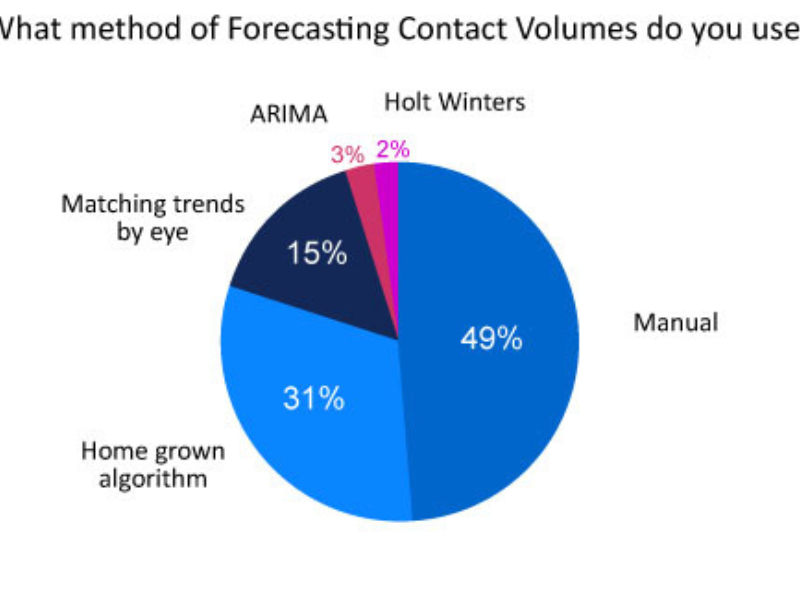
The best method depends on your operation, not theory.
Use this framework:
- Low volume, small team: Historical trends with basic seasonal adjustments.
- Mid-size, moderate seasonality: Time-based forecasting with Erlang-based staffing.
- Large or complex centers: Combine traditional models with AI-assisted forecasting.
Key factors to consider:
- Call volume volatility.
- Number of channels.
- Budget and tooling.
- Tolerance for forecasting error.
Most teams succeed by mixing methods rather than relying on one.
Best Practices for Accurate Call Center Forecasting

Prepare and Clean Historical Data
Bad data leads to bad forecasts.
Шаги:
- Remove one-time anomalies like outages or recalls.
- Separate different call types with different AHT.
- Align timestamps and time zones.
- Validate data completeness before modeling.
Clean data improves accuracy more than advanced techniques.
Account for Seasonality and External Factors
Demand is not driven by history alone.
Включая:
- Marketing campaigns and promotions.
- Billing cycles and product launches.
- Holidays and regional events.
- Policy or pricing changes.
Work with marketing and product teams early. Add buffers when uncertainty is high.
Use Workforce Management Software Effectively
Automation reduces manual errors.
Преимущества:
- Faster schedule generation.
- Better handling of shrinkage.
- Skill-based staffing alignment.
Spreadsheets work at small scale but break down as complexity grows.
Review and Adjust Forecasts Regularly
Forecasting is not a one-time task.
Лучшие практики:
- Review short-term forecasts daily.
- Compare forecast vs actual results.
- Adjust intraday when demand shifts.
- Update long-term forecasts monthly or quarterly.
Common Challenges in Call Center Forecasting and How to Handle Them

- Incomplete data: Standardize reporting and data collection.
- Unexpected spikes: Build buffers and intraday monitoring.
- Changing call mix: Forecast by call type, not totals.
- Poor alignment: Share assumptions across teams.
- Overreliance on one model: Combine methods for balance.
How to Improve Forecast Accuracy Over Time

- Track forecast accuracy consistently.
- Compare results by interval, not just daily totals.
- Combine historical, seasonal, and real-time inputs.
- Incorporate agent and supervisor feedback.
- Refine assumptions after every major event.
- Treat forecasting as a continuous improvement cycle.
Small, regular improvements outperform major model changes.
Quick Takeaways for Call Center Managers

- Forecasting protects both budget and customer experience.
- Simple, clean data beats complex models.
- Review forecasts often and adjust quickly.
- Mix methods to handle uncertainty.
- Make forecasting part of daily operations, not a monthly task.
Часто задаваемые вопросы (FAQ)

What is call center forecasting used for?
Call center forecasting is used to predict contact demand and plan staffing levels. It helps ensure enough agents are available to meet service goals without overspending.
How far ahead should a call center forecast?
Most centers forecast short-term (daily and weekly) for scheduling and long-term (monthly or quarterly) for hiring and capacity planning.
Is AI forecasting better than traditional methods?
AI forecasting performs better in complex or volatile environments. Traditional methods are often sufficient for stable, lower-volume centers.
What metrics matter most for forecasting?
Call volume, average handle time, service level, abandonment rate, and shrinkage have the biggest impact on staffing accuracy.
Conclusion / Closing CTA

Call center forecasting is a practical discipline, not a theoretical exercise. Accurate forecasts reduce costs, protect service levels, and improve both customer and agent experience. The most effective teams focus on clean data, simple methods, and regular adjustment. Review your current forecasting approach, identify gaps, and consider whether your tools and processes still match your operation’s complexity.
Вопросы и ответы

What is call center forecasting?
Call center forecasting predicts future call volumes and staffing needs using historical data and various methods. It helps optimize resource allocation, ensuring efficient operations and improved customer service.
Why is accurate call center forecasting important?
Accurate forecasting prevents overstaffing or understaffing, reducing costs and enhancing customer satisfaction. It ensures enough agents are available to meet demand, improving service levels and agent performance.
How do call centers forecast calls?
Call centers use historical data, AI, and machine learning tools to predict call volumes and staffing requirements. This includes analyzing trends and patterns to optimize scheduling and resource allocation.
What are common methods for call center forecasting?
Methods include historical trend analysis, time-based forecasting, Erlang C for staffing estimation, and AI-driven models for complex pattern detection. Each has its strengths for different call center needs.
How does seasonality affect call center forecasting?
Seasonality impacts call volumes due to factors like holidays or promotions. Forecasting must adjust for these fluctuations to ensure adequate staffing and maintain service levels.
Читать далее:
- Учебники успеха для клиентов: Полное руководство для успеха SaaS
- Лучшие практики работы колл-центров в розничной торговле: Руководство по масштабируемой поддержке
- Примеры резюме для колл-центра на 2026 год: ATS-дружественные шаблоны



 English
  Russian
  Chinese