
Основные выводы

- Active practice beats passive learning. AI simulations let learners practice real scenarios, not just watch videos or read slides.
- Skills develop 2-3x faster through realistic scenarios, instant feedback, and unlimited repetition.
- Scales without losing personalization. Train 10 or 10,000 people with role-specific scenarios and adaptive difficulty.
- Best for judgment-based skills: Communication, decision-making, conflict resolution, and high-stakes conversations.
- Measurable ROI: Organizations reduce training time by 30-50%, lower onboarding costs, and minimize real-world mistakes.
What Is AI Simulation Training?

AI simulation training is practice-based learning where people work through realistic scenarios that respond to their choices in real time.
Unlike traditional training—where learners watch videos, read slides, or attend lectures—simulations require active participation. Learners perform tasks, make decisions, and experience consequences. The AI analyzes their choices and adapts the scenario accordingly.
Three core components:
- Realistic scenarios: Practice situations pulled from actual job tasks, not generic examples
- Adaptive AI: The system analyzes behavior and adjusts difficulty, feedback, and outcomes based on performance
- Learning by doing: Learners build skills through repetition and reflection, not memorization
The critical difference from basic simulations: Traditional simulations follow fixed scripts. AI simulations change based on learner behavior. A sales objection exercise might take 10 different paths depending on how the learner responds. This variability mirrors real work, where no two conversations are identical.
The key difference from traditional simulations is adaptability. Basic simulations follow fixed scripts. AI simulations adjust the scenario based on how the learner behaves. The experience changes each time.
In modern workforce development, AI simulation training fills the gap between theory and real work. It allows employees to practice complex situations before they face them on the job.
Example in action:
A new manager practices delivering difficult performance feedback to an underperforming employee.
- Scenario 1: Manager opens with blunt criticism. The AI employee becomes defensive, shuts down, and the conversation derails. System flags: “Approach was too direct. Employee disengaged after 30 seconds.”
- Scenario 2 (retry): Manager starts with empathy, asks open-ended questions. AI employee opens up about workload challenges. Conversation leads to a performance improvement plan. System highlights: “Tone shift at 1:15 built trust. Question at 2:30 uncovered root cause.”
The manager runs this scenario 5 times, experimenting with different openings, word choices, and responses to pushback. By the fifth attempt, they’ve learned what works—before having this conversation with a real employee.
AI simulation vs basic simulation
- AI simulation: Adaptive scenarios, personalized feedback, varied outcomes.
- Basic simulation: Static scripts, limited feedback, predictable paths.
Why Traditional Training Often Falls Short
Most training programs fail because they treat learning as information transfer, not skill development. Employees complete modules, pass quizzes, and return to work—where they hesitate, make avoidable mistakes, or default to old habits.
The core problem: passive learning doesn’t build capability.
1. Low engagement = Low retention Slides and videos demand attention but not action. Research shows people forget 70% of information within 24 hours unless they practice it. A manager might watch a 45-minute video on conflict resolution, but when an actual conflict happens two weeks later, they freeze—because watching is not the same as doing.
2. No safe space to fail Traditional training skips from theory to real work. A new sales rep learns objection-handling techniques in a classroom, then immediately faces live prospects. Their first 20 calls are learning experiences—but they’re learning at the customer’s expense, risking deals and damaging relationships.
3. Delayed feedback loops Instructor-led training happens in batches. A learner makes a mistake in Week 1, receives feedback in Week 3, and has already repeated that mistake 50 times in real work. By then, the incorrect behavior is a habit.
4. One-size-fits-all approach A team of 30 managers completes the same training. Five are already excellent at feedback conversations and are bored. Ten struggle with the basics and are overwhelmed. Fifteen are somewhere in between. No one gets what they actually need.
The business impact:
- Longer time-to-competence: New hires take 3-6 months to perform at acceptable levels
- Higher risk of mistakes: Errors happen during the learning phase, affecting customers and compliance
- Lower ROI on training: Companies spend $1,200+ per employee annually on training, but behavior rarely changes
AI simulation training solves this by putting practice before consequences—letting people fail safely, learn immediately, and improve before the stakes are real.
From L&D experience, teams often complete training but still struggle in real situations. The problem is not motivation. It is the lack of realistic practice.
When training does not mirror real work, employees hesitate, make avoidable mistakes, or default to old habits. This slows performance, increases risk, and raises coaching costs.
How AI Simulation Training Works
Real-World Scenario Simulation
Real-World Scenario Simulation
AI simulations recreate actual workplace situations—not generic training exercises. Each scenario reflects real job tasks, industry-specific challenges, and realistic consequences.
How a simulation unfolds:
Step 1: Context setup The learner receives a realistic brief. For example: “You’re a customer service manager. A VIP client just threatened to cancel their $50K/year contract due to a billing error. They’re on the phone in 60 seconds. What do you do?”
Step 2: Active decision-making The learner chooses how to respond—selecting from dialogue options, typing free-form responses, or speaking (in voice-enabled simulations). The AI plays the client, responding naturally based on the learner’s tone, word choice, and approach.
Step 3: Dynamic consequences The scenario evolves based on decisions. If the learner starts defensive, the AI client escalates. If the learner shows empathy first, the AI client softens. Each choice creates a branch in the conversation path.
Step 4: Outcome and reflection The simulation ends with a result: contract saved, contract lost, or partial resolution. The system then breaks down what worked, what didn’t, and suggests alternative approaches.
Почему это работает: Learners experience the full cycle—problem, decision, consequence, reflection—without risking a real client relationship. They can immediately retry the scenario with a different approach, building pattern recognition through repetition.
Learners can practice high-risk or high-pressure situations without real-world consequences.
Пример:
Handling an angry customer, managing a safety incident, or resolving team conflict.
Adaptive Learning Through AI
Adaptive learning means the training adjusts itself to the learner. AI analyzes choices, patterns, and performance to personalize the experience.
AI adapts by:
- Increasing or lowering difficulty.
- Changing scenario paths based on behavior.
- Adjusting feedback depth and coaching prompts.
Beginners receive more guidance and simpler scenarios. Advanced learners face ambiguity, resistance, and edge cases.
This keeps training challenging without being overwhelming.
Real-Time Feedback and Skill Reinforcement
AI simulations provide feedback during and after each scenario.
Ключевые элементы:
- Immediate cues when a decision helps or harms outcomes.
- Post-scenario breakdowns of strengths and gaps.
- Suggestions for alternative approaches.
Unlike instructor-only feedback, AI feedback is consistent and always available. Learners can repeat scenarios to reinforce skills and build confidence.
Micro case:
A sales rep retries the same objection-handling scenario until their close rate improves.
Key Benefits of AI Simulation Training
Accelerated Skill Development
Skills develop faster when learners practice instead of observe. AI simulations compress experience by exposing learners to many scenarios in a short time.
Practice leads to:
- Faster decision-making.
- Stronger judgment under pressure.
- Higher confidence in real situations.
Learners move from theory to competence without waiting for real-world exposure.
Higher Engagement and Retention
Simulations demand active participation. Learners are part of the experience, not spectators.
Compared to traditional e-learning:
- Engagement stays higher.
- Attention lasts longer.
- Retention improves through repetition and realism.
People remember what they do, not what they watch.
Scalable and Cost-Effective Training
Once built, AI simulations scale across teams and locations.
Преимущества включают:
- Consistent training quality.
- Reduced reliance on live instructors.
- Lower travel and facilitation costs.
This is especially valuable for distributed or fast-growing teams.
Personalized Learning at Scale
AI delivers personalization without manual effort.
Each learner receives:
- Role-specific scenarios.
- Feedback tailored to their behavior.
- A pace that matches their skill level.
This balance of scale and personalization is hard to achieve with traditional methods.
Common Use Cases of AI Simulation Training
Leadership and Management Training
Leaders practice decision-making, feedback, and conflict management.
Распространенные сценарии:
- Difficult performance conversations.
- Handling team resistance.
- Balancing empathy with accountability.
AI allows leaders to experiment with different approaches safely.
Sales and Customer Service Training
Sales and Customer Service Training
Sales and support teams live in conversations—where tone, timing, and word choice determine outcomes. AI simulations let them practice these high-stakes interactions before facing real prospects or customers.
Общие случаи использования:
1. Objection handling A sales rep practices responding to “Your price is too high” across 20 different scenarios. The AI plays prospects with different priorities (budget-conscious, ROI-focused, comparison shopping). The rep learns which approaches work for which buyer types—without losing real deals during the learning curve.
Влияние на бизнес: Reps who train with simulations close 15-25% more deals in their first 90 days compared to traditional classroom training.
2. Discovery conversations An account executive practices asking open-ended questions to uncover customer needs. The AI plays a prospect who is vague, impatient, or overly talkative. The rep learns to guide conversations without interrogating, builds rapport, and identifies opportunities—skills that take experienced reps years to develop naturally.
3. De-escalating frustrated customers A support agent faces an angry customer whose order was delayed for the third time. The AI escalates if the agent is defensive, calms down if the agent validates emotions first. Agents practice the exact phrases that defuse tension—so when a real customer threatens to cancel, they know exactly what to say.
Пример: LinkedIn uses simulation-based training for their sales team at scale. Reps practice discovery calls, objection handling, and closing conversations in AI scenarios before client meetings, improving first-meeting conversion rates.
Platforms used by companies like LinkedIn and SocialTalent apply this approach at scale.
Compliance, Safety, and Risk Training
AI simulations allow safe practice of rare but critical incidents.
Примеры:
- Workplace safety responses.
- Data privacy decisions.
- Ethical dilemmas.
Repetition builds correct behavior before mistakes happen in real life.
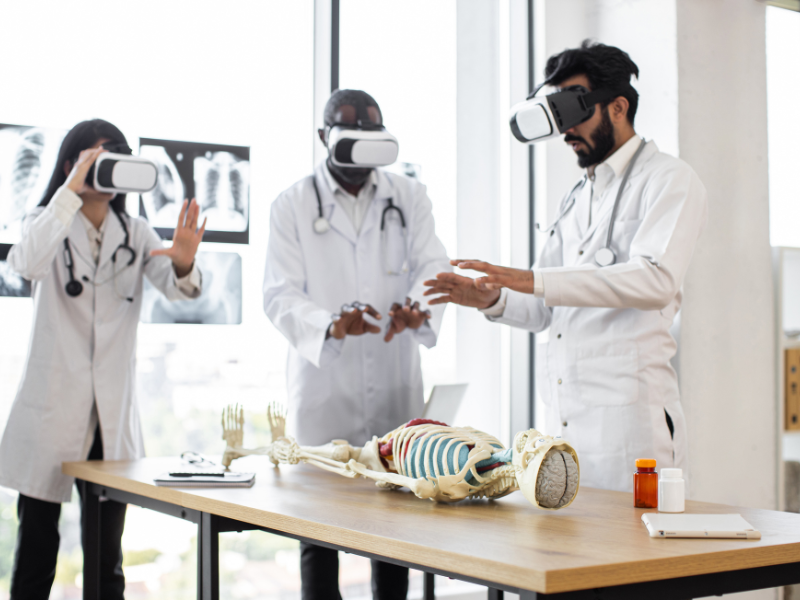
Healthcare and Technical Skills Training
In high-stakes environments, practice must be realistic and safe.
К числу примеров использования относятся:
- Clinical decision-making.
- Technical troubleshooting.
- Emergency response coordination.
Simulation-based tools similar to BlueLine Sims are widely used here.
AI Simulation Training vs Traditional Training Methods
| Аспект | AI Simulation Training | Traditional Training |
|---|---|---|
| Learning style | Active and experiential | Passive and theoretical |
| Feedback | Immediate and adaptive | Delayed or generic |
| Персонализация | Высокий | Низкий |
| Масштабируемость | Высокий | Ограниченный |
| Риск | Safe practice | Real-world mistakes |
Traditional methods still work for basic knowledge transfer. AI simulation training is best when behavior and judgment matter.
Who Should Use AI Simulation Training?
- L&D teams focused on skill application, not just completion.
- HR leaders developing future managers and leaders.
- Sales and service teams handling complex conversations.
- Organizations scaling training across regions or roles.
When AI Simulation Training May Not Be the Best Fit
- Training focused only on factual knowledge.
- Very small teams with limited training budgets.
- One-time compliance refreshers with no behavior change needed.
The Future of AI-Driven Simulation Training

AI simulations will become more immersive and integrated with daily work tools. Expect deeper personalization, richer scenarios, and closer alignment with real performance data. The focus will remain practical, not experimental.
Frequently Asked Questions About AI Simulation Training
Is AI simulation training suitable for beginners?
Yes. Scenarios adjust to skill level, providing guidance and simpler challenges for new learners while building confidence.
How realistic are AI simulations?
They are modeled on real workplace situations and respond dynamically, making them far more realistic than scripted role-plays.
Do instructors still play a role?
Yes. Instructors guide, interpret results, and coach. AI handles practice and feedback at scale.
Сколько времени требуется, чтобы увидеть результаты?
Many teams see behavior improvements within weeks, especially for communication and decision-making skills.
Which industries benefit most?
Leadership, sales, customer service, healthcare, compliance, and technical fields benefit the most.
Заключение

AI simulation training solves a core problem in learning: the gap between knowing and doing. It helps people practice real situations, receive instant feedback, and improve faster. Teams that rely on judgment, communication, and decision-making benefit the most.
If you want training that changes behavior, not just checks boxes, explore AI simulation platforms or pilot a simulation-based program for your team.
Вопросы и ответы

What is AI simulation training?
AI simulation training uses artificial intelligence to create immersive, real-world scenarios for skill development. It combines adaptive learning with experiential practice, helping learners engage actively and improve faster compared to traditional methods.
How does AI simulation training work?
AI simulation training replicates real-life scenarios in a safe, controlled environment. Learners interact, make decisions, and receive immediate AI-driven feedback, while the system adapts difficulty based on progress, ensuring personalized learning.
Is AI simulation training suitable for beginners?
Yes, AI simulation training is highly adaptable, making it suitable for beginners and advanced learners alike. It starts with basic scenarios and adjusts complexity based on user performance, allowing gradual skill development.
What industries benefit most from AI simulation training?
AI simulation training benefits industries like healthcare, leadership development, sales, customer service, compliance, and technical skill training. Any field requiring hands-on practice and decision-making can leverage it effectively.
Can AI simulations replace human instructors?
AI simulations complement rather than replace human instructors. They provide immediate feedback and scalable scenarios, while instructors focus on deeper mentoring, coaching, and addressing individual learner needs.
How quickly can results be seen with AI simulation training?
Results are typically seen within weeks. The immersive nature, adaptive learning, and repeated practice accelerate skill acquisition and retention, making it a fast and effective training solution.
How realistic are AI-driven simulations?
AI-driven simulations are highly realistic, modeling workplace scenarios and behaviors with advanced algorithms. They mimic challenges learners face in real-world settings, offering authentic experiential learning.
Is AI simulation training expensive?
AI simulation training is cost-effective at scale. It reduces reliance on physical resources, travels, and manual effort, while delivering consistent, personalized learning experiences to large groups efficiently.
What are the main advantages of AI simulation training?
Key advantages include accelerated skill development, personalized learning, higher engagement, immediate feedback, and scalability. These features improve retention and bridge the gap between training and practical application.
Читать далее:
- ИИ для успешной работы с клиентами: Predict Churn and Personalize at Scale
- Что такое высокотехнологичное обслуживание клиентов? Определение и основные преимущества


 English
  Russian
  Chinese