

主要收获

-
A standardized call center RFP template cuts vendor evaluation time by 40-60%, allowing you to compare platforms on metrics that actually matter—not just feature lists.
Clear data on call volume, agent count, and geographic coverage directly improves pricing accuracy. Vendors respond with real quotes instead of ballpark estimates.
Structured evaluation criteria prevent “feature fatigue”—balancing cost, deployment speed, compliance needs, and vendor stability across 10-15 shortlisted platforms.
Customizing your RFP by use case (outbound sales vs inbound support vs omnichannel) ensures vendors propose solutions that fit your operation, not generic enterprise packages.
A disciplined RFP process shortens procurement cycles from 12-16 weeks to 6-8 weeks, getting your team live faster while maintaining negotiation leverage.
What Is an Airline RFP Template and When to Use It

A call center RFP template is a structured procurement document that standardizes how you request and evaluate proposals from cloud contact center vendors. It defines exactly what data vendors must provide—pricing models, technical capabilities, compliance certifications, service levels—and establishes clear scoring criteria so you can compare platforms objectively.
Without a template, vendor evaluation becomes chaotic. You receive 15 different proposals in 15 different formats. One vendor sends a 60-page deck focusing on AI features. Another sends a 3-page pricing sheet. A third proposes an enterprise solution when you need something for 20 agents. Comparing these apples-to-oranges responses wastes weeks and often leads to choosing the vendor with the best sales presentation, not the best operational fit.
Use a call center RFP template when:
- Your company operates or plans to launch a contact center with 10+ agents
- You’re evaluating multiple vendors (typically 3-8 platforms) and need consistent comparison
- You have specific requirements around pricing model (per-seat vs usage-based), compliance (PCI-DSS, GDPR, TCPA), or integrations (CRM, ticketing systems)
- Your current vendor contract is expiring and you want leverage for renegotiation
Do NOT use a call center RFP when:
- You’re a 3-5 person startup testing a basic inbound line (just sign up for a trial)
- You’ve already selected a vendor and just need implementation details
- Your requirements are so niche that only 1-2 vendors can meet them (RFP adds no value)
It is commonly used by:
- Corporate travel buyers
- Procurement managers
- Travel managers
- TMC consultants (travel management company advisors)
Use an airline RFP template when:
- Your company has meaningful, repeat air spend.
- You want to negotiate discounts, added value, or better terms.
- You need to compare multiple airlines on the same routes.
Do not use an airline RFP template when:
- Travel volume is low or highly irregular.
- You only need spot pricing for ad-hoc travel.
- Routes are dominated by a single carrier with no alternatives.
Why a Standardized Airline RFP Template Matters

-
1. Eliminates Vendor Noise and Sales Theater
Most contact center vendors lead with their strengths and bury their weaknesses. Five9 emphasizes workforce management. Talkdesk showcases AI routing. Genesys talks about enterprise scale. Without a template forcing uniform responses, you spend 20+ hours per vendor just figuring out what they actually offer.
A structured RFP cuts through this. It forces every vendor to answer the same questions: “What’s your ASR (Answer Seizure Ratio) on international routes?” “Do you charge per seat or per minute?” “Can you deploy in Kazakhstan within 48 hours?” Vendors can’t dodge. You get comparable answers.
2. Reduces Evaluation Time by 40-60%
Without a template, evaluation cycles drag. Your team asks Vendor A about pricing. They respond in 3 days. You realize you need more details on SLAs. They respond in 5 more days. Meanwhile, Vendor B sent you a deck you can’t compare directly to Vendor A’s format.
With an RFP, all vendors respond to identical questions simultaneously. You receive 8 proposals on the same day, in the same format, covering the same evaluation criteria. Comparison takes days, not months.
3. Aligns Internal Stakeholders Before Vendor Chaos Begins
Contact center procurement involves 5-7 stakeholders: IT (security, integrations), Operations (call flows, agent tools), Finance (budget, ROI), Compliance (data residency, TCPA), and Executives (strategic alignment). Without an RFP, each group evaluates vendors differently. IT loves Vendor X for API flexibility. Operations prefers Vendor Y for ease of use. Procurement picks Vendor Z for price. You spend 8 weeks reconciling internal conflicts.
A template forces alignment upfront. Before issuing the RFP, stakeholders agree on weighted scoring: “Pricing is 35%, deployment speed is 25%, compliance is 20%, integrations are 20%.” When vendors respond, everyone evaluates using the same rubric. Decisions happen in days, not contentious meetings.
4. Strengthens Negotiation Leverage Through Transparent Competition
Vendors adjust pricing based on perceived competition. If they think they’re your only option, they price high. If they know you’re evaluating 6 platforms using identical criteria, they sharpen their pencils.
An RFP signals serious procurement discipline. Vendors see you’re organized, data-driven, and comparing offers objectively. This alone can lower pricing 15-30% compared to informal outreach.
Key Sections Every Airline RFP Template Should Include

Company and Travel Program Overview
Section 1: Company and Contact Center Overview
This section sets context so vendors understand your operation’s scale, complexity, and strategic priorities. Vendors use this to assess deal size and solution fit.
包括
- Company profile: Industry, revenue range, employee count, years in operation
- Contact center scope: Current agent count, growth projections (12-24 months), geographic footprint (where agents sit), operational hours (24/7, business hours, specific time zones)
- Use case mix: Percentage breakdown of inbound support vs outbound sales vs blended operations
- Technology stack: Current platform (if replacing), CRM system (Salesforce, HubSpot, custom), ticketing tools (Zendesk, Freshdesk), payment processors
- Clear RFP objectives: What you’re optimizing for (cost reduction, faster deployment, better compliance, specific features)
Example objective (GOOD):
“We operate a 120-agent BPO serving crypto exchanges and fintech clients across APAC and EMEA. We need a cloud call center platform that supports pay-as-you-go pricing (no per-seat licensing), deploys in under 48 hours, maintains PCI-DSS Level 1 compliance, and offers intelligent routing for 24/7 multilingual support across 8 time zones.”
Example objective (POOR):
“Seeking a reliable, cost-effective contact center solution with good customer service and modern features.”
The first example is specific—vendors immediately know if they can meet these requirements. The second is vague—every vendor thinks they’re “reliable” and “cost-effective.
Focus on clarity, not marketing language.
Good objective example:
- “Increase share on transatlantic routes while maintaining flexibility for premium travelers.”
Poor objective example:
- “Seek best possible partnership and value.”
Route, Volume, and Market Data
This is the most critical pricing driver.
Include route-level data:
- Origin–destination pairs.
- Annual segments or tickets.
- Cabin mix (economy, premium economy, business).
- Historical data and realistic forecasts.
Present data in a simple table.
| Route | Annual Segments | Cabin Mix |
|---|---|---|
| JFK–LHR | 1,200 | 70% Y / 30% J |
| SFO–NRT | 600 | 60% Y / 40% J |
小贴士
- Separate historical data from forecasts.
- Avoid inflated volumes; airlines will discount credibility fast.
- Flag strategic growth markets clearly.
Pricing and Discount Structure
Ask for pricing in a way that allows comparison.
Common discount models:
- Percentage off published fares.
- Fixed net fares by cabin.
- Market-based discounts by route group.
Also address ancillary costs:
- Seat selection.
- Baggage.
- Change and cancellation fees.
- Distribution surcharges.
What to ask for:
- Clear discount logic.
- Blackout dates or fare class exclusions.
- Last-seat availability rules.
What not to ask for:
- Unrealistic “all routes, all cabins” discounts.
- Vague best-effort language.
Service Levels and Passenger Experience
Service quality often outweighs small price differences.
Include measurable expectations:
- On-time performance benchmarks.
- Irregular operations handling (IROPs: delays, cancellations, disruptions).
- Rebooking priority for corporate travelers.
- Lounge access and loyalty benefits.
核对表:
- Dedicated corporate support contact.
- Clear disruption communication process.
- Upgrade and standby policies.
Real-world trade-off:
- A slightly higher fare may be justified if rebooking speed during disruptions is materially better.
Operational and System Requirements
Keep this section practical and non-technical.
Cover:
- GDS compatibility (global distribution systems used for booking).
- Reporting frequency and data fields.
- Access to performance and spend data.
Define KPIs:
- Market share performance.
- Fare competitiveness.
- Disruption recovery times.
| KPI | 目标 |
|---|---|
| On-time departure | ≥85% |
| Disruption rebooking | <30 minutes |
Contract Terms and Compliance
This section protects both sides.
包括
- Contract length and review cycles.
- Service level agreements (SLAs).
- Escalation paths for issues.
- Data privacy and compliance requirements.
Sample SLA metrics:
- Response time to escalations.
- Reporting accuracy.
- Contracted discount adherence.
Airline Evaluation and Comparison Framework

Vendor Performance Evaluation Criteria
Use consistent dimensions across all airlines:
- Price and discount depth.
- Network coverage and schedules.
- Service quality and disruption handling.
- Data transparency and reporting.
- Strategic fit with your travel program.
Balance cost with value. Lowest fare rarely equals lowest total cost.
Bid Evaluation Framework and Scoring
Weighted scoring keeps decisions objective.
Step-by-step:
- Define evaluation categories.
- Assign weights based on priorities.
- Score each airline consistently.
- Review totals and sensitivities.
例如
| Category | Weight |
|---|---|
| 定价 | 40% |
| Network & Schedule | 25% |
| Service Levels | 20% |
| Reporting & Support | 15% |
Common mistakes:
- Overweighting price alone.
- Changing weights after seeing bids.
Using the Template to Support Negotiation
Use RFP results as leverage.
- Identify where airlines underperform peers.
- Run clarification or best-and-final rounds.
- Document concessions and trade-offs.
Negotiation tips:
- Focus on a small number of high-impact routes.
- Trade volume commitments for flexibility, not just discounts.
- Capture final terms in writing.
How to Customize an Airline RFP Template for Different Airline Types

Network Carriers vs Low-Cost Carriers
| Area | Network Carriers | Low-Cost Carriers |
|---|---|---|
| 定价 | Complex discounts | Simple net fares |
| 服务 | Bundled | Mostly unbundled |
| Flexibility | 更高 | 有限公司 |
Adapt your template:
- Simplify pricing fields for low-cost carriers.
- Focus on ancillaries and disruption handling.
Regional and Short-Haul Airlines
Priorities shift toward:
- Frequency and reliability.
- Schedule alignment with business hours.
- Operational flexibility.
Keep the RFP shorter and route-focused.
Cargo or Mixed Passenger-Cargo Airlines
Relevant for companies with freight needs.
包括
- Cargo capacity commitments.
- Priority handling terms.
- Separate pricing and service clauses.
Keep passenger and cargo sections clearly separated.
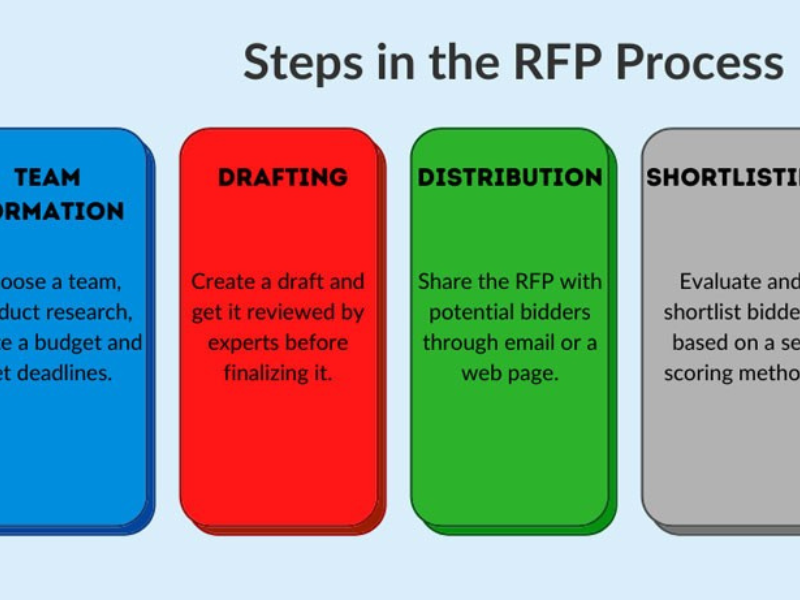
Step-by-Step Guide to Using an Airline RFP Template

- Define objectives and success metrics.
- Clean and validate route and volume data.
- Customize the airline RFP template.
- Issue the RFP with clear timelines.
- Manage Q&A centrally.
- Evaluate bids using weighted scoring.
- Shortlist and negotiate.
- Finalize contracts and communicate internally.
Typical timeline:
- Preparation: 2–4 weeks.
- RFP and evaluation: 4–6 weeks.
- Negotiation and contracting: 2–4 weeks.
Common Mistakes to Avoid in Airline RFPs

- Overstating volumes and growth projections.
- Asking every airline the same questions without customization.
- Ignoring service and disruption performance.
- Failing to document final agreements clearly.
Frequently Asked Questions About Airline RFP Templates

What is included in a standard airline RFP template?
It typically includes company overview, route data, pricing requests, service requirements, and evaluation criteria.
Can one airline RFP template be used globally?
Yes, but it should be adjusted for regional markets and regulations.
How often should airline RFPs be run?
Most corporate programs run them every 1–3 years, depending on market changes.
Is an airline RFP only about price?
No. Service quality, reliability, and operational fit are equally important.
Conclusion & CTA

A well-structured airline RFP template brings clarity, speed, and leverage to corporate travel sourcing. It helps you compare airlines on what truly matters and supports stronger, more transparent negotiations. Use this guide to customize a template that fits your travel program and airline mix.
Download the airline RFP template and tailor it for your next sourcing cycle.
Câu Hỏi Thường Gặp

What is an airline RFP template?
An airline RFP template is a structured document used by companies to solicit proposals from airlines, aiming to negotiate fares and evaluate services. It simplifies the procurement process and helps track different bids efficiently.
Why is a standardized airline RFP template important?
Standardized templates ensure consistency, improve negotiation efficiency, and facilitate clearer comparisons between airline offerings, ultimately aiding in better decision-making and cost management.
How can an RFP template be customized for different airline types?
The template can be tailored for network carriers, low-cost airlines, regional operators, and cargo airlines by adjusting sections like pricing, service levels, and specific requirements relevant to each type.
Can a standardized RFP template support negotiation?
Yes, by providing structured data, facilitating easier bid comparison, and offering leverage points for negotiating better terms and conditions with airlines.
What are common mistakes to avoid when using an airline RFP template?
Avoid unclear objectives, inadequate data presentation, ignoring compliance aspects, and failing to use the template to guide negotiations effectively, which can weaken procurement outcomes.
Does the template include evaluation criteria for vendors?
Yes, it offers criteria for assessing vendor performance based on metrics like service levels, cost efficiency, and compliance with industry standards.
更多信息
- 网络电话在游戏中的意义 优势 挑战 和顶级工具
- Reliable Global Outbound Call Solutions to Boost Sales
- VoIP Communication Guide Benefits and How It Works