
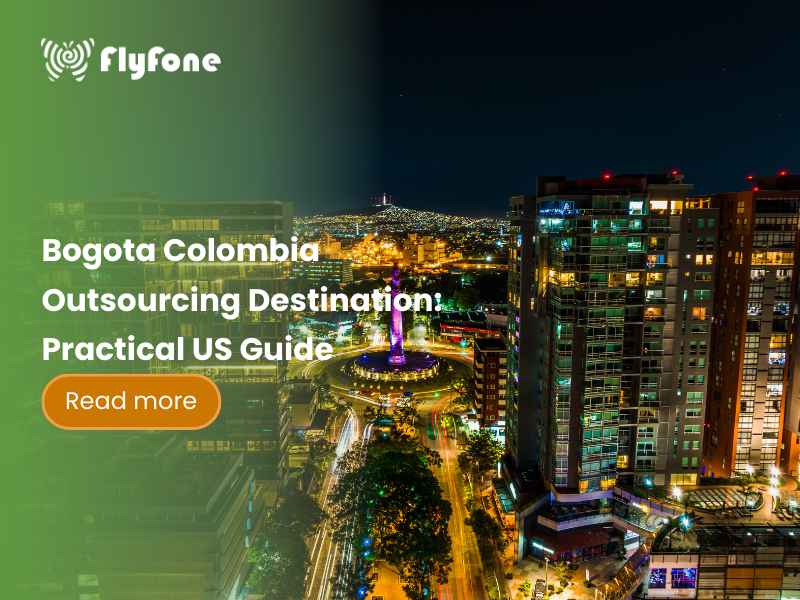
Bogota Colombia Outsourcing Destination: Practical US Guide


US companies spent over $45 billion on nearshore outsourcing to Latin America in 2024, and Bogotá has emerged as one of the region’s fastest-growing hubs. But not every destination works for every business model.
If you’re evaluating where to place your next customer support team, software development squad, or back-office operation, this guide cuts through generic outsourcing advice. You’ll get a practical assessment of Bogotá’s strengths, limitations, and operational fit—based on cost structure, talent availability, regulatory complexity, and day-to-day collaboration realities.
By the end, you’ll know whether Bogotá should stay on your shortlist or whether another nearshore destination better matches your priorities.

目录

Key Takeaways You Should Know First

  • Cost structure balances savings with stability. Labor costs are 40–60% lower than comparable US roles, but higher than secondary LATAM cities. This middle-ground pricing reduces turnover and maintains service quality as teams scale.
    Time zone alignment eliminates handoff delays. Bogotá operates on Eastern/Central Time, meaning your US team can have live standups at 9am, resolve blockers by lunch, and close feedback loops same-day—something Asian outsourcing can’t offer.
    English proficiency varies significantly by role. Senior positions and client-facing teams typically have strong English skills (B2–C1 level). Entry-level roles require careful screening and may need language training investments.
    The city excels at specific service types. Bogotá has mature infrastructure for BPO operations, customer support, software development, and financial shared services. Highly specialized technical roles (machine learning, blockchain) are harder to fill quickly.
    Regulatory setup requires local guidance. Establishing legal entities, tax compliance, and payroll involves multiple Colombian authorities. Budget 4–8 weeks and work with experienced local partners—shortcuts create compliance risks.

Why US Companies Are Evaluating Bogotá for Outsourcing

The calculus for nearshore outsourcing has changed. Ten years ago, the primary driver was labor arbitrage—find the cheapest talent possible. Today, US companies optimize for a different equation: speed + collaboration + cost efficiency, not just the lowest hourly rate.

Bogotá competes on this new equation better than most alternatives:

Geographic alignment eliminates coordination friction. Bogotá runs on Eastern Time (ET) year-round, no daylight saving adjustments needed. Your team in Miami or New York can run synchronous workflows—live sprint planning at 9am, pair programming sessions after lunch, end-of-day demos at 4pm. Compare this to Asia, where “real-time collaboration” means someone works overnight shifts permanently.

Economic scale supports sustainable operations. Bogotá isn’t a niche city with 50,000 people and one university. It’s Colombia’s capital with 8+ million residents, dozens of technical institutions, and continuous inflow of business and IT graduates. When you need to scale from a 10-person pilot to a 100-person operation, the talent pool exists locally—you don’t need to open a second city.

Cost pressure remains real, and Bogotá delivers meaningful savings. US customer support agents cost $40,000–65,000 annually (salary + benefits + infrastructure). Colombian equivalents cost $18,000–28,000 for similar skill levels. That 50–60% reduction isn’t the deepest discount in LATAM, but it’s enough to justify the investment while keeping wages competitive enough locally to retain good people.

In practice, US companies typically start with one of three entry points:

  • Customer support team (Tier 1–2): Handling routine inquiries, freeing US-based agents for complex escalations
  • Software development squad: Supporting internal tools, SaaS products, or mobile apps where daily collaboration matters
  • Shared services team: Managing finance, HR, data operations, or procurement workflows

Once the pilot proves stable, expansion becomes the natural next step.


Bogotá at a Glance as an Outsourcing Destination

Bogotá’s Role in the Colombian Outsourcing Market

  • Bogotá’s Role in the Colombian Outsourcing Market

    Bogotá accounts for roughly 60% of Colombia’s total outsourcing workforce—approximately 150,000+ people employed in BPO, IT services, and shared service centers. This makes it the country’s primary hub by significant margin.

    While Medellín has positioned itself as a tech-focused alternative (often called “Colombia’s Silicon Valley”), its outsourcing sector is about one-third the size of Bogotá’s. For companies needing large-scale operations or multiple service lines under one roof, Bogotá offers more infrastructure and vendor options.

    Economic and Business Environment

    Colombia’s economy has grown 3–4% annually over the past five years, making it one of the more stable markets in the region. The USD-to-COP exchange rate has historically favored US companies—your dollar stretches further when paying local salaries, though exchange volatility exists (monitor rates quarterly).

    Both private investment and government incentives support outsourcing growth. Colombia’s Ministry of ICT has prioritized developing tech talent and improving digital infrastructure, which directly benefits companies setting up operations in Bogotá.

Economic and Business Environment

  • Colombia has shown steady economic growth relative to the region.
  • The USD–COP exchange rate generally favors US companies.
  • Outsourcing demand is supported by government and private investment.


Types of Outsourcing Services Bogotá Excels At

Business Process Outsourcing and Call Center Services

Bogotá has one of the most mature BPO ecosystems in Latin America.

Common outsourced functions include:

  • Customer service (voice, chat, email).
  • Technical support and help desk operations.
  • Sales support and lead qualification.
  • Claims processing and account management.

Why it works well:

  • Large bilingual (English–Spanish) labor pool for regional and US coverage.
  • Strong service culture with KPI-driven performance.
  • Existing infrastructure designed for high-volume operations.

A typical setup:

  • US company retains strategy and escalation.
  • Bogotá team handles day-to-day execution.
  • Shared dashboards and real-time reporting.

This model works best for companies that value responsiveness and consistency over rock-bottom pricing.


Software Development and IT Services

Bogotá is a solid nearshore option for software development, especially for US companies that want close collaboration.

Common services:

  • Web and mobile application development.
  • QA and testing.
  • DevOps and cloud support.
  • Data engineering and analytics.

Typical tech stacks:

  • Java, Python, JavaScript, .NET.
  • Modern frameworks and cloud platforms.

优点

  • Developers are familiar with US-style workflows.
  • Agile ceremonies run smoothly due to time overlap.

缺点

  • Top developers are in high demand.
  • Rates are higher than secondary LATAM cities.

This makes Bogotá best suited for product-focused teams, not commodity development.


Shared Services and Back-Office Operations

Bogotá performs well in structured, process-driven roles.

Common shared services:

  • Accounting and financial operations.
  • HR administration and payroll support.
  • Data entry, reporting, and analytics support.
  • Procurement and vendor management.

Why Bogotá fits:

  • Strong university output in business and finance.
  • High attention to process and compliance.


Key Advantages of Bogotá as an Outsourcing Destination

Cost Efficiency Without Extreme Trade-Offs

Cost Efficiency Without Extreme Trade-Offs

Bogotá is not the cheapest outsourcing destination in Latin America—and for many companies, that’s actually a strategic advantage rather than a drawback.

Here’s the cost-quality trade-off:

Labor cost comparison (annual, fully loaded):

  • US customer service agent: $45,000–65,000
  • Bogotá customer service agent: $22,000–32,000
  • Guatemala/Nicaragua equivalent: $15,000–20,000
  • Savings vs US: 50–60% with Bogotá, 65–70% with Central America alternatives

That 10–15% price premium over cheaper markets buys you:

Lower attrition: Bogotá wages are competitive within Colombia, attracting professionals who stay 2–3 years instead of 6–12 months. Turnover typically runs 20–30% annually vs 40–60% in ultra-low-cost markets. Each replacement costs 3–6 months of lost productivity during hiring and training.

Service consistency: Teams that stay longer develop deeper product knowledge, build rapport with customers, and require less supervision. Quality scores (CSAT, NPS) typically stabilize 15–20% higher than operations with constant churn.

Scalability without quality erosion: When you need to double from 50 to 100 agents, Bogotá’s talent pool depth means you’re not scraping the bottom of the barrel. You maintain similar hiring bars instead of lowering standards to fill seats quickly.

The reframing: Bogotá is cost-efficient (maximizes value per dollar spent) rather than low-cost (minimizes dollars spent regardless of outcome). If your business model requires the absolute lowest labor cost and can absorb higher churn, look elsewhere. If you’re optimizing for total cost of ownership including training, turnover, and quality impacts, Bogotá’s middle-ground pricing often delivers better ROI.

Talent Pool and Education Ecosystem

Bogotá benefits from:

  • Dozens of major universities and technical institutions.
  • Continuous inflow of graduates across IT, business, and communications.
  • Strong professional ambition in younger workers.

Talent depth is strongest in:

  • Customer operations.
  • Software development.
  • Finance and analytics.

Time Zone Alignment and Geographic Proximity

  • Full business-hour overlap with most US teams.
  • Direct flights from major US cities.
  • Easier executive oversight and on-site visits.


Cultural Compatibility With US Businesses

From experience, Bogotá teams adapt well to US expectations:

  • Direct communication styles.
  • KPI-based performance management.
  • Service-level accountability.

This reduces friction during onboarding and scale-up.

Infrastructure and Connectivity

  • Reliable broadband in business districts.
  • Modern office buildings and coworking spaces.
  • Eldorado International Airport supports frequent US travel.


Challenges and Limitations to Consider

English Proficiency Variability

English Proficiency Variability

English proficiency in Colombia spans a wide range—from near-native fluency to basic conversational ability. Unlike the Philippines (where English is an official language and education is largely conducted in English), Colombia’s English skills are more variable and role-dependent.

What this means in practice:

Customer-facing roles (support, sales): You can reliably find candidates with B2–C1 English proficiency (CEFR scale), meaning they handle unscripted customer conversations, understand accents, and write professional emails. However, these candidates represent maybe 20–30% of the available talent pool, not 80%.

Back-office roles (data entry, accounting, QA): English requirements drop significantly. Many candidates have A2–B1 proficiency (basic conversational, reading comprehension) which suffices for internal documentation and email but not real-time customer interaction.

Entry-level roles: This is where variability hits hardest. Fresh university graduates may have B1 English on paper but struggle with phone conversations involving US accents, idioms, or fast-paced dialogue. You’ll need to screen 3–4 candidates to find one who meets customer-facing standards.

How to mitigate effectively:

Implement role-specific language testing during hiring. Don’t rely on resumes claiming “fluent English.” Use:

  • Live phone screening (10 minutes): Unscripted conversation testing comprehension and response speed
  • Written assessment (15 minutes): Email response simulation with grammar and tone evaluation
  • CEFR benchmarking: Require B2 minimum for customer roles, B1 for internal roles

Budget 15–20% more time in hiring cycles to account for language screening dropouts.

Invest in language training programs. Typical approach:

  • Pre-hire bootcamp (2–3 weeks): Candidates with B1 English attend intensive training to reach B2 before starting
  • On-the-job coaching (ongoing): Weekly accent training, phraseology practice, idiomatic expression workshops
  • 费用 $200–400 per employee for bootcamp, $50–100/month for ongoing training

Companies that budget for this upfront see 30–40% improvement in first-call resolution rates within 90 days.

Partner with experienced vendors who pre-screen language skills. If you’re working with a BPO provider or staffing agency, verify they use objective language assessment (not just self-reported proficiency). Ask for sample call recordings from their existing teams to calibrate expectations.

Competitive Talent Market in Bogotá

Bogotá is popular—and competition is real.

风险:

  • Slower hiring for senior roles.
  • Higher attrition if compensation is not competitive.

Mitigation strategies:

  • Offer clear career paths.
  • Partner with vendors who focus on retention.
  • Avoid underpricing talent.

Regulatory and Administrative Complexity

Setting up operations involves multiple entities, including:

  • Camara de Comercio (business registration authority).
  • DIAN (tax authority).

This is manageable but not DIY-friendly.

最佳做法:

  • Work with experienced local partners.
  • Avoid shortcuts on compliance.


Bogotá vs Other Nearshore Outsourcing Destinations

Bogotá vs Medellín

系数 Bogotá Medellín
Talent scale Larger Smaller
费用 Slightly higher Slightly lower
BPO maturity 非常高 Moderate
最适合 Scaling teams Specialized tech

Bogotá vs Mexico City and Other LATAM Hubs

  • Mexico City offers proximity but higher competition and cost.
  • Central America offers lower cost but smaller talent pools.
  • Bogotá balances scale, cost, and collaboration.

Who Should Outsource to Bogotá (And Who Should Not)

Best Fit Use Cases

Best Fit Use Cases

Bogotá makes strategic sense if your operation matches these profiles:

You need real-time collaboration, not just handoff work. If your outsourced team attends daily standups, participates in live troubleshooting, or needs to respond to Slack messages within 30 minutes during US business hours, Bogotá’s time zone alignment is essential. Async-heavy workflows (submit ticket, get response next day) work anywhere—synchronous work needs timezone overlap.

You’re scaling beyond 20–30 people. Pilot teams work almost anywhere. But when you need to hire 50, then 100, then 200 people over 18 months, Bogotá’s talent pool depth prevents you from exhausting local supply or compromising hiring standards. Smaller cities hit talent ceilings around 50–75 people.

Service quality and team stability drive your economics. If customer lifetime value is high ($5,000+ per customer), a bad support interaction costs real money. Bogotá’s lower attrition and stronger English proficiency mean fewer quality incidents and better customer retention—worth the 10–15% cost premium over ultra-cheap alternatives.

You’re outsourcing customer support, IT services, or shared services—not manufacturing or deep R&D. Bogotá excels at service delivery: customer operations, software development, financial processing. It’s not an engineering R&D hub (like Bangalore) or manufacturing center (like Shenzhen). Match the city to the function.

When Bogotá May Not Be the Right Choice

Consider alternatives if:

Your only decision criterion is the lowest possible labor cost. If you’re optimizing purely for cost per hour and can absorb 40–50% annual turnover, markets like Guatemala, Nicaragua, or the Philippines offer 15–25% lower rates. You’ll sacrifice stability and time zone overlap, but hit your cost target.

You need highly specialized technical talent immediately (machine learning engineers, blockchain developers, DevOps architects at scale). Bogotá has these roles, but supply is tight. You’ll compete with local startups and other outsourcers. If you need 10 ML engineers hired within 60 days, look at larger tech hubs (Mexico City, Buenos Aires) or widen the search to multiple LATAM cities.

You lack internal capacity to manage remote teams. Outsourcing isn’t autopilot. Someone on your side needs to own: clear requirements, regular check-ins, performance monitoring, conflict resolution. If you’re a 5-person startup where everyone is underwater, adding remote team management may fail regardless of destination. Build internal capacity first, or partner with a managed services provider who handles the middle layer.

When Bogotá May Not Be the Right Choice

Bogotá may not fit if you:

  • Only care about the lowest possible cost.
  • Need highly specialized, niche technical talent immediately.
  • Lack internal capacity to manage remote teams.

Final Evaluation of Bogotá as an Outsourcing Destination

Bogotá is a practical, balanced nearshore outsourcing destination for US companies.

Strengths:

  • Time zone alignment.
  • Large, educated workforce.
  • Mature outsourcing ecosystem.

局限性:

  • English proficiency varies.
  • Talent competition requires thoughtful hiring.
  • Regulatory setup needs local support.

Decision framework:

  • If collaboration and scale matter, Bogotá is a strong choice.
  • If cost is your only driver, look elsewhere.


FAQ – Common Questions About Outsourcing to Bogotá

Is Bogotá safe for outsourcing operations?

Yes. Major business districts are well-developed and commonly used by global companies.

How much can US companies save by outsourcing to Bogotá?

Savings are meaningful compared to US labor, though not the lowest in LATAM.

Is Bogotá better than Medellín for outsourcing?

Bogotá is better for scale and BPO. Medellín can be better for niche tech teams.

Do Bogotá teams work US hours?

Yes. Most outsourcing teams align fully with US business hours.

Strong Closing CTA

If you’re shortlisting nearshore outsourcing destinations, Bogotá deserves serious evaluation. The next step is simple: compare vendors, validate talent quality, and pilot a small team. Done right, Bogotá can become a long-term extension of your US operations.

常见问题

Why is Bogotá a top outsourcing destination?

Bogotá offers a bilingual workforce, cost-effective solutions, reliable infrastructure, and geographic proximity to the US. It’s a tech and BPO hub with a strong talent pool trained in diverse fields such as IT services and customer support.

What types of services can be outsourced to Bogotá?

Bogotá specializes in software development, IT services, call centers, business process outsourcing (BPO), and back-office operations. Companies benefit from its skilled professionals and familiarity with US business practices.

How does Bogotá compare to Medellín for outsourcing?

While Medellín is known as Colombia’s “Silicon Valley” with a strong IT presence, Bogotá offers a larger talent pool and more international business infrastructure, making it ideal for large-scale outsourcing projects.

How cost-effective is outsourcing in Bogotá compared to the US?

Salaries for Colombian professionals are typically 30–50% lower than in the US, allowing businesses to save significantly while still accessing highly skilled talent.

Are language barriers a concern when outsourcing to Bogotá?

Most outsourcing professionals in Bogotá are bilingual in English and Spanish. While English proficiency varies, many firms provide language training to ensure effective communication.

What time zone does Bogotá operate within?

Bogotá operates on Eastern Time (ET) during most of the year, minimizing challenges related to collaboration with US-based teams.

Is Bogotá’s infrastructure reliable for outsourcing?

Yes, Bogotá has excellent infrastructure, including modern office spaces, high-speed internet, and world-class facilities, ensuring smooth operations for outsourcing companies.

What industries most frequently outsource to Bogotá?

Industries such as technology, customer service, finance, and healthcare frequently turn to Bogotá for software development, call center services, and back-office support.

What are the challenges of outsourcing to Bogotá?

Challenges include moderate English proficiency outside the business sector, competitive hiring markets, and navigating Colombia’s business regulations. Proper planning and reliable partners can mitigate these risks.

Who should consider outsourcing to Bogotá?

US companies seeking nearshore solutions for IT, customer support, or process outsourcing should consider Bogotá. It’s best suited for businesses valuing cost efficiency, cultural alignment, and strong collaboration capabilities.

更多信息

目录

索引