

If you need faster outbound calling but are not sure which dialer fits, this guide gives you a clear answer fast.
You and I will compare predictive dialer vs auto dialer in plain English, including how each one works, where each fits best, the trade-offs around call volume, personalization, and TCPA compliance, plus a simple framework to help you choose the right outbound dialer software for your business.
Key Takeaways
- A predictive dialer is built for speed, scale, and higher agent productivity in large outbound calling environments.
- An auto dialer is built for control, simpler workflows, and more personalized customer outreach.
- The biggest difference is pacing: predictive dialers place calls ahead of agent availability, while auto dialers usually follow a more controlled sequence.
- Call abandonment risk is higher with predictive dialing and much lower with controlled auto dialing.
- Small teams usually do better with auto dialers, while larger teams often benefit more from predictive dialing.
- If compliance pressure is high, a more controlled dialing approach is often easier to manage.
Predictive Dialer vs Auto Dialer at a Glance
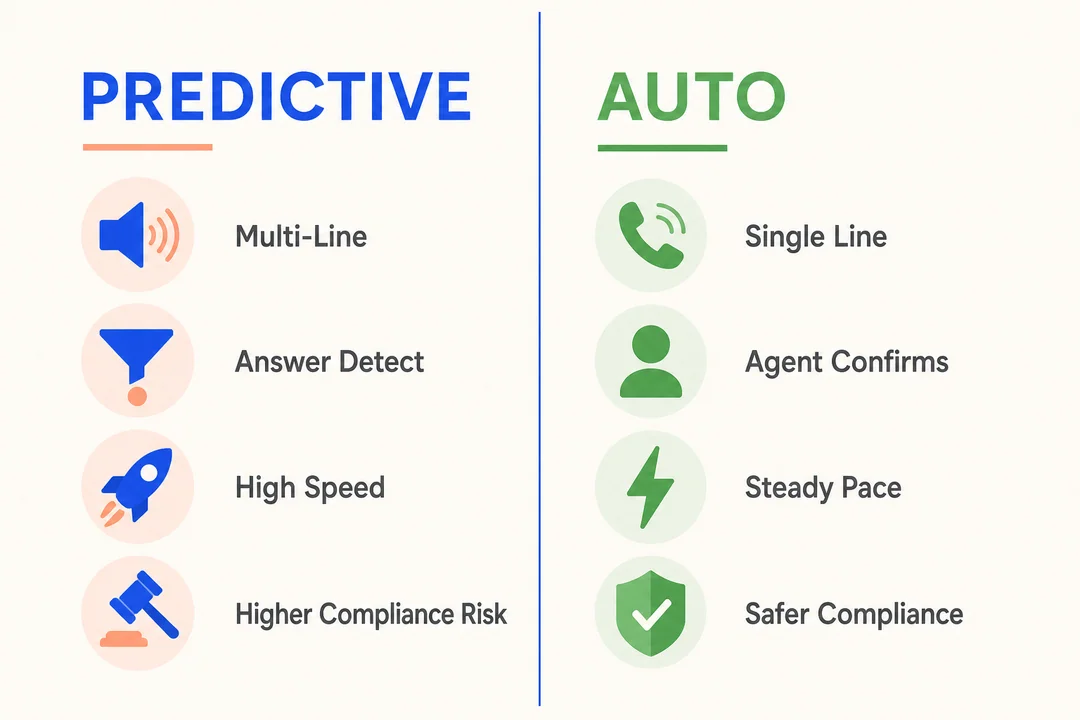
The main difference between a predictive dialer and an auto dialer is how they place calls. A predictive dialer uses a dialing algorithm (software logic that decides when to place calls) to call multiple numbers before agents are fully free, aiming to maximize agent talk time. An auto dialer places calls from a list in a more controlled sequence, giving agents more pacing control and usually more time to prepare.
Predictive dialer
- Best for high call volume and larger teams.
- Prioritizes speed and agent efficiency.
- Carries higher compliance and abandonment risk.
Auto dialer
- Best for smaller teams and targeted outreach.
- Prioritizes control and personalization.
- Usually easier to manage from a compliance standpoint.
| Factor | Predictive Dialer | Auto Dialer |
|---|---|---|
| Best for | Large outbound teams | SMBs and lean teams |
| Speed | High | Moderate |
| Personalization | Lower | Higher |
| Compliance risk | Higher | Lower |
| Team size | Medium to large | Small to medium |
| CRM fit | Strong | Strong |
What Is a Predictive Dialer?
Predictive dialer definition in simple terms
A predictive dialer is an automated calling system that predicts when an agent will be available and starts placing calls before that moment arrives. Its goal is simple: reduce waiting time and keep more agents in live conversations.
It is commonly used inside contact center software and outbound call infrastructure where teams handle large calling volumes and want to improve efficiency without manual dialing.
How a predictive dialer works
- The system checks which agents are busy, wrapping up, or becoming available.
- It uses a dialing algorithm to estimate when an agent will be free.
- It places multiple calls at the same time through VoIP (internet-based calling).
- If a live person answers, the system routes that call to an available call center agent.
- It may use Answering Machine Detection (AMD), which helps identify voicemail so agents spend less time on non-live calls.
- Some systems also support dynamic lead-to-agent matching, meaning the platform tries to connect the right contact to the right available rep based on rules or campaign settings.
The business point is simple: the system tries to make sure agents spend more time talking and less time waiting.
Main benefits of a predictive dialer
Businesses choose predictive dialers when raw efficiency matters most.
- Higher agent productivity means more live conversations per hour.
- Lower agent idle time helps reduce wasted payroll time between calls.
- Better call center efficiency supports high-volume outbound campaigns.
- Faster list penetration lets teams work through large lead lists quickly.
- Stronger throughput helps teams that care more about volume than deep personalization.
For example, if a large sales team spends all day calling cold leads, predictive dialing can keep reps in near-continuous conversations instead of waiting through ringing, busy lines, and voicemail.
Best-fit use cases for predictive dialers
Predictive dialers make the most sense when speed is the main priority.
- Large sales teams running high-volume prospecting campaigns.
- Collections teams that need to reach many contacts quickly.
- Enterprise call centers focused on throughput and utilization.
- Outbound teams using sales enablement tools and structured workflows.
- Campaigns with broad lead lists where each conversation does not require heavy pre-call research.
These use cases fit predictive dialing because the system is designed to optimize volume, not slow down for one-to-one call prep.
Practical caution before choosing a predictive dialer
A predictive dialer can be powerful, but it is not always the right first step.
- Call abandonment risk is higher if calls connect before an agent is ready.
- Compliance oversight is more important because pacing is more aggressive.
- Small teams may find it too fast for their workflow.
- Follow-up quality can drop if the process is not well managed.
A common mistake is a small team buying predictive software too early. They get more dials, but weaker follow-up, rushed calls, and avoidable compliance stress.
What Is an Auto Dialer?
Auto dialer definition in simple terms
An auto dialer is an automated calling system that places outbound calls from a contact list without requiring agents to dial each number manually. In this article, the term means sequential or pre-set automated dialing with more agent control than predictive pacing.
It is widely used in contact center dialing solutions and outbound calling software for teams that want efficiency without losing control of timing and call flow.
How an auto dialer works
- You upload a contact list or sync one from your CRM.
- The system dials one record at a time, or a limited number based on pre-set rules.
- The agent gets a more controlled connection flow and often more time to review the contact.
- After the call, outcomes are logged for lead management and follow-up.
- If CRM integration is enabled, notes, statuses, and next steps can update automatically.
The key difference from predictive dialing is pacing. An auto dialer usually moves in a steady, deliberate sequence rather than trying to predict agent availability and push call volume as far as possible.
Main benefits of an auto dialer
An auto dialer is the steady and manageable option for many teams.
- More personalized customer outreach because agents have more prep time.
- More agent control over pacing and call handling.
- Simpler adoption for smaller teams and first-time buyers.
- Lower operational complexity compared with predictive dialing.
- Better fit for compliance-sensitive outreach where oversight matters.
A good example is a team calling warm leads or handling appointment follow-ups. The goal is not just more calls. The goal is better conversations with fewer process risks.
Best-fit use cases for auto dialers
Auto dialers fit teams that want structure without aggressive pacing.
- Scheduled callbacks where timing and context matter.
- Appointment reminders with simple, repeatable workflows.
- Targeted sales outreach to warm or segmented leads.
- Small business outbound calling with lean headcount.
- CRM-driven follow-up flows that depend on notes and next steps.
- Deliberate customer conversations where call quality matters more than volume.
These cases fit auto dialers better because the workflow supports control, context, and manageable pacing.
Practical caution before choosing an auto dialer
The trade-off is scale.
- Raw call volume is lower than predictive dialing.
- Agents may have more downtime between calls.
- Large outbound campaigns may outgrow it.
- Fast-growth teams may eventually want more throughput.
An auto dialer can start to feel limiting when a team moves from dozens of calls per rep to hundreds and needs to squeeze more talk time from each shift.
Predictive Dialer vs Auto Dialer: Key Differences
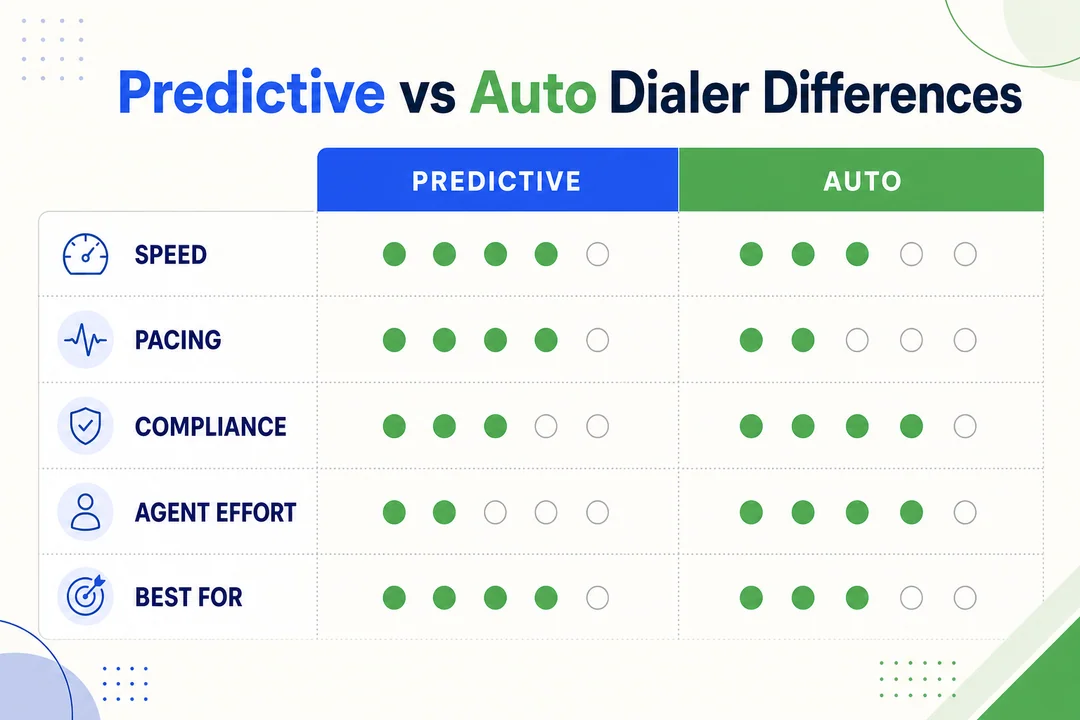
Dialing method and call pacing
A predictive dialer uses algorithmic predictive pacing. It decides when to place calls based on expected agent availability and can dial multiple lines at once.
An auto dialer usually follows sequential dialing or another pre-set logic. It moves in a more controlled order and does not push pacing as aggressively.
This changes the daily experience for agents. Predictive feels faster and more automated. Auto feels steadier and easier to manage.
Agent productivity and idle time
Predictive dialing usually improves agent productivity because the system works to reduce gaps between live calls.
- Agents spend less time waiting for rings and voicemails.
- Agent idle time is usually lower.
- Agent talk time is often higher.
- The impact is strongest in larger teams with constant call demand.
Auto dialers still improve efficiency over manual dialing, but they usually leave more breathing room between calls.
Call volume and campaign scale
Predictive dialers are built for higher call volume. They are better suited for large outbound campaigns, bigger lists, and teams that need maximum throughput.
Auto dialers are better for lower-volume or segmented outreach where each contact matters more. If your list is smaller and more intentional, controlled pacing often works better than speed alone.
Personalization and call quality
Auto dialers usually support better personalization because agents have more time to review the contact before or between calls.
Predictive systems can reduce prep time because speed comes first. That does not mean call quality is always poor. It means the system is optimized for volume, not deep pre-call context.
If your sales motion depends on relationship-building, discovery, or tailored messaging, an auto dialer often fits better.
Call abandonment risk
This is one of the most important differences.
A predictive dialer has a higher call abandonment risk because it may place calls before an agent is fully ready. If more live people answer than available agents, some calls may be dropped or delayed.
An auto dialer has much lower abandonment risk in controlled use because it usually places calls at a pace closer to agent capacity.
TCPA compliance and telephony compliance complexity
At a high level, compliance is usually harder with predictive dialing than with controlled auto dialing. More automation and more aggressive pacing create more need for monitoring, rules, and operational discipline.
This includes general concerns around TCPA compliance, telephony compliance, and TSR rules. This is not legal advice, but from a buyer perspective, predictive systems usually require tighter controls.
Business implications include:
- More attention to abandonment rules.
- More monitoring of pacing settings.
- More need for suppression lists and opt-out handling.
- More process discipline across campaigns and teams.
Team size and operational fit
If you are asking which is better, predictive or auto dialer for small business, the answer is usually auto dialer.
- Predictive dialer: Better for larger teams and scaled outreach.
- Auto dialer: Better for SMBs, lean teams, and smaller contact centers.
- Choose based on your current operating model, not your future wish list.
A tool that fits today will usually produce better outcomes than one built for a scale you have not reached yet.
CRM integration, reporting, and workflow support
Both dialer types can support strong CRM integration and workflow tools. What matters is the actual platform, not just the label.
Look for:
- CRM syncing for contact records and notes.
- Reporting dashboards for outcomes and productivity.
- Lead routing and follow-up workflows.
- Automatic logging of call results.
Side-by-Side Comparison Table
Use this table if you want the fastest way to compare predictive vs auto-dialing technology.
| Criteria | Predictive Dialer | Auto Dialer |
|---|---|---|
| Definition | Automated dialer built for speed and volume | Automated dialer built for control and steady pacing |
| How it works | Predicts agent availability and dials ahead | Dials from a list in sequence or by pre-set rules |
| Outbound calling speed | High | Moderate |
| Agent talk time | Usually higher | Usually moderate |
| Agent idle time | Lower | Higher than predictive |
| Customer engagement style | Fast, high-volume | Deliberate, more controlled |
| Lead conversion approach | More attempts, less prep per call | Fewer calls, more context per call |
| Compliance risk | Higher | Lower |
| Call abandonment risk | Higher | Lower |
| Personalization level | Lower | Higher |
| CRM integration | Common and often robust | Common and often robust |
| Best for | Large teams and high-volume campaigns | SMBs, callbacks, targeted outreach |
| Main drawback | More compliance and abandonment risk | Less scalable for high-volume growth |
Pros and Cons of Predictive Dialers
Pros
- Increases live connections per hour.
- Reduces idle time for agents.
- Supports high-volume prospecting and outbound campaigns.
- Scales well for larger teams.
- Improves call center efficiency when lists are large and workflows are mature.
These strengths matter most when your business needs more conversations, not more prep time.
Cons
- Higher abandonment risk if pacing is too aggressive.
- Less room for personalized outreach.
- Requires closer compliance monitoring.
- Can overwhelm small or less mature teams.
- Depends on clean workflows and solid reporting discipline.
Best for whom?
Best for
- Large outbound teams
- Call centers
- High-volume prospecting operations
Less suitable for
- Very small teams
- High-touch sales processes
- Compliance-sensitive workflows without strong controls
Pros and Cons of Auto Dialers
Pros
- Easier to manage day to day.
- Lower compliance risk in controlled setups.
- Better for personalized customer outreach.
- More accessible for SMB buyers.
- Useful for callback queues, reminders, and follow-up workflows.
This is one reason many first-time buyers start with an auto dialer.
Cons
- Lower raw call volume.
- Less efficient at scale.
- More agent downtime than predictive systems.
- Slower fit for aggressive growth teams that need maximum throughput.
Best for whom?
Best for
- SMBs
- Lean sales teams
- Appointment-driven outreach
- Quality-focused sales teams
Less suitable for
- Very large outbound operations
- Teams optimized for maximum volume
Which One Should You Choose?
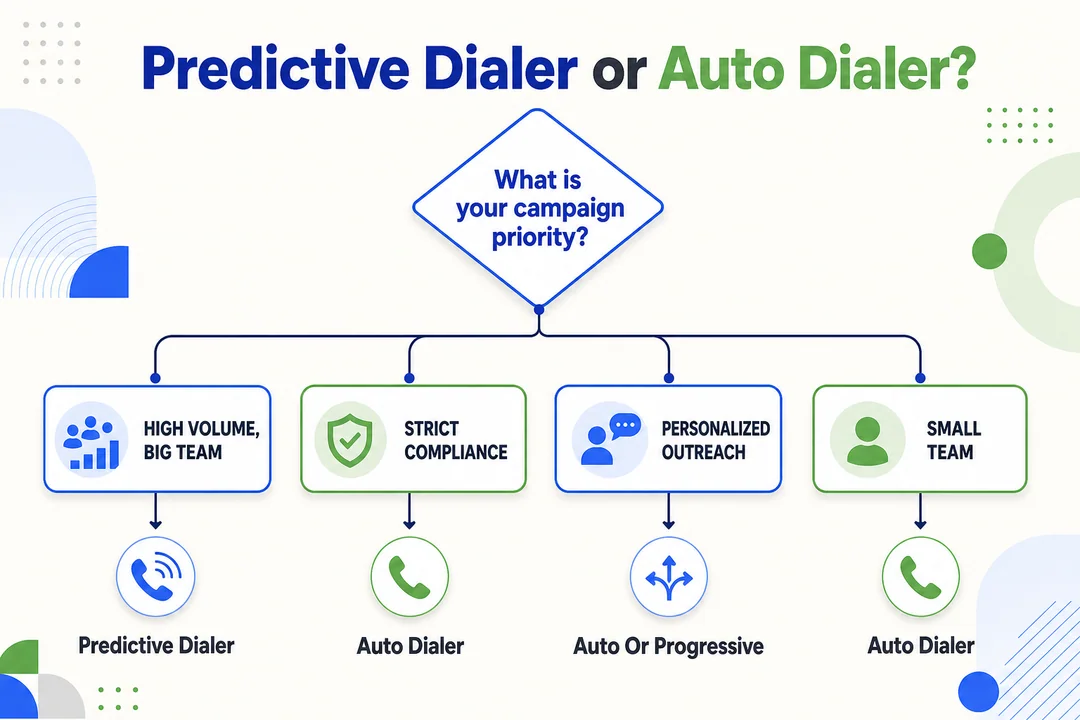
Choose a predictive dialer if
- You run high-volume outbound campaigns.
- You have a medium or large team.
- Agent productivity is your top priority.
- Your workflows are already structured and measurable.
- You have compliance processes in place.
- Your outreach model depends more on volume than one-to-one personalization.
Be careful if your team is small or still building process discipline.
Choose an auto dialer if
- You have a small or lean team.
- You need more control over pacing.
- Your sales process depends on personalization.
- You operate in a compliance-sensitive environment.
- You want simpler onboarding and easier daily management.
- Your outreach is built around callbacks, warm leads, or scheduled follow-ups.
Simple rule of thumb for first-time buyers
If your main goal is volume, choose a predictive dialer. If your main goal is control, choose an auto dialer.
If compliance risk is a major concern, controlled dialing is usually the safer starting point unless your team is ready to manage predictive pacing responsibly.
Decision Checklist for Buyers
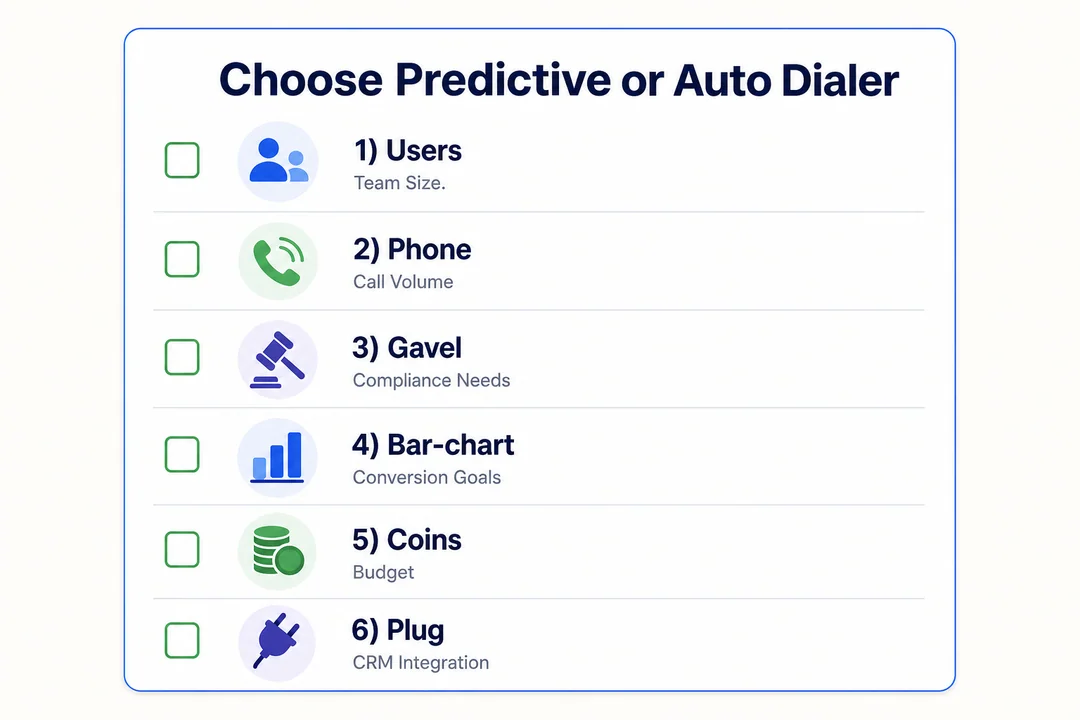
Questions to ask before choosing dialer software
Use these questions as a pre-purchase filter:
- How many agents will use the system today?
- How large is your call list each day or week?
- How important is personalization in each conversation?
- How much compliance exposure does your outreach carry?
- Do you need deep CRM integration and lead management?
- Is your main goal speed, conversion quality, or control?
- Are you scaling fast in the next 6 to 12 months?
- What reporting do you need for productivity, outcomes, and abandonment?
Buyer advice based on common business types
- Small business sales team: Usually start with an auto dialer because it is easier to manage and supports better personalization.
- Mid-size growing outbound team: Compare both carefully. Your choice depends on list size, workflow maturity, and compliance tolerance.
- Enterprise contact center: Predictive often fits better because scale and agent utilization matter more.
- Regulated outreach team: Controlled dialing is often the safer option because oversight is simpler.
Real-World Scenarios
A 5-person sales team doing scheduled follow-ups
An auto dialer is usually the better fit here. The team needs context, callbacks, and steady pacing more than raw speed. It also keeps the workflow manageable and supports higher-quality conversations with warm leads.
A 100-agent outbound team running high-volume campaigns
A predictive dialer usually makes more sense. At this scale, reduced idle time and higher throughput have a major impact. The trade-off is that reporting, pacing control, and compliance oversight need to be much tighter.
A regulated business balancing outreach and compliance
A controlled auto dialer is often the safer choice. Lower abandonment risk and simpler oversight make it easier to manage outreach responsibly. This is a general operational recommendation, not legal advice.
Common Confusion to Clear Up
Is a predictive dialer a type of auto dialer?
Sometimes, yes. In the market, auto dialer is often used as a broad umbrella term for automated calling systems. A predictive dialer is a more specific dialing method within that broader category.
Auto dialer vs progressive dialer: are they the same?
Not exactly. A progressive dialer is usually a more controlled dialing mode that places the next call only when an agent is available. Many buyers treat it as a subtype of auto dialer or a close adjacent category.
Why some vendors use dialer terms differently
Vendor terminology is not always consistent. One platform’s auto dialer may look a lot like another platform’s progressive or power dialer.
Compare actual features instead:
- Pacing logic
- Number of lines dialed
- Agent control level
- Abandonment controls
- CRM and reporting features
Compliance Basics You Should Know
Why call abandonment matters
Call abandonment matters because it affects customer experience, increases compliance risk, and may signal that your dialing pace is too aggressive. It is not just a legal issue. It is also an operational warning sign.
Real-time abandonment monitoring helps teams spot problems before they spread across campaigns.
Basic TCPA and TSR considerations
At a general level, TCPA and TSR concerns become more important as dialing becomes more automated and aggressive. Predictive systems often need closer oversight because pacing can increase abandonment exposure.
This is not legal advice. If your outreach is regulated, review your process with qualified compliance or legal experts.
Features that help reduce risk
- Answering Machine Detection (AMD) helps reduce wasted agent time on voicemail.
- DNC list management helps prevent calls to blocked or restricted numbers.
- Abandonment monitoring helps teams track pacing problems in real time.
- Call recording policies support quality control and internal review.
- CRM-based suppression lists help remove contacts who should not be called.
Frequently Asked Questions
What is the main difference between a predictive dialer and an auto dialer?
The main difference is pacing. A predictive dialer prioritizes speed and agent efficiency by dialing ahead, while an auto dialer prioritizes control and a steadier call flow.
Which is better for small business: predictive or auto dialer?
For most small businesses, an auto dialer is the better fit. It is easier to manage, supports more personalized outreach, and usually carries less compliance complexity. Predictive may fit only if call volume is high and controls are already mature.
Are predictive dialers legal?
Yes, predictive dialers can be legal, but legality depends on how they are used and how well your team manages compliance. This is not legal advice, and regulated teams should review their setup carefully.
Is an auto dialer better for personalized customer outreach?
Usually, yes. An auto dialer gives agents more control and more time to prepare, which often leads to better personalized conversations.
Do predictive dialers increase call abandonment?
They can. Predictive systems may place calls before an agent is fully available, which increases the chance that some answered calls are delayed or dropped.
Can both dialers integrate with CRM systems?
Yes, many predictive and auto dialers support CRM integration. Before buying, check the details around syncing, notes, lead routing, reporting, and follow-up automation.
What if I need something between manual calling and predictive dialing?
A progressive dialer is often the middle-ground option. It automates dialing but waits until an agent is available before placing the next call, which gives you more control with less manual work.
Conclusion
Predictive dialer vs auto dialer comes down to one core trade-off. Predictive dialing gives you more speed, scale, and agent efficiency. Auto dialing gives you more control, personalization, and simplicity.
The right choice depends on your team size, outreach style, and compliance tolerance. Match the tool to the way your team works now, not the way you hope it might work later. In most cases, the best dialer is the one your team can use well, manage safely, and scale with confidence.
More in Operations & CX Optimization
View all →
Customer Experience Transformation: Framework and Steps
A telecom customer calls support about a billing error. They explain the problem to the IVR system. Then to the first agent. Then get transferred and explain again. Then escalated—and explain a third time. Forty minutes later, they're exhausted and the problem still isn't solved. This is what broken customer experience looks like. And it's costing you customers. Customer experience…


Web Caller Meaning: JavaScript caller, Calling Tools or Portals
“Web caller” is one of those phrases where the search results and the searcher are frequently talking about different things. Three unrelated audiences use it: developers hitting an error on the legacy JavaScript caller property, buyers evaluating browser-based calling software, and people trying to reach a specific portal or training page whose exact name they cannot recall. That fragmentation is…

Customer Experience Strategy: How to Build One That Works
Customer experience is getting worse, not better. Forrester's 2025 Global CX Index found that 21% of brands declined in CX quality while only 6% improved — and in the US, 25% declined against 7% that improved, the second consecutive year of that pattern. Most of those brands were not neglecting customer experience. They were working on it without a strategy…



 English
  Russian
  Chinese