
Cloud Based PBX: What It Is, How It Works, and When It Makes Sense for a Business
Managing an older office phone system gets harder as teams become more distributed and hardware becomes more expensive to maintain. That is why many businesses researching a modern 商务电话系统 quickly run into the term cloud based PBX, and just as quickly run into confusing overlap with 网络电话, hosted PBX, 和 UCaaS.
A cloud based PBX is a business phone system delivered over the internet instead of through on-site PBX hardware. This guide explains what it means, how it works, how it compares with other communication options, and what benefits and limitations businesses should understand before making a decision.

What Is a Cloud Based PBX?
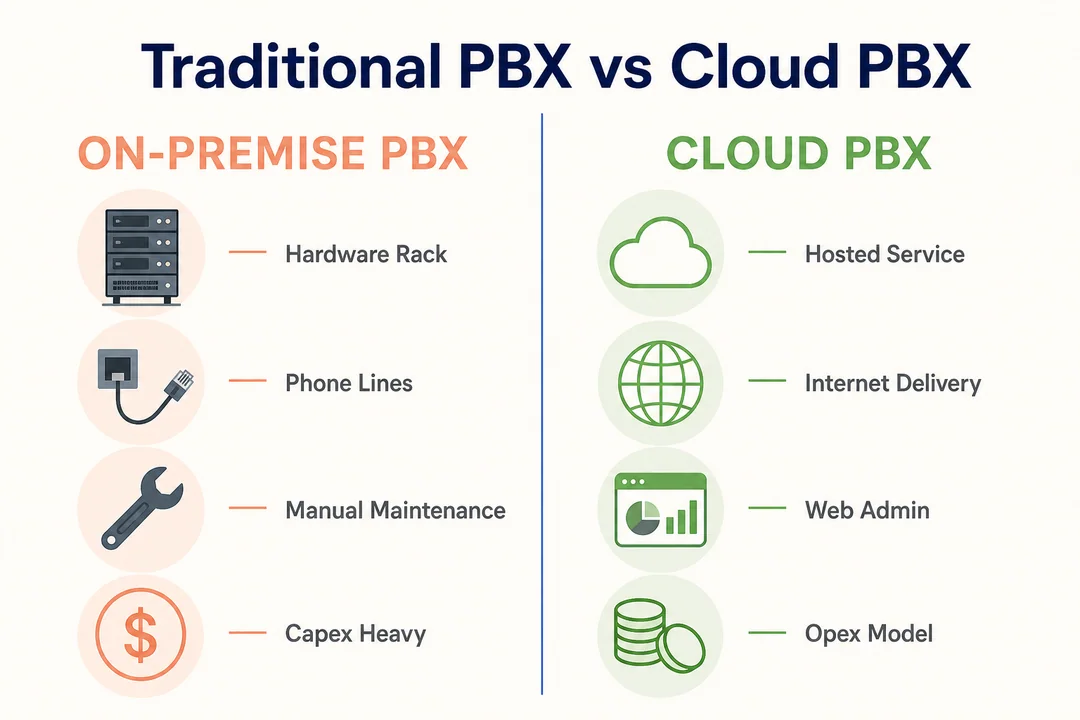
A cloud based PBX is a business phone system delivered over the internet instead of relying on on-site PBX hardware. It handles core calling functions such as extensions, 呼叫路由, 语音留言, and transfers through provider-hosted software, rather than through a PBX box installed and maintained in your office.
In practical terms, a cloud based PBX gives a business the same core phone system purpose as a traditional setup, but changes how the system is delivered and managed. Instead of owning and maintaining the main PBX equipment internally, the business uses a provider-hosted service.
You may also see this model called hosted PBX 或 virtual PBX. In many cases, those terms refer to a very similar idea. The exact wording varies by vendor, which is one reason this category can feel harder to compare than it should.
What PBX Actually Means
PBX (Private Branch Exchange) is the system that manages a company’s internal and external calls. It typically controls extensions, 呼叫路由, 语音留言, transfers, and other business calling functions that help direct calls to the right people.
Why “Cloud Based” Changes the Model
The main change is not what the phone system does. The main change is where it runs and who maintains it.
With a cloud-delivered model:
- The provider hosts the core PBX system.
- The business does not need to maintain the main on-premise PBX hardware.
- Users and admins usually access the system through internet-connected devices and an online admin portal.
For a business replacing an aging office PBX box, this often means less telecom hardware to manage locally and a simpler way to make changes as teams grow or move.

How Does a Cloud Based PBX Work?
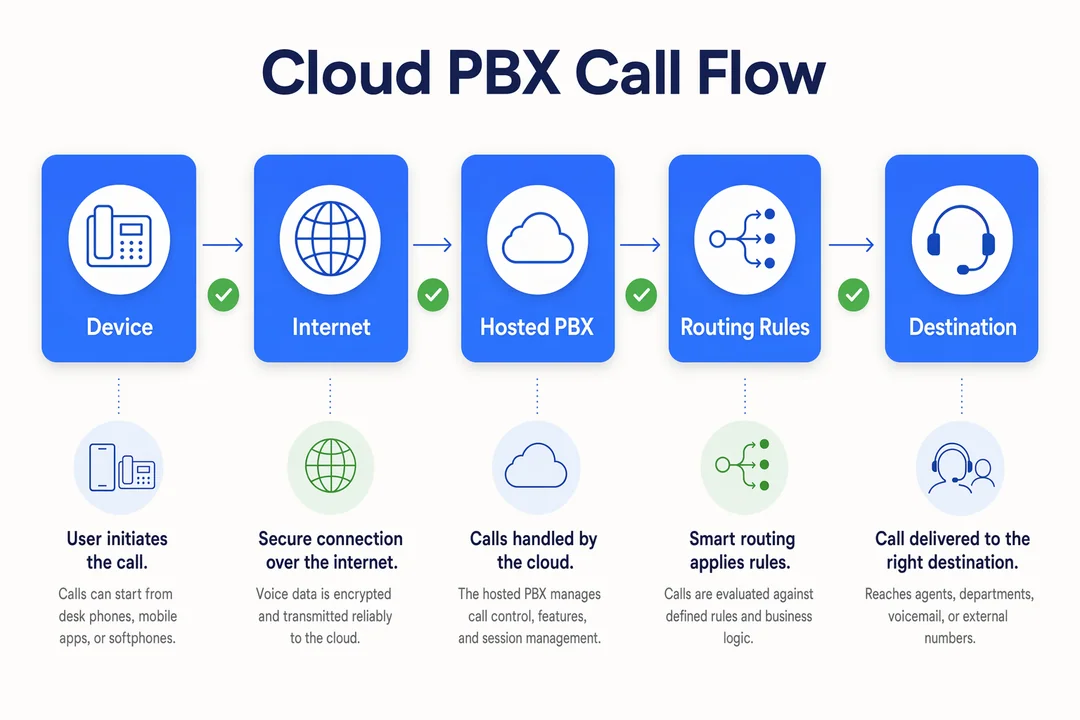
A cloud based PBX works by having the provider host the phone system in the cloud, while calls are carried over internet-based technologies such as 网络电话. Users connect through phones or apps, and admins manage numbers, rules, and routing through software instead of local PBX equipment.
- The provider hosts the PBX platform in its cloud infrastructure.
- Calls run over the internet using 网络电话 instead of relying mainly on legacy phone lines.
- Users connect through desk phones, mobile apps, browsers, or a 软电话 on a laptop.
- Admins assign numbers, set each extension, and configure 呼叫路由 rules.
- Calls follow preset rules such as forwarding, business hours logic, or IVR menus.
- The provider maintains the core system, updates, and service availability.

Many providers also support SIP 中继, which is a way to connect internet-based calling services to business telephony environments. For most buyers, the key point is simpler: the phone system becomes a managed service rather than a box your team has to run.
Calls Travel Over IP Instead of Legacy Phone Lines
- Voice traffic runs over IP networks using 网络电话.
- 传统 PSTN lines are no longer the main delivery model.
- Internet quality has a direct impact on stability and 通话质量.
The Provider Hosts the Core PBX Infrastructure
The provider runs the core PBX environment in a cloud or data center environment. That usually includes maintenance, updates, and platform-level reliability responsibilities. The business consumes the service instead of managing the entire telephony stack directly.
What Setup Usually Looks Like for Users and Admins
For day-to-day use, the setup is usually straightforward:
- Each user gets a business number and an extension.
- Employees can use a desk phone, mobile app, browser, or 软电话.
- Admins configure users, departments, and 呼叫路由 from a web portal.
- Business hours, forwarding rules, and greetings can often be updated quickly.
- Deployment is often faster than with a hardware-heavy PBX rollout.
A company with two offices and remote staff, for example, can manage one internet-based phone system across locations without installing full PBX hardware at each site. That is a major reason many businesses start evaluating cloud-hosted telephony in the first place.
Cloud Based PBX vs Traditional PBX vs VoIP vs UCaaS
These terms overlap, but they are not the same thing. That distinction matters because many businesses begin research wanting a better phone system and end up comparing tools that solve different communication problems.
The simplest rule of thumb is this: 网络电话 is the calling technology, cloud based PBX is the cloud-delivered phone system model, traditional PBX is the on-site hardware model, and UCaaS is a broader communications platform that usually includes more than calling.
Why These Terms Get Confused
Vendors often use overlapping labels, and that creates confusion early in the buying process. 网络电话 describes how calls are transmitted over the internet. A cloud based PBX, hosted PBX, 或 virtual PBX usually describes how the business phone system is delivered. In other words, cloud PBX often uses VoIP, but the two terms are not identical.
The table below is a quick comparison framework, not an absolute rule. Some providers blur category lines, especially when they bundle calling with messaging or support tools.
| 标准 | 传统 PBX | Cloud Based PBX | UCaaS |
|---|---|---|---|
| Core model | On-premise hardware | Cloud-hosted phone system | Cloud communications suite |
| 前期成本 | Higher CAPEX | Lower upfront cost | Lower upfront cost |
| 维护 | Managed internally | Managed by provider | Managed by provider |
| 可扩展性 | Slower, hardware-dependent | Faster and more flexible | High across channels |
| Remote work support | 有限公司 | 强大 | 强大 |
| Main focus | Business telephony | Business telephony in the cloud | Calling, messaging, video, collaboration |
| 最合适 | Organizations needing on-site control | Businesses modernizing phone systems | Teams needing broader unified communications |

A useful way to think about it:
- 传统 PBX 或 on-premise PBX fits businesses that want local control and are prepared to manage hardware.
- Cloud based PBX fits businesses that mainly want modern business calling without maintaining PBX hardware.
- UCaaS fits organizations that want calling, messaging, video, and collaboration in one platform.
- A 云呼叫中心 becomes more relevant when support or sales operations need advanced routing, QA, and performance workflows.
When a Business Needs Only PBX vs Something Broader
- Choose PBX if your main need is reliable business calling, extensions, and routing.
- 考虑 UCaaS if messaging, meetings, and internal collaboration matter as much as telephony.
- Consider a 云呼叫中心 if you manage higher call volumes, structured service teams, or complex sales/support workflows.
Each model still has valid use cases. The right answer depends less on the label and more on what your teams actually need to do every day.
Main Benefits of a Cloud Based PBX for Businesses
For many organizations, the appeal of a cloud-hosted phone system is operational more than technical. It often reduces hardware dependence, simplifies administration, and makes it easier to support changing team structures.
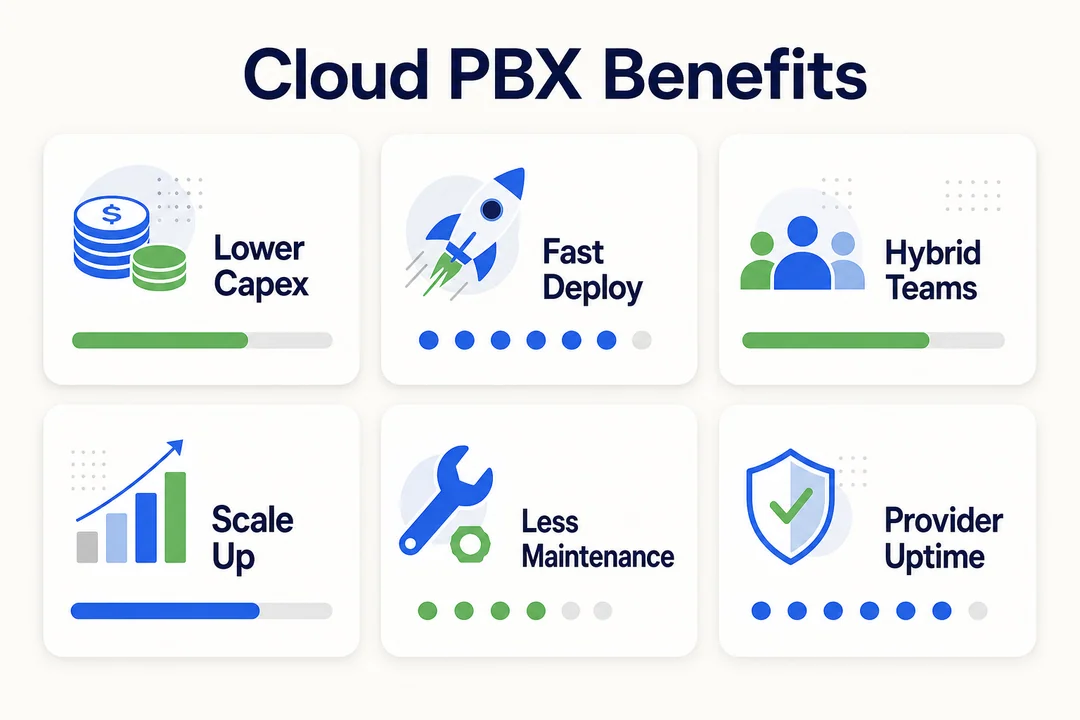
Key benefits usually include:
- Lower upfront cost than a hardware-heavy PBX approach
- Faster deployment and simpler provisioning
- Better support for 远程工作 and hybrid teams
- More flexibility across devices and locations
- Stronger 扩展性 as the business grows
Lower Upfront Cost and Less Telecom Overhead
A cloud based PBX often reduces the need for on-site PBX hardware, which can lower CAPEX (Capital Expenditure) compared with a traditional PBX rollout. It can also reduce the internal burden of maintaining telephony equipment, upgrades, and configuration changes.
That does not mean every provider will be cheaper in every case. Pricing models vary. But for many businesses, the move shifts cost from hardware ownership to service-based spend and simpler administration.
Easier to Scale and Provision Across Teams
This is one of the most practical benefits for a growing business.
- New users can often be added faster than in hardware-led systems.
- Numbers, extensions, and departments are easier to provision.
- Multi-location setups are typically simpler to manage.
- Seasonal hiring or team resizing is easier to support.
For organizations opening new offices, adding remote staff, or adjusting team sizes during busy periods, this kind of 扩展性 can remove a lot of telecom friction.
Better Support for Hybrid and Distributed Workforces
A cloud-based model usually gives employees more ways to use the system:
- Desk phones in the office
- Mobile apps for remote staff
- Browser access
- Laptop-based 软电话 tools
That matters because many business teams are no longer tied to one office. A cloud PBX can support business continuity when employees work from home, travel, or shift between locations. It also gives admins one place to manage routing and policies across the organization.
In many cases, cost savings, deployment speed, and flexibility are the main reasons companies move away from traditional PBX hardware. The exact value depends on provider quality, pricing structure, and whether the business network is ready to support voice traffic well.
Common Features to Expect in a Cloud Based PBX
Most cloud PBX platforms include a practical mix of calling features, routing tools, and admin controls. The exact feature set varies, but businesses should expect the basics to support everyday phone operations without needing separate PBX hardware.
Must-Have Calling Features
These are the core features most businesses expect from a modern phone system:
- Extensions
- Voicemail
- Call forwarding
- Call transfers
- 呼叫队列
These functions handle the basics of business telephony: reaching the right person, passing calls between employees, and making sure unanswered calls still have a destination.
Routing and Self-Service Features
Routing tools matter once a business has more than a few employees or departments. They help callers reach the right team faster and reduce manual handoffs.
Common features include:
- Auto-attendant
- IVR(交互式语音应答)
- Business hours rules
- Department-based 呼叫路由
- Greeting and menu configuration
For example, a caller might hear a welcome message, choose sales or support, and then be routed based on time of day or team availability. That is much easier to manage centrally in a cloud-hosted model than in many older phone environments.
Analytics, Integrations, and Admin Controls
Modern systems also tend to include management and visibility tools such as:
- Call reporting and 分析
- Mobile access or 软电话 支持
- 客户关系管理集成
- Helpdesk integration
- Browser-based admin portal
- User and permission management
These features are useful because they connect phone activity to daily workflows. A manager may want simple call volume reporting. A sales team may want 客户关系管理集成 so calls are easier to track. An operations team may want browser-based control over users, numbers, and routing rules.
Feature depth varies by provider and plan, so businesses should confirm what is standard versus what requires a higher service tier.
What Are the Limitations or Challenges of a Cloud Based PBX?
A cloud based PBX is convenient, but it is not automatically the right fit for every business. The biggest trade-offs usually involve internet dependency, 通话质量, provider reliability, and how well security and admin controls are handled.
常见的挑战包括
- Weak internet can lead to poor audio or dropped calls
- Network latency and jitter can affect voice quality
- Provider uptime and support responsiveness vary
- Security and admin controls are not equal across platforms
- Some businesses need more than a basic PBX model
Common Risks in Plain Business Terms
The most common issue is simple: if your network performs poorly, your call experience can suffer. That affects employee productivity and customer interactions.
In practical terms:
- Weak Wi-Fi can damage 通话质量
- Network latency can create noticeable delays
- Jitter can make voices sound choppy or robotic
- A lack of backup connectivity increases outage risk
Cloud delivery still needs proper network planning. Businesses sometimes underestimate this, especially when moving quickly from older phone hardware to app-based calling.
What to Check Before Choosing a Provider
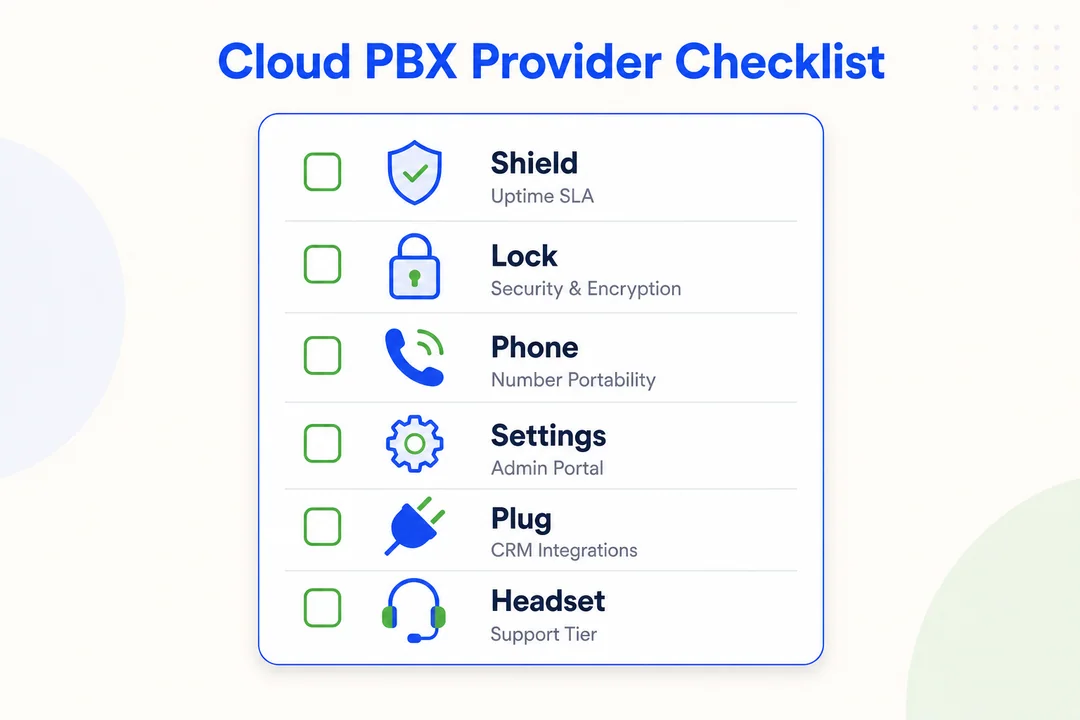
Before selecting a provider, review the basics carefully:
- Uptime commitments and the stated SLA(服务水平协议)
- Redundancy, backup routing, and failover design
- Encryption, admin permissions, and broader security controls
- Number management and portability support
- Support responsiveness and escalation process
A cloud PBX is not automatically reliable just because it is cloud-based. Good provider design, solid redundancy, and a healthy network environment are what make the service dependable in real business use.
Who Should Use a Cloud Based PBX?
A cloud based PBX is a strong fit for businesses that want a modern phone system without maintaining traditional PBX hardware. It is especially attractive for organizations that need simpler administration, flexible deployment, and better support for changing work models.
Good-Fit vs Less-Ideal Fit
Good fit:
- Companies replacing an older 小型企业电话系统
- Organizations with 远程团队 or hybrid work setups
- A growing business that needs easier user provisioning
- Multi-location teams that want simpler number and routing management
- Businesses that mainly need business calling and core telephony functions
Less ideal fit:
- Businesses with highly specialized on-site telecom requirements
- Organizations that require strict local hardware control for niche reasons
- Teams needing advanced omnichannel workflows
- Large support or sales operations with complex QA, campaign, or routing needs
When a Business Outgrows Basic PBX
Some organizations eventually need more than a phone system for basic business communications. When call volume, routing complexity, QA needs, outbound workflows, or omnichannel requirements increase, a 云呼叫中心 is usually the better category to evaluate.
When a business outgrows basic PBX and needs faster deployment, flexible routing, global calling support, or 人工智能驱动的质量保证, a 云呼叫中心 platform such as Flyfone becomes more relevant.
结论
A cloud based PBX is a 商务电话系统 delivered through the cloud rather than through on-site PBX hardware. For many businesses, it is a practical way to modernize calling, simplify administration, and support remote or multi-location teams without the overhead of maintaining a traditional PBX.
The main decision comes down to scope. If your priority is business calling, a cloud PBX may be enough. If you need broader messaging and collaboration, UCaaS may be the better fit. If your operations require advanced routing, QA, or omnichannel support, a cloud call center is the next category to compare.
A smart next step is to review provider checklists side by side and compare PBX, UCaaS, and cloud call center options based on actual business needs. If you want a structured fit assessment against your call volume, routing model, and remote setup, 预约专属演示 与 Flyfone 团队一起。
常见问题
What is a cloud based PBX?
A cloud based PBX is a business phone system that runs over the internet instead of on-premise PBX hardware. The provider hosts and manages the underlying infrastructure, so businesses get call routing, extensions, voicemail, and IVR without buying or maintaining their own equipment.
How is a cloud PBX different from VoIP and UCaaS?
VoIP is the underlying technology that carries voice over the internet. A cloud PBX is a service model that uses VoIP to deliver a managed business phone system. UCaaS is a broader bundle that combines PBX-style calling with messaging, video meetings, and team collaboration in one platform.
What are the main benefits of using cloud PBX for a business?
Cloud PBX typically delivers:
- Lower upfront cost with little or no on-site hardware.
- Easier scaling across users, sites, and remote locations.
- Strong support for hybrid and distributed teams.
- Fast deployment through a web admin portal.
- Less internal maintenance burden on the IT team.
What core features should a cloud PBX system include?
A standard cloud PBX typically covers:
- Call routing and call forwarding rules.
- Auto-attendant (IVR) and recorded greetings.
- Voicemail with voicemail-to-email.
- Call reporting and basic analytics.
- Softphone support on desktop and mobile apps.
What are the limitations of a cloud PBX?
A cloud PBX depends entirely on the internet connection. If the network is unstable, call quality can suffer through jitter or latency. Businesses should check available bandwidth, network latency, and provider SLAs for uptime before signing on.
When should a business consider moving from cloud PBX to a cloud call center?
When the business outgrows basic PBX, for example, it needs more complex routing, supervisor controls for sales or support teams, AI-driven call analysis, or omnichannel handling, a dedicated cloud call center platform usually fits better than stretching a PBX to do the job.