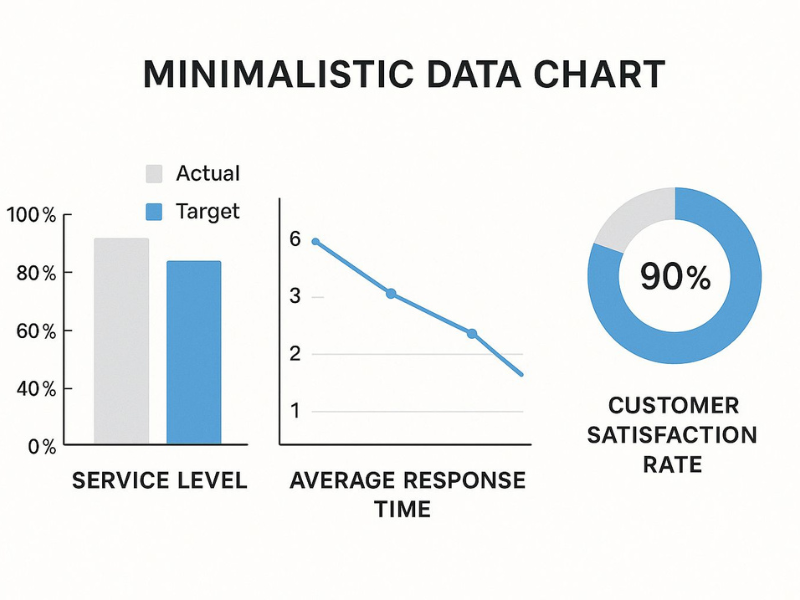

Service level measures how quickly your call center answers incoming calls—and whether customers wait longer than acceptable thresholds. This guide explains the standard service level calculation formula, common measurement mistakes, and how operations teams use service level data to optimize staffing decisions. You’ll learn to calculate service level accurately and interpret the results for real-world operational improvements.
What Is Call Center Service Level?

Service level is a percentage-based metric that measures how many inbound calls are answered within a predefined time threshold. Unlike average wait time, which can mask performance issues, service level provides a binary pass/fail measurement: did this call meet your speed standard, or did it exceed your acceptable wait time?
For example, if your target is 80% of calls answered within 20 seconds, service level tracks whether you’re consistently meeting that threshold across every interval of the day.
Key characteristics:
-
Percentage-based measurement: Service level reports what portion of calls met your standard (e.g., 82%), not an average wait time. This prevents outliers from distorting your understanding of customer experience.
Time threshold dependency: Your service level is only as meaningful as the threshold you set. Answering 80% of calls within 60 seconds represents a very different customer experience than 80% within 15 seconds.
Queue performance indicator: Service level measures how quickly callers move from queue to agent, not what happens during the conversation. High service level means fast pickup; it doesn’t guarantee first-call resolution or quality interactions.
“Answered within a defined time threshold” means the call is picked up by an agent before the clock hits that limit.
例如
- If your target is 80% of calls answered within 20 seconds, service level tracks whether you hit that goal.
Service level is often confused with average metrics. That’s a mistake.
Averages hide peaks and delays. Service level exposes them.
Why Service Level Matters in Call Center Operations

Service level functions as both a customer experience indicator and an operational diagnostic tool.
Customer Impact:
Higher service levels correlate directly with lower abandonment rates. When service level drops from 85% to 70%, abandonment typically increases by 10-15 percentage points as customers lose patience with extended wait times. Each abandoned call represents a lost opportunity—whether that’s a sales inquiry, support request, or retention conversation.
Staffing Accuracy:
Service level reveals whether your workforce planning aligns with actual demand. Consistently missing your target during afternoon hours suggests understaffing during peak periods. Conversely, exceeding your target by wide margins may indicate overstaffing—paying idle agents who could be deployed elsewhere.
Real-Time Management:
Unlike end-of-day averages, service level can be monitored continuously throughout operational hours. When performance drops mid-shift, supervisors can respond immediately by reassigning agents from lower-priority queues or activating callback protocols before abandonment rates spike.
Operational Stability:
Stable service level performance across days and weeks indicates predictable operations. Erratic service level patterns—meeting target Monday but failing Thursday—signal forecasting problems, inconsistent attendance, or inadequate scheduling buffers.
The Standard Call Center Service Level Formula

The most widely accepted formula is simple and consistent.
Service Level (%) =
(Number of calls answered within the threshold ÷ Total calls offered) × 100
Here’s what each part means:
- Calls answered within the threshold:
Calls picked up by an agent before the time limit expires. - Service level threshold:
The maximum wait time you allow (for example, 20 seconds). - Calls offered:
All inbound calls that reach the queue and could be answered, including those that abandon.
Why “calls offered” matters:
- It reflects true demand.
- It prevents inflated results.
- It aligns reporting with customer reality.
Different systems may label metrics differently, but the logic should stay the same.
How to Calculate Call Center Service Level Step by Step

Follow these steps every time to stay consistent.
- Define your threshold
Decide the wait time that matters to your customers, such as 20 or 30 seconds. - Count total calls offered
Include all inbound calls that entered the queue during the period. - Count calls answered within the threshold
Only include calls answered before the time limit. - Apply the formula
Divide answered-within-threshold calls by calls offered. Multiply by 100.
Consistency matters more than perfection.
Use the same rules every reporting period.
Simple Calculation Example
Assume this 30-minute interval:
| 公制 | Value |
|---|---|
| Calls offered | 200 |
| Calls answered within 20 seconds | 160 |
计算:
Service Level = (160 ÷ 200) × 100 = 80%
Interpretation:
- You met an 80/20 target.
- 20% of callers waited longer than expected or abandoned.
This single number tells you more than an average wait time ever could.
Understanding Service Level Thresholds (80/20 Explained)

Every service level target consists of two components: a percentage and a time threshold. The notation “80/20” means 80% of calls are answered within 20 seconds.
Why 80/20 Became Industry Standard:
The 80/20 benchmark emerged from decades of research balancing customer patience against operational costs. Studies show that most customers will tolerate 15-20 second waits without significant satisfaction impact, while answering every call in under 10 seconds would require 30-40% more agents than most operations can justify economically. 80% represents an achievable target that doesn’t demand perfect performance—allowing for normal variation in call volume and agent availability.
Common Variations:
- 90/30: More relaxed standard for lower-urgency queues (billing inquiries, general questions)
- 85/15: Tighter standard for high-value customer segments (premium support, VIP lines)
- 70/20: Acceptable for overflow periods or during expected volume spikes
The right threshold depends on customer expectations, call urgency, and operational constraints—not arbitrary industry convention.
What 80/20 does 不 mean:
- Every caller waits 20 seconds.
- The other 20% don’t matter.
Why 80/20 is popular:
- It balances customer patience with staffing cost.
- It’s achievable for most inbound teams.
- It works well for general support lines.
Important trade-offs:
- Shorter thresholds improve experience but require more agents.
- Longer thresholds reduce cost but increase abandonments.
80/20 is a guideline, not a rule.
Choose targets based on customer expectations and call urgency.
How Abandoned Calls Affect Service Level Calculation

An abandoned call occurs when a customer hangs up before an agent answers. From a service level calculation perspective, abandoned calls are critical because they represent complete service failures—customers who needed assistance but gave up waiting.
Why Abandoned Calls Must Be Included:
Excluding abandoned calls from the “calls offered” denominator artificially inflates service level results. For example, if 200 calls entered your queue, 150 were answered within 20 seconds, and 30 abandoned, your service level is 75% (150/200). If you exclude the 30 abandons, your service level appears to be 88% (150/170)—a misleading representation that hides significant customer experience problems.
Abandoned calls directly correlate with service level performance. When average wait time increases, abandonment rates typically rise proportionally. A queue that sees 5% abandonment at 85% service level might experience 15% abandonment when service level drops to 70%. These customers didn’t receive help—they represent both immediate service failures and potential long-term relationship damage.
The Short Abandon Exception:
Most call centers exclude abandons under 5 seconds, treating them as misdials or accidental hang-ups rather than service failures. A customer who disconnects within 3 seconds likely never intended to complete the call. However, abandons after 5+ seconds indicate the customer made a deliberate choice to wait, then gave up—these must be counted to accurately reflect your service performance.
Ignoring abandoned calls usually makes service level look better than it really is.
Service level and abandonment are two sides of the same story:
- Longer waits increase abandons.
- Higher abandons signal poor service level.
Are Abandoned Calls Included or Excluded?
In practice, most centers:
- Include abandoned calls in “calls offered.”
- Exclude very short abandons (often under 5 seconds).
Short abandons are usually misdials or instant hang-ups.
Key risks to watch:
- Changing abandon rules mid-reporting skews trends.
- Excluding too many abandons hides real issues.
- Comparing reports with different rules leads to wrong conclusions.
最佳做法:
- Pick a clear rule.
- Document it.
- Apply it consistently.
Where the Data Comes From

Service level data usually comes from:
- ACD systems (call routing platforms)
- Workforce management tools
- Real-time and historical dashboards
Accurate calculation depends on correct system configuration, especially when the clock starts.
Common Mistakes When Calculating Service Level

Even experienced operations teams make these calculation errors that distort performance measurement:
1. Confusing Service Level with Average Speed of Answer (ASA)
Service level measures a percentage meeting a threshold; ASA calculates average wait time across all calls. These metrics tell different stories. Your ASA might be 18 seconds (looks good), but your service level could be 65% if half your calls are answered in 5 seconds while the other half wait 35+ seconds. Service level prevents averages from masking bimodal distributions where some customers get excellent service while others wait unacceptably long.
2. Excluding Too Many Abandoned Calls
Some teams exclude all abandons to “focus on calls we actually handled.” This dramatically inflates results. If you answered 160 calls within threshold but 40 customers abandoned after waiting, excluding those 40 makes your service level appear to be 160/160 = 100% instead of the accurate 160/200 = 80%. You’re hiding the fact that 20% of customers gave up—exactly the insight service level should provide.
3. Using Inconsistent Time Thresholds
Changing your threshold mid-reporting period breaks trend analysis. If January used 20 seconds, February used 30 seconds, and March returned to 20 seconds, your service level percentages aren’t comparable. A 75% service level at 20 seconds represents faster answering than 85% at 30 seconds. Maintain consistent thresholds for meaningful performance tracking.
4. Reporting Only Daily Averages
Daily service level of 82% might look acceptable, but it could hide 9 AM performance at 60% and 2 PM performance at 95%. Service level should be calculated in 15- or 30-minute intervals to identify patterns, not averaged across entire days. Interval-level data reveals when you’re understaffed and need scheduling adjustments.
5. Trusting Dashboard Displays Without Verification
Real-time wallboards sometimes show “service level goal achievement” (green = good, red = bad) without displaying the actual percentage or clearly defining what’s being measured. Always verify that your dashboards calculate service level consistently with your definitions—particularly how abandoned calls and time thresholds are handled.
- Using inconsistent thresholds
Changing from 20 to 30 seconds breaks trend analysis. - Trusting wallboards without understanding logic
Some displays show goal achievement, not real percentages. - Reporting only daily or monthly averages
Service level should be tracked in short intervals.
Understand the logic first.
Then trust the numbers.
Service Level vs Other Call Center Metrics

| 公制 | What it Measures | 何时使用 |
|---|---|---|
| Service Level | % answered within time limit | Speed and accessibility |
| ASA | Average wait time | Overall delay trend |
| 放弃率 | % callers who hang up | Customer patience |
| FCR | Issues resolved on first call | Service quality |
No single metric tells the full story.
Quick Summary: How to Calculate and Interpret Service Level

Service level provides a clear, actionable measurement of how quickly your call center connects customers with agents. Unlike averages that obscure performance variations, service level’s binary threshold creates accountability: each call either meets your standard or it doesn’t.
Key Takeaways:
The standard formula—(calls answered within threshold ÷ total calls offered) × 100—remains consistent across industries. Your threshold choice defines what “good enough” means for your customers. The 80/20 benchmark works for many operations, but high-urgency queues may require 85/15 or 90/20 standards.
Abandoned calls must be included in calculations to reflect true customer experience. Excluding them hides service failures and inflates results. However, most centers reasonably exclude abandons under 5 seconds as likely misdials.
Service level works best alongside complementary metrics like Average Speed of Answer, Abandonment Rate, and First Call Resolution. Together, these indicators provide complete visibility into both accessibility (service level) and quality (FCR).
Operational Application:
Use service level data for workforce planning—identifying peak periods that need additional staffing, validating schedule effectiveness, and making real-time adjustment decisions when performance drops mid-shift. Service level is a leading indicator that enables proactive management rather than reactive problem-solving.
Accurate service level calculation starts with standardizing your methodology—defining threshold, abandoned call rules, and measurement intervals. When your data is consistent and reliable, your operational decisions improve accordingly.
Frequently Asked Questions (FAQ)

What is a good service level for a call center?
For most inbound support teams, 80/20 is considered good. The right target depends on customer expectations and call urgency.
Is service level the same as average speed of answer?
No. Service level measures a percentage within a time limit. Average speed of answer is a single average time.
How often should service level be measured?
Most centers measure it in 15- or 30-minute intervals to catch peaks and gaps.
Should abandoned calls be included in service level?
Yes, except for very short abandons. Including them reflects real customer experience.
Frequently Asked Questions (FAQs)

What is service level in a call center?
Service level in a call center measures the percentage of calls answered within a predetermined time threshold, such as answering 80% of calls within 20 seconds. It’s a key performance metric for assessing call center efficiency and customer satisfaction.
How do you calculate service level in a call center?
Service level is calculated using this formula:
(Number of calls answered within threshold ÷ Total calls offered) x 100
For example, if 100 calls are offered and 80 are answered within the target timeframe, the service level is 80%.
What is the difference between service level and ASA?
Service level measures the percentage of calls answered within a specific timeframe, while ASA (Average Speed of Answer) reflects the average time agents take to answer calls. Both are important but serve different monitoring purposes.
Should abandoned calls be excluded from service level calculation?
It depends. Some call centers exclude abandoned calls within short durations (e.g., 5 seconds) as they may represent accidental dials. However, excluding all abandoned calls can misrepresent performance. Consistency in calculations is crucial.
What is the 80/20 service level standard?
The 80/20 standard refers to answering 80% of calls within 20 seconds, a common benchmark in the industry. While effective for measuring efficiency, its suitability may vary depending on customer expectations and call center goals.
Why is service level important for call center operations?
Service level directly impacts customer satisfaction, wait times, and operational efficiency. Maintaining an optimal service level ensures customers are served quickly, minimizes call abandonment, and aligns staffing with demand.
How often should service level be measured?
Service level is typically measured in intervals such as every 30 minutes, hourly, or daily, depending on call center needs. Frequent monitoring allows for better workforce optimization and real-time adjustments.
更多信息
Outbound Call Centers Types Benefits and Setup Guide
自动呼叫分配软件 提高效率指南