
For most patients, the contact center is healthcare. It’s the first call when symptoms appear, the voice that confirms an appointment, the chat that answers a billing question at 9 PM. When it works well, patients feel taken care of before they ever see a clinician. When it fails—busy signals, long holds, unanswered messages—patients disengage, miss appointments, or seek care elsewhere.
This guide breaks down how healthcare contact centers actually work, what separates high-performing operations from average ones, and what healthcare organizations need to run them effectively at scale.
Key Takeawaye
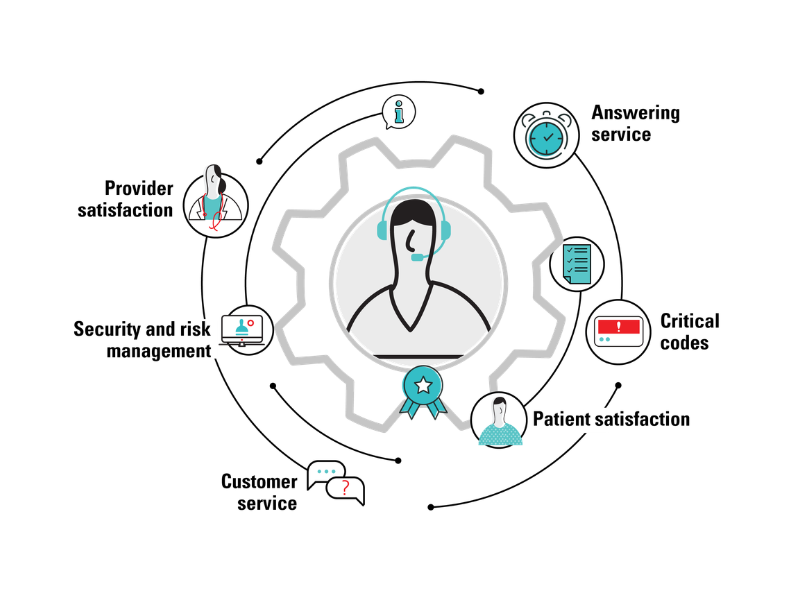
- A healthcare contact center manages all patient communication—calls, SMS, chat, and portal messages—through a single coordinated system, so patients aren’t bounced between departments or asked to repeat themselves.
Done right, it reduces no-show rates, shortens scheduling delays, and cuts administrative load on clinical staff—without requiring more headcount. - Patients benefit from clearer guidance, faster responses, and more confidence navigating care.
- Healthcare organizations gain efficiency, lower administrative burden, and better visibility into patient needs.
- Omnichannel communication ensures patients can switch channels without repeating information.
- Automation and AI help manage volume but must support—not replace—human care.
- Compliance, privacy, and data security are non-negotiable in healthcare contact centers.
What Is a Healthcare Contact Center?

A healthcare contact center is the operational backbone of patient communication. It’s a centralized team and platform that manages every inbound and outbound interaction—from a patient’s first appointment request to a post-discharge follow-up call—across phone, SMS, chat, email, and patient portals.
What separates a healthcare contact center from a standard call center isn’t just the subject matter—it’s the stakes. Agents handle sensitive health information, navigate strict privacy requirements, and communicate with patients who are often anxious, in pain, or confused about their care. That requires specific training, specific workflows, and a platform built to support both.
Common channels include:
- Phone calls
- SMS and text messaging
- Live chat
- Patient portals
- Sometimes social messaging, depending on policy
Healthcare contact centers are used by:
- Hospitals and health systems
- Primary care and specialty clinics
- Urgent care networks
- Telehealth providers
- Insurance-linked care organizations
Picture a patient scheduling a cardiology consultation. They call to book, get an automated text reminder 48 hours before, message via chat to ask about their insurance coverage, and receive a follow-up call after discharge to confirm their next steps. Every one of those interactions runs through the same contact center system—with the same patient record visible to each agent handling the conversation.
That continuity is what makes healthcare contact centers genuinely different. Agents aren’t just routing calls—they understand care pathways, recognize urgency signals, and know that how they handle an administrative task can directly affect a clinical outcome.
Why Healthcare Contact Centers Matter in Modern Healthcare
Healthcare organizations are managing more patient volume with fewer administrative staff, while patients expect the same responsiveness from their clinic that they get from their bank or airline. The contact center is where that pressure lands first.
From the patient’s side, access is everything. A missed call, a 20-minute hold, or a voicemail that never gets returned doesn’t just create frustration—it delays care. Patients who can’t reach their provider on the first attempt often reschedule late, skip follow-ups, or look for another provider entirely.
From the operations side, a well-run contact center absorbs volume that would otherwise fall on clinical staff—freeing nurses and coordinators to focus on care that actually requires their expertise, rather than answering the same scheduling and billing questions fifty times a day.
Healthcare contact centers matter because they:
- In practice, a well-run contact center does four things that are hard to replicate any other way: it serves as the primary access point for patients navigating a complex system; it keeps communication consistent across multiple visits and providers; it absorbs the high volume of routine, repeatable requests that would otherwise burn out clinical staff; and it gives patients faster, clearer answers—which directly affects how they feel about their care, regardless of what happens in the exam room.
In practice, many issues never need to reach clinical staff. Appointment changes, insurance questions, or basic medication inquiries can be resolved quickly by trained contact center agents. That frees clinicians to focus on care that truly requires medical expertise.
Core Functions of a Healthcare Contact Center
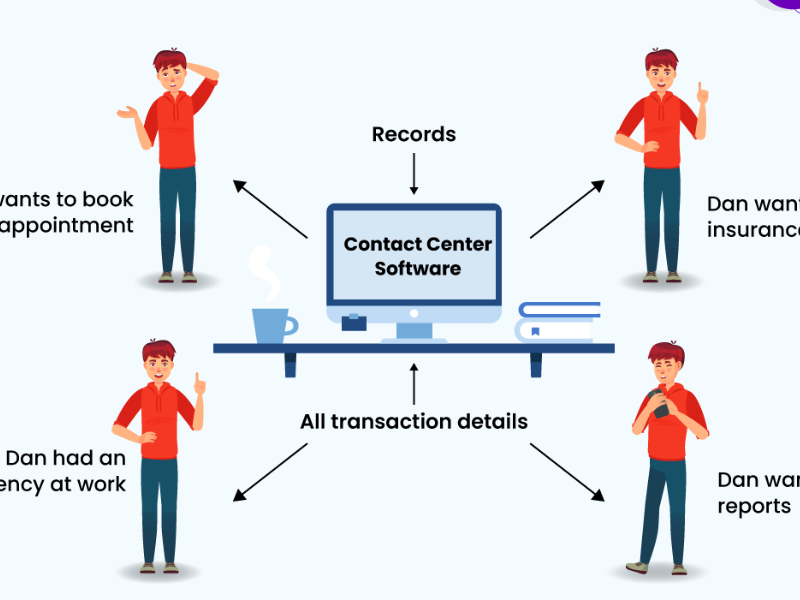
Appointment Scheduling and Coordination
Scheduling is the single highest-volume function in most healthcare contact centers—and the one with the most direct impact on revenue and care continuity. A no-show isn’t just a missed appointment; it’s a gap in care, a slot that can’t be backfilled, and a recurring cost that compounds across hundreds of weekly bookings.
A modern scheduling workflow handles the full cycle: intake across phone, text, or online request; real-time matching with provider availability; automated confirmations sent immediately after booking; and reminders via SMS or voice 24–72 hours before the appointment. When reminders include a direct reschedule link, patients can change their appointment without calling back—which reduces inbound queue pressure during peak hours and gives the clinic time to fill the slot.
Agents in this function also coordinate referrals, follow-up visits, and pre-visit instructions—touchpoints that, when handled proactively, meaningfully reduce day-of confusion and late arrivals.
Prescription Refills and Medication Support
Prescription refill intake is one of the most disruptive tasks for clinical staff when handled without a clear process. A physician interrupted mid-consultation to approve a routine refill request isn’t a minor inefficiency—it’s a daily friction that compounds across every provider in the practice.
Healthcare contact centers handle the administrative layer: verifying patient identity, confirming medication details, logging the request, routing it to the right clinician or pharmacy workflow, and keeping the patient informed of approval status or expected delays. The clinical decision stays with the provider. The coordination work—which is most of it—moves to the contact center.
The key to doing this well is communication clarity. Patients should leave every interaction knowing exactly what happens next and when to follow up if they haven’t heard back.
Patient Education and Outreach
Most contact center interactions are reactive—patients call with a problem, and agents respond. But high-performing healthcare contact centers also run proactive outreach that prevents problems from developing in the first place.
This includes preventive care reminders for overdue screenings or vaccinations, post-visit follow-ups that confirm patients understood their discharge instructions, and chronic care check-ins for conditions like diabetes or hypertension where consistent monitoring reduces costly complications. These calls are often short—five minutes or less—but their impact on adherence and avoidable readmissions is significant. For organizations under value-based care contracts, proactive outreach isn’t a nice-to-have; it directly affects reimbursement.
Medical Triage and Call Routing
Contact center triage isn’t clinical decision-making—it’s intelligent routing. Agents follow structured scripts and symptom-based decision trees developed with clinical oversight, and their job is to match the patient’s urgency level with the right next step: an immediate escalation to a nurse line, a same-day urgent care appointment, a standard clinic referral, or self-care guidance for low-acuity concerns.
Done well, this function meaningfully reduces unnecessary emergency room visits—which are costly for both patients and health systems—while ensuring genuinely urgent situations get escalated without delay. The protocol matters more than the agent’s individual judgment, which is why well-designed triage scripts and regular training reviews are non-negotiable.
Billing, Insurance, and Administrative Support
Billing confusion is one of the most common reasons patients disengage from their care. A patient who doesn’t understand a statement, fears a large bill, or can’t figure out what their insurance covers will delay follow-up visits, avoid calling back, and sometimes dispute charges that were entirely valid.
Healthcare contact centers address this by consolidating billing support into one accessible team: verifying insurance eligibility before visits to avoid surprises, walking patients through charges and statements in plain language, setting up payment arrangements for patients who need flexibility, and connecting those who qualify with financial assistance programs. Handling these conversations proactively—before bills go to collections or patients go silent—protects both the patient relationship and the organization’s revenue cycle.
Key Benefits of Healthcare Contact Centers

Benefits for Patients
-
For patients, the difference a well-run contact center makes is felt immediately: appointments are easier to book, questions get answered without being transferred three times, and there’s a consistent point of contact that tracks their history rather than starting from scratch on every call. That consistency builds trust—and patients who trust their provider’s communication are more likely to stay engaged with their care.
For healthcare organizations, the operational case is equally strong. Centralizing communication reduces the volume of routine requests that land on clinical staff, which lowers burnout and lets providers focus on what they’re trained to do. It also creates real visibility: when every interaction is logged and measurable, operations teams can see exactly where volume concentrates, where wait times spike, and where workflows need adjustment—instead of managing by gut feel.
Benefits for Healthcare Organizations
- Lower administrative workload for clinical staff.
- Better use of staffing through centralized workflows.
- Improved visibility into patient demand and pain points.
- More consistent service quality across locations.
Best Practices for Effective Healthcare Contact Centers

Patient-Centered Communication
Healthcare communication requires a different standard than standard customer service. Patients calling a contact center are often anxious, in pain, or navigating a system they don’t fully understand. Empathy isn’t a soft skill in this context—it’s a functional requirement.
In practice, this means agents listen before they respond, use plain language rather than clinical or administrative jargon, confirm that the patient understood the information given, and close every interaction with clear next steps: what happens next, who does it, and when the patient should follow up if they don’t hear back. That last part—setting concrete expectations—is where many contact centers fall short, and it’s where most patient frustration originates.
Omnichannel Communication in Healthcare
Patients don’t think in channels—they think in conversations. They expect to call about an issue, get a follow-up text, and then check their portal for documentation without having to re-explain the situation at each step. Omnichannel infrastructure makes that continuity possible by feeding every interaction—regardless of channel—into a single patient record visible to any agent handling the account.
In practice, each channel serves a different purpose: phone for urgent or complex issues where tone and real-time response matter; SMS for reminders, confirmations, and quick status updates; chat for lower-acuity questions and scheduling adjustments; portals for documentation, test results, and secure clinical messaging. The goal isn’t to force patients onto a single channel—it’s to make all channels work together seamlessly
Staff Training and Performance Management
Healthcare contact center agents carry more responsibility than most customer-facing roles, and their training needs to reflect that. Handling a billing question poorly costs goodwill. Mishandling a triage call can cost more.
Core training areas cover HIPAA compliance and data handling, familiarity with basic care pathways and referral processes, de-escalation techniques for distressed or confused patients, and consistent empathy standards that don’t vary by agent or shift. Training shouldn’t be a one-time onboarding event—regular call reviews, targeted coaching, and quality scoring against defined benchmarks are what keep standards from drifting over time.
The metrics that matter most: first-call resolution rate (how often issues are resolved without a callback), average handle time balanced against quality scores, and patient satisfaction scores tied to specific interaction types rather than averaged across everything.
Using Data and Analytics to Improve Operations
The advantage of running a centralized contact center is that every interaction generates data—and that data is only useful if someone is actually acting on it.
A basic improvement loop looks like this: analyze call driver reports weekly to identify what patients are calling about most, cross-reference with resolution rates to spot where agents are struggling, adjust staffing levels or workflow routing to address the bottleneck, then measure whether the change had the intended effect. Repeat monthly.
Beyond operational efficiency, analytics surface something more valuable: unmet patient needs. If a specific question type spikes after a new procedure rollout, or if chat volume surges around billing cycle dates, that’s signal—for better patient education, for website content updates, or for proactive outreach campaigns that deflect volume before it hits the queue.
Technology and Automation in Healthcare Contact Centers

AI-Powered Patient Support
AI in healthcare contact centers serves two distinct roles, and conflating them creates unrealistic expectations.
On the front end, AI-powered IVR systems and chatbots handle high-volume, low-complexity interactions—appointment confirmations, refill status checks, insurance eligibility queries—without agent involvement. Deflecting 25–40% of routine inbound volume allows agents to focus on interactions that actually require human judgment.
On the back end, AI speech analytics automatically review recorded calls for compliance flags, script adherence, and patient sentiment. This is where the operational value is most significant: a manual QA team can realistically review 3–5% of calls; AI can review 100%, flagging the interactions that need human follow-up rather than forcing supervisors to search for them. For healthcare organizations managing HIPAA audit risk, that documentation coverage is no longer a competitive advantage—it’s a baseline expectation.
The critical design principle for both applications: every AI-handled interaction must have a clearly marked, easy path to a live agent. In healthcare, there’s no acceptable scenario where a patient can’t reach a human.
Telehealth and Telemedicine Integration
As telehealth volume has grown, contact centers have become the operational layer that keeps virtual care accessible. Agents schedule and confirm virtual visits, send patients the correct platform links and access instructions, troubleshoot technical issues before appointments start—which significantly reduces no-shows caused by access problems rather than patient intent—and follow up after visits to confirm next steps and schedule any required in-person care. Without this coordination layer, telehealth platforms generate more confusion than they resolve.
Remote Patient Monitoring Assistance
For patients on remote monitoring programs—continuous glucose monitors, cardiac event monitors, post-surgical vitals tracking—the contact center is the first point of response when a device generates an alert. Agents follow clinical protocols to determine whether the reading requires immediate escalation, a scheduled follow-up, or patient education about the device. This function requires close coordination with clinical teams to ensure response protocols are current and agents know exactly when to escalate versus when to reassure.
Compliance, Security, and Data Protection
Healthcare contact centers operate under a higher compliance burden than virtually any other customer-facing function. In the US, HIPAA (Health Insurance Portability and Accountability Act) governs how patient health information is stored, transmitted, and accessed—with violations carrying penalties ranging from $100 to $50,000 per incident depending on severity and negligence level.
Practically, this means every component of the contact center stack must meet specific requirements: access controls that limit agent visibility to only the patient data their role requires, encrypted communication channels for all voice, chat, and messaging interactions, audit logs that document who accessed what data and when, and regular staff training that’s documented and updated as regulations evolve.
Compliance isn’t just a legal obligation—it’s a trust signal. Patients who know their information is protected are more willing to share the details that help agents actually assist them. Organizations that treat compliance as a baseline rather than a checkbox build contact center programs that are both legally defensible and operationally effective.
Key Trends Shaping the Future of Healthcare Contact Centers
-
Several trends are reshaping how healthcare contact centers operate at the infrastructure level.
AI is moving beyond basic routing into post-call summarization and real-time agent assist—tools that surface relevant patient history or suggested responses during a live interaction, reducing handle time and the cognitive load on agents managing complex conversations.
Multilingual support is becoming a baseline expectation rather than a premium feature, particularly in regions with diverse patient populations where language barriers directly affect care access and clinical outcomes.
Predictive analytics are shifting contact centers from reactive to proactive: identifying patients at high risk of missing follow-up appointments, flagging accounts likely to disengage, and enabling outreach campaigns timed to clinical milestones rather than administrative schedules.
And integration depth is increasing—contact center platforms are connecting more tightly with EHR systems, billing platforms, and population health tools, so agents have the context they need without switching between five different screens to answer a single patient question.
What to Consider When Implementing or Improving a Healthcare Contact Center
Before selecting or upgrading a healthcare contact center platform, evaluate these five areas with specificity—not just as checkboxes.
Scalability means more than handling more calls. It means handling volume spikes—flu season surges, post-discharge follow-up campaigns, emergency outreach—without degraded performance or manual workarounds. Ask vendors for specific numbers: peak concurrent calls supported, queue capacity, geographic routing options.
Integration depth determines whether your agents work in one system or five. At minimum, the platform should connect with your scheduling and billing systems. Native EHR integration is increasingly available and significantly reduces documentation errors and handle time.
Reporting usability separates platforms that generate data from platforms that generate insight. If your operations team needs a data analyst to interpret the dashboards, the reporting isn’t actually useful for day-to-day management.
Onboarding speed matters more than vendors typically advertise. A platform that takes 6 weeks to deploy and 3 weeks to train staff on creates real operational disruption. Cloud-native platforms that go live in days—not months—reduce that risk significantly.
Vendor healthcare experience is the factor most commonly underweighted in procurement decisions. A vendor who has never implemented in a healthcare environment will discover compliance requirements, workflow nuances, and integration challenges on your timeline and at your cost. Prior healthcare deployments and relevant certifications are worth verifying before signing.
Frequently Asked Questions
What makes a healthcare contact center different from a regular call center?
Healthcare contact centers handle sensitive health information, follow strict privacy rules, and support care-related workflows, not just customer service tasks.
Are healthcare contact centers required to be HIPAA compliant?
Yes. Any system or team handling patient health information must meet HIPAA requirements to protect privacy and security.
Can AI replace human agents in healthcare contact centers?
No. AI supports routine tasks, but human judgment is essential for empathy, safety, and complex patient situations.
Conclusion

A healthcare contact center, when built and run well, does something that’s difficult to achieve any other way: it makes a complex system feel manageable to the people navigating it. Patients get consistent, clear communication. Clinical staff get relief from administrative volume. Operations teams get visibility into where the system is working and where it isn’t.
The organizations that invest seriously in this function—in the right platform, the right training, and the right workflows—see measurable returns: lower no-show rates, higher patient retention, reduced staff burnout, and stronger compliance posture.
If you’re evaluating your current contact center setup or planning a new implementation, the right starting point is an honest assessment of where your patient communication breaks down today—and what it’s costing you to leave it that way.
Read more:
Contact Center KPI Benchmarking by Industry: Real Standards
Contact Center Outsourcing: A Practical Guide for Businesses

 English
  Russian
  Chinese