

Support volume doubles every 6-12 months at a growing company, but recruiting and training an in-house team takes 10-14 weeks. That gap is where contact center outsourcing earns its place: instead of building capacity, you rent it from a provider that already has trained agents, multi-channel infrastructure, and running processes.
The decision looks simple on a rate card and rarely is. An offshore hourly rate against a fully loaded in-house salary suggests savings of 60% or more, yet the largest published survey of outsourcing buyers puts average realized savings at 15%. The gap between those two numbers is where most programs succeed or fail, and it is governed by things that never appear in a quote: how much oversight the program needs, how quickly agents turn over on your account, and what the contract left undefined.
This guide covers what outsourcing actually costs against a fully loaded in-house agent, how the engagement runs week by week, which models exist, what goes wrong, how to evaluate providers, and the metrics that predict whether the program survives its second year. Figures are cited where a published source exists and labelled as estimates where none does.
Key Takeaways

- Speed is the real advantage. Standing up an in-house team runs 10-14 weeks. Onboarding with an established provider runs 2-6 weeks. For a product launch, a seasonal peak, or a new market, that difference decides the outcome more often than the rate does.
- The cost comparison that matters. A fully loaded in-house agent in the US costs roughly $65,000-78,000 a year once benefits, infrastructure, and supervision are counted. Outsourcing converts that to an hourly rate: broadly $8-18 offshore (Philippines, India, Vietnam), $14-28 nearshore (Mexico, Colombia, Costa Rica), $28-45 onshore (US, Canada, UK).
- Rate arithmetic overstates the saving. The bands imply 40-60%. ISG’s 2024 study of 368 outsourcing decision-makers put average realized savings at 15%. Governance time, quality remediation, and the ramp period absorb the rest. Budget against the lower figure.
- Governance is not optional. Plan on 5-10 hours a week of oversight once a program is stable, and more during ramp: call reviews, QA calibration, quarterly business reviews. That is our own operating estimate rather than a published benchmark, but the direction is not in doubt. “Set it and forget it” is the most reliable way to lose the quality you were promised.
- Best fit: seasonal spikes, 24/7 coverage without night shifts, multilingual expansion, and repeatable tier-1 volume. Poor fit: conversations where the product is sold, work requiring deep engineering judgment, and total volume under roughly 200 contacts a month.
What Is Contact Center Outsourcing?
Contact center outsourcing means hiring a third-party provider to handle customer interactions — phone, live chat, email, social messaging, support tickets — on your behalf. It sits inside Business Process Outsourcing (BPO), where a company delegates a non-core operation to a specialist that already owns the infrastructure, training, and process.
Three factors drive the decision, and it is worth being honest about which one is yours, because each points to a different provider.
Speed to scale. Hiring and training 20 in-house agents takes 10-14 weeks once you count recruiting, onboarding, and time to full productivity. An established provider can be live in 2-6 weeks because the agents and the multi-channel stack already exist. For a fintech adding 24/7 coverage during a funding round, or a retailer preparing for the holiday season, that is usually the deciding factor rather than price.
Cost predictability. In-house teams carry fixed costs — salaries, benefits, space, supervision — regardless of volume. When tickets fall 40% in a slow quarter you still pay the full team. Outsourcing converts that into a variable cost tied to hours consumed, which makes budgets easier to defend and easier to adjust.
Channel and language coverage. Omnichannel support in-house means unified ticketing, workforce management, a QA function, and channel-specific training. Providers have standardized that stack across many clients. The same applies to languages: adding native-speaker coverage in three markets is a staffing project internally and a scheduling question for a provider that already staffs those languages.
Inbound versus outbound: different skills, different providers
Inbound support handles incoming requests — customer service, technical troubleshooting, billing questions, order tracking. It rewards product knowledge, empathy, and problem-solving. Agents work from queues with volume that swings through the day, and average handle time typically runs 4-8 minutes per contact.
Outbound work is proactive: appointment setting, follow-ups, renewals, collections, sales. It rewards resilience and compliance awareness — TCPA in the US, GDPR in the EU — and agents work from lists against daily targets rather than from a queue.
This matters at vendor selection because most providers are genuinely good at one and merely adequate at the other. Inbound specialists handle high-volume service well but lack sales training. Outbound specialists own dialer infrastructure and compliance expertise but struggle with technical support. If you need both, ask for client references doing your specific type of work, not a general capability statement.
Contact center versus call center: why the label matters in procurement
| Aspect | Call center | Contact center | Business impact |
|---|---|---|---|
| Channels | Phone only | Phone, chat, email, social | One conversation continues across channels instead of restarting on each |
| Customer view | Fragmented — separate ticket per channel | Unified — one conversation history | Gartner finds low-effort service, where customers do not repeat themselves or switch channels, cuts repeat calls by up to 40% |
| Reporting | Call metrics only (AHT, ASA, FCR) | Omnichannel analytics across the journey | Visibility into actual customer experience, not just phone performance |
| Pricing model | Per seat or per minute | Often per interaction, varying by channel | More complex billing, better aligned to workload — one agent handles several concurrent chats but only one call, so non-voice unit costs are materially lower |
| Use case | Basic phone support, such as an order-status hotline | Modern CX operations, such as SaaS or ecommerce support | A mixed channel model raises contacts handled per agent, because non-voice work runs concurrently and voice cannot |
Selecting a phone-only provider when you actually need multi-channel support produces siloed operations and a worse customer experience than you started with. Verify the provider handles your real channel mix, and that their reporting shows a unified customer journey rather than a separate dashboard per channel.
How Much Does Contact Center Outsourcing Cost?
Outsourcing replaces a fixed annual cost per employee with a variable hourly rate. The comparison below decides most business cases, so it is worth building carefully rather than accepting a vendor’s headline number.
| Cost element | In-house agent (US) |
|---|---|
| Base salary | $40,630 median, $45,110 mean (BLS, May 2024) |
| Benefits and payroll costs | +43% of base — $17,400-19,400 (BLS ECEC: benefits are ~30% of total compensation) |
| Infrastructure (space, hardware, licenses) | $3,000-5,000 per seat per year (planning figure; no public benchmark exists) |
| Supervision | One supervisor per 10-15 agents, or $4,300-8,500 per agent |
| Fully loaded cost per agent | $65,000-78,000 per year |
Against that, outsourced rates run broadly $28-45 per agent hour onshore, $14-28 nearshore, and $8-18 offshore. Treat those as the bands vendors quote rather than as a benchmark. Everest Group and ISG maintain real contact-center pricing databases, but neither publishes rates openly, so every public rate card — including this one — is assembled from quotes rather than from measured data.
Where the arithmetic stops working. Offshore rates imply a 60-70% saving against a fully loaded in-house agent. Almost nobody realizes that. ISG’s 2024 study of 368 outsourcing decision-makers put average realized savings at 15%, with cost-savings achievement the weakest-rated dimension in the survey. Labor arbitrage plus process improvement tends to cap out around 20-30%. The difference goes into oversight time, quality remediation, and the ramp period.
A worked example, as modeled arithmetic rather than a measured case. Take a program of 30 dedicated agents. In-house at the fully loaded figures above runs $1.95M-2.34M a year. The same headcount offshore at $8-18 per hour, assuming 1,800 productive hours per agent per year, runs $432,000-972,000 in vendor fees. That looks like a 55-80% saving. Apply the ISG finding and the realistic planning number is far closer to 15-30% once you add a program manager, QA time, travel, remediation during ramp, and the months where you pay for both teams during transition. Model your own case both ways and present the lower figure to finance.
What the quoted rate usually excludes: setup and implementation fees, training hours (often billed at full agent rate), minimum monthly commitments, and change requests. Ask every vendor for a fully loaded 12-month model including the ramp period before comparing quotes.
Where cost savings matter most: seasonal businesses, early-stage companies with limited runway, and high-volume transactional support. Where they matter least: premium enterprise segments, technically complex products, and any market where retention depends on exceptional support.
How the Engagement Actually Runs, Week by Week
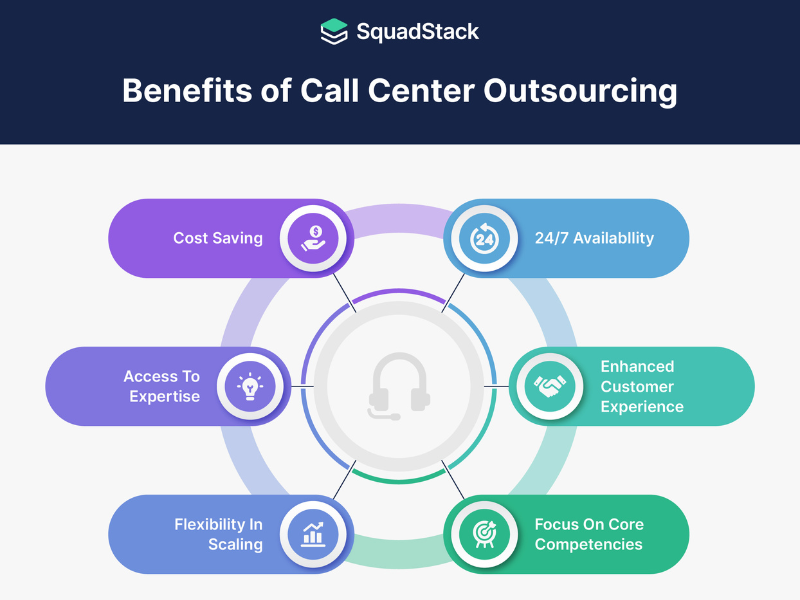
A straightforward program goes live in 2-6 weeks. Programs in regulated industries with heavy compliance training run 8-12 weeks. The sequence rarely changes, and most failures trace back to compressing one of these stages rather than to the choice of provider.
Weeks 0-1: define the work. Before any vendor conversation, write down monthly contact volume by channel, peak-hour concentration, required coverage hours and time zones, languages, target service level, and the systems agents must use. Run a rough internal-versus-outsourced cost comparison including hiring, training, management, and tooling. A vague brief guarantees a low quote followed by a re-price three months later, because the vendor priced what you described rather than what you have.
Weeks 1-2: contracting and access. This is where terms get set that are painful to change later: initial term, SLA definitions and credits, whether training hours are billable, data-handling obligations, and who owns the knowledge base. Systems access usually takes longer than expected — single sign-on, CRM permissions, and access to a test environment are the common blockers.
Weeks 2-4: knowledge transfer and training. This phase decides the outcome more than any other. Hand over product documentation, workflows, FAQs, and — most importantly — edge cases and the reasoning behind exceptions. Define brand voice, tone, and escalation rules explicitly. Train agents on real recorded scenarios, not scripts alone. Ask how many hours of client-specific training an agent receives before taking a live contact, and treat any answer under 40 hours as a warning for anything beyond simple tier-1 work.
Weeks 4-6: supervised ramp. Agents take live contacts with side-by-side monitoring and a lower target volume. Expect handle time and quality scores to sit below target for two to four weeks. Integrate the provider into your own CRM and ticketing rather than accepting a parallel system, set the cadence of weekly performance reviews, and listen to real recorded interactions yourself. Treat the outsourced team as an extension of the business, not a black box behind a monthly report.
Outsourcing Models: Where Agents Sit and What You Hand Over

Two decisions define a model: where the agents sit, and how much of the operation you hand over. Get those right and most other details follow.
| Model | Typical rate (per agent hour) | Best for | Main trade-off |
|---|---|---|---|
| Onshore (US, Canada, UK) | $28-45 | Regulated industries, high-value accounts, brand-sensitive support | Highest cost; limits how much volume you can afford to cover |
| Nearshore (Mexico, Colombia, Costa Rica) | $14-28 | US-hours coverage with bilingual English/Spanish teams | Smaller talent pool than offshore; rates rising as demand grows |
| Offshore (Philippines, India, Vietnam) | $8-18 | High-volume tier-1 support, 24/7 coverage, cost-driven programs | Time-zone gap for real-time escalation; accent and cultural fit need screening |
A growing number of companies run a hybrid model: onshore agents handle escalations and VIP accounts while offshore teams absorb tier-1 volume. The blended rate depends entirely on the ratio — a 70/30 offshore-to-onshore split lands somewhere around $14-26 per hour, a 50/50 split closer to $18-32. Ask the vendor to model the blend at your actual mix rather than accepting a headline blended figure, which is usually quoted at the most offshore-heavy ratio they think you will accept. The same logic applies to offshore outsourcing more broadly: the geography sets the rate, but the ratio sets the invoice.
On scope, four arrangements cover almost every engagement. Staff augmentation means the provider supplies agents while you keep your own tools, scripts, QA, and management — the most control and the least relief from operational load. Managed service adds supervisors, QA, and reporting against agreed SLAs, and is the common arrangement for teams of ten or more. Full BPO hands over the entire function including technology and process design: fastest to stand up, hardest to reverse. Overflow or after-hours only takes contacts outside your hours or above a volume threshold, and is the usual way to test a vendor before expanding.
If you are outsourcing for the first time, overflow or after-hours is the low-risk entry point. It produces a real performance sample on your own traffic before you move core volume, and it costs a fraction of a full transition to unwind if the provider disappoints.
When Outsourcing Pays Off, and When It Does Not

Outsourcing is not an all-or-nothing decision. Most companies start at one pressure point and expand from there. Five situations recur, and the economics work most reliably in them.
Seasonal or campaign-driven spikes. Retail support volume can triple between November and January. Hiring 30 seasonal agents in-house means recruiting in September, training through October, and separating people in February — full onboarding cost for roughly three months of output. A partner absorbs the same spike on a variable rate, and the ramp-down costs nothing beyond the notice period.
Extending to 24/7 without night shifts. Running your own overnight shift means shift differentials, higher attrition, and a supervisor awake at 3 a.m. A partner with delivery centers in another time zone covers those hours during their normal working day. This is the single most common reason mid-sized SaaS companies outsource first.
Entering a market where you do not speak the language. Launching in Germany, Japan, or Brazil requires native-speaker support from day one. Recruiting native speakers into your home office is slow and expensive; providers already staff multilingual teams and add a language in weeks rather than quarters.
Backlog recovery. When response times slip from four hours to three days, the fix is capacity and it is needed now. Outsourcing buys immediate headcount while you rebuild the internal team properly instead of panic-hiring.
Necessary but undifferentiating work. Password resets, order status, and returns rarely win customers, but they still have to be handled well. Moving tier-1 volume to a partner frees the in-house team for cases where product knowledge actually changes the outcome. Ecommerce support programs are the clearest example of this split working.
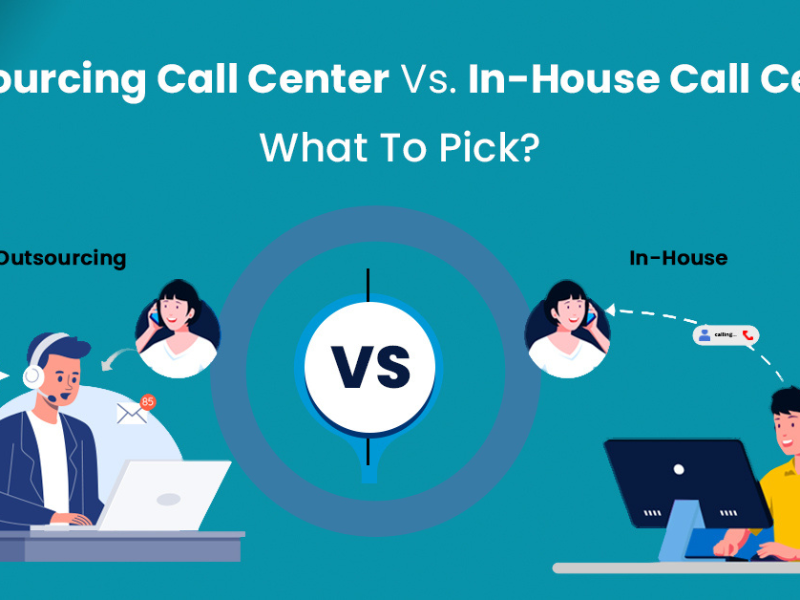
| Factor | In-house team | Outsourced partner |
|---|---|---|
| Time to add 20 agents | 10-14 weeks | 2-6 weeks |
| Cost structure | Fixed — paid regardless of volume | Variable — scales with hours used |
| Fully loaded cost per agent | $65,000-78,000/year | $14,000-78,000/year depending on location |
| Product depth | High — agents live with the product | Moderate — depends on training investment |
| Scaling down | Slow and expensive (severance, morale) | Contractual notice period |
| Management load | You own hiring, scheduling, QA, coaching | Vendor owns delivery; you own oversight |
| 24/7 coverage | Requires night shifts and differentials | Covered by delivery centers in other time zones |
Four questions settle the decision faster than any general argument, and each one rules something out. What is your monthly contact volume? Under roughly 200 contacts a month, oversight costs more than it saves, so stay in-house; between 200 and 500, overflow or after-hours fits; above 500, a dedicated managed-service team usually becomes cost-effective. Those thresholds are our operating rule rather than a published benchmark — no analyst firm or trade body publishes a minimum-volume figure, and we have looked. There is a harder constraint you can verify directly: most providers set a contractual minimum of five to ten dedicated FTE and will either decline smaller work or price it as though you had hired the full team. What kind of conversations are these? Repeatable patterns transfer well; conversations requiring deep product judgment, or where the sale happens, stay in-house with tier-1 volume outsourced underneath. What is actually driving the decision? Cost pushes offshore, coverage pushes nearshore, language points to a multilingual specialist, and speed favors a provider with bench capacity — naming the primary driver prevents choosing on the wrong criterion. Who will manage the relationship? Without 5-10 weekly hours for QA review, calibration, and reporting, quality drifts and the savings disappear into rework.
If volume clears 500 a month, a meaningful share is repeatable, you can name the primary driver, and someone owns the relationship — run a 60-90 day pilot on a defined slice. If any of the four is missing, fix that first. Starting with a full switch is how most failed programs begin.
The Five Risks That Kill Outsourcing Programs

Outsourcing fails often enough that the risks deserve the same attention as the savings. Five account for most program failures, and each has a specific preventive measure that belongs in the contract rather than in a quarterly conversation.
Quality drift after the first quarter. Vendors staff their strongest agents during the pilot. Six months in, those agents have rotated to newer accounts and CSAT slips. Write named-team continuity into the contract, require monthly calibration sessions where your QA team and theirs score the same calls, and review scorecard agreement rather than only the scores. A widening gap between your scoring and theirs is the earliest signal that standards have diverged.
Agent attrition you cannot see. Turnover benchmarks in general circulation put annual agent attrition at 30-45%, and outsourced voice floors sit at the upper end. No vendor-independent public dataset covers outsourced attrition specifically — ContactBabel’s decision-makers’ guide is the closest thing to primary research and it is a paid report. That is precisely the argument for not relying on an industry figure: ask for attrition on your specific account, not the company-wide average, and make it a reported metric in the monthly business review. Every departure resets product knowledge.
Knowledge staying with the vendor. After two years the partner may understand your customers better than you do. That is comfortable until you want to change providers. Own the knowledge base, own the ticketing system, and require that call recordings and transcripts are exportable in a standard format.
Data protection and compliance exposure. Regulatory obligations do not transfer with the work. If a partner mishandles cardholder or patient data, the liability remains yours. Verify certifications directly with the issuing body rather than accepting a PDF, confirm where data is stored and processed, restrict agent access to the minimum required, and require breach notification within a defined window.
Hidden cost structure. The quoted hourly rate rarely matches the invoice. Setup fees, training hours billed at agent rate, minimum monthly commitments, and change requests accumulate. Ask for a fully loaded 12-month cost model including the ramp period, and check specifically whether training hours are billable.
The pattern behind all five is the same: problems come from what the contract leaves undefined, not from outsourcing itself.
How to Choose a Contact Center Outsourcing Partner

Vendor selection usually goes wrong in the same place: the evaluation measures how well a provider sells rather than how well they deliver. A sequence that tests delivery starts with defining the work in writing, as described above, and then shortlisting on fit rather than size.
Size is the most common selection error. A provider with 400,000 employees may assign a 15-seat program to a junior team; a 300-person provider may give the same program senior attention. Ask what percentage of their revenue an account your size represents, and which of their existing clients most resembles you in volume, industry, and channel mix. That single question separates providers who want your business from providers who will staff it properly.
Then ask the questions that reveal delivery quality rather than sales quality:
- What is annual agent attrition on accounts of our size and type?
- What is average agent tenure on the team we would be assigned?
- How many hours of client-specific training before an agent takes live contacts?
- What is your supervisor-to-agent ratio?
- Which SLA misses have you paid penalties on in the last 12 months?
- Can we listen to live calls, and can our QA team score them independently?
The last question matters most. Providers confident in their delivery say yes immediately, and hesitation there predicts more problems than any pricing discussion. Follow it by asking for a reference the vendor did not select — specifically a client who left, and why. A provider who cannot name one is either very new or not being straight with you.
Finally, pilot before committing. Run 60-90 days on a defined slice such as after-hours only or a single channel, measure against your own baseline rather than the vendor’s dashboard, and agree in advance what result justifies expanding. On contract terms, the ones worth negotiating hardest are an initial term no longer than 12 months, SLA credits with real financial weight, named-team continuity, your ownership of the knowledge base and recordings, a defined exit and transition-assistance clause, and clarity on whether training hours are billable. If the technology stack is also in question, evaluate that separately against a contact center technology shortlist rather than letting the provider’s platform decide it for you.
Major Contact Center Outsourcing Providers

The market splits into three tiers, and the right tier depends far more on your program size than on any published ranking. The figures below are company-reported scale, given for orientation rather than as an endorsement.
| Provider | Reported scale | Footprint | Typically serves |
|---|---|---|---|
| Concentrix | ~440,000 employees | 70+ countries; entered the Fortune 500 at #426 in 2025, expanded through its $4.8B acquisition of Webhelp in 2023 | Several hundred seats and up |
| Teleperformance (TP) | ~410,000 employees | 80+ countries, including about 25,000 staff in the United States | Several hundred seats and up |
| TELUS International | 108,000+ employees | 32 countries, close to 70 delivery centers; weighted toward technology clients | Mid-size to enterprise programs |
| Foundever | 20,000+ US employees | Formed by the merger of Sitel Group and SYKES; large multilingual international footprint | Mid-size to enterprise programs |
| Alorica | 50,000+ US employees | Positioned around high-volume programs and regulated-industry compliance | High-volume enterprise programs |
| Mid-market specialists | Hundreds to low thousands | Global Response, TeleDirect, Working Solutions, LiveOps, 1840 & Company and similar | Roughly 10-200 seats |
| Regional and offshore specialists | Varies by market | Concentrated in one delivery geography: the Philippines, India, Latin America, Eastern Europe, Vietnam | Cost-driven and single-region programs |
For a program of 10 to 200 seats, the practical advantage of a mid-market provider is attention: the account represents a meaningful share of their revenue rather than a rounding error, and the people who won the business are usually the people who run it. Regional specialists concentrated in a single geography generally offer the lowest rates and the deepest local labor-market knowledge, with less breadth if you later need multi-region coverage.
Published “top provider” lists are compiled on very different bases — some on headcount, some on client reviews, some on commercial relationships. None of them knows your volume, your industry, or your compliance requirements. Use them to assemble a shortlist, then evaluate against the delivery questions in the previous section. Scale is a poor proxy for the quality of the specific team assigned to your account, which is the only thing that will affect your customers.
Metrics That Predict Whether the Program Lasts

An outsourcing program is only as good as what you measure. These belong in a monthly business review, with the benchmarks the industry actually uses rather than targets a vendor proposes.
| Metric | How it is calculated | Common benchmark | Strong performance |
|---|---|---|---|
| First Call Resolution (FCR) | Issues resolved on first contact ÷ total first contacts | 70-79% | 80%+ — reached by only about 5% of centers |
| Service Level | Calls answered within threshold ÷ total answered | 80/20 (80% within 20 seconds) | 90/15 for premium support |
| Average Speed of Answer (ASA) | Total wait time ÷ answered calls | Under 30 seconds | Under 15 seconds |
| Abandonment Rate | Abandoned calls ÷ total inbound calls | 5% or lower | 2-3% or lower |
| CSAT | Satisfied responses ÷ total responses | 90%+ | 95%+ |
| Occupancy Rate | Handling time ÷ logged-in time | 85-90% ceiling | Above 90% signals burnout risk, not efficiency |
| Average Handle Time (AHT) | Talk + hold + after-call work ÷ calls | Highly context-dependent | Judge against your own baseline, not an industry figure |
Benchmark figures compiled from CloudTalk’s benchmarking analysis, which cites SQM Group first-contact-resolution research.
Applying one standard across sectors produces misleading conclusions. Healthcare contact centers commonly target an ASA of 20-40 seconds with hold times of 30-60 seconds and abandonment around 5%. In financial services, Net Promoter Score averages sit in the 20s. Cost per contact in the nonprofit sector typically runs $2.70-$5.60, reaching about $7.16 at the high end. (Industry figures via Giva’s industry benchmark compilation.)
Five further metrics do not appear on a standard dashboard, and they are the ones that predict whether the relationship survives. Agent attrition on your account — not the vendor’s company-wide figure — tends to rise about one quarter before CSAT falls. Escalation rate to your in-house team climbing means training or scope is wrong. QA score agreement, the gap between your scoring and the vendor’s, widens when the two sides are measuring different things. Time to competency for new agents tracks how well knowledge transfer is holding up as staff turn over. Cost per resolved contact, not cost per contact, is the only cost metric worth reporting: a cheap agent who resolves nothing is expensive.
One caution on target-setting. AHT and FCR pull against each other — pushing agents to close calls faster reliably lowers first-call resolution, which raises repeat contacts and total cost. If you set only one target, set FCR.
Contact Center Outsourcing vs CCaaS
These are frequently compared as alternatives, but they solve different problems. Outsourcing supplies people. CCaaS (Contact Center as a Service) supplies software. Many companies need both.
| Contact center outsourcing | CCaaS | |
|---|---|---|
| What you are buying | Trained agents and managed delivery | Cloud platform: routing, IVR, omnichannel, analytics |
| Who handles contacts | The provider’s agents | Your own agents |
| Typical pricing | Per agent hour ($8-45) | Per seat per month |
| Time to launch | 2-6 weeks | Days to weeks |
| Solves | Not enough people, or the wrong hours | Aging or fragmented technology |
Choose outsourcing when the technology works but you cannot staff the hours or the volume. Choose CCaaS when the team is adequate but calls drop, reporting is unreliable, or channels are disconnected. Choose both when scaling, and run one platform across in-house and outsourced agents so routing, reporting, and quality monitoring stay unified — fragmented tooling between internal and vendor teams is among the most common causes of poor visibility in hybrid programs. A useful test: if you cannot answer “what was our service level last Tuesday between 2 and 4 p.m.” in under a minute, the gap is technology, and more agents will not fix it.
Frequently Asked Questions About Contact Center Outsourcing

How much does contact center outsourcing cost?
Vendor-quoted rates run roughly $8–18 per agent hour offshore (Philippines, India, Vietnam), $14–28 nearshore (Mexico, Colombia, Costa Rica), and $28–45 onshore (US, Canada, UK). Compare that against a fully loaded in-house agent at $65,000–78,000 per year including salary, benefits, infrastructure, and supervision. Note that the rate gap overstates what you will actually save: ISG’s 2024 survey put average realized savings at 15%. Ask any vendor for a 12-month fully loaded model that includes setup fees, ramp period, and whether training hours are billable. The quoted hourly rate is rarely the invoice.
What channels can outsourced contact centers handle?
Voice, email, live chat, SMS, social media, and messaging apps such as WhatsApp are standard. Most providers price voice and non-voice differently, and non-voice channels usually allow higher concurrency per agent. Confirm which channels are included at the quoted rate rather than assuming.
How do I control service quality with an external team?
Three mechanisms do most of the work: independent QA (your team scores a sample of calls, not just the vendor’s), monthly calibration sessions where both sides score the same calls to keep standards aligned, and SLA credits that make missed targets financially real. Track agent attrition on your specific account. It is the earliest warning that quality is about to fall.
Is contact center outsourcing secure?
It can be, but the responsibility does not transfer. Your regulatory obligations remain yours regardless of who handles the contact. Verify certifications directly with the issuing body rather than accepting a PDF, confirm exactly where data is stored and processed, define breach-notification timelines in the contract, and restrict agent access to the minimum data required.
How long does it take to get started?
Typically 2–6 weeks for a straightforward program: one to two weeks for contracting and systems access, one to two weeks for agent training, then a supervised ramp. Complex or regulated programs with heavy compliance training can run 8–12 weeks. Either way it is substantially faster than the 10–14 weeks required to recruit and train an equivalent in-house team.
Can I outsource only part of my support?
Yes, and for a first engagement it is the sensible approach. Common partial models are after-hours coverage only, overflow above a volume threshold, a single channel such as chat, or tier-1 contacts with escalations returning in-house. This gives you a genuine performance sample before moving core volume.
What is the minimum size worth outsourcing?
As a working rule, below roughly 200 contacts per month oversight costs more than it saves. Between 200 and 500, after-hours or overflow models tend to work best. Above 500, a dedicated managed-service team usually becomes cost-effective. Check the provider’s minimum FTE commitment too, since that often binds before volume does.
Can I switch providers if it does not work out?
Only if the contract allows it. Protect this before signing: keep an initial term of 12 months or less, own the knowledge base and ticketing system yourself, require call recordings and transcripts to be exportable in a standard format, and include a defined transition-assistance clause. Without these, switching costs can exceed the savings that motivated the move.
Where to Start

Contact center outsourcing is a capacity decision before it is a cost decision. If volume clears roughly 500 contacts a month, a meaningful share of that volume is repeatable, and someone internally owns the relationship, the model works — provided the contract defines quality, attrition reporting, and exit terms before the first call is answered.
The practical next step is to write the brief: volume by channel, coverage hours, languages, target service level, and the systems agents must use. Then request fully loaded 12-month models from three providers in the tier that matches your program size, and run a 60-90 day pilot on a defined slice before moving core volume.
Read more:
Outbound Call Center: Types, Benefits and Setup
Business Process Outsourcing Services: Models, Scope and Costs
More in Industry
View all →
Customer Experience Trends 2026: What Changed and What to Do
Customer experience in 2026 is being reshaped by three converging forces: persistent economic uncertainty, widespread AI adoption, and fundamentally different customer expectations. Today's customers are more price-conscious than previous years, less attached to brands they once trusted, and willing to switch providers the moment value becomes unclear. For businesses, this means customer experience is no longer a differentiator—it's a survival…


Customer Experience Analytics: Metrics, Data and Tools
Most companies do not have a customer data problem. They have a customer data connection problem: marketing measures ad clicks, support measures resolution time, product measures feature adoption, and nobody can answer whether the customer who abandoned checkout on Tuesday is the same one who called about pricing on Thursday. Customer experience analytics is the practice that closes that gap…

What Is Customer Experience Management? A Practical Guide
Customer experience management (CXM) is the practice of designing, measuring, and improving every interaction a customer has with your company — treated as one connected journey rather than as separate departmental touchpoints. It is what turns a collection of well-meaning teams into an experience a customer can recognise as coming from a single organisation. The distinction that matters is between…



 English
  Russian
  Chinese