

Call center outsourcing Vietnam is appearing on more buyer shortlists, but many teams still make avoidable mistakes when comparing vendors. The biggest problem is not lack of options. It is comparing the wrong provider types, relying too heavily on price, and missing delivery risks hidden behind polished sales decks. Unlike generic “top provider” pages, this guide is built to support real commercial investigation. It explains what buyers are actually evaluating, where Vietnam fits well, how to compare provider models, and what to validate before signing. Vietnam is worth serious consideration, but it is not automatically the best fit for every service model, language requirement, or control expectation. Provider quality varies widely, and cost alone is a weak buying filter.
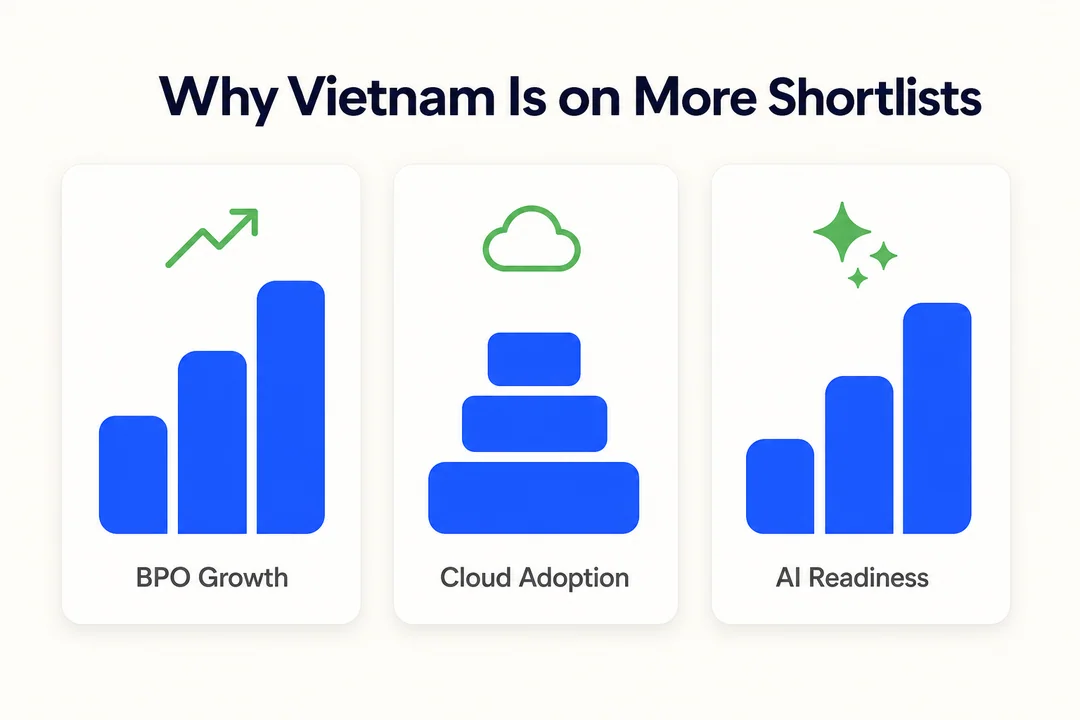
Why Vietnam Is on More Call Center Outsourcing Shortlists
Vietnam is gaining attention because it offers a strong mix of cost-to-quality potential, flexible talent, and improving delivery infrastructure. The smarter buyer question is not “Is Vietnam cheaper?” but “Can Vietnam deliver better operational cost-efficiency for the support model we need?” That distinction matters.
For many growth-stage companies, APAC-focused teams, and brands that need faster launch timelines, Vietnam can be a practical outsourcing destination. It is especially relevant when businesses need flexible staffing, multilingual regional support, and modern cloud tools rather than a rigid legacy contact center model.
At the same time, provider quality is not uniform. Some vendors are strong in execution discipline, supervisor coverage, and reporting maturity. Others are still weak in live QA, onboarding structure, or escalation governance. That is why Vietnam should be treated as a serious option, not a shortcut.
Recent market signals support this trend. Multiple industry trackers and market reports point to continued growth in Vietnam’s BPO and cloud contact center segments, with cloud-based contact center adoption in particular expanding quickly across APAC. Government-backed digital investment and stronger enterprise technology adoption are also improving the operating environment.
Cost Efficiency Is Only the Starting Point
Lower pricing helps, but only if it supports stable delivery. A low-cost vendor with weak QA, poor retention, and overstretched supervisors often damages cost-to-quality performance over time. Real operational cost-efficiency comes from consistent service, lower rework, manageable retraining, and fewer delivery surprises after launch.
Workforce and Language Capabilities
- Vietnam is highly relevant for Vietnamese and English support operations.
- Some providers also support Japanese, Korean, and Mandarin.
- Multilingual claims should be verified through live call samples.
- Review the hiring model behind each language team.
- Check whether QA reviewers are language-qualified, not just agents.
- Ask how the provider measures language quality after go-live.
Infrastructure Readiness and Digital Momentum
Vietnam’s improving digital infrastructure and broader cloud communications ecosystem support faster deployment, better continuity for remote or hybrid teams, and clearer reporting visibility. For buyers, this translates into practical outcomes: quicker onboarding, more flexible operations, and less dependence on outdated on-premise contact center setups. Still, not every provider uses the same technology stack, so infrastructure maturity should be validated at vendor level, not assumed at country level.
What “Call Center Outsourcing in Vietnam” Can Actually Mean
Call center outsourcing in Vietnam can refer to several very different models: a full-service BPO, a dedicated agent team, a staffing partner, or a technology-led setup using a cloud-based contact center platform. The right choice depends on how much control, flexibility, compliance oversight, and operational ownership your business wants to keep.
One of the most common buyer mistakes is comparing unlike-for-like vendors. A staffing firm, a managed BPO operator, and a platform-led outsourcing setup are not interchangeable. They may all appear in the same shortlist, but they solve different problems.
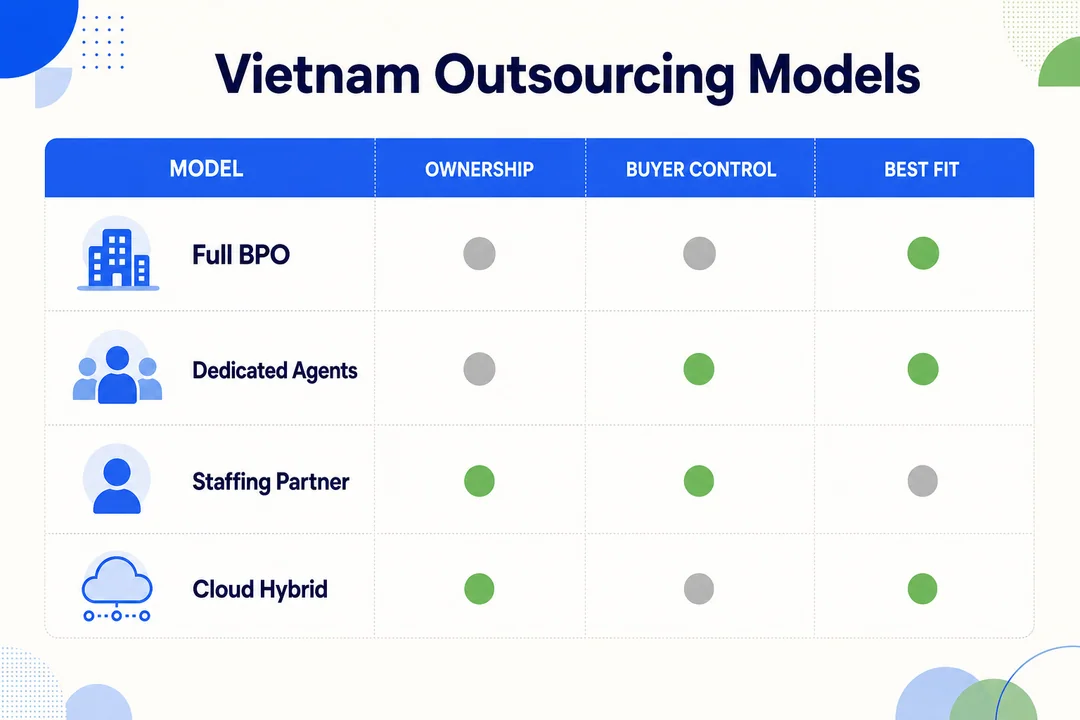
| Model | Who manages operations | Buyer control | Best fit | Main trade-off |
|---|---|---|---|---|
| Full-service BPO | Provider | Low to medium | Teams outsourcing delivery ownership | Less direct process control |
| Dedicated agent model | Shared between buyer and provider | Medium to high | Buyers with strong workflows and QA standards | Requires more internal management |
| Staffing partner | Buyer largely manages | High | Companies needing headcount support | Buyer carries delivery discipline |
| Platform-led or hybrid | Shared, with technology control retained | High | Buyers wanting visibility, portability, and faster scaling | More setup decisions upfront |
Full-Service BPO Call Center
A BPO provider in Vietnam typically manages recruitment, training, supervision, QA, reporting, and day-to-day service delivery. This model fits companies that want to outsource more operational ownership rather than manage every workflow internally. It is commonly used for inbound support, outbound sales, retention campaigns, collections, and blended customer operations. The trade-off is reduced direct control. If the provider’s management quality is weak, problems may surface only after volumes increase.
Dedicated Agent Model
With dedicated agents, the buyer usually keeps more control over scripts, workflows, KPIs, and quality standards, while the provider handles hiring and local employment infrastructure. This can work well when the business already has a mature support playbook and wants to reduce direct hiring burden. It is different from shared-seat or pooled-agent setups, where teams serve multiple clients and control is looser. In many cases, this model overlaps with offshore staffing, but with more operational structure around the team.
Cloud Platform-Led or Hybrid Model
In a hybrid setup, the business may work with an outsourcing partner while keeping more visibility through its own cloud-based contact center platform. This is useful when routing flexibility, auto-dialer support, analytics, omnichannel communication, portability, and AI-driven quality assurance matter. It also reduces lock-in risk because workflows and reporting do not sit entirely inside the vendor’s environment. For businesses that need rapid deployment, usage-based pricing, AI-assisted monitoring, and global routing flexibility, a platform layer such as Flyfone becomes part of the outsourcing decision, not just a backend tool.
How to Evaluate a Call Center Outsourcing Partner in Vietnam
- Confirm service scope and channels.
- Review dedicated versus shared structure.
- Validate language quality and hiring model.
- Check reporting, QA, and supervisor coverage.
- Review SLA, escalation, and data handling.
- Assess technology stack and integration readiness.
- Compare pricing logic and contract flexibility.
How to choose a BPO provider in Vietnam depends less on marketing claims and more on how clearly the vendor can prove delivery discipline. Buyers often make three avoidable mistakes here: choosing on hourly rate alone, accepting reporting claims without samples, and assuming “multilingual support” means production-ready language quality.
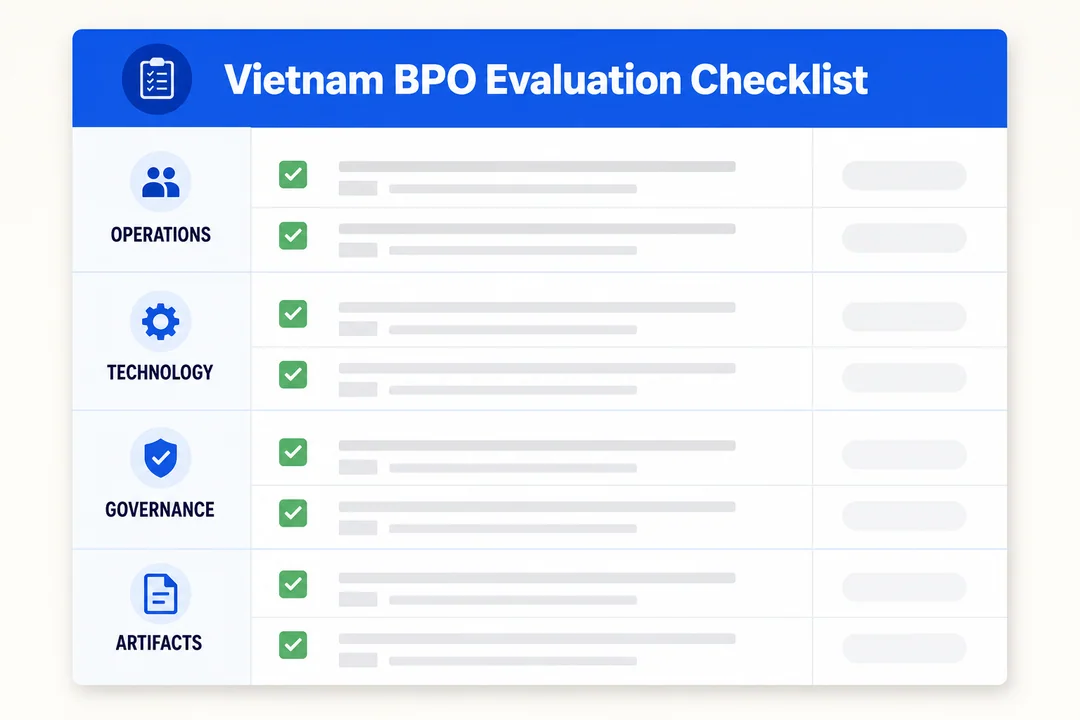
| Category | What to check | Why it matters | Proof to request |
|---|---|---|---|
| Operations | Training, QA, supervisor coverage, ramp-up | Determines day-to-day execution quality | Onboarding plan, QA scorecard, staffing plan |
| Language | Live quality, hiring sources, reviewer quality | Reduces brand and CX risk | Live samples, recruiter profile, QA process |
| Technology | Dialer, routing, dashboards, recording | Affects reliability and visibility | Stack overview, demo, sample dashboard |
| Governance | SLA, escalation, continuity, security | Protects service continuity | SLA sample, escalation matrix, policy summary |
| Commercials | Pricing logic, hidden fees, contract terms | Prevents surprise costs and lock-in | Pricing sheet, term sheet, add-on list |
Operational Criteria
- Review staffing stability, not just headcount size.
- Ask how the provider handles training and nesting periods.
- Check QA calibration cadence between client and vendor teams.
- Validate supervisor-to-agent ratio across each shift.
- Confirm weekend, holiday, and after-hours coverage.
- Review business continuity planning for outages or absenteeism.
- Test ramp-up capability during campaigns or seasonal spikes.
- Assess workforce scalability against realistic volume scenarios.
Proof requests that matter:
- Sample onboarding plan
- Sample QA scorecard
- Sample weekly or monthly report
- Staffing and ramp-up plan
A common buyer mistake is accepting generic “we can scale quickly” language without seeing how the provider actually recruits, trains, and supervises new cohorts.
Technology Criteria
- Dialer performance for outbound productivity and call pacing
- Omnichannel communication across voice, chat, email, or messaging
- CRM and API integration readiness
- Real-time dashboards for visibility into queue and agent performance
- Failover routing for continuity during carrier or system disruption
- AI-assisted QA for broader review coverage
- Call recording controls for compliance and coaching
- Access control for safer data handling
The goal is not technical sophistication for its own sake. It is commercial reliability. A modern cloud-based contact center platform using VoIP can improve launch speed, flexibility, visibility, and vendor portability. But buyers should still ask how integrations are implemented and who owns configuration logic after go-live.
Commercial and Governance Criteria
- Service Level Agreement (SLA)
- Setup timeline and launch dependencies
- Pricing model and billing logic
- Hidden fees for setup, reporting, storage, or support
- Contract length and exit terms
- Escalation matrix and named points of contact
- Ownership of call recordings and operational data
Vague data ownership creates long-term risk. If recordings, QA history, performance logs, and workflow logic sit entirely inside the provider environment, switching vendors later becomes slower, costlier, and more disruptive.
Red Flags That Should Slow Down a Deal
- Vague reports with no operational depth
- No sample QA scorecards provided
- Unclear ownership of service quality
- Long contracts pushed before pilot validation
- No proof of similar ramp-up history
- Staffing and managed delivery mixed together
- Weak answers on privacy and security handling
A practical screening action is to run a small paid pilot or limited-scope launch before committing larger volume. This surfaces reporting gaps, coaching quality, and escalation responsiveness early, when switching costs are still low.
Top Vietnam Call Center Outsourcing Providers to Shortlist
The Vietnam BPO market includes a mix of full-service providers, technology-led firms, and platform-enabled hybrid operators. The list below highlights providers commonly seen on buyer shortlists from market trackers such as Outsource Accelerator, GoodFirms, and Clutch. Use it as a starting reference, then validate fit against your operating model.
Outsourced Global
Best for: Mid-market and enterprise buyers needing dedicated agent teams with operational governance.
Strength: Broad service coverage and large agent pool across multiple domains.
Watch-out: Stronger fit when full-service ownership is preferred over flexible hybrid models.
Innovature BPO
Best for: Buyers prioritizing structured QA, finance/insurance domain expertise, and bilingual support.
Strength: Mature operations process and a clear focus on regulated industries.
Watch-out: Less attractive for very small pilots or low-volume programs.
Kyanon Digital
Best for: Tech-enabled customer support combined with digital product operations.
Strength: Strong digital and product engineering background that adds technology depth to outsourcing work.
Watch-out: Best fit when CX and digital workflows overlap; less ideal for pure-call BPO.
LTS Global Digital Services
Best for: Multilingual customer support and digital service operations.
Strength: Regional language coverage and digital-first delivery model.
Watch-out: Customer concentration varies by language pair, validate capacity for your locale.
Altius Link Vietnam
Best for: Enterprise buyers wanting an established Japan-affiliated BPO operating in Vietnam.
Strength: Backed by an experienced parent group with enterprise governance discipline.
Watch-out: Pricing and contract structure usually skew enterprise.
Connext Global Solutions
Best for: US-headquartered buyers seeking blended dedicated-team delivery with Vietnam operations.
Strength: US-anchored account management plus Vietnam delivery, useful for transparent escalation.
Watch-out: Service breadth varies by line of business; confirm specific domain experience.
Flyfone (Cloud Platform Partner)
Best for: Hybrid buyers who want a Vietnam outsourcing partner but keep their own cloud telephony layer for routing, QA, and reporting visibility.
Strength: Pay-as-you-go cloud call center with auto-dialer (predictive, progressive, power modes), AI-powered quality assurance on every call, global voice routing on AWS Singapore, under-1-hour deployment, no seat fees, drops onto whichever BPO you choose.
Watch-out: Flyfone is the technology layer, not a staffing partner, pair it with a BPO above.
Most shortlists end at 2–3 providers. Buyers usually compare one large full-service BPO (Outsourced Global, Altius Link) with one mid-size specialist (Innovature, Kyanon) and validate the cloud telephony layer separately.
Why hybrid Vietnam outsourcing setups use Flyfone
Vietnam BPOs deliver strong cost efficiency and growing technical capability, but reporting transparency, QA depth, and routing visibility still vary widely by provider. Hybrid buyers keep the staffing layer with a BPO but run voice operations on their own cloud call center so they own routing logic, real-time dashboards, AI QA on every call, and a clean migration path if they ever switch providers. Flyfone fits this model with AWS Singapore infrastructure that supports APAC voice stability and pay-as-you-go pricing that scales with campaign demand. Book a discovery call to map your BPO partnership against the right cloud telephony setup before scaling volume.
Vietnam vs Other Outsourcing Options: Where It Fits Best
Country choice should follow service model, language needs, support complexity, and internal control expectations. Vietnam fits well in many scenarios, especially when buyers want strong operational cost-efficiency, flexible team structures, and improving technology maturity. But provider execution matters as much as country selection.
The Philippines may remain stronger for some deep-English, high-volume CX environments. India often fits large-scale, process-driven operations with broad outsourcing maturity. In-house support remains strongest when maximum control and brand oversight matter more than launch speed or cost.
| Option | Best fit | Strengths | Limits | Buyer note |
|---|---|---|---|---|
| Vietnam | APAC support, flexible scaling, mixed-language operations | Strong cost-to-quality, adaptable teams, growing tech maturity | Quality varies by provider; not every vendor is enterprise-mature | Strong choice when flexibility and execution discipline align |
| Philippines | Deep-English voice support, large CX programs | Strong voice culture, mature customer service operations | Cost can be higher; model may be less flexible | Often strong for high-volume English-heavy support |
| India | Large-scale structured operations, process-heavy environments | Scale, mature outsourcing ecosystem, broad specialization | Can feel less tailored for some mid-market buyers | Good for complex, process-driven outsourcing |
| In-house | High-control brand environments | Direct oversight, tighter internal governance, cultural alignment | Lower launch speed, higher fixed cost, harder scaling | Best when control outweighs cost-efficiency |
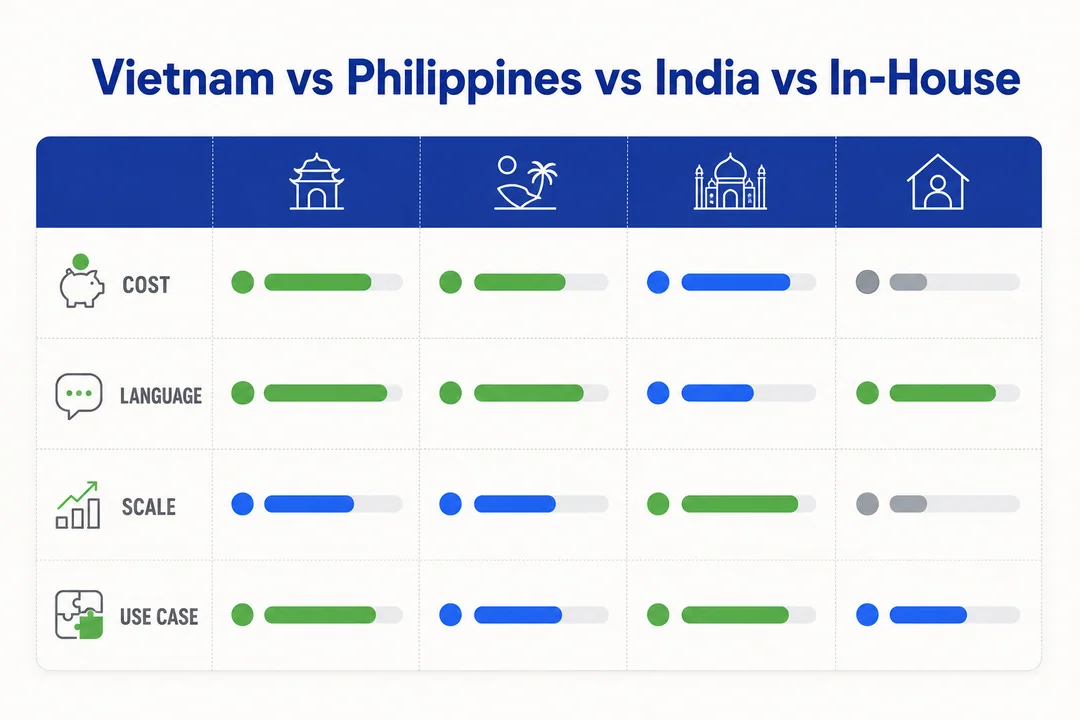
In every market, service quality depends on provider discipline, not country branding. The same applies to offshore staffing and managed delivery. A well-run mid-sized Vietnam operator can outperform a larger vendor elsewhere if reporting transparency, supervision, and workflow ownership are stronger.
What Modern Buyers Should Expect From a Vietnam Call Center Partner in 2025–2026
Modern outsourcing quality is no longer defined by headcount alone. It increasingly depends on infrastructure maturity, workflow visibility, and how quickly the provider can support change without losing control. That is why cloud, reporting, and QA capability now belong in the core vendor evaluation, not in an optional IT appendix.
Must-Have Infrastructure Checklist
- Cloud-based contact center platform for faster deployment and easier scaling
- Omnichannel communication so teams can manage more than voice alone
- Real-time dashboards for faster issue detection and campaign visibility
- Secure call recording for compliance, coaching, and dispute review
- API and CRM integration to reduce manual work and reporting gaps
- Failover routing to support continuity during traffic or carrier disruption
- Flexible scaling for campaigns, new markets, or seasonal volume changes
- QA visibility across calls, teams, and supervisor workflows
These are not luxury features. They shape launch speed, operating resilience, and management visibility.
Why AI and Cloud Now Affect Outsourcing Quality, Not Just Cost
A modern provider should show how AI and cloud tools improve oversight, not just how they reduce labor. AI-powered call center solutions for BPO can reduce manual review workload, surface patterns across more interactions, and help managers coach agents faster. AI-driven Quality Assurance is useful when scorecards are clear, reporting is actionable, and coaching workflows actually follow.
Cloud setup improves launch speed, geographic flexibility, and global routing options. It also makes remote and hybrid delivery models easier to manage. For businesses that need under-1-hour deployment, global routing, AI-native QA, and usage-based pricing, the platform layer meaningfully affects outsourcing agility. This is where solutions like Flyfone become relevant.
Still, AI alone is not a differentiator. If scorecards are weak, coaching is inconsistent, or reports are hard to use, AI simply creates more noise. Buyers should treat infrastructure as part of provider quality, not as a separate technical footnote.
Shortlisting Vietnam Providers: A Practical Decision Framework
Buyers often need user-curated references and proof artifacts, not another “top 10” vendor list. A better approach is to move from broad market research into a controlled vendor shortlist built around fit, evidence, and pilot validation.
-
Define scope, channels, and target KPIs
Clarify volume, service hours, languages, channels, response targets, and what success looks like. -
Choose the provider model that fits your control needs
Decide between full-service BPO, dedicated agents, staffing support, or a hybrid platform-led approach. -
Ask for proof points and sample reporting
Request sample reports, QA scorecards, onboarding timeline, and evidence of similar ramp-up experience. -
Validate the technology stack and SLA structure
Review the technology stack overview, Service Level Agreement (SLA) sample, escalation matrix, security handling, and data ownership terms. -
Run a pilot before expanding volume
Start with a limited-scope launch to test delivery quality, reporting transparency, supervisor responsiveness, and workflow fit.
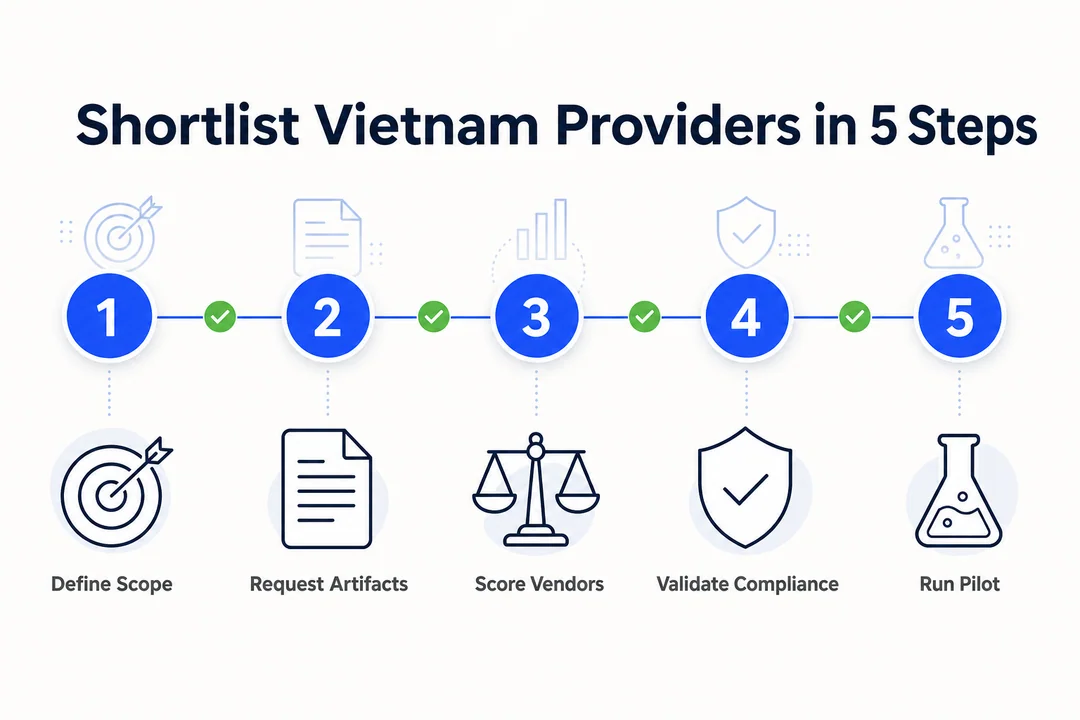
This process is simpler than it sounds. It helps procurement, operations, and support leaders align on facts instead of relying on sales narratives. It also prevents a common mistake: signing too early based on price and then discovering the provider’s reporting or quality governance is too weak to scale.
Conclusion
Call center outsourcing Vietnam can be a strong option when the provider model matches your operating needs and the vendor can prove execution quality. Country choice alone is never enough. The best decisions come from comparing service scope, reporting transparency, SLA clarity, technology readiness, data ownership, and pilot performance.
If your team is building a vendor shortlist, focus on fit before price. A lower quote is not a better outcome if quality control, escalation, or visibility are weak. For businesses that also need more routing flexibility, faster launch, or clearer oversight, reviewing the underlying cloud-based contact center platform is now part of smart vendor selection.
If you want a second opinion on shortlist logic, pilot structure, or infrastructure fit, review your options with the Flyfone team and validate the model before scaling volume.
Frequently Asked Questions
Why consider call center outsourcing in Vietnam?
Vietnam balances competitive operating costs (typically 30-50% lower than legacy contact centers) with a young, well-educated workforce that adapts quickly to modern AI and cloud tooling. The country is also seeing strong government-backed digital infrastructure investment.
What are the common call center outsourcing models in Vietnam?
The main models are: full-service BPO (provider runs the operation end-to-end), dedicated agent teams (more buyer control with embedded agents), and cloud/hybrid models (technology-led setups that combine outsourced staffing with the buyer’s own contact center platform for flexibility and visibility).
How do I evaluate a reputable Vietnam outsourcing partner?
Score them on three pillars: operational maturity (QA process, supervisor-to-agent ratio), technical capability (CRM integration, security posture, real-time dashboards), and governance commitments (SLAs, data ownership, escalation flows).
How does Vietnam outsourcing compare with the Philippines or India?
Vietnam stands out for cost flexibility and quick technology adoption. The Philippines is strongest for large native-English-speaking workforces. India suits very-large-scale structured operations. Choice depends on language needs and operational complexity.
What red flags should I avoid when selecting a partner?
Be cautious if a provider supplies vague reporting, lacks a clear QA scorecard template, has no documented training process, or forces long-term contracts without allowing a pilot to verify real performance.
What role does a cloud platform play in outsourcing?
A cloud platform (like Flyfone) serves as the technology backbone, enabling sub-1-hour deployment, optimized global call routing, AI-driven quality monitoring, and pay-as-you-go pricing instead of fixed monthly seat fees.
What’s the next step to start outsourcing in Vietnam?
Start by clearly defining scope, support channels, and target KPIs. Then ask candidates for real artifacts like sample reports and onboarding playbooks. Finally, run a small pilot project to validate execution before scaling volume.
More in Operations & CX Optimization
View all →
Customer Experience Transformation: Framework and Steps
A telecom customer calls support about a billing error. They explain the problem to the IVR system. Then to the first agent. Then get transferred and explain again. Then escalated—and explain a third time. Forty minutes later, they're exhausted and the problem still isn't solved. This is what broken customer experience looks like. And it's costing you customers. Customer experience…


Web Caller Meaning: JavaScript caller, Calling Tools or Portals
“Web caller” is one of those phrases where the search results and the searcher are frequently talking about different things. Three unrelated audiences use it: developers hitting an error on the legacy JavaScript caller property, buyers evaluating browser-based calling software, and people trying to reach a specific portal or training page whose exact name they cannot recall. That fragmentation is…

Customer Experience Strategy: How to Build One That Works
Customer experience is getting worse, not better. Forrester's 2025 Global CX Index found that 21% of brands declined in CX quality while only 6% improved — and in the US, 25% declined against 7% that improved, the second consecutive year of that pattern. Most of those brands were not neglecting customer experience. They were working on it without a strategy…


 English
  Russian
  Chinese