

Outbound teams are under constant pressure to increase coverage without burning rep time on repetitive dialing, dead leads, and low-quality first conversations. That is why interest in the AI cold caller category is rising fast. The problem is that the market often blurs together robocalls, dialers, voice bots, and generic AI claims, which makes evaluation harder than it should be.
This guide is designed to cut through that noise. We will explain what an AI cold caller actually is, how it fits into automated sales outreach, where it adds value, where it can create risk, and what buyers should review before choosing a platform. The goal is not to sell the idea of AI replacing sales teams. It is to help RevOps leaders, Sales Ops managers, founders, and technical evaluators make a sound decision.
What Is an AI Cold Caller?
An AI cold caller is an AI-powered outbound voice system that places calls, follows conversation logic, asks basic qualifying questions, and routes the next step based on the prospect’s response. It is designed for structured outreach, not static robocalls, and not full-cycle human selling.
Many buyers confuse an AI cold caller with anything that automates calling. In practice, the category is narrower than that. A true AI cold caller sits inside AI outbound calling workflows and uses AI voice agents to interact in real time. In other words, it is a form of conversational AI sales support for early-stage, repetitive outreach within automated sales outreach programs.
Definition: What an AI Cold Caller Actually Does
An AI cold caller is an outbound calling system that can start conversations, follow branching scripts, ask qualifying questions, capture outcomes, and route interested prospects to the right next step. It is not just a prerecorded message, and it should be treated as a workflow layer rather than a replacement for all human-led selling.
AI Cold Caller vs Other Calling Tools
A common buying mistake is assuming all call automation tools belong to the same category. They do not.
| Tool type | Main purpose | Can it hold a dynamic conversation? | Best use case |
|---|---|---|---|
| AI cold caller | Automate early outbound conversations and qualification | Yes, within defined logic | High-volume front-end outreach |
| Predictive/power dialer | Increase call volume for human reps | No | Reps calling large lead lists faster |
| AI coaching / conversation intelligence tool | Analyze live or recorded rep calls | Limited or no | Coaching, transcription, call review |
| Human SDR workflow | Build rapport, qualify, handle nuance | Yes | Strategic selling and consultative discovery |
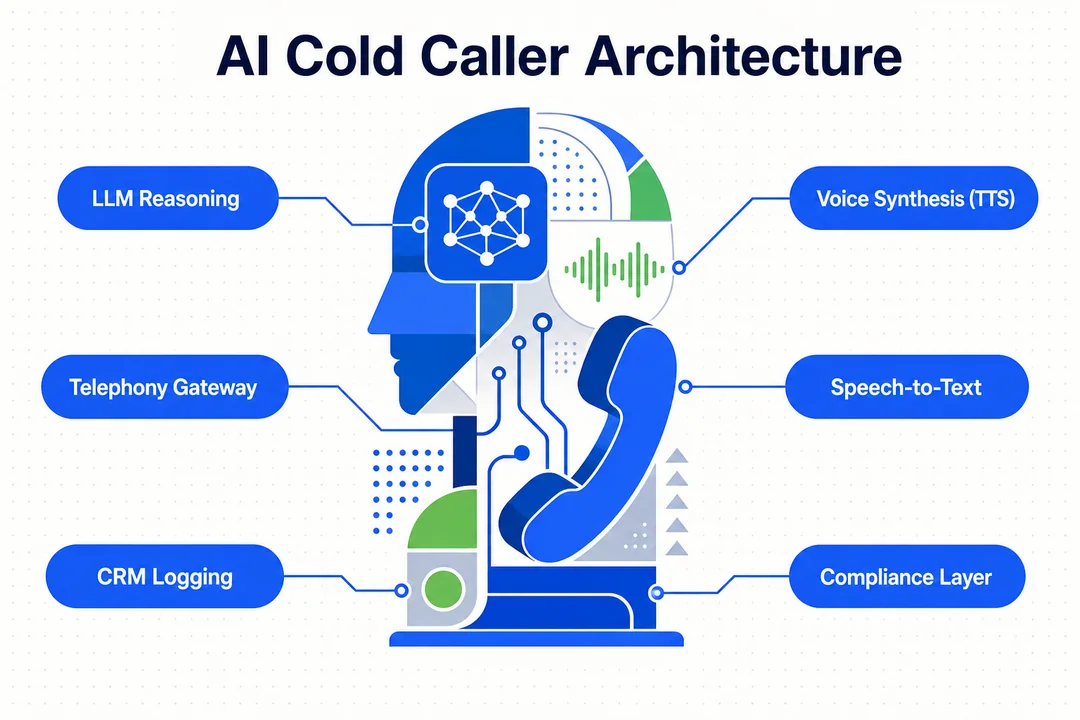
The main takeaway: an AI cold caller is useful in specific outbound workflows, but it is not the right answer for every sales motion.
How AI Cold Callers Work in a Real Outbound Workflow
The easiest way to understand AI outbound calling is to view it as an operating workflow, not an AI science project.
- Sync or upload lead data
- Set campaign rules and scripts
- Launch outbound calls
- Qualify prospects through voice interaction
- Route outcomes or hand off to reps
- Review transcripts, analytics, and QA data
Most buyers do not need deep theory about models or machine learning. They need to know how calls move from list to conversation to follow-up, and where execution quality can break down.
Before the Call
Before launch, the foundation is operational:
- Segmentation: Split leads by source, geography, industry, account tier, or campaign type.
- Campaign setup: Define goals such as first-touch qualification, reactivation, or appointment setting.
- Script logic: Build branching paths for interest, objections, voicemail, callback requests, and disqualification.
- Time-zone rules: Prevent calls from firing at the wrong local hour.
- CRM integration: Sync contact records, ownership, statuses, and outcomes automatically.
- Compliance controls: Apply disclosure language, suppression lists, recording policies, and market-specific restrictions.
This is where many teams underestimate the work. Poor list hygiene or weak CRM mapping can damage lead qualification quality before the first call even starts.
During the Call
Once live, AI outbound calling systems initiate calls over VoIP and handle structured interaction logic:
- The AI starts the call and introduces the purpose.
- It follows branching prompts based on the prospect’s answer.
- It asks basic lead qualification questions.
- It may use NLP (Natural Language Processing) and intent cues to identify interest or objection patterns.
- It can trigger transfer, callback scheduling, voicemail handling, or no-action outcomes.
- In some setups, predictive dialing is used around the workflow, but that is different from the voice interaction layer itself.
The strength here is consistency. The risk is that poor scripting or weak handoff design can make the interaction feel rigid.
After the Call
The post-call stage is where value becomes measurable:
- Transcript generation: Convert calls into searchable records.
- Speech-to-text analytics: Turn conversations into reviewable data.
- Call scoring: Grade outcomes against campaign goals or QA logic.
- Tagging/dispositions: Mark interested, not interested, callback, bad number, or escalate.
- Follow-up workflows: Push next actions into SDR queues, calendars, or nurture sequences.
- Dashboards and reporting: Track campaign output, outcomes, and quality visibility.
- QA review: Identify script gaps, transfer failures, and conversation patterns.
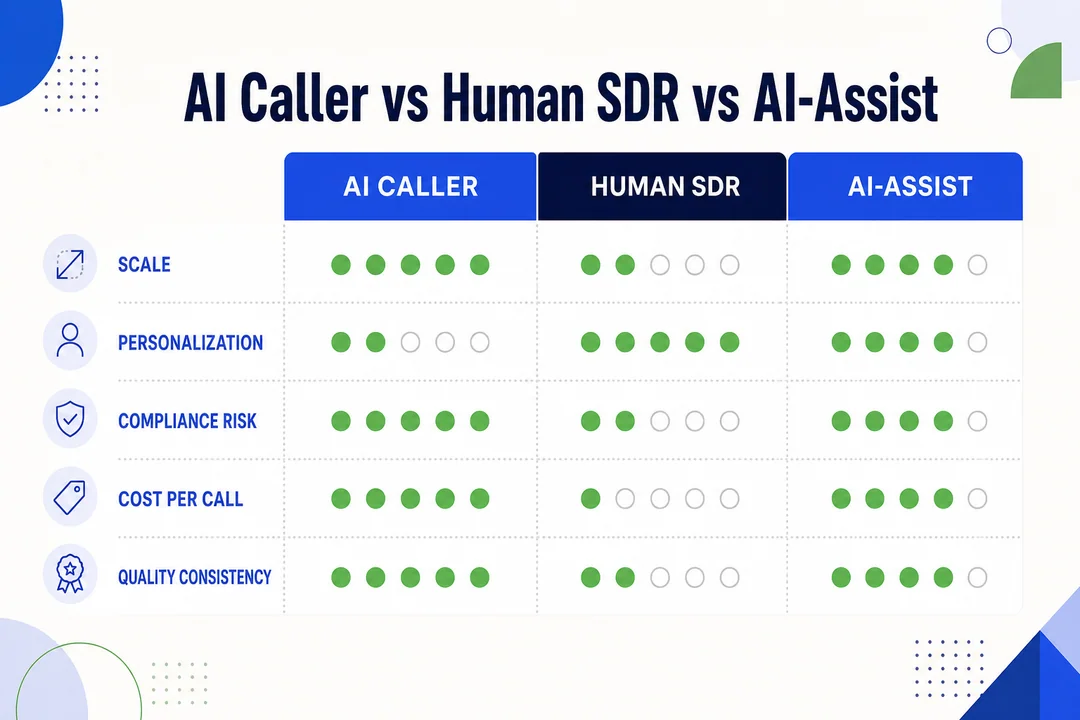
In practice, AI outbound calling performance depends less on AI claims alone and more on setup quality, call routing, integration accuracy, and usable speech-to-text analytics.
Where AI Cold Callers Add Value, and Where They Do Not
The strongest use case for AI cold calling is repetitive, scriptable front-end outreach. The weakest use case is complex selling that depends on deep context, trust, and flexible judgment.
Best-Fit Use Cases
AI cold callers tend to perform best in the following workflows:
- High-volume lead qualification: Screen large lead pools before human reps step in.
- Appointment setting: Confirm interest, gather basics, and route qualified prospects to calendars or reps.
- Re-engagement campaigns: Reactivate older leads, dormant accounts, or past inquiries.
- Multi-time-zone outreach: Extend call coverage without forcing teams into difficult shifts.
- BPO and repetitive outbound motions: Support structured campaigns where consistency matters more than nuanced discovery.
These are the environments where outbound automation, lead prioritization, and sales productivity tend to improve most.
Weak-Fit Use Cases
AI cold callers are usually a poor fit for:
- Complex enterprise deals: Where discovery is layered and stakeholder context matters.
- Highly sensitive conversations: Such as complaints, collections, medical topics, or emotionally charged interactions.
- Relationship-led prospecting: Where tone, trust, and timing matter more than scale.
- Escalation-heavy workflows: Where the call can shift quickly and unpredictably.
Using AI in the wrong motion can hurt both qualification quality and brand perception.
Best Operating Model
For most teams, the best model is hybrid.
If the workflow is repetitive and scriptable, AI is a strong candidate for first touch, basic qualification, and routing. If the workflow is strategic and nuance-heavy, humans should remain central. That is often the most practical route to better sales productivity without compromising trust.
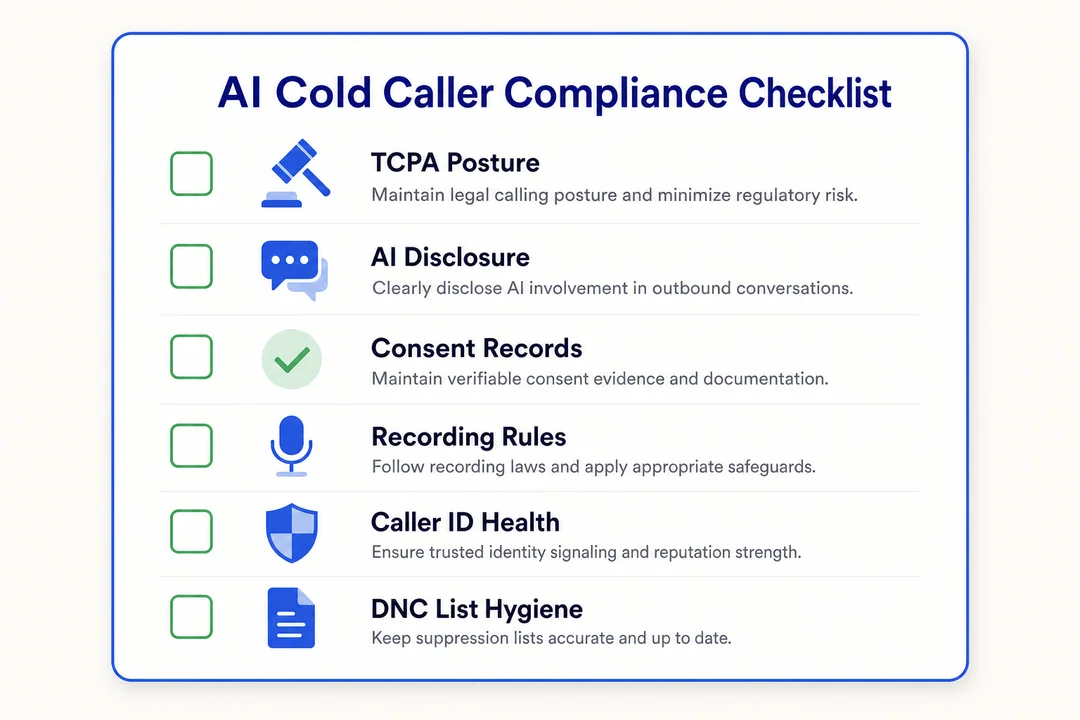
The key point is simple: AI should remove repetitive friction, not replace judgment where human selling still matters most.
Benefits and Risks Buyers Should Evaluate Before Adopting an AI Cold Caller
The business case for an AI cold caller can be strong, but only if leaders evaluate upside and risk together.
| Evaluation factor | Potential upside | Main risk |
|---|---|---|
| Coverage | Reach more leads across more hours | Low-quality targeting can increase waste |
| Qualification speed | Faster speed-to-qualification | Weak scripts can misclassify intent |
| Rep efficiency | Save rep time for warmer opportunities | Poor handoff design creates friction |
| QA visibility | Better review through transcripts and scoring | Bad data can lead to false confidence |
| Brand experience | More consistent front-end messaging | Robotic interactions can damage trust |
| Compliance exposure | More standardized controls if designed well | Violations can create legal and reputational risk |
Business Upside in Measurable Terms
A well-designed deployment can improve:
- Broader call coverage: More outreach capacity without scaling headcount at the same rate.
- Faster speed-to-qualification: Reps spend more time on leads that clear basic filters.
- Higher sales efficiency: Repetitive front-end work moves off the rep’s plate.
- More consistent talk tracks: Messaging becomes easier to standardize.
- Improved QA visibility: Call analytics and transcripts create reviewable evidence.
- Faster follow-up actions: Outcomes move directly into workflows and reporting.
These gains can support stronger sales efficiency, but they are not automatic.
Hidden Risks Leadership Should Review
Before launch, buyers should review:
- Compliance exposure across markets and campaign types.
- Poor caller experience if voice logic feels unnatural.
- Brand damage from aggressive or badly timed outreach.
- CRM or routing integration gaps that break the workflow.
- Wrong use-case fit where AI is used in a motion that needs human nuance.
- Operational risk from weak monitoring and low-quality call handling.
The real issue is rarely AI alone. It is the combination of workflow mismatch, weak conversation quality, and poor operating control.
Compliance, Governance, and Brand Safety: The Non-Negotiables
No AI cold calling project should launch without a serious review of compliance, governance, and brand safety. These obligations are not uniform across markets, and buyers should never assume that one setup works everywhere.
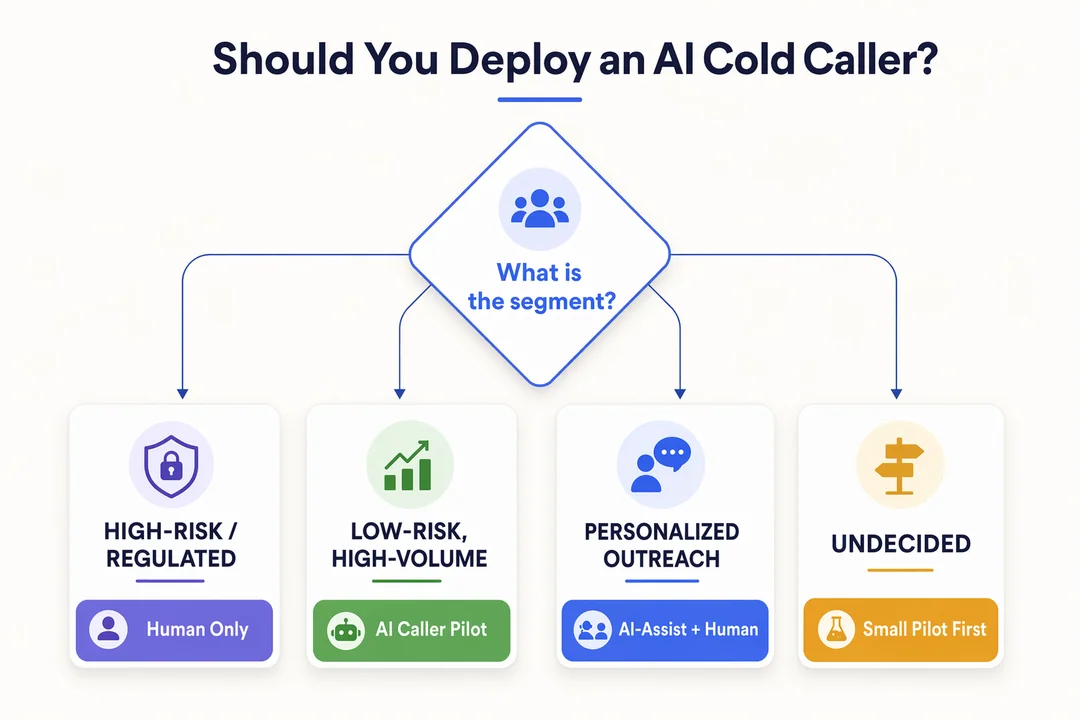
The FCC has taken a clear stance on AI-generated voice-related concerns in the broader calling landscape, and regulations such as the TCPA in the US and GDPR in Europe create meaningful obligations around consent, data use, and outreach controls. Compliance obligations vary by jurisdiction, industry, and campaign design, so buyers should review requirements with legal counsel before launch.
Questions Buyers Should Ask Vendors
Use this checklist during evaluation:
- Disclosure controls: Can the workflow support required disclosure language?
- Opt-out logic: Is there a reliable and traceable opt-out process?
- Call recording controls: Can recording be enabled, restricted, stored, or deleted by policy?
- Data handling: How are logs, transcripts, and personal data stored and secured?
- Geography rules: Can campaigns be restricted by location, time zone, or legal rule set?
- Audit trail: Is there a record of call events, decisions, outcomes, and policy actions?
Why Infrastructure Matters to Governance
Governance is not only about policy documents. It also depends on telephony performance and system control.
- Routing quality affects the real call experience.
- Monitoring and fallback logic support consistent execution.
- Traceability matters when teams need to investigate incidents or complaints.
- Auditability is part of governance, not just a reporting feature.
Strong compliance posture depends on both legal review and operational discipline.
How to Choose the Right AI Cold Calling Solution
When comparing AI cold calling software, buyers should start with workflow fit, not feature volume. A platform can sound impressive in a demo and still fail in production if the routing, reporting, or integration layer is weak.
Must-Have Buying Criteria
-
Use-case fit
Confirm the platform fits your actual motion: qualification, reactivation, appointment setting, or another defined use case. -
CRM integration and API connectivity
Strong CRM integration is essential for syncing data, ownership, outcomes, and follow-up actions. -
Call routing and transfer logic
Review how the system handles rep handoff, fallback paths, voicemail, callback requests, and failed transfers. -
Reporting and QA visibility
Good reporting should include outcomes, transcripts, performance trends, and reviewable QA data. -
Compliance controls
Look for practical controls around disclosure, suppression, recording policies, and audit trails. -
Deployment speed
Time-to-value matters. Many teams do not need a multi-month rollout for a defined outbound use case. -
Pricing transparency
Understand usage charges, feature tiers, storage costs, support terms, and whether the model supports scaling. In some cases, pay-as-you-go pricing can align better with fluctuating campaigns.
Nice-to-Have Capabilities
Beyond the basics, useful extras can include:
- Advanced sentiment tagging
- Deeper workflow branching
- Multilingual support
- Coaching overlays
- More customizable dashboards
Why Telephony Infrastructure Should Be Part of the Evaluation
This is one of the most overlooked areas in AI cold calling software reviews.
Voice quality alone is not enough. Buyers should evaluate:
- Connection quality
- Global call routing
- Failover logic
- Monitoring
- Scalability
- VoIP reliability under load
A platform with strong AI but weak telephony execution can still produce poor results. The call experience depends on both intelligence and infrastructure.
Vendor Evaluation Checklist
| Evaluation area | Must-have | Nice-to-have | Why it matters |
|---|---|---|---|
| Use-case fit | Defined workflow match | Vertical templates | Prevents tool-workflow mismatch |
| CRM/API | Bi-directional sync | Custom webhooks | Keeps outreach and follow-up connected |
| Call routing | Transfer and fallback logic | Advanced branching | Protects handoff quality |
| Reporting | Outcome dashboards and transcripts | Custom KPI boards | Improves decision-making and QA |
| Compliance | Disclosure, opt-out, audit trail | Regional policy presets | Reduces governance risk |
| Deployment | Fast setup | Guided onboarding | Speeds time-to-value |
| Pricing | Transparent usage model | Flexible packaging | Supports scale without hidden costs |
For teams that need fast deployment, flexible outbound operations, AI QA visibility, open APIs, stable routing, and usage-based economics, Flyfone is relevant to include in the shortlist. The reason is not just AI functionality. It is the combination of cloud calling infrastructure, operational flexibility, and scalable outbound support.
A Practical Decision Framework: Build, Buy, or Layer AI on Top of Your Existing Calling Stack?
There is no universal answer to the in-house vs platform question. The right path depends on how mature your outbound calling stack already is, how fast you need to launch, and how much operational complexity your team can absorb.
Decision Table
| Decision factor | Build internally | Buy a platform | Layer AI onto existing stack |
|---|---|---|---|
| Time to launch | Slowest | Fastest | Moderate |
| Technical complexity | Highest | Lowest | Medium |
| Upfront cost | Often high | More predictable | Varies |
| Workflow control | Highest | Moderate to high | Depends on current tools |
| Compliance readiness | Your team owns it | Shared with vendor capabilities | Depends on both layers |
| Infrastructure reliability | Your responsibility | Vendor-backed | Mixed responsibility |
| Best-fit company type | Mature technical teams | Teams prioritizing speed | Teams with a strong base stack |
In practice, buying is often the most efficient route for teams that want speed and lower technical overhead. Building offers more control, but also more operational burden. Layering can work well when your cloud call center, sales automation, and communication infrastructure foundation is already strong.
What a Strong AI Outbound Setup Looks Like in Practice
A strong setup is usually not about one standout feature. It is about coordinated operations across data, telephony, logic, and review.
Scenario Snapshot
Imagine a team running outbound campaigns across several markets. They start with segmented lead lists, apply compliant campaign rules, and launch an AI qualification flow for first-touch outreach. When a prospect shows real intent, the system triggers call routing to a live rep. After the call, transcripts, recordings, and outcomes flow into dashboards for QA and follow-up.
A practical setup often includes:
- Segmented lead lists by campaign priority and region
- Compliant campaign rules for time zones, suppression, and disclosures
- AI qualification flow for early filtering and intent capture
- Live rep handoff when a trigger threshold is met
- Transcripts and recordings for review and audit support
- AI QA and real-time monitoring for visibility into performance
- Global VoIP infrastructure underneath to support stable execution
Not every organization can launch at this maturity level on day one. The important point is to build toward a controlled operating model, not just add features.
Conclusion
An AI cold caller is best understood as an operational layer for repetitive outreach and early qualification, not as a universal replacement for human reps. The strongest evaluations look beyond the voice experience and assess workflow fit, compliance readiness, call routing reliability, integration quality, reporting depth, and pricing structure together.
For most organizations, the next step is not blind adoption. It is a workflow review: where AI fits, where humans should stay central, and what a scalable cloud communication setup needs to support safe rollout. If your team is evaluating AI outbound calling and wants a more structured view of fit, infrastructure, and deployment tradeoffs, book a tailored walkthrough with the Flyfone team to explore which model matches your sales motion responsibly.
Frequently Asked Questions
What is an AI cold caller?
An AI cold caller is a voice-bot system that uses artificial intelligence to place outbound calls automatically, follow a conversation script, and handle basic lead qualification tasks inside a sales workflow.
How is an AI cold caller different from a robocall or auto-dialer?
Unlike robocalls, which usually play pre-recorded messages, or simple auto-dialers, which only connect lines, an AI cold caller uses natural language processing (NLP) to hold two-way conversations, understand context, and respond flexibly during the call.
Is using an AI cold caller legal?
AI cold calling is legal as long as the business follows data privacy and outreach rules such as the TCPA and GDPR. That includes disclosing the use of AI, supporting a reliable opt-out path, and keeping transparent call logs and records.
Can an AI cold caller replace a human sales rep?
No. An AI cold caller is best at repetitive stages such as first-touch outreach and basic qualification. Complex deals that require empathy and high-level negotiation still need experienced human reps.
How do you evaluate a reliable AI cold calling solution?
Prioritize platforms with smooth CRM integration, stable VoIP infrastructure, detailed reporting, clear compliance controls, and flexible call routing that can adapt to each campaign.
Why does VoIP infrastructure matter so much for AI cold calling?
Even strong AI cannot perform well on weak telephony. Reliable infrastructure reduces latency, supports a high connection rate, and keeps audio quality clean, which helps the AI process speech accurately in real time.
More in Operations & CX Optimization
View all →
Customer Experience Transformation: Framework and Steps
A telecom customer calls support about a billing error. They explain the problem to the IVR system. Then to the first agent. Then get transferred and explain again. Then escalated—and explain a third time. Forty minutes later, they're exhausted and the problem still isn't solved. This is what broken customer experience looks like. And it's costing you customers. Customer experience…


Web Caller Meaning: JavaScript caller, Calling Tools or Portals
“Web caller” is one of those phrases where the search results and the searcher are frequently talking about different things. Three unrelated audiences use it: developers hitting an error on the legacy JavaScript caller property, buyers evaluating browser-based calling software, and people trying to reach a specific portal or training page whose exact name they cannot recall. That fragmentation is…

Customer Experience Strategy: How to Build One That Works
Customer experience is getting worse, not better. Forrester's 2025 Global CX Index found that 21% of brands declined in CX quality while only 6% improved — and in the US, 25% declined against 7% that improved, the second consecutive year of that pattern. Most of those brands were not neglecting customer experience. They were working on it without a strategy…


 English
  Russian
  Chinese