

Rising call volume, higher service expectations, and ongoing labor pressure are pushing support leaders to rethink how voice operations scale. At the same time, legacy IVR often breaks down when customers speak naturally, interrupt, or need anything beyond a rigid menu path. That is why interest in an ai voice agent for call center operations is growing alongside broader call center automation initiatives. This guide compares AI voice agents, IVR, basic voicebots, and human agents through a buyer lens. It focuses on conversation quality, routing, integration, deployment speed, and operational control so your team can move from curiosity to a practical shortlist.
What Is an AI Voice Agent for a Call Center?
An ai voice agent for call center operations is a conversational system that can listen to spoken requests, understand intent, respond in natural language, complete simple tasks, and transfer calls when needed. Unlike traditional IVR, which depends on fixed menus and keypad choices, an AI voice agent is designed to handle more flexible spoken interactions and adapt better to how people actually talk.
In practice, an ai voice agent for call center teams works as a business-facing layer of conversational AI for contact centers. It listens to the caller, interprets the request, checks the right data or workflow, and either resolves the issue or routes it to the right person with context. That makes it useful for repetitive service tasks where speed and consistency matter. It is not a universal replacement for people. AI voice works best for routine, structured customer interactions, while emotionally sensitive or exception-heavy cases often still need human agents.
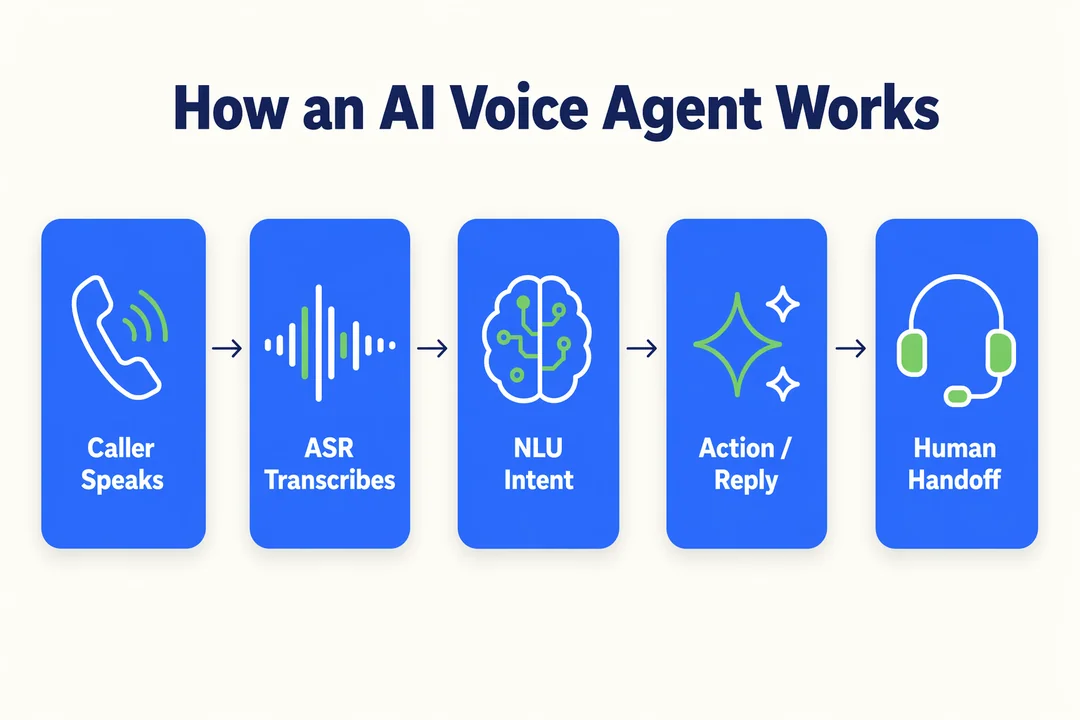
What powers the interaction
A typical automated voice assistant relies on Automatic Speech Recognition (ASR) to turn speech into text, Natural Language Understanding (NLU) to interpret intent, a response or task layer to answer questions or trigger actions, and routing logic to decide whether the issue should stay automated or move to an agent. For buyers, the business point is simple: if any of these layers are weak, the caller experience quickly feels slow, robotic, or unreliable.
What it should and should not handle first
| Best-fit workflows | Human-first workflows |
|---|---|
| FAQs and simple policy questions | Emotionally charged complaints |
| Identity verification | Exception-heavy disputes |
| Appointment or payment reminders | Advisory conversations |
| Order tracking and account lookup | Regulated edge cases without strong guardrails |
| Basic routing and triage | High-stakes retention calls |
| After-hours support | Complex multi-step case resolution |
Typical voice AI use cases include:
- Order status and delivery tracking
- Appointment reminders or booking updates
- Identity verification
- Balance checks
- Account lookup
- After-hours routing and triage
AI Voice Agent vs IVR vs Basic Voicebot vs Human Agent
Most buyers do not need another abstract AI definition. They need to know which interaction model fits which call type. The real question is not which tool sounds smartest in a demo, but which one improves service outcomes without breaking workflows in production. That is where ai voice agent vs traditional IVR systems becomes a useful evaluation lens.
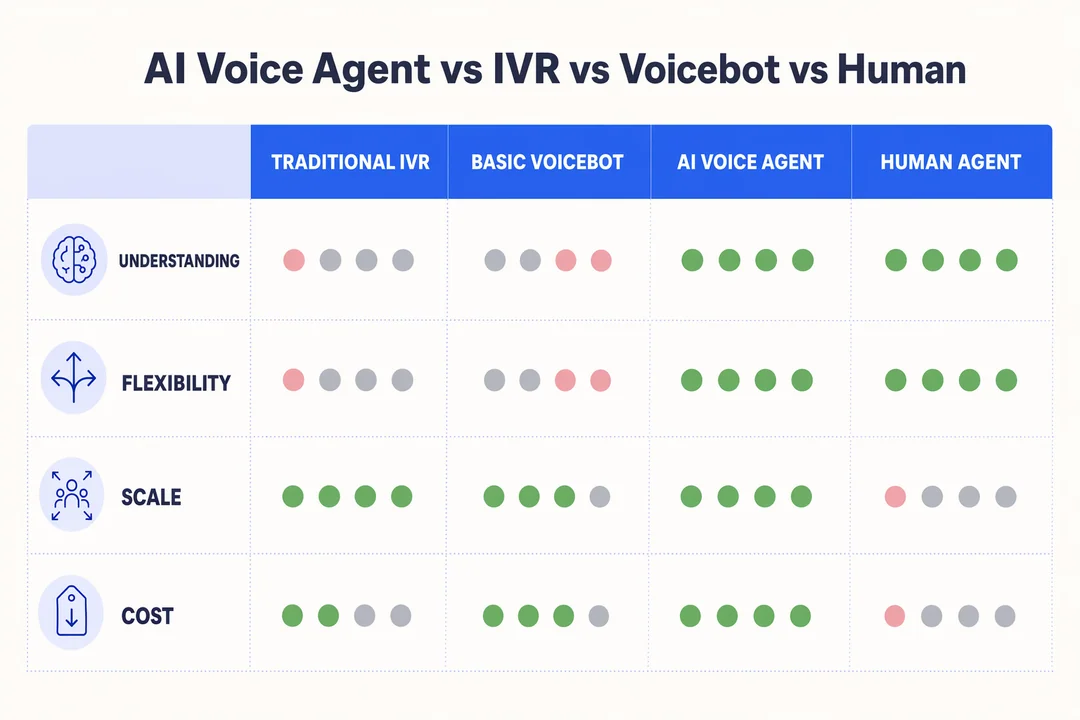
| Criteria | Traditional IVR | Basic Voicebot | AI Voice Agent | Human Agent |
|---|---|---|---|---|
| Conversation style | Menu-driven | Scripted spoken paths | Natural spoken interaction | Fully adaptive conversation |
| Flexibility | Low | Low to moderate | Moderate to high | Very high |
| Task handling | Simple routing | Narrow predefined tasks | Broader routine tasks with context | Complex and judgment-based tasks |
| Escalation quality | Often limited | Often loses context | Better handoff when designed well | Native handling |
| Customer experience | Acceptable for simple routing | Mixed | Stronger for routine voice self-service | Best for empathy and nuance |
| Cost to scale | Low | Low to moderate | More efficient than adding agents linearly | Highest cost to scale |
| Best-fit use case | Simple menu routing | Single-path automation | Repetitive, high-volume spoken requests | Sensitive, complex, exception-heavy calls |
| Recommended role | Front-door navigation | Narrow automation layer | Routine service and triage | Resolution of nuanced issues |
Traditional IVR still has a place when the goal is very basic call routing and the workflow is stable. A voicebot can go one step further, but many remain rules-based and struggle when callers interrupt, rephrase, or jump topics. An AI voice agent adds value when customers want to speak naturally and still complete a real task. A live agent remains the strongest option when empathy, judgment, negotiation, or exception handling matters most.
The most effective operating model is usually hybrid, not AI-only. Call containment rate matters because it shows how much repetitive volume stays out of the queue, but it is not the only KPI that matters. If escalation is clumsy and callers repeat themselves, the short-term containment gain may still damage customer experience.
Recommended operating model
- Use a hybrid human-AI collaboration workflow instead of trying to automate every call.
- Let AI handle repetitive volume such as verification, tracking, reminders, and basic routing.
- Let humans handle exceptions, escalations, complaints, and emotionally sensitive conversations.
- Success depends on clean routing and context handoff, not just containment.
Where AI Voice Agents Deliver the Most Value in Call Centers
The fastest ROI usually comes from repetitive, high-volume interactions where speed, consistency, and availability matter more than nuanced judgment. For many teams, the biggest gain is not replacing agents. It is reducing queue pressure, extending service coverage, and improving how human agents spend their time. That is where the benefits of AI voice agents for high-volume support become operationally meaningful.
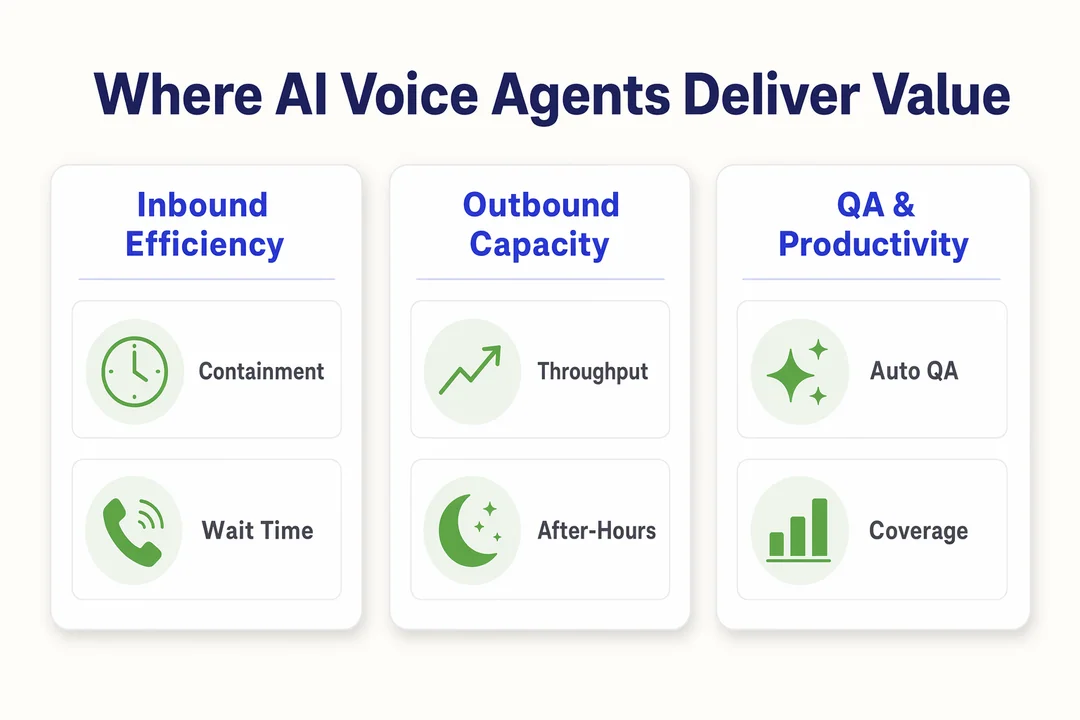
Best-fit inbound scenarios
For inbound service, AI voice works best when the request is predictable and the answer path is clear.
- FAQs and policy questions
- Account lookup
- Booking changes
- Balance checks
- Order tracking
- Call routing
- After-hours support
In practice, these workflows improve call containment rate, reduce wait time, and expand first-response coverage without adding headcount linearly. This is especially relevant for BPO teams, fintech operations, and cross-border support groups that face demand spikes or multiple time zones.
Outbound opportunities
Outbound is often underused in AI evaluations, even though it can create fast operational value.
- Payment reminders
- Lead qualification
- Follow-up campaigns
- Surveys
- Notifications
AI supports high-volume outreach without forcing the business to hire in direct proportion to campaign volume. For teams managing collections, appointment attendance, or lead follow-up, this improves scalability and makes customer interaction more consistent. In some cases, predictive engagement also helps prioritize who should receive a reminder first based on urgency or account status.
Internal productivity and QA value
The value of voice AI is broader than caller-facing automation.
- Agent assist during live calls
- Automated call summaries
- Speech-to-text analytics
- Wider QA coverage
- Compliance tagging
- Reporting and coaching support
This layer often improves average handle time and agent utilization more quietly but just as meaningfully as self-service. It is also one reason many support leaders treat AI voice as an operating model upgrade, not just a front-end bot. For multilingual support environments, multilingual support plus centralized reporting can also improve consistency across regions.
What to Look for When Choosing an AI Voice Agent Platform
Knowing how to deploy ai voice agent for call center operations starts with evaluating workflow fit and production readiness, not just demo performance. Strong demos do not always translate into strong production performance. Buyers should focus on what happens under load, during interruptions, at handoff, and inside the reporting layer after launch.
-
Conversation quality and real-time response capability
This is the first test because even a smart answer feels broken if the pause is awkward. Strong real-time response capability helps the conversation feel usable under real call conditions. Weak performance creates caller frustration and abandonment. -
Interruption handling and turn-taking
Callers do not speak in clean scripts. They interrupt, clarify, and change direction. If the platform cannot manage natural turn-taking, the interaction feels robotic and trust drops quickly. -
Intent recognition and task completion
Good intent recognition is not only about understanding words. It is about completing the right action, such as checking an account, updating a booking, or triggering the right route. Weak task completion creates false containment and follow-up workload. -
Human handoff quality with context
Clean handoff is one of the biggest production differentiators. If escalation loses the summary, caller intent, or account context, customers repeat themselves and the service experience degrades. Poor handoff design is one of the most common deployment failures. -
CRM integration, ticketing, SIP, API, and webhook support
Strong CRM integration and workflow connectivity are essential for service continuity. The AI should not live in isolation. It needs to read and update records, trigger workflows, and interact with your existing environment through SIP, API, or webhook support. -
Reporting, QA, compliance monitoring, and sentiment visibility
Buyers need dashboards that show outcomes, not just call counts. Look for QA coverage, compliance monitoring, call recording visibility, and where relevant, real-time sentiment analysis. Without this layer, operations lose control after go-live. -
Deployment model, cloud infrastructure, SLA/support, and pricing flexibility
The platform’s cloud infrastructure, support responsiveness, and pricing model directly affect time to value and operational risk. For multilingual or global operations, routing quality and language support matter. For regulated or brand-sensitive environments, governance and audit visibility matter. Usage-based pricing can be more efficient than seat-based pricing when team size or call volume fluctuates.
Technical checks that matter to business outcomes
A few technical checks matter because they directly shape service results. Latency affects whether the caller feels heard naturally. Interruption handling affects whether people can speak normally instead of adapting to the bot. Intent recognition and task completion determine whether automation actually resolves work or simply delays it. Reliability under load matters because voice quality that works in a test environment may fail during campaign spikes or peak support windows. When evaluating how to deploy ai voice agent for call center workflows, buyers should translate each technical claim into one question: does this reduce friction in production?
Operational buyer checks
Operationally, buyers should verify more than the AI layer itself. Check whether the platform supports CRM integration, ticketing workflows, SIP, API, and webhooks without forcing fragile workarounds. Review dashboards for routing visibility, agent performance, containment trends, and exception rates. Confirm whether QA tools, compliance monitoring, call recording, sentiment analysis, and reporting are built in or require extra vendors. Look at routing control, onboarding speed, support responsiveness, and actual SLA (Service Level Agreement – service performance commitment) terms. Also review the pricing model carefully. Seat-based pricing can become inefficient for fluctuating teams, while usage-based pricing may align better with seasonal or campaign-driven operations.
Need a structured evaluation template before speaking to vendors? Request a workflow assessment from Flyfone to review routing, handoff, integration, and reporting requirements.
Common Failure Points and When AI Voice Agents Are Not the Right Fit
The main voice AI limitations in call centers usually show up when teams automate unclear or unstable processes. In most cases, the failure is not just the model. It is weak workflow design, poor knowledge base accuracy, broken escalation logic, or missing ownership between operations and IT. That is where customer experience risk increases fastest.
Red flags that suggest a team is not ready yet:
- Service workflows are unclear or change constantly
- The knowledge base is inconsistent or outdated
- No clear escalation owner exists
- CRM or routing integration is weak
- The call mix is highly emotional or complaint-heavy
- Compliance-heavy interactions lack guardrails and review controls
Not every call type should be AI-led. Advisory conversations, sensitive disputes, or brand-critical retention calls often remain better in human hands. A safer path is a pilot rollout around one narrow workflow, then measure outcomes, refine prompts and routing, improve process clarity, and expand gradually. In practice, that phased approach reveals whether the platform can handle real production behavior rather than just scripted test cases.
Top AI Voice Agent Platforms in 2026
Below are seven platforms regularly shortlisted by call center buyers evaluating AI voice agents. Each plays a different role: some are voice-first developer platforms, some are AI-native call center automation suites, and some are full cloud contact center stacks with AI built in. Match the platform category to your operating model before comparing features.
Flyfone
Best for: BPO, outbound-heavy teams, and cross-border operations that need a cloud call center with AI QA, fast deployment, and usage-based pricing.
Differentiator: Under-1-hour rollout, AWS Singapore for APAC stability, AI-powered quality assurance on 100% of calls, no seat fees.
Watch-out: Less ideal if you only need a developer voice-API kit.
Retell AI
Best for: Engineering teams that want to compose AI voice agents with custom logic, LLM choice, and granular control.
Differentiator: Developer-first voice agent platform with low-latency conversation and flexible LLM/TTS routing.
Watch-out: Requires engineering capacity to assemble the operational layer (routing, agent workspace, reporting).
Bland.ai
Best for: Enterprise outbound teams that need high-volume phone agents with strong scripting and conversation controls.
Differentiator: Enterprise-grade voice AI with workflow tools aimed at production phone automation.
Watch-out: Pricing and customization can favor larger workloads over small-team experiments.
PolyAI
Best for: Enterprises in finance, hospitality, and retail running customer self-service at scale.
Differentiator: Production-grade voice AI with multilingual support and strong NLU on routine customer journeys.
Watch-out: Heavier sales cycle and enterprise positioning; not the fastest path for SMB buyers.
ElevenLabs Voice Agents
Best for: Teams that prioritize natural-sounding TTS and multilingual voice quality on top of conversational AI.
Differentiator: Best-in-class voice synthesis with agent capabilities for 24/7 customer conversations.
Watch-out: Strongest on the voice layer; operational depth (routing, QA, CRM sync) varies by integration.
Genesys Cloud CX (AI Agents)
Best for: Established enterprise contact centers extending an existing CCaaS with virtual agents.
Differentiator: Native AI virtual agents inside a mature contact center suite, handoff, queue, and reporting share one platform.
Watch-out: Suite weight and pricing make it heavier than purpose-built AI voice startups.
Aircall AI Voice Agent
Best for: CRM-centric sales and support teams already using Aircall who want AI to handle inbound qualification and FAQs.
Differentiator: Tight CRM integration plus AI voice on top of an established business phone product.
Watch-out: Best fit when you are already on Aircall, less attractive as a standalone AI evaluation.
Most teams shortlist 2 to 3 of these based on use case. A BPO or outbound operation usually compares Flyfone, Bland.ai, and a CCaaS suite. A developer team often compares Retell AI and ElevenLabs against a build-vs-buy decision. A traditional enterprise typically compares Genesys, PolyAI, and one cloud-native alternative.
Deployment Options: Build, Assemble, or Use a Voice-Ready Platform
The deployment decision is really a trade-off between speed, control, complexity, and production readiness. Some teams want maximum customization. Others need to launch quickly and reduce integration burden. There is no universal answer, which is why deployment options should be evaluated against internal capability and business urgency, not ideology.
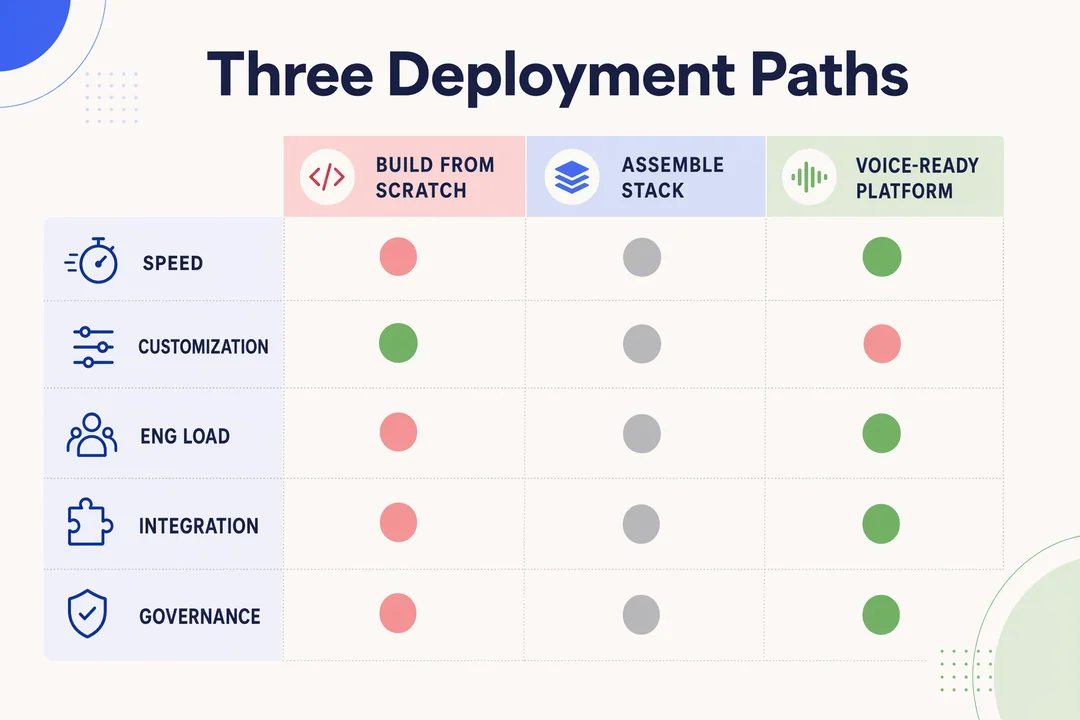
| Criteria | Build from Scratch | Assemble Multi-Vendor Stack | Use Voice-Ready Cloud Call Center Platform |
|---|---|---|---|
| Deployment speed | Slowest | Moderate | Fastest |
| Customization | Highest | High | Moderate to high |
| Internal engineering load | Very high | High | Lower |
| Integration burden | High | Very high | Lower to moderate |
| Governance complexity | High | Very high | Lower |
| Production-readiness | Depends on team maturity | Uneven | Usually stronger out of the box |
| Scalability | Strong if built well | Can be strong but fragmented | Strong with less operational friction |
| Ongoing operations | Heavy internal ownership | Complex vendor coordination | Simpler centralized ownership |
Building makes sense for highly specialized environments, unusual compliance constraints, or organizations with deep internal engineering capability. Assembling a stack can offer flexibility, but governance often becomes difficult because latency, routing, analytics, and handoff quality sit across multiple vendors. For many businesses, a CCaaS or cloud call center platform is the fastest path to production because it combines infrastructure, routing, integrations, and operational tooling in one environment.
This matters even more for AI-powered contact center automation across regions. If your operation needs global VoIP routing, fast onboarding, and centralized reporting, a voice-ready platform usually reduces delivery risk. Pricing flexibility also matters. In some cases, pay-as-you-go pricing fits variable demand better than fixed seat commitments.
How Flyfone Fits the AI Voice Agent Evaluation Criteria
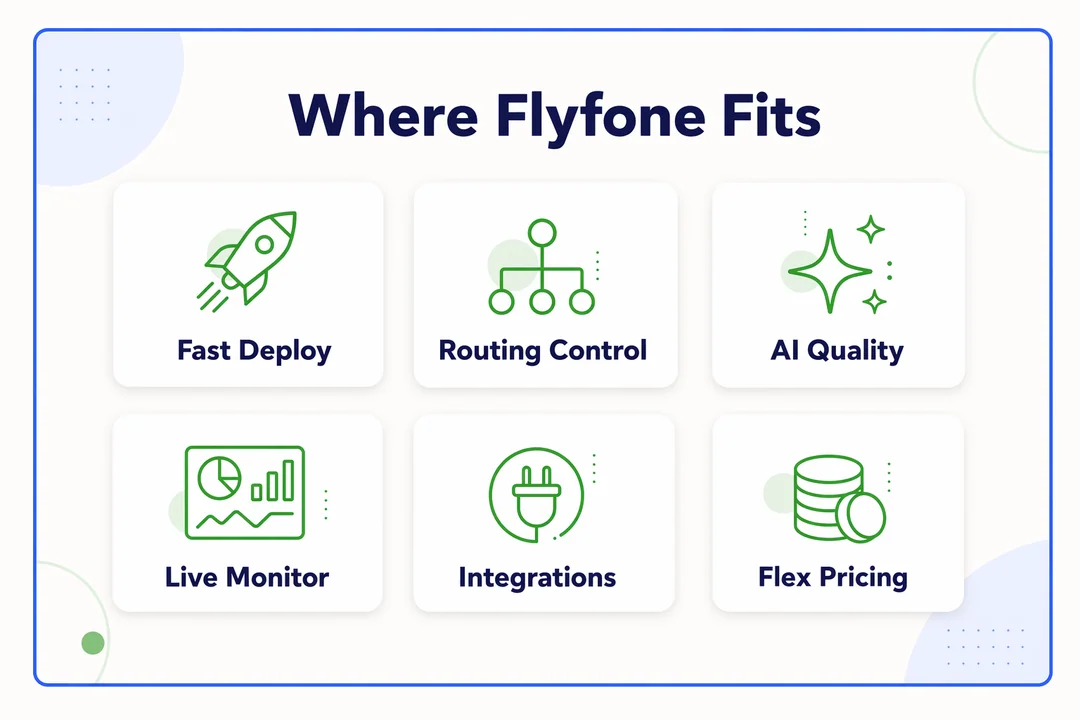
If your evaluation criteria prioritize fast deployment, flexible routing, integration readiness, operational visibility, and pricing flexibility, Flyfone becomes relevant in a practical way. It is not just an AI layer. It is an AI-powered cloud call center platform designed for teams that need to launch quickly, scale without infrastructure rebuilds, and keep tighter control over global voice operations.
Operational advantages for fast-moving teams
- Under-1-hour deployment supports teams that need rapid launch instead of long setup cycles. This matters for seasonal campaigns, outsourcing operations, and fast-growth support teams.
- Global numbers and routing help organizations serve distributed markets with better call handling continuity.
- No seat fees and usage-based pricing reduce waste for businesses with fluctuating volume or changing team size.
- Flexible onboarding lowers the burden on internal IT and operations teams.
- Responsive support is important because issue resolution speed affects live service quality, not just vendor satisfaction.
This model is especially relevant for fast-moving BPO, fintech, crypto, iGaming, and cross-border teams that cannot afford rigid contracts or slow provisioning.
Support for hybrid human + AI operations
- Inbound and outbound workflows, including an integrated auto-dialer, support both service and campaign use cases in one environment.
- Routing control helps teams manage triage, escalation, and fallback more precisely.
- AI-native quality assurance improves call review coverage and reduces manual monitoring workload.
- Real-time monitoring gives operations teams better visibility into connection quality, campaign performance, and agent activity.
- SIP/API integrations support CRM, ticketing, and workflow connectivity rather than isolating voice operations.
- Support for multilingual and global operations matters for distributed customer bases and multi-market growth.
Flyfone is hosted on AWS Singapore, which is relevant for routing stability and lower-latency support across APAC and global operations. Its value is strongest when the buyer needs not just AI, but the surrounding communication infrastructure required to run voice at scale.
If your team is comparing voice automation options against routing, onboarding speed, and cost flexibility, book a solution consultation with Flyfone to assess workflow fit before platform selection.
Practical Verdict: Is an AI Voice Agent Right for Your Call Center?
The best indicator of success is not how advanced the demo looks. It is whether your operation has the right workflow patterns, routing logic, and data access to support automation safely.
Best fit
- Repetitive, high-volume interactions
- After-hours support coverage
- Multilingual or global routing needs
- Rapidly scaling teams
Use caution
- Mixed environments where some flows are predictable but escalation is still immature
- Teams with uneven knowledge quality or limited integration maturity
- Operations exploring scaling customer support with AI voice automation for the first time
Poor fit
- Complaint-heavy environments
- Advisory conversations
- Exception-heavy operations with weak process design
By maturity
- Startups and SMEs: start with one workflow and prove operational fit
- Mid-market teams: reduce repetitive load and improve agent productivity
- Complex support and BPO teams: combine AI voice with routing, QA, reporting, and broader contact center automation
This is ultimately a call center modernization decision, not just an AI purchase. The right path depends on operational fit, not market hype.
Conclusion
An ai voice agent for call center environments works best as part of a broader operating model, not as a standalone bot added on top of broken workflows. The right buying lens is straightforward: start with use-case fit, then evaluate conversation quality, handoff design, integrations, reporting, and scalability under real operating conditions.
For most teams, the safest approach is a narrow launch, measurable outcomes, and gradual expansion. That is how you separate a promising demo from a platform that can actually support production service. If you want a structured workflow assessment before committing to a vendor or rollout path, explore whether Flyfone fits your routing, integration, and operational scale requirements.
Frequently Asked Questions
What is an AI voice agent for a call center?
An AI voice agent is a system that automates customer phone conversations using speech recognition (ASR) and natural language understanding (NLU). It interprets caller intent, resolves common requests, and responds in real time instead of routing through rigid keypad menus.
Why should businesses upgrade from traditional IVR to an AI voice agent?
Traditional IVR forces customers through keypad menus that frustrate callers and limit resolution. An AI voice agent lets customers speak naturally, raises self-service resolution rates, and cuts hold times, especially for repetitive inquiries that would otherwise queue for a human.
Will an AI voice agent fully replace human agents?
No. AI voice agents work best on repetitive, structured tasks (order status, booking, FAQs). Complex issues, emotional escalations, and exception handling still require human agents. The right model is hybrid: AI handles volume, humans handle edge cases.
How do I measure the effectiveness of an AI voice agent?
Track four metrics: call containment rate (calls resolved without human handoff), average handle time (AHT), customer satisfaction (CSAT), and accurate-escalation rate when handoff is needed. A useful agent improves containment without dropping CSAT.
Is an AI voice agent expensive to deploy?
Compared with hiring more agents, AI voice agents reduce per-call cost through unlimited concurrent scale and pay-as-you-go pricing. You pay for actual usage minutes, not per-seat licenses, which fits seasonal or variable-volume operations.
Does Flyfone support AI voice agent deployment?
Flyfone is a cloud call center platform with an open infrastructure ready to integrate AI, API, and CRM tools. It supports under-1-hour deployment, intelligent routing, and real-time monitoring dashboards so AI agents can be operated alongside human teams from day one.
More in Operations & CX Optimization
View all →
Customer Experience Transformation: Framework and Steps
A telecom customer calls support about a billing error. They explain the problem to the IVR system. Then to the first agent. Then get transferred and explain again. Then escalated—and explain a third time. Forty minutes later, they're exhausted and the problem still isn't solved. This is what broken customer experience looks like. And it's costing you customers. Customer experience…


Web Caller Meaning: JavaScript caller, Calling Tools or Portals
“Web caller” is one of those phrases where the search results and the searcher are frequently talking about different things. Three unrelated audiences use it: developers hitting an error on the legacy JavaScript caller property, buyers evaluating browser-based calling software, and people trying to reach a specific portal or training page whose exact name they cannot recall. That fragmentation is…

Customer Experience Strategy: How to Build One That Works
Customer experience is getting worse, not better. Forrester's 2025 Global CX Index found that 21% of brands declined in CX quality while only 6% improved — and in the US, 25% declined against 7% that improved, the second consecutive year of that pattern. Most of those brands were not neglecting customer experience. They were working on it without a strategy…

 English
  Russian
  Chinese