
Gaming call center outsourcing allows game studios to scale player support operations without building large in-house teams. Instead of hiring, training, and managing support staff internally, studios partner with specialized external providers who handle tickets, calls, and live chat across multiple time zones and languages.
This approach solves a core operational challenge: live-service games generate unpredictable support volume that spikes during launches, updates, and events—while internal teams need consistent focus on game development, not firefighting support queues.
Key Takeaways

- Gaming call center outsourcing allows studios to scale player support without long-term hiring commitments or infrastructure investment.
- Outsourced teams handle customer inquiries, technical troubleshooting, billing disputes, and account security issues across email, chat, phone, and in-game tickets.
- The right partner improves player satisfaction, retention, and community trust.
- Risks exist but can be reduced with clear processes, training, and reporting.
- Outsourcing works best for live-service games, global audiences, and fast growth phases.
What Is Gaming Call Center Outsourcing?

Gaming call center outsourcing is the practice of hiring a specialized external provider to manage player support operations. These providers focus on gaming-specific support rather than general customer service.
In a typical setup, the outsourcing partner supplies trained agents, tools, and processes. They work as an extension of your studio, not a generic help desk.
Gaming support differs from traditional call center work in three critical ways:
1. Game mechanics expertise required
Agents need working knowledge of your game’s systems—not just generic FAQs. When a player reports “lost MMR after disconnect,” the agent must understand matchmaking rating mechanics, server rollback policies, and compensation procedures. Traditional call center agents reading scripts can’t navigate this complexity.
2. High emotional stakes
Players aren’t just customers—they’re emotionally invested. Losing ranked progress, missing limited-time rewards, or experiencing pay-to-win imbalance triggers genuine frustration. Agents need de-escalation skills and empathy, not corporate deflection scripts.
3. Direct impact on retention
Support quality influences whether players stay or quit. Fast, understanding responses during moments of frustration can save at-risk players. Slow or dismissive support accelerates churn, especially in competitive games where community perception spreads through Discord and social media within hours.
In live-service games (games updated continuously with events and content), support demand spikes after launches, patches, and promotions. Outsourcing allows studios to absorb these spikes without burning out internal teams.
Business impact of gaming support quality:
Support directly influences three revenue-critical metrics:
- Player churn: Industry data shows players who receive support within 2 hours are 65% more likely to remain active after 30 days compared to those waiting 24+ hours.
- Lifetime value (LTV): Resolved payment issues and restored accounts prevent permanent player loss. For free-to-play games where only 2-5% of players spend money, losing even 50 paying players equals $3,000-8,000 in monthly recurring revenue.
- Community perception: Fast support builds trust that spreads through social channels. Slow support triggers negative reviews, Reddit threads, and Discord complaints that deter new player acquisition.
Common hybrid model:
Most studios outsource high-volume, documented issues (Tier 1: password resets, known bugs, purchase problems) while keeping complex investigations in-house (Tier 2: unconfirmed bugs requiring dev team reproduction and code analysis).
Example: A mid-size live-service studio outsources Tier 1 support (basic tickets and chats), while keeping complex bug investigations in-house with developers.
What Services Are Typically Outsourced in Gaming Support?
Gaming studios outsource support functions that are high-volume, time-sensitive, and operationally heavy.
These services map directly to common pain points: player frustration, technical instability, payment issues, and account security.
Customer Support for Gamers
This is the most commonly outsourced function.
Typical responsibilities include:
- Gameplay clarification: Explaining progression systems, reward mechanics, and event rules when players encounter confusion.
- Emotional support during frustration: De-escalating players upset by losses, perceived unfairness, or unexpected balance changes.
- Volume absorption during spikes: Managing 3-10× normal ticket volume immediately following major updates, events, or viral controversies.
Real scenario:
A European mobile game studio released a balance patch that nerfed a popular character. Within 6 hours, support tickets jumped from ~200/day to 650/day—mostly emotional complaints and refund requests.
The outsourced team absorbed this surge by:
- Triaging duplicates: Identified that 70% of tickets were about the same balance change
- Empathetic acknowledgment: Responded with “We understand this change affects your strategy. Here’s the design reasoning…” rather than defensive scripts
- Escalation filtering: Forwarded 15 constructive feedback threads to the design team while handling routine complaints
Result: Developers focused on evaluating data and community feedback instead of answering hundreds of repetitive tickets. Community anger subsided within 72 hours because players felt heard, even if the balance change stayed.
Short case: After a major balance patch, a studio saw a 3× spike in tickets. An outsourced team absorbed first responses, filtered duplicates, and calmed players while developers worked on fixes.
Technical Support for Games and Platforms
Technical support focuses on functional issues.
Common technical support tasks:
- Crash and performance troubleshooting: Walking players through driver updates, graphics settings adjustments, and cache clearing when games freeze, stutter, or fail to launch.
- Cross-platform guidance: Helping players navigate differences between PC, console, and mobile versions—especially for cross-save, controller mapping, and platform-specific bugs.
- Bug data collection and escalation: Gathering reproduction steps, system specs, and error logs to pass structured reports to internal QA and development teams.
Why tiered structure matters:
Technical issues vary widely in complexity. A flat support structure overwhelms agents and delays resolutions.
Tier 1 agents (frontline, 70-80% of tickets):
- Handle documented issues with known fixes
- Example: “Game won’t launch on Windows 11” → Guide through compatibility mode settings
- Resolution time: 5-15 minutes
Tier 2 agents (specialized, 15-20% of tickets):
- Investigate undocumented problems requiring deeper diagnosis
- Example: “Random crashes only during multiplayer” → Reproduce issue, analyze crash logs, identify network sync bug
- Resolution time: 30 minutes to 2 hours
Dev team escalation (5-10% of tickets):
- Confirmed bugs requiring code fixes or architecture changes
- Example: “Memory leak causing crashes after 3+ hours of gameplay” → Needs profiler analysis and patch
- Resolution time: Days to weeks (next patch cycle)
Clear handoff criteria prevent bottlenecks. Without defined tiers, Tier 1 agents waste time on problems they can’t solve, while developers drown in tickets they shouldn’t see.
Billing, Payments, and In-Game Purchases
Payment issues are revenue-critical and trust-sensitive—delays or errors directly cause churn and chargebacks.
Common billing support scenarios:
- Subscription confusion: Players unsure why they were charged, when renewal occurs, or how to cancel. Requires clear explanation of billing cycles and proactive cancellation confirmation.
- Missing purchases: Player bought a cosmetic skin or battle pass but didn’t receive it. Agent must verify transaction ID, check server logs, and either restore items or process refund—typically within 2-4 hours to prevent escalation.
- Refund requests: Accidental purchases (especially by children), dissatisfaction with content, or technical issues preventing use. Requires judgment: legitimate cases get fast refunds, abuse attempts get documented denial.
- Fraud and chargebacks: Detecting stolen credit cards, account takeovers, or fraudulent refund claims. Prevents revenue loss and maintains payment processor relationships (too many chargebacks = higher fees or account suspension).
Why speed and accuracy matter:
Payment problems trigger immediate distrust. A player who spent $50 and didn’t receive their items will:
- Request refund within 6 hours if no response
- Leave negative review within 24 hours
- Dispute charge with bank within 48 hours (chargeback costs you $15-30 in fees + the original amount)
Fast resolution (under 2 hours) typically saves 80-90% of these scenarios. Delayed resolution (24+ hours) converts frustrated customers into permanent detractors.
Account Management, Moderation, and Security
Account issues are sensitive and high-risk.
Common responsibilities:
- Account recovery and identity verification.
- Handling ban appeals and enforcement explanations.
- Reviewing cheating or abuse reports.
Clear moderation guidelines are essential to ensure consistency.
Why Gaming Companies Choose to Outsource Call Center Services
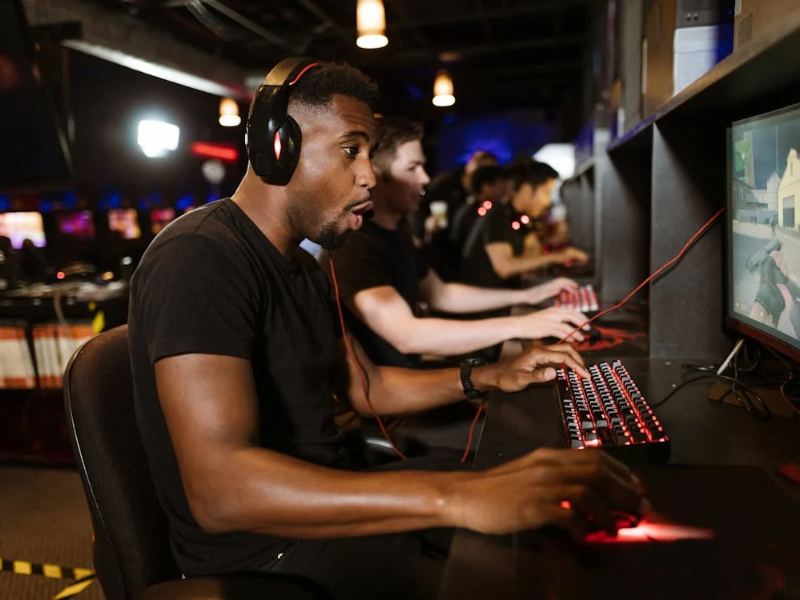
Studios outsource because player support scales faster than internal teams.
Key drivers include:
- Global audiences: Players expect help at any hour.
- Live-service pressure: Updates trigger unpredictable ticket volumes.
- Focus: Internal teams need to build and improve games, not run call centers.
Outsourcing converts fixed costs into flexible operating expenses. It also reduces hiring time and training overhead.
Key Benefits of Gaming Call Center Outsourcing
Cost Efficiency and Predictable Expenses
Outsourcing converts fixed support costs into flexible operating expenses—critical for studios facing unpredictable player growth.
Cost structure comparison:
In-house team (fixed):
- 15 full-time support agents
- Annual cost: ~$600,000 (salary + benefits + equipment + management overhead)
- Risk: If player base shrinks or game sunset approaches, you’re locked into payroll commitments and severance obligations
Outsourced team (flexible):
- Contract pricing: $3,000-5,000 per agent per month (varies by region and expertise)
- Scale up/down with 2-4 weeks notice
- No benefits, equipment, or office space costs
- Annual cost for equivalent 15 agents: ~$540,000-900,000 depending on volume needs
When outsourcing saves money:
- Seasonal games: If support volume drops 60% outside peak season, you only pay for active agents during busy months
- Early-stage studios: Avoid hiring 10-15 people before knowing if your game will retain players long-term
- Scaling experiments: Test 5 agents initially, add 20 more if launch succeeds—no hiring delays
When in-house might be cheaper:
- Stable, mature games with consistent daily volume and 3+ year lifespan
- Very small operations (<5 agents) where outsourcing minimums exceed single-hire costs
The decision isn’t purely cost—it’s about risk management. Outsourcing protects against over-hiring before proving retention, and allows fast scaling when opportunities emerge.
Example: A studio replaces a fixed 15-person support team with a scalable monthly contract.
Scalability During Launches and Peak Periods
Gaming support volume is uniquely volatile—unlike SaaS or e-commerce where spikes are predictable, game updates can trigger 5-10× normal volume within hours.
Typical support volume curve:
- 2 weeks pre-launch: Baseline ~100 tickets/day (existing player questions)
- Launch day (Hour 0-12): Spike to 800-1,200 tickets/day (login issues, purchase problems, new player confusion)
- Launch week: Sustained 500-700 tickets/day (bug reports, gameplay questions)
- Week 2-3: Gradual decline to 250-300 tickets/day
- Week 4+: Return to ~150 tickets/day baseline
In-house team limitation:
If you hire 15 agents to handle launch week (700 tickets/day), you’re overstaffed by 60-70% once volume normalizes. Laying off agents damages morale and reputation. Keeping them means paying for idle capacity.
Outsourcing flexibility:
2 weeks before launch:
- Ramp from 10 to 30 agents
- Intensive training on known issues, escalation paths, and tone guidelines
Launch day:
- Deploy all 30 agents + 10 on-call reserves
- Shift supervisors monitor queue in real-time, adjust agent allocation between email/chat/phone
Week 2-3:
- Scale down to 18 agents as volume drops
- Transition focus from reactive troubleshooting to proactive FAQ updates
Week 4+:
- Maintain 12 agents for steady-state
- Retain trained backup pool for next seasonal event
Business impact:
This elasticity prevents two costly scenarios:
- Under-staffing: Long wait times → negative reviews → lost players during critical launch window
- Over-staffing: Paying for idle agents → wasted budget that could fund development
Studios that plan scaling before launch protect both player experience and budget efficiency.
Global Coverage and Multilingual Customer Support
Players expect help in their language and time zone.
Outsourced providers offer:
- 24/7 follow-the-sun coverage.
- Native or fluent multilingual agents.
- Cultural awareness for regional markets.
Access to Trained Gaming Support Agents
Specialized providers recruit agents who play games.
Advantages include:
- Faster understanding of issues.
- Natural use of gamer language.
- Higher empathy and credibility with players.
Potential Risks and Challenges to Be Aware Of
Outsourcing is not risk-free.
Common risks and mitigations:
- Loss of brand voice: Provide scripts, tone guides, and examples.
- Quality inconsistency: Start small and use regular QA reviews.
- Data security concerns: Enforce strict access controls and audits.
- Poor escalation: Define clear ownership between support and dev teams.
When Does Outsourcing Make Sense for a Gaming Business?

Outsourcing is most effective in specific situations.
It makes sense when:
- You run a live-service or online game.
- Your player base spans multiple regions.
- Support volume fluctuates heavily.
- Internal teams are overloaded.
It may be less suitable for very small indie teams with limited players or highly experimental builds.
In-House vs Outsourced Gaming Call Centers
| Aspect | In-House | Outsourced |
|---|---|---|
| Cost | Fixed | Variable |
| Scalability | Slow | Fast |
| Coverage | Limited | Global |
| Control | High | Shared |
Many studios use a hybrid model: in-house for complex issues, outsourced for volume.
How Gaming Call Center Outsourcing Typically Works
A standard outsourcing process follows clear steps.
- Assessment: Define support scope, channels, and volume.
- Partner selection: Choose providers with gaming experience.
- Knowledge transfer: Share game guides, policies, and tools.
- Training: Agents learn gameplay, tone, and escalation rules.
- Soft launch: Start with limited volume and monitor quality.
- Full rollout: Scale coverage based on demand.
- Ongoing optimization: Review KPIs and player feedback.
Clear documentation and communication are critical at every step.
How to Choose the Right Gaming Call Center Outsourcing Partner
Proven Experience in Gaming Customer Support
Look for partners with:
- Experience in your genre and platform.
- References from similar studios.
- Understanding of live-service dynamics.
Scalability and Staffing Flexibility
Ask how they handle:
- Launch-day surges.
- Seasonal events.
- Sudden drops in volume.
Multichannel and Multilingual Capabilities
The partner should support:
- Email, chat, social, and in-game tickets.
- Key languages in your player base.
- Seamless channel handoffs.
Data Security and Compliance Standards
Ensure strong controls around:
- Account access.
- Payment data.
- Internal tools and logs.
Communication, Reporting, and Transparency
Demand visibility through:
- Clear KPIs and SLAs.
- Regular performance reports.
- Direct communication channels.
Common Outsourcing Locations for Gaming Call Centers
Popular regions include:
- Philippines: Strong English skills and gaming familiarity.
- Eastern Europe: Technical expertise and EU coverage.
- Latin America: Time-zone alignment with North America.
- India: Large-scale operations and cost efficiency.
Best Practices for Successful Gaming Support Outsourcing
Effective outsourcing requires structure.
Best practices include:
- Share roadmaps and patch schedules early.
- Maintain a living knowledge base.
- Review tickets weekly with the provider.
- Align support metrics with player retention goals.
- Treat outsourced agents as part of the team.
Studios that invest in collaboration see better player loyalty.
FAQ – Common Questions About Gaming Call Center Outsourcing
Is gaming call center outsourcing suitable for indie studios?
Yes, if player volume exceeds what a small team can handle, even part-time outsourcing helps.
Will outsourced agents understand my game?
Only if you choose a partner with gaming experience and provide proper training.
Can I outsource only part of my support?
Yes, many studios outsource Tier 1 support and keep complex cases in-house.
How long does setup usually take?
Most setups take 4–8 weeks, depending on complexity and volume.
Does outsourcing hurt player trust?
No, when agents are trained well and follow your brand voice, players rarely notice.
Conclusion
Gaming call center outsourcing is a practical way to scale player support, control costs, and protect player experience. When done right, it strengthens retention and frees your team to focus on building great games. Start by auditing your current support load, then evaluate whether an experienced gaming partner can help you grow with confidence.
FAQs
What is gaming call center outsourcing?
Gaming call center outsourcing refers to hiring external specialists to handle player support tasks like technical issues, account assistance, and gameplay queries. This allows gaming companies to focus on core development while ensuring seamless player experiences.
Why do gaming companies outsource call center services?
Gaming companies outsource for cost efficiency, scalability during peak periods, 24/7 multilingual support, and access to trained agents specialized in gaming. Outsourcing ensures better player satisfaction and retention.
What services can be outsourced in gaming call centers?
Common services include technical support, account recovery, in-game purchase assistance, community moderation, and customer support for gameplay issues or payment disputes.
How do outsourced gaming call centers improve player experience?
These call centers provide quick resolutions, multilingual support, and expertise from agents familiar with gaming culture, ensuring players feel valued and supported.
What are the risks of outsourcing gaming call center services?
Potential risks include data breaches, lack of cultural alignment, and inconsistent service quality. Choosing a reputable BPO partner with strong security measures and gaming expertise mitigates these risks.
How do I choose the right outsourcing partner for gaming support?
Look for proven expertise in gaming customer service, scalability, multichannel support, robust data security, and clear communication and reporting practices. Request case studies and client references to ensure fit.
What are the benefits of multilingual support in gaming call centers?
Multilingual support helps gaming companies cater to global audiences by addressing language and cultural needs, enhancing player satisfaction and loyalty.
Where are the best locations for outsourcing gaming call centers?
Countries like the Philippines and India are popular due to skilled agents, cost efficiency, and experience in gaming support outsourcing. Other regions include Eastern Europe and Latin America based on your target markets.
Read more:
Call Center Agent Performance Metrics That Actually Improve CX
VoIP Meaning in Gaming Benefits Challenges and Top Tools



 English
  Russian
  Chinese