

Employee experience in customer support directly shapes how customers feel, stay loyal, and judge your brand—often more than tools or scripts.
Key Takeaways at a Glance
-
Agent tools directly impact customer wait times: When support agents toggle between 5+ systems to answer one question, average handle time increases 40-60%. Customers on hold sense the clicking and awkward pauses. Consolidated platforms reduce this friction immediately.
Burnout shows up in your metrics within weeks: Support teams experiencing high turnover report 18-25% lower CSAT scores. When agents feel overwhelmed, customers hear it in their tone—shorter responses, faster transfers, less patience.
Manual QA consumes manager time that should go to coaching: Traditional quality assurance requires managers to manually review 3-5% of calls. That’s 10-15 hours weekly spent listening to recordings instead of developing agents. Automated QA scores 100% of interactions, freeing managers to coach proactively.
Empowered agents close issues faster: When agents can make small decisions (like processing refunds under $50) without supervisor approval, first-contact resolution improves 25-35%. Customers don’t get transferred. Agents feel trusted.
Understanding Employee Experience in Customer Support

What employee experience means for support teams
Employee experience (EX) in customer support isn’t about office perks or free snacks. It’s the friction—or ease—agents encounter during every customer interaction.
EX includes the practical, daily realities agents face:
System usability: Can agents pull up customer history in 5 seconds, or do they juggle three different tools while the customer waits? In high-volume call centers handling 1,000+ calls daily, every extra click compounds into hours of wasted agent time and frustrated customers.
Decision-making authority: Can agents process a simple refund immediately, or must everything escalate to a supervisor? When agents lack basic autonomy, handle time increases and customers repeat their story multiple times.
Performance visibility: Do agents know how they’re performing, or do they find out during quarterly reviews? Real-time feedback helps agents course-correct immediately instead of developing bad habits for months.
Training support: Are new agents thrown into live calls after watching three videos, or do they receive ongoing coaching? Ramp-up time affects both agent confidence and customer experience quality.
For call center operations, EX isn’t soft or secondary—it’s operational infrastructure that determines whether agents can actually do their jobs effectively.
How employee experience differs from general HR initiatives
- Employee experience in support is immediate and shows up in live customer interactions.
- It focuses on daily workflows, not annual reviews or policies.
- Small issues compound quickly into customer frustration.
- Support EX directly impacts revenue-facing outcomes.
Key elements of the employee journey in customer support
- Onboarding and ramp-up speed
- Ongoing training and coaching
- Tools and system usability
- Workload balance and scheduling
- Feedback, recognition, and growth paths
Why Employee Experience Directly Affects Customer Support Quality
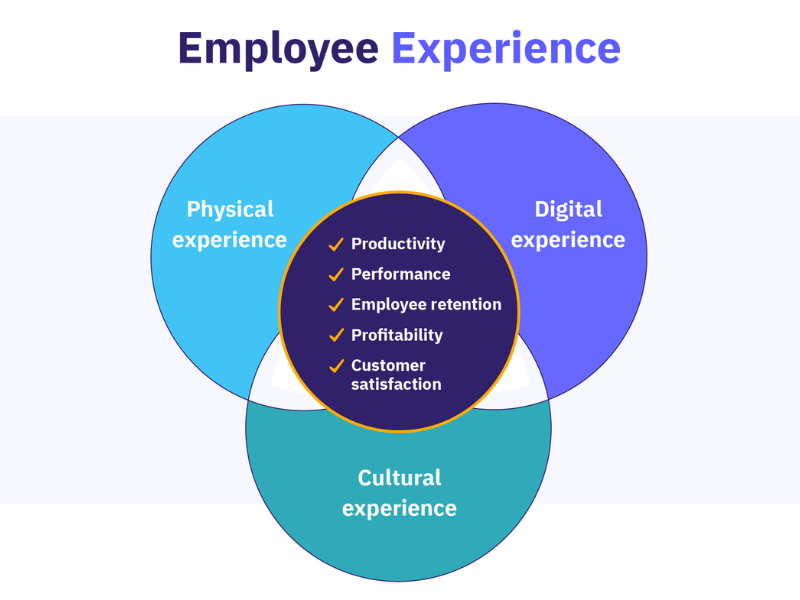
The link between employee morale and customer interactions
Support work requires emotional labor (managing emotions while helping others). When morale is low, agents sound rushed, defensive, or disengaged. Customers sense this immediately.
In teams I’ve worked with, high-morale agents slow down just enough to listen. Low-morale agents rush to close tickets. The issue is rarely skill—it’s emotional capacity.
Example:
Two agents handle the same refund issue. One feels trusted and supported. The other is burned out and monitored on handle time. The first reassures the customer. The second sticks to the script. The outcomes are very different.
How frontline staff behavior shapes customer perception
Support agents are the brand in human form. No script or automation can fully cover for poor employee experience.
Motivated agent:
- Listens fully
- Explains clearly
- Takes ownership
Disengaged agent:
- Transfers often
- Sounds robotic
- Avoids responsibility
Customers remember the feeling, not the policy.
Cause-and-effect chain: employee experience → service quality → customer satisfaction
- Poor EX → stress and shortcuts
- Stress → lower service quality
- Lower quality → weaker CSAT and NPS
- Weak CX → churn and negative reviews
Common Employee Experience Problems in Customer Support Teams

Employee burnout and high workload
Employee burnout and high workload
Support agent burnout isn’t just an HR issue—it’s a revenue problem. Replacing a burned-out agent costs $15,000-$25,000 in recruiting, training, and lost productivity. Meanwhile, burned-out agents who stay drive CSAT scores down 18-25%.
What actually causes burnout in call center operations:
Unpredictable volume spikes without staffing adjustments: When call volume suddenly doubles during a product launch or regulatory deadline, agents absorb the overflow. If staffing can’t flex quickly, agents work longer hours or skip breaks to clear queues. This pattern repeated over weeks leads to exhaustion.
Tool-switching cognitive overload: Support agents handling complex issues often toggle between: ticketing system, CRM, knowledge base, internal chat, and call platform. Each context switch costs 23 seconds on average (research from University of California Irvine). For an agent handling 80 calls per day, that’s 30+ minutes of pure friction—time that could be spent actually helping customers.
Performance uncertainty: When agents don’t know how they’re performing until quarterly reviews, they operate in constant anxiety. Are they doing well? Falling behind? Without regular feedback, agents either overthink every interaction or disengage entirely.
How burnout manifests in customer interactions:
- Average handle time increases 20-30% as agents struggle to focus
- Transfer rates double as exhausted agents avoid complex problems
- After-call work expands as agents need recovery time between interactions
- Sick leave usage spikes 40-50% in the months before agents quit
These aren’t attitude problems—they’re predictable responses to sustained operational stress. Addressing the root causes (tool friction, workload unpredictability, feedback gaps) prevents burnout more effectively than wellness programs.
Lack of training, coaching, and development
Many teams focus on onboarding but stop there. Without ongoing coaching, agents plateau.
This leads to inconsistent answers, more escalations, and agents who rely on scripts instead of judgment.
[Ảnh: Training lifecycle diagram]
Poor tools, outdated systems, and workflow friction
Agents often juggle ticketing systems, CRM (customer relationship management tools), and internal docs. Tool switching drains focus and patience.
Slow systems increase handle time and frustration—for both agents and customers.
Limited empowerment and rigid support processes
Limited empowerment and rigid support processes
When agents must escalate every decision to a supervisor, two things happen: customers wait longer, and agents feel incapable.
Common scenarios where lack of empowerment hurts:
Customer wants $20 refund for delayed delivery:
- Rigid process: Agent must create escalation ticket, customer waits 24-48 hours for supervisor review, then receives email with refund confirmation. Customer had to wait days for a $20 issue.
- Empowered process: Agent sees customer history (loyal, no previous refund requests), processes $20 refund immediately. Total interaction time: 3 minutes. Customer satisfied, agent feels trusted.
Customer needs order details changed (address correction):
- Rigid process: Agent must transfer to “Order Modifications” team, customer repeats entire story, waits in new queue. Total time: 15-20 minutes.
- Empowered process: Agent has edit access to order system, makes change directly, confirms with customer. Total time: 2 minutes.
Why empowerment improves both EX and CX:
For agents: Making decisions builds confidence and job satisfaction. Agents feel like problem-solvers, not ticket-routers. This directly impacts retention—support teams with decision-making authority report 30-40% lower turnover.
For customers: Issues resolve in one conversation. No transfers, no callbacks, no repeating information. First-contact resolution improves 25-35% when agents have basic autonomy.
The key is smart boundaries: Agents should have clear thresholds (e.g., “refunds under $50 require no approval, over $50 require supervisor review”). This balances risk management with operational speed.
Business Impact of Employee Experience on Customer Support Outcomes

Effects on customer satisfaction metrics (CSAT, NPS)
Effects on customer satisfaction metrics (CSAT, NPS)
Employee experience directly drives customer satisfaction scores, and the impact shows up faster than most leaders expect.
The data:
Gallup’s research on employee engagement found that business units with highly engaged employees achieve 10-20% higher customer satisfaction scores compared to units with disengaged employees. In call center operations, this translates to measurable CSAT and NPS improvements within 60-90 days of EX interventions.
Why the connection is so direct:
Support interactions are live and unscripted. Unlike marketing materials or product features, there’s no buffer between employee mood and customer perception. When an agent feels supported, has working tools, and isn’t drowning in queues, that stability carries through in their voice and pace.
Example of EX → CX transmission:
Two agents handle identical customer issues. Agent A works with unified tools, clear empowerment rules, and receives daily performance feedback. Agent B toggles between three systems, escalates everything, and hasn’t received coaching in two months.
- Agent A’s customer: Issue resolved in 4 minutes, agent sounds confident and helpful, CSAT score: 4.8/5
- Agent B’s customer: Issue takes 11 minutes, multiple holds, agent sounds uncertain, CSAT score: 3.2/5
The customer doesn’t know about the agent’s tools or training—they just sense competence versus struggle. Poor EX manifests as poor CX, even when agents are trying their best.
Impact on customer retention and loyalty
Customers stay when support feels consistent and human. Retention costs less than acquisition, and good employee experience protects that investment.
Trust builds through repeated positive interactions.
How employee turnover affects support consistency and trust
High turnover breaks continuity. Customers repeat themselves. Knowledge disappears.
Each new agent resets the relationship.
The ripple effect on brand reputation and revenue
Support experiences drive reviews, referrals, and social proof. Poor EX quietly damages revenue over time.
Customers don’t blame systems. They blame brands.
How Positive Employee Experience Improves Customer Support Performance
Empowered employees delivering faster and more empathetic support
When agents feel trusted, they resolve issues faster and escalate less.
Results include:
- Higher first contact resolution
- Fewer handoffs
- More confident conversations
Better problem-solving through frontline staff engagement
Engaged agents spot patterns early. They know what confuses customers.
When leaders listen, teams fix root causes instead of symptoms.
Improved personalization in customer interactions
Context plus autonomy leads to better personalization. Agents can adjust tone, explain trade-offs, and respond like humans.
Emotional intelligence matters more than perfect wording.
Stronger alignment between employee engagement and customer experience (EX–CX alignment)
EX–CX alignment means employee goals, tools, and incentives support customer outcomes.
The payoff is consistency, clarity, and a customer-centric culture.
Practical Ways to Improve Employee Experience in Customer Support
Listening to employee feedback and acting on it
- Collect regular feedback using tools like Qualtrics or Medallia.
- Identify top friction points agents mention.
- Share what you’re changing and why.
- Follow up to confirm improvement.
Closing the loop builds trust fast.
Improving training, coaching, and emotional intelligence
- Shift from one-time onboarding to continuous coaching.
- Train soft skills like de-escalation and empathy.
- Use real tickets for coaching moments.
Supporting work-life balance and reducing burnout
- Set realistic staffing and schedules.
- Clarify escalation rules.
- Encourage real breaks and time off.
Small changes reduce long-term attrition.
Using AI and automation to reduce agent workload
Using AI and automation to reduce agent workload
AI works best in support when it removes administrative busywork without removing human judgment. Three high-impact applications:
1. Automated call transcription and note-generation
How it works: AI transcribes conversations in real-time and generates summary notes automatically. Agents review, edit if needed, and submit—instead of typing detailed notes from memory after each call.
Impact: Saves 30-40 seconds per call. For agents handling 80 calls daily, that’s 40-53 minutes reclaimed—roughly 8-10 additional calls handled without working harder. Agents also report lower cognitive fatigue because they can focus on listening instead of mentally preparing their notes.
2. Real-time knowledge suggestions during calls
How it works: As the customer describes their issue, AI searches the knowledge base and surfaces relevant articles or troubleshooting steps directly in the agent’s view. Agents see suggestions without interrupting the conversation to manually search.
Impact: Reduces time spent searching for answers from 45-60 seconds to under 10 seconds. New agents especially benefit—they get instant access to information that experienced agents have memorized. This shortens new hire ramp-up from 4 weeks to 2-3 weeks.
3. Automated quality scoring for all interactions
How it works: AI analyzes 100% of calls for tone, resolution completeness, compliance adherence, and customer sentiment. Managers receive dashboards showing which agents excel and which need coaching on specific skills (e.g., “Agent struggled with de-escalation in 6 of 45 calls this week”).
Impact: Traditional QA requires managers to manually review 3-5% of calls—roughly 10-15 hours weekly. Automated scoring frees this time for live coaching and team development. Agents receive feedback daily instead of quarterly, allowing immediate course correction.
The EX outcome: Agents spend 60-70% less time on busywork (note-taking, searching, performance guessing) and more time solving actual customer problems—the part of support work most agents find meaningful.
Aligning workplace culture with customer service goals
Reward quality, not just speed. Celebrate thoughtful resolutions.
Culture signals tell agents what really matters.
Simple Framework to Align Employee Experience and Customer Support
Mapping the employee journey alongside the customer journey
Mapping both journeys reveals shared pain points. Fixing one often fixes the other.
Identifying friction points that hurt both employees and customers
- Long approval chains
- Tool overload
- Unclear policies
- Conflicting KPIs
Measuring progress using employee feedback and customer satisfaction metrics
| Employee Signal | Customer Signal |
|---|---|
| Engagement score | CSAT |
| Burnout feedback | Repeat contacts |
| Tool satisfaction | Handle time |
Key Takeaways for Customer Support Leaders

Why employee experience is a support performance driver, not an HR-only concern
Employee experience is operational. It directly affects service quality, customer trust, and revenue. Treating it as HR-only leaves performance gains on the table.
What to prioritize first for immediate impact on customer experience
- Fix obvious tool and workflow pain points.
- Reduce unnecessary escalations.
- Listen to frontline feedback weekly.
- Coach managers on empathy, not just metrics.
Frequently Asked Questions (FAQ)

How does employee experience affect customer support quality?
Employee experience shapes agent mood, confidence, and patience. Better EX leads to calmer interactions, faster resolution, and higher customer satisfaction.
Is employee experience important for small support teams?
Yes. In small teams, each agent has a bigger impact. Poor EX shows up faster and affects a larger share of customers.
Can AI improve employee experience in customer support?
Yes, but only when AI removes administrative friction without adding surveillance pressure.
Three ways AI improves agent EX:
Automated transcription and note-taking: Agents typically spend 30-40 seconds after each call typing summary notes from memory. AI transcription captures the conversation in real-time and generates notes automatically. Agents review and submit—saving 40-60 minutes daily in an 80-call shift. More importantly, agents can focus fully on listening during calls instead of mentally preparing their documentation.
Real-time knowledge suggestions: When customers describe issues, AI searches knowledge bases and surfaces relevant articles directly in the agent’s dashboard—without interrupting the conversation. This reduces time spent searching from 45-60 seconds to under 10 seconds. New agents especially benefit, gaining instant access to information experienced agents have memorized.
100% quality scoring instead of random sampling: Traditional QA requires managers to manually review 3-5% of calls, creating anxiety (“Will my call get randomly checked?”) and delayed feedback. AI scores every interaction for tone, resolution quality, and compliance—giving agents daily performance visibility instead of quarterly surprises. Managers save 10-15 hours weekly on manual listening and redirect that time to coaching.
The critical distinction: AI should provide assistance and visibility, not punishment triggers. When used to micromanage or penalize agents for minor deviations, AI worsens EX by creating constant surveillance stress.
Frequently Asked Questions (FAQ)
What is employee experience (EX) in customer support?
Employee experience (EX) in customer support refers to how employees perceive their overall work journey, including training, tools provided, work-life balance, and emotional support. A positive EX directly impacts their performance and the quality of customer interactions.
How does employee experience impact customer experience (CX)?
Employee experience impacts customer experience by shaping how employees interact with customers. Supported and engaged employees deliver faster, more empathetic, and consistent service, while poor EX leads to disengaged, robotic, or substandard interactions that reduce customer satisfaction.
Why should companies align employee and customer experience strategies?
Aligning EX and CX ensures employees have the resources, tools, and motivation to deliver a high-quality customer experience. This alignment reduces friction in workflows, builds stronger customer loyalty, and improves both employee satisfaction and business outcomes, such as higher CSAT scores.
What are some common employee experience challenges in support teams?
Employee experience challenges in support teams often include high burnout due to workload pressure, outdated tools causing inefficiencies, lack of proper training or coaching, and rigid processes limiting frontline autonomy. These factors negatively affect customer service quality.
How can AI improve employee experience in customer support?
Employee experience affects customer support quality through three direct mechanisms:
1. Tone and empathy transmission: Support interactions are live conversations where agent mood is audible. When agents feel supported—they have working tools, manageable workloads, and clear feedback—that stability carries into their voice. Customers perceive this as competence and patience. Conversely, when agents are burned out or frustrated with systems, customers hear it as impatience or disengagement, even if the agent is trying their best.
2. Speed and efficiency: Agents working with poor tools (multiple logins, slow systems, unclear processes) spend 40-60% more time per interaction. This manifests as longer hold times, more “let me check that” pauses, and frequent transfers. Customers don’t know the agent is fighting with systems—they just experience slow, fragmented service.
3. Problem-solving quality: Agents who feel empowered and trained approach problems confidently. They ask clarifying questions, propose solutions, and take ownership. Disempowered or under-trained agents stick rigidly to scripts, avoid complexity by transferring, or provide incomplete answers that generate repeat contacts.
The data backs this up: Organizations with highly engaged support teams report 18-25% higher CSAT scores and 30-40% lower repeat contact rates compared to teams with poor EX.
What immediate steps can businesses take to improve employee experience in support?
Businesses can start improving employee experience by listening to employee feedback, offering continuous training, reducing burnout through better workflows, introducing AI-powered tools, and aligning workplace culture with customer service goals. These steps create a foundation for improved CX.
Does investing in employee experience lead to better customer retention?
Yes, and the retention impact often appears within 60-90 days of EX improvements.
The retention mechanism works through consistency:
Customers stay with companies when support feels reliable and human. This requires agents who: (1) have been with the company long enough to develop expertise, (2) aren’t burned out, and (3) have tools that let them access customer history and resolve issues in one interaction.
When EX is poor:
- High agent turnover (40-60% annually) means customers constantly encounter new, inexperienced agents
- Customers must re-explain their history because agents lack context or tools
- Inconsistent service quality erodes trust—customers wonder if next interaction will be smooth or frustrating
- Frustrated agents transfer problems instead of solving them, forcing customers through multiple conversations
When EX is strong:
- Lower turnover (15-25% annually) means more experienced agents who recognize returning customers
- Agents have unified systems showing full customer history—no need to repeat information
- Consistent service quality builds trust—customers know what to expect
- Empowered agents resolve issues in first contact, reducing customer effort
The data: Call centers that improve agent retention by 20-30 percentage points through better EX see corresponding customer retention improvements of 5-8%. For subscription businesses, that retention lift compounds significantly—an 8% retention improvement can increase customer lifetime value by 25-40%.
The bottom line: You can’t deliver consistent customer experience with constantly churning support teams. Investing in EX stabilizes your frontline, which stabilizes customer relationships.
How does employee turnover affect customer experience?
High employee turnover disrupts customer experience by creating inconsistent support quality, loss of institutional knowledge, and repeat explanations for customers. Retaining experienced employees ensures smoother interactions and builds trust in customer relationships.


 English
  Russian
  Chinese