

US businesses paid an average of $65,000 per year for customer support roles in 2024—up 18% from three years ago. At the same time, finding qualified candidates takes 4–6 months in competitive markets.
Offshore outsourcing addresses both problems: access to skilled professionals at 40–70% lower costs, with hiring timelines measured in weeks instead of months. But success depends on understanding when it works, where it fails, and how to manage it effectively.
This guide covers the real operational benefits, common challenges, and decision framework for offshore outsourcing—so you can evaluate if it fits your business model.
Key Takeaways at a Glance

- Cost reduction: Offshore teams typically cost 40–70% less than US-based equivalents for similar skill levels
- Talent access: Hire specialized skills (customer support, development, back-office) in 2–3 weeks vs 4–6 months locally
- Operational flexibility: Scale teams up or down based on demand without long-term payroll commitments
- 24/7 capability: Time zone differences enable round-the-clock operations and faster project turnaround
- Risk management: Success requires documented processes, clear KPIs, and ongoing performance monitoring
- Long-term value: Best results come from treating offshore teams as partners, not disposable vendors
What Is Offshore Outsourcing?

Offshore outsourcing means hiring third-party providers in other countries to handle business functions you would otherwise manage internally—typically customer support, software development, data processing, or back-office operations.
The core trade-off: You exchange direct management control for cost savings, faster scaling, and access to specialized skills. When processes are well-documented and performance metrics are clear, this trade-off delivers significant value.
It is different from:
- BPO (Business Process Outsourcing): Outsourcing any business process, domestic or international.
- Offshoring: Opening and managing your own operations overseas instead of using a third party.
Commonly outsourced functions include:
- Customer support and call centers (including customer service BPO)
- If customer support is one of the first functions you’re planning to offshore, it’s worth understanding how a BPO call center operates, including its structure, benefits, and potential risks before selecting a provider.
- Software development and QA
- Accounting, bookkeeping, and payroll
- Data entry and back-office operations
Why Businesses Use Offshore Outsourcing Today

Three market forces are driving offshore outsourcing adoption in 2025:
Rising labor costs: US wages for customer support, development, and administrative roles increased 15–20% between 2021–2024, compressing margins for SMBs and startups.
Talent scarcity: Technical and specialized roles stay open 4–6 months on average—too slow for companies needing to launch products or scale support teams quickly.
Competitive pressure: Businesses that deploy faster and operate leaner gain market advantage. Offshore teams provide capacity without the overhead of US hiring cycles.
As a result, offshore outsourcing has evolved from emergency cost-cutting to planned capacity strategy.
How different business stages use offshore outsourcing:
Startups (pre-revenue to Series A): Offshore customer support or QA testing allows founders to launch products without hiring 5+ full-time employees upfront. A typical pattern: founders handle initial support, offshore team takes over at 100+ tickets/week.
Growing SMBs ($1M–10M revenue): Offshore back-office work (bookkeeping, data entry, admin) frees leadership time for sales and product. Common use case: $50,000/year US bookkeeper → $18,000/year offshore equivalent with same deliverables.
Established companies ($10M+ revenue): Dedicated offshore development or support teams function as long-term capacity—scaling projects without expanding US headcount or office space.
Offshore outsourcing works best when treated as an extension of your business, not a disconnected vendor.
Key business drivers today include:
- Cost pressure: When payroll + benefits for a US team exceed 50–60% of revenue, offshore teams provide margin relief without reducing service quality.
- Talent gaps: Skilled roles stay open for months in competitive markets.
- Speed to market: Delays in hiring slow product launches and customer support.
- Operational focus: Leaders need to spend time on growth, not daily execution.
A common pattern:
- Startups offshore customer support or development to launch faster.
- SMBs offshore back-office work to stabilize margins.
- Growing companies build dedicated offshore teams as long-term capacity.
Top 7 Benefits of Offshore Outsourcing

Lower Operational Costs Without Sacrificing Quality
The primary cost advantage is labor arbitrage—paying market rates in countries where skilled professionals earn less for equivalent work. A customer support agent in the Philippines delivers the same service quality as a US agent but costs $18,000–25,000/year instead of $55,000–65,000.
This wage difference exists because of cost-of-living variations, not skill gaps. Many offshore professionals have comparable education, English fluency, and technical expertise—they simply work in markets where housing, food, and services cost less.
Cost savings typically come from:
- Lower salaries and benefits
- Reduced office and infrastructure expenses
- Shared tools and management from providers
Example comparison:
-
US-based agent: $55,000–65,000/year salary + $15,000–20,000 benefits = $70,000–85,000 total
Offshore equivalent (Philippines): $18,000–25,000/year fully loaded = $18,000–25,000 total
Net savings: $45,000–60,000 per agent annually (65–75% reduction)
Quality stays consistent when you:
- Choose providers with proven experience
- Define clear SLAs (service-level agreements)
- Track performance with simple KPIs
Watch for hidden costs like poor onboarding, unclear scope, or weak management.
Access to a Global Talent Pool
Certain skills are difficult to hire locally—either because demand exceeds supply or because US salaries make roles unaffordable for smaller businesses. Offshore markets provide access to these same skills at sustainable costs.
Many regions have developed specializations based on education systems, language capabilities, and time zone alignment:
Examples:
-
Philippines: Customer support, virtual assistants, back-office administration—strong English fluency (92% of population), cultural alignment with Western business practices, time zone overlap with US West Coast for evening/overnight coverage.
India: Software development, IT services, data engineering—large technical talent pool (1.5M+ STEM graduates annually), cost-effective for development teams, strong expertise in fintech and SaaS infrastructure.
Eastern Europe (Poland, Romania, Ukraine): Product engineering, cybersecurity, design—European time zones enable real-time collaboration with US East Coast, strong technical universities, experience with enterprise software development.
Benefits include:
- Faster hiring timelines
- Larger candidate pools
- Specialized expertise without premium US salaries
This is especially valuable for niche or high-demand roles.
Scalability and Workforce Flexibility
Offshore teams scale up or down based on demand. This flexibility reduces hiring risk.
Use cases:
- Seasonal spikes in customer support
- Short-term product development projects
- Rapid expansion into new markets
Instead of layoffs or rushed hiring, you adjust capacity through contracts. This model fits startups and SMBs that need agility.
Increased Focus on Core Business Functions
Outsourcing non-core tasks gives leadership time back. Teams focus on what drives growth.
Before outsourcing:
- Leaders manage support tickets and admin tasks
- Product and sales move slowly
After outsourcing:
- Internal teams focus on strategy, product, and customers
- Decision-making improves
This shift often has a bigger impact than cost savings alone.
24/7 Business Operations and Faster Turnaround
Time zone differences become an advantage with the right setup.
Benefits:
- Overnight progress on development tasks
- Round-the-clock customer support
- Faster issue resolution
Example:
- US team hands off work at end of day
- Offshore team continues execution
- Results ready by next morning
Improved Operational Efficiency
Offshore providers rely on standardized processes and performance tracking.
Efficiency improves through:
- Documented workflows
- Defined SLAs and KPIs
- Dedicated team leads
This structure often brings more discipline than internal teams stretched across roles.
Risk Diversification and Business Continuity
Operating across locations reduces single-point risk.
Benefits include:
- Continuity during local disruptions
- Redundancy in staffing and operations
- Greater resilience in crises
Many companies use offshore teams as part of their business continuity plan.
Common Challenges of Offshore Outsourcing (and How Companies Handle Them)

Communication and Cultural Differences
Different communication styles can cause misunderstandings.
Effective solutions:
- Clear documentation and written processes
- Regular check-ins with defined agendas
- Cultural onboarding for both sides
Using simple communication tools consistently matters more than meetings.
Time Zone Coordination Issues
Time Zone Coordination Issues
Time zone differences slow decisions when teams treat them as blockers instead of designing workflows around them.
What actually causes delays:
US team sends question at 5pm EST, offshore team (12 hours ahead) already offline. Offshore team sees question next morning their time (5am EST), responds, but US team doesn’t see it until 9am EST—16-hour round trip for a 2-minute answer.
Effective coordination strategies:
- Define 2–3 hour overlap window: If working with Philippines team (12-hour difference), schedule core overlap 8–10am EST (8–10pm Manila time) or 6–8pm EST (6–8am Manila time). US team frontloads questions before overlap, offshore team batches urgent items for overlap discussion.
- Async-first workflows: Use project management tools (Asana, Linear, Notion) where work status is always visible—not buried in Slack threads. Each task includes: current status, blocker (if any), next step, and decision owner. Anyone can see progress without asking.
- Decision authority matrix: Document which decisions can be made autonomously vs require approval. Example: “Offshore QA team can reject builds if 3+ critical bugs found, no approval needed” vs “Pricing changes require US approval, but offshore team can propose with analysis.” Clear authority eliminates waiting.
Time zone advantage example:
A development team hands off code at 5pm EST with deployment instructions. Offshore team deploys overnight (EST), monitors for issues, and reports results by 8am EST next morning. Features ship 16 hours faster than single-timezone teams.
Most teams need only 2–3 overlap hours daily.
Data Security and Compliance Concerns
Security risks are real but manageable.
Standard safeguards:
- NDAs and SLAs
- Role-based system access
- Compliance with relevant standards
Reputable providers already operate under strict security frameworks.
Offshore vs Nearshore vs Onshore Outsourcing
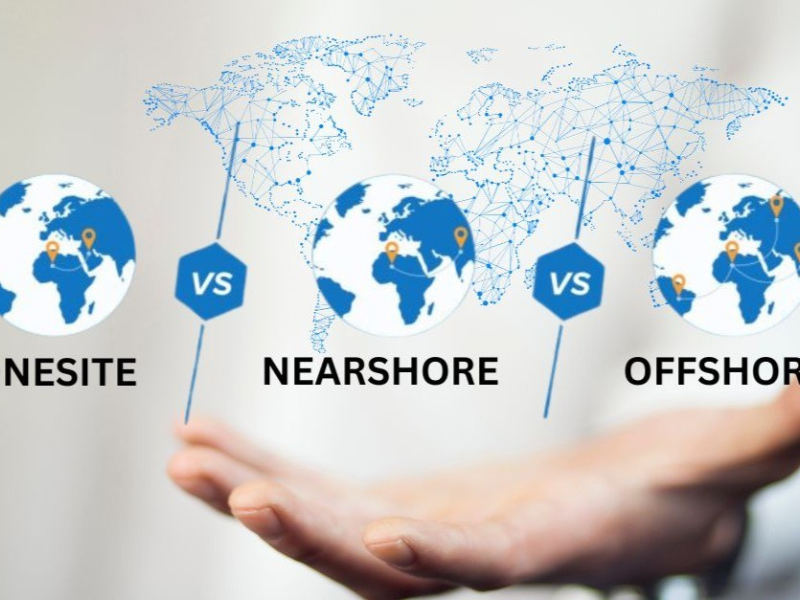
| Model | Location | Cost | Control | Best For |
|---|---|---|---|---|
| Offshore | Distant countries | Lowest | Medium | Cost efficiency, scale |
| Nearshore | Nearby countries | Medium | Higher | Collaboration, time overlap |
| Onshore | Same country | Highest | Highest | Sensitive or regulated work |
Offshore offers the strongest cost and scale advantages when processes are clear.
When Offshore Outsourcing Makes Sense for Your Business

Offshore outsourcing is a good fit if:
- Labor costs limit growth
- Hiring locally takes too long
- Work can be standardized and documented
- You plan for a long-term partnership
It may not fit if:
- Work requires constant real-time collaboration
- Processes are undefined or changing daily
- Data sensitivity outweighs cost benefits
Quick decision checklist:
- Can tasks be clearly documented?
- Do savings justify coordination effort?
How to Get Started With Offshore Outsourcing (High-Level)

- Identify non-core, repeatable tasks.
- Define scope, outcomes, and success metrics.
- Shortlist experienced providers.
- Start with a pilot team or project.
- Review performance and scale gradually.
Key Takeaways on the Benefits of Offshore Outsourcing

-
Offshore outsourcing works when treated as a strategic capacity decision, not a quick cost fix.
The value proposition is clear: Access skilled professionals at 40–70% lower cost, hire in weeks instead of months, and scale flexibly without fixed overhead. For most SMBs and growing companies, these advantages outweigh the coordination effort required.
Success depends on three factors:
- Process clarity: Can you document how work should be done and what success looks like?
- Performance measurement: Will you track results weekly and provide clear feedback?
- Long-term commitment: Are you willing to invest 60–90 days for the team to reach full productivity?
If you answer yes to all three, offshore outsourcing typically delivers 3–5x ROI within the first year.
Recommended next steps:
- Identify one non-core function consuming 20+ hours per week of your team’s time (customer support, data entry, QA testing)
- Document the current process in 2–3 pages—how it’s done today, what good output contains, how you measure success
- Run a 90-day pilot with a reputable provider, measuring both cost savings and time freed up for your internal team
- Scale only if pilot succeeds—if the offshore team delivers value, expand scope; if not, end the engagement and learn from what didn’t work
Most businesses that approach offshore outsourcing this way—clear scope, measured results, realistic timeline—build successful long-term partnerships that become competitive advantages.
FAQ – Common Questions About Offshore Outsourcing

Is offshore outsourcing only about cost savings?
No. Cost is a driver, but speed, talent access, and scalability often deliver more value.
Does offshore outsourcing reduce quality?
Quality stays consistent when processes are documented and performance is measured—regardless of location.
Quality issues stem from three sources: unclear expectations (team doesn’t know what “good” looks like), insufficient training (team lacks context or tools), or weak accountability (no one tracks results). These problems affect US teams too—they’re just more visible with offshore teams because geographic distance removes casual oversight.
The solution: Define quality standards explicitly (what metrics matter, what good output contains, what common mistakes to avoid), provide examples of excellent work, and review performance weekly in the first month. Teams that do this see offshore quality match or exceed US equivalents within 60–90 days.
What roles are best suited for offshore outsourcing?
Customer support, development, back-office, and administrative roles work best.
Read more:
- Customer Success Playbooks: The Ultimate Guide for SaaS Success
- How to Create an Effective Customer Success Plan: Step-by-Step
- How Customer Success Operations Improves Customer Service at Scale



 English
  Russian
  Chinese