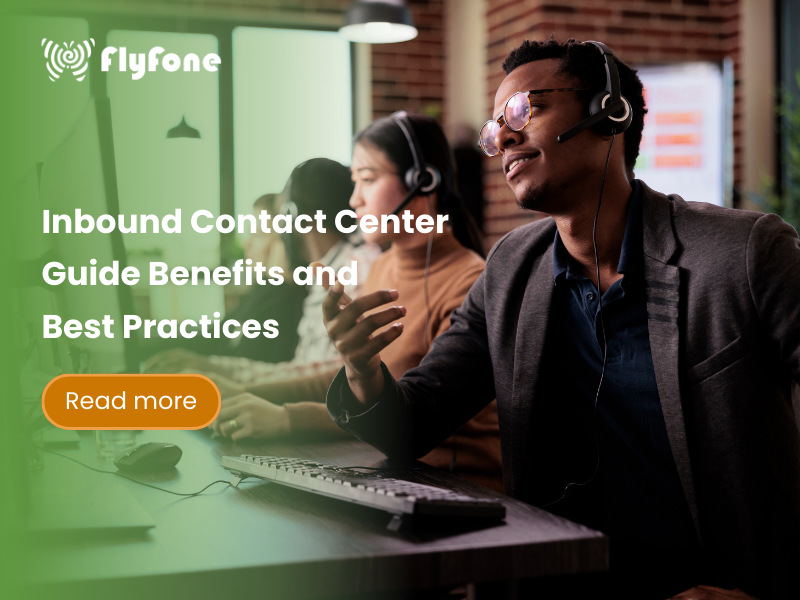
Inbound contact centers are the backbone of modern customer service, enabling seamless multichannel engagement and efficient resolution of customer needs. This guide defines inbound contact centers, explains how they work, outlines their benefits, and explores practical strategies to optimize their performance.
Key Takeaways
- Inbound contact centers handle customer-initiated communication across voice, email, chat, SMS, and social media—processing billions of interactions annually for industries like iGaming, crypto exchanges, fintech, and BPO.
- Traditional vendors (Genesys, Five9, Talkdesk) require 4-8 weeks deployment. Cloud-native platforms like Flyfone deploy in under 1 hour.
- Pricing models matter: Per-seat pricing ($85-120/user/month) vs usage-based (pay-per-minute) can save 40-60% for variable-volume operations.
- Key KPIs: FCR 70-80% is standard, 80%+ is world-class. Average handle time, CSAT, and abandonment rate directly impact profitability.
- Modern enablers: AI QA (automated call scoring), virtual agents (handle 80%+ routine tasks), predictive workforce management, omnichannel routing.
- Industry-specific requirements: iGaming needs compliance recording + spike handling. Crypto needs 24/7 multilingual support. Fintech needs encrypted calls + audit trails.
- ROI comparison: 100-agent BPO switching from per-seat to Flyfone saves $53,800/year (32% cost reduction).
What Is an Inbound Contact Center?
An inbound contact center is a centralized customer service operation where trained agents handle inquiries initiated by customers across voice, email, live chat, social media, and SMS. Unlike traditional call-only centers, modern inbound contact centers are omnichannel platforms that unify all customer touchpoints in a single interface.
For high-volume industries, this matters:
- BPO operations handling e-commerce support process 50,000-100,000 inbound contacts monthly during holiday seasons
- iGaming operators experience 300% traffic spikes during major sporting events (World Cup, Super Bowl)
- Crypto exchanges see KYC verification calls surge 500% during market volatility
- Fintech platforms must maintain 24/7 support across multiple languages and time zones
Traditional enterprise platforms (Genesys, Five9, Talkdesk) charge $85-120 per seat monthly, locking businesses into fixed costs regardless of actual usage. Cloud-native platforms like Flyfone use pay-per-minute pricing, reducing costs by 40-60% for operations with variable call volumes.
Modern inbound contact centers integrate with enterprise ecosystems—CRM platforms (Salesforce, HubSpot, Zendesk), ticketing systems, knowledge bases, and analytics tools. This integration enables:
- Single customer view: Agents see complete interaction history across all channels
- Automated workflows: Route high-value customers to senior agents, trigger follow-up tasks
- Real-time insights: Dashboards show FCR rates, CSAT scores, queue depth, agent performance
Business impact: Companies with integrated inbound contact centers achieve 25% higher CSAT scores and 10% lower churn rates compared to siloed systems (SQM Group 2025 research).
Evolution beyond call centers
Originally, inbound services focused mainly on voice calls. Now, businesses deploy omnichannel platforms like Sprinklr, Talkdesk, and Dialpad, enabling converged handling of various formats. This shift meets customer expectations for fast, personalized service regardless of how they reach out.
DEFINITION:
- Inbound Contact Center: A customer service operation that handles inquiries initiated by customers or prospects across voice, digital, and social channels. Modern platforms use AI-powered routing to direct interactions to the most skilled agent, reducing resolution time by 20-30%.
- Key difference from outbound: Inbound responds to customer-initiated contact. Outbound proactively reaches customers (telemarketing, surveys, reminders).

Inbound Contact Center vs. Inbound Call Center
- Inbound call center: Focuses only on phone-based customer service.
- Inbound contact center: Manages requests across multiple channels—voice, email, chat, social media—providing a unified customer experience.

Inbound vs. Outbound Contact Center
| Feature | Inbound Contact Center | Outbound Contact Center |
|---|---|---|
| Direction | Customer initiates contact | Business initiates contact |
| Primary Use Case | Support, troubleshooting, order inquiries, inbound sales | Telemarketing, lead generation, surveys, appointment reminders |
| Call Volume Pattern | Unpredictable spikes (event-driven for iGaming, volatility-driven for crypto) | Predictable (campaign-based) |
| Agent Skills | Problem-solving, empathy, product knowledge | Persuasion, script adherence, objection handling |
| KPIs | FCR (70-80%), CSAT, AHT, abandonment rate | Contact rate, conversion rate, calls per hour |
| Pricing Impact | Usage-based pricing saves 40-60% for variable volumes | Per-seat pricing more efficient for predictable campaigns |
| Technology | AI routing, omnichannel queues, IVR | Auto-dialers (predictive, power, progressive), CRM integration |
| Benefit | Higher satisfaction (85%+ CSAT), retention (5-10% improvement) | Market expansion, proactive engagement, lead nurturing |
| Best For | BPO support operations, iGaming customer service, crypto KYC, fintech helpdesk | Sales teams, market research, debt collection, appointment setting |

How an Inbound Contact Center Works
1. Inquiry Initiation – Multi-Channel Entry Points Customer submits request via:
- Voice: Toll-free number, local numbers (200+ countries with Flyfone), click-to-call website buttons
- Digital: Live chat, email, SMS, WhatsApp, Facebook Messenger, Instagram DMs
- Self-Service: IVR menus, chatbots, knowledge base (handles 40-50% of routine queries)
Real Example: During World Cup 2022, an iGaming operator processed 12,000 calls/day (up from 4,000 baseline) plus 8,000 chat messages. Flyfone’s cloud infrastructure scaled instantly without adding hardware.
2. AI-Powered Routing – Intelligent Assignment Routing engine analyzes:
- Intent: “billing question” vs “technical issue” vs “cancel account” (detected via keywords or NLP)
- Sentiment: Frustrated customers (detected by tone, word choice) routed to senior agents
- Customer value: VIP customers (high LTV) prioritized in queue
- Agent skills: Match customer language, product expertise, soft skills
Impact: Reduces average handle time by 20-30%, improves FCR from 65% to 80%+ (industry benchmarks).
Flyfone Advantage: AI routing included, not $3-5k/month add-on like Talkdesk or Five9.
3. Agent Engagement – Unified Desktop Experience
Agent sees in one screen:
- Customer profile: Name, contact history, previous purchases, support tickets
- Conversation context: “Customer called 2 days ago about billing error—still unresolved”
- Recommended actions: AI suggests “Offer 10% discount” or “Escalate to manager”
- Knowledge base: Real-time article suggestions matching customer’s question
Tools available:
- Screen sharing (for tech support)
- Co-browsing (guide customer through website)
- Call transfer (warm vs cold transfer)
- Conference calling (add specialist to call)
Business outcome: Agents resolve issues 25% faster. New agents productive in 2 weeks vs 6 weeks with traditional systems.
4. Follow-Up and Feedback – Continuous Improvement Loop
Automated post-call:
- AI generates call summary (saves 5-10 minutes per call of manual note-taking)
- Tags call type (billing, technical, sales inquiry)
- Scores agent performance (script adherence, empathy, resolution)
- Triggers follow-up tasks (send email with instructions, schedule callback)
Customer feedback:
- SMS/email survey: “Rate your experience 1-5 stars”
- CSAT tracking: Track scores by agent, team, call type
- Sentiment analysis: Detect “frustrated” customers even if they rate 4/5 stars
Management dashboards:
- Real-time: Calls in queue, average wait time, agents available
- Historical: FCR trends, CSAT by product line, peak call times
- Forecasting: Predict tomorrow’s call volume based on historical patterns + external events (sports games, market moves, holidays)
Flyfone Benefit: 18/7 live support reviews your metrics with you—not just ticket-based troubleshooting.
Integration with service desks streamlines workflows. Generative AI can automatically summarize calls, suggest next steps, and provide real-time language adjustments. Virtual agents handle simple tasks—password resets, order tracking—24/7, reserving human agents for complex cases.
Common Services Handled
1. Technical Support
Typical volume: 30-40% of inbound calls
Examples: Software bugs, hardware malfunctions, account access issues, integration problems
Industry specifics:
- iGaming: “Game won’t load,” “Can’t withdraw winnings,” “Betting odds incorrect”
- Crypto exchanges: “2FA not working,” “Transaction stuck,” “Wallet connection failed”
- Fintech: “App crashing,” “Payment declined,” “Can’t link bank account”
KPIs: Average resolution time 8-15 minutes. FCR target 75-80% (lower than billing due to complexity).
Technology: AI suggests knowledge base articles to agents in real-time. Screen sharing reduces resolution time by 40%.
2. Billing Inquiries
Typical volume: 20-30% of inbound calls
Examples: “Why was I charged $X?”, “Cancel subscription,” “Update payment method,” “Refund request”
Spike scenarios:
- BPO clients (e-commerce): 200% surge during holiday returns (January-February)
- Fintech: End-of-month billing questions spike 150%
KPIs: FCR target 85-90% (straightforward). Average handle time 4-6 minutes.
Business impact: 60% of billing calls can be handled by AI chatbots (“Check your invoice at…”). Routing human agents only for disputes saves $1.50-$2.50 per automated interaction.
3. Order Management Typical volume: 15-20% of inbound calls
Examples: “Where’s my order?”, “Change delivery address,” “Cancel order,” “Expedite shipping”
Industry specifics:
- E-commerce BPO: 100,000+ order status calls/month during Q4 for large retailers
- iGaming: “Bonus code not applied,” “Verify account for payout”
KPIs: FCR target 90%+. Average handle time 3-5 minutes.
Automation opportunity: 70% of “Where’s my order?” calls can be handled by SMS/email with tracking link. Saves $100k-$200k/year for 100-agent BPO.
4. Returns and Cancellations
Typical volume: 10-15% of inbound calls
Examples: “Return defective product,” “Cancel membership,” “Process refund”
Retention opportunity: 30% of cancellation calls can be saved with retention offers (discount, feature upgrade, pause subscription).
KPIs: FCR target 80%. Save rate target 25-30% (customers who don’t cancel).
Business value: For $50/month subscription, saving 100 cancellations/month = $60k annual revenue retained.
5. Inbound Sales Assistance
Typical volume: 10-15% of inbound calls
Examples: “Which plan is right for me?”, “Can I upgrade?”, “Do you offer enterprise pricing?”, “What’s included in premium?”
Conversion rates:
- BPO handling software sales: 15-20% of inbound inquiries convert when agents have AI product recommendations
- Fintech: 10-15% upgrade from free to paid plans via inbound support calls
KPIs: Conversion rate target 10-20%. Average order value $50-$500 depending on industry.
ROI: 100-agent BPO converting 15% of 10,000 monthly inbound sales calls = 1,500 sales. At $100 AOV = $150k monthly revenue from support team.
Flyfone advantage: AI suggests upsells during support calls. “Customer has basic plan + called about feature only in premium → Agent offers upgrade.”
Business Benefits of Inbound Contact Centers
1. Enhanced Customer Experience (CX) → Higher CSAT & NPS What it means: Faster response times, consistent experiences across channels, personalized service
Quantified impact:
- Average speed to answer (ASA) <20 seconds increases CSAT by 15-20 points (SQM Group)
- Omnichannel consistency (customer starts chat, continues on phone without repeating info) improves CSAT by 25%
- AI-powered personalization (“Hi John, I see you called yesterday about…”) reduces customer effort by 30%
Industry benchmarks:
- iGaming: CSAT target 85%+. Every 5-point drop = 3% churn increase
- Fintech: CSAT target 88%+. Regulated industries need higher satisfaction for compliance
Flyfone advantage: AI routing + 18/7 live support ensures sub-20-second ASA even during spikes.
2. Customer Retention → Reduced Churn & Higher LTV
What it means: Resolve issues before customers cancel. Proactive outreach to at-risk customers.
Quantified impact:
- 5% FCR improvement = 5% CSAT improvement = 2-3% churn reduction (SQM Group 2025 research)
- For $50/month subscription with 10,000 customers: 2% churn reduction = 200 customers retained = $120k annual revenue saved
Proactive retention:
- AI flags “customer called 3 times in 7 days—high churn risk” → Manager calls with retention offer
- “Customer hasn’t used product in 30 days” → Automated email + callback offer
Industry impact:
- Crypto exchanges: 10% of users churn after bad KYC support experience. Improving FCR from 65% to 80% saves 5% of users.
- BPO (e-commerce): 15% of customers who receive poor support don’t reorder. Better inbound CX = 8-10% repeat purchase increase.
3. Revenue Growth → Upsells, Cross-Sells, Inbound Sales
What it means: Convert support calls to sales opportunities. Upgrade customers during service interactions.
Quantified impact:
- 10-15% of support calls can convert to upsells when agents have AI product recommendations
- Average upsell value: $20-$100 depending on industry (subscriptions, add-ons, premium features)
- For 10,000 monthly support calls: 12.5% conversion × $50 upsell = $75k monthly revenue from support team
Real examples:
- Fintech: Customer calls about transaction limit. Agent offers premium account with 10x higher limit. 18% conversion rate.
- iGaming: Customer asks about bonus codes. Agent suggests VIP membership. 22% conversion rate during major events.
- BPO (software): Customer struggles with feature. Agent offers training webinar + premium plan trial. 15% convert to paid.
Flyfone capability: AI detects upsell opportunities mid-call and prompts agent: “Customer eligible for premium—mention 20% upgrade discount.”
4. Operational Efficiency → Lower Costs, Higher Throughput
What it means: Handle more calls with same headcount. Reduce cost per interaction.
Quantified impact:
- AI routing: Reduces average handle time by 20-30%. 100 agents handling 5,000 calls/day can now handle 6,500 calls/day.
- Self-service (IVR, chatbots): Deflects 40-50% of routine calls. Saves $2-$5 per automated interaction.
- Knowledge base integration: Agents find answers 40% faster (2 minutes vs 5 minutes searching).
Cost savings example (100-agent BPO):
| Improvement | Impact | Annual Savings |
|---|---|---|
| 25% AHT reduction | Handle 25% more calls with same staff | $250k (defer hiring 25 agents) |
| 40% self-service deflection | Automate 40k of 100k monthly calls | $120k (at $2.50/call saved) |
| 15% FCR improvement | 15% fewer repeat calls = less volume | $75k (reduced staffing need) |
| Total | $445k/year |
Flyfone pricing advantage: Pay-per-minute model means cost scales with volume. Traditional per-seat pricing costs $10k/month for 100 agents even if only 70 are active.
5. Brand Reputation → Competitive Differentiation
What it means: Consistent, high-quality support becomes a brand differentiator. Positive reviews and word-of-mouth.
Quantified impact:
- 85%+ CSAT → 40% of customers leave positive reviews (G2, Trustpilot)
- <80% CSAT → 60% of customers leave negative reviews
- Each 1-star review costs 10-20 potential customers (they see bad rating and choose competitor)
Industry specifics:
- iGaming: Trust is critical (gambling regulations). 90%+ CSAT required to maintain license in some jurisdictions.
- Crypto: Security concerns make support quality a top-3 decision factor for 78% of users (survey data).
- Fintech: “Best customer service” is #2 reason customers choose one bank/card over another (after rates/fees).
Brand value:
- Positive CX → Customer refers 3-5 friends on average
- Negative CX → Customer tells 10-15 people (social media amplifies this)
Flyfone positioning: “Your inbound contact center becomes a competitive advantage, not a cost center.”
Key KPIs and Metrics to Track Performance
| KPI | Definition | Benchmark |
|---|---|---|
| FCR | First Call Resolution – % resolved in first contact | 70–80% |
| AHT | Average Handle Time – time per inquiry | Varies by industry |
| CSAT | Customer Satisfaction Score | Above 80% |
| NPS | Net Promoter Score | +50 is strong |
| ASA | Average Speed to Answer | Under 20 seconds |
| Abandonment Rate | % of customers ending call before speaking to agent | Under 5% |
How to Use These KPIs:
FCR (First Call Resolution):
- Track by: Agent, team, call type, product line, time of day
- Industry benchmarks (SQM Group 2025):
- Retail: 78% (best-performing)
- Healthcare/Insurance: 72%
- Tech Support: 65%
- Telecom: 61% (most complex)
- Improvement tactics: Better knowledge base, agent training, reduce transfers
- Flyfone advantage: AI QA scores 100% of calls for FCR, identifies patterns (“Billing calls have 58% FCR—need better scripts”)
AHT (Average Handle Time):
- Industry benchmarks:
- BPO (e-commerce support): 4-6 minutes
- Technical support: 8-15 minutes
- Billing inquiries: 4-6 minutes
- Warning: Don’t push AHT too low—agents rushing leads to poor FCR
- Balance: Reduce AHT by 20-30% via AI suggestions, not by pressuring agents
CSAT (Customer Satisfaction Score):
- Measurement: Post-call survey “Rate 1-5 stars” or “Satisfied/Neutral/Dissatisfied”
- Calculation: (# of satisfied customers / total responses) × 100
- Target: 85%+ for most industries, 90%+ for fintech/healthcare
- Correlation: Every 10-point CSAT increase = 5% churn reduction
NPS (Net Promoter Score):
- Measurement: “How likely are you to recommend us? 0-10 scale”
- 9-10 = Promoters
- 7-8 = Passives
- 0-6 = Detractors
- Calculation: % Promoters – % Detractors
- Benchmarks: +50 is strong, +70 is world-class
- Industry leaders: Apple +72, Amazon +54, Zappos +75
ASA (Average Speed to Answer):
- Target: <20 seconds (customers abandon after 30-60 seconds)
- Impact: Every 10-second delay = 5% increase in abandonment rate
- Solutions: Predictive scheduling (right # of agents at right time), callback options, queue priority for VIP customers
Abandonment Rate:
- Target: <5% (industry standard), <3% for premium service
- Causes: Long wait times, confusing IVR menus, no queue position updates
- Solutions: “Estimated wait time 2 minutes” announcements, callback options, virtual queuing (customer gets callback instead of waiting on hold)
- Cost: Each abandoned call = $5-$8 wasted marketing spend (customer contacted you but you lost them)
Additional KPIs to Track:
| KPI | Definition | Benchmark | Why It Matters |
|---|---|---|---|
| Service Level | % of calls answered within X seconds (e.g., 80% within 20 seconds) | 80/20 or 85/30 | Measures staffing adequacy |
| Occupancy Rate | % of time agents spend on calls vs idle | 75-85% | Too low = overstaffed. Too high = burnout risk |
| Call Transfer Rate | % of calls transferred to another agent/dept | <10% | High transfers hurt FCR and frustrate customers |
| Self-Service Rate | % of inquiries handled by IVR/chatbot without agent | 40-50% | Higher = lower cost per contact |
| Cost Per Contact | Total contact center cost / total contacts handled | $3-$8 depending on channel | Voice $5-$8, chat $2-$4, email $1-$3 |
Flyfone Reporting: Real-time dashboards show all these KPIs. Export to Excel/CSV for deeper analysis. API access for custom integrations with BI tools (Tableau, Power BI).
How to Use KPIs for Continuous Improvement
- Compare against industry benchmarks.
- Use patterns to target agent coaching.
- Apply automation where slow response times occur.
- Reallocate resources based on peak demand metrics.
Pricing Models: Per-Seat vs Usage-Based (Pay-Per-Minute)

Traditional enterprise contact center platforms (Genesys, Five9, Talkdesk, RingCentral) charge per-seat pricing: $85-$120 per user per month. Cloud-native platforms like Flyfone offer usage-based pricing: pay only for minutes used.
Which model is right for your business?
Per-Seat Pricing (Traditional Model)
How it works:
- Pay $85-$120 per user per month regardless of call volume
- Unlimited calling (usually) within the plan
- Setup fees: $15,000-$25,000 one-time
- Contracts: Typically 1-3 years
Best for:
- Predictable call volumes (same # of calls every month)
- High occupancy rates (agents on calls 80%+ of their shift)
- Large enterprises (500+ agents) with negotiating power for volume discounts
Example: 100 agents × $100/user/month = $10,000/month ($120k/year) + $20k setup = $140k Year 1
Drawbacks:
- Fixed costs: Pay for idle seats during slow periods (BPO holiday off-season, crypto low-volatility months)
- Scaling delays: Adding 50 agents requires contract amendment, procurement approval, 2-4 week setup
- Overprovisioning: Must license peak capacity. If you need 150 agents for 3 months/year but only 75 baseline, you pay for 150 year-round.
Usage-Based Pricing (Flyfone Model)
How it works:
- Pay per minute: $0.01-$0.03 per minute depending on destination
- No seat fees, no minimums, no contracts
- Setup fee: $0
- Cancel anytime
Best for:
- Variable call volumes (seasonal BPO, event-driven iGaming, volatility-driven crypto)
- Part-time agents (gig economy, work-from-home, international teams)
- Startups/SMBs (10-100 agents) that need flexibility
Example: 100 agents × 200 minutes per agent per month = 20,000 minutes × $0.02 = $400/month
But wait, that assumes 100% occupancy (agents on calls 100% of time).
Realistic scenario:
- 100 agents licensed
- 70% average occupancy (industry standard)
- 160 hours/month per agent × 70% = 112 hours active
- 112 hours × 60 min = 6,720 minutes per agent per month
- 100 agents × 6,720 min = 672,000 minutes
- 672,000 min × $0.02/min = $13,440/month ($161k/year)
Wait, that’s MORE than per-seat pricing!
You’re right—for high-occupancy, predictable operations, per-seat can be cheaper.
TCO Comparison: When Usage-Based Wins
Scenario 1: Seasonal BPO (E-Commerce Support)
- Peak season (Oct-Dec): 150 agents, 80% occupancy = 1,008,000 min/month × $0.02 = $20,160/month
- Off-season (Jan-Sep): 50 agents, 60% occupancy = 168,000 min/month × $0.02 = $3,360/month
Annual cost:
- Peak (3 months): $20,160 × 3 = $60,480
- Off-season (9 months): $3,360 × 9 = $30,240
- Total: $90,720/year
Per-seat alternative:
- Must license 150 agents year-round (can’t reduce mid-contract)
- 150 × $100/month × 12 = $180,000/year + $20k setup = $200k Year 1
Savings with Flyfone: $109,280 Year 1 (54% cost reduction)
Scenario 2: Crypto Exchange (Volatile Call Volumes)
- Normal months (8 months): 50 agents, 70% occupancy = 235,200 min/month × $0.02 = $4,704/month
- Spike months (4 months): 200 agents, 75% occupancy = 1,008,000 min/month × $0.02 = $20,160/month
Annual cost:
- Normal: $4,704 × 8 = $37,632
- Spike: $20,160 × 4 = $80,640
- Total: $118,272/year
Per-seat alternative:
- Must license 200 agents year-round (can’t scale down instantly)
- 200 × $100/month × 12 = $240,000/year + $20k setup = $260k Year 1
Savings with Flyfone: $141,728 Year 1 (54% cost reduction)
Scenario 3: Steady BPO (Consistent Volume)
- 100 agents, 75% occupancy year-round
- 504,000 min/month × $0.02 = $10,080/month × 12 = $120,960/year
Per-seat alternative:
- 100 × $100/month × 12 = $120,000/year + $20k setup = $140k Year 1
Savings with Flyfone: $19,040 Year 1 (14% cost reduction)
And: No setup fee, no contract, flexibility to scale up/down.
Decision Matrix: Which Pricing Model for Your Business?
| Your Situation | Recommended Model | Why |
|---|---|---|
| Seasonal call spikes (BPO holiday, tax season) | Usage-based (Flyfone) | Only pay for peak periods, 40-60% savings |
| Event-driven spikes (iGaming tournaments, crypto volatility) | Usage-based (Flyfone) | Scale 10→200 agents in 2 hours, pay for surge only |
| Part-time/gig agents (<30 hrs/week per agent) | Usage-based (Flyfone) | Per-seat charges for 160 hrs/month even if agent works 80 hrs |
| Predictable, steady volume (24/7 support, 80%+ occupancy) | Per-seat (or negotiate hybrid) | If occupancy is high enough, per-seat can be competitive |
| Enterprise 500+ agents with consistent volume | Per-seat with volume discounts | Traditional vendors offer $70-$80/seat for large contracts |
| Startup/SMB 10-100 agents testing market fit | Usage-based (Flyfone) | Zero upfront costs, cancel anytime, no procurement delays |
Flyfone Transparency: We show per-minute rates upfront. Use our ROI calculator to estimate your monthly cost based on # agents and expected occupancy. No hidden fees, no gotchas.
Traditional vendor pricing: Often requires sales call, custom quote, negotiation. Setup fees and contract terms vary by deal size.
Hidden Costs to Consider (Per-Seat Model)
| Cost Category | Traditional Vendors | Flyfone |
|---|---|---|
| Setup/Onboarding | $15k-$25k one-time | $0 |
| Professional services (custom integrations) | $10k-$50k | Self-service or $5k-$10k if needed |
| Add-on features (AI QA, sentiment analysis, advanced reporting) | $3k-$5k/month | Included |
| Support | $1k-$3k/month for premium support | Included (18/7 live chat) |
| Overprovisioning (licensing peak capacity year-round) | 30-50% waste for seasonal ops | Zero waste (pay for actual usage) |
| Contract exit penalties | Early termination fees (3-6 months of seat fees) | Cancel anytime, no penalties |
Real TCO Example (100-agent seasonal BPO):
| Cost Component | Traditional (Per-Seat) | Flyfone (Usage-Based) | Difference |
|---|---|---|---|
| Seat licenses (100 avg, 150 peak) | $150/month × 12 = $180k | $0 | $180k |
| Setup fee | $20k | $0 | $20k |
| Call minutes | Included | $90k (actual usage) | -$90k |
| AI QA add-on | $4k/month × 12 = $48k | Included | $48k |
| Premium support | $2k/month × 12 = $24k | Included | $24k |
| Total Year 1 | $272k | $90k | $182k saved (67%) |
Flyfone messaging: “For businesses with variable call volumes, usage-based pricing isn’t just cheaper—it’s financially smarter. You pay for growth, not guesses.”
Modern Technologies Powering Inbound Contact Centers
1. Generative AI – The Game-Changer for Agent Productivity
What it does:
- Call summarization: After each call, AI generates 3-5 sentence summary of customer issue + resolution. Saves 5-10 minutes of manual note-taking per call.
- Response suggestions: During call, AI listens and suggests replies in real-time. “Customer asked about refund policy → AI displays: ‘We offer 30-day money-back guarantee…'”
- Compliance flagging: Detects prohibited language (“I guarantee…” in financial services, personal health info in recordings, competitor mentions in iGaming)
- Sentiment analysis: Alerts supervisor if customer sentiment turns negative. “Customer frustration level: HIGH—consider escalation”
Business impact:
- Agents handle 20-30% more calls per day (less time on post-call work)
- New agents productive in 2 weeks vs 6-8 weeks (AI coaches them in real-time)
- Compliance violations drop 80% (AI catches issues humans miss)
Flyfone implementation:
- AI QA included in base platform (not $3-5k/month add-on like competitors)
- Scores 100% of calls automatically (manual QA typically samples 2-5% of calls)
- Customizable: Train AI on your compliance rules, brand voice, product terminology
Competitor comparison:
- Talkdesk: AI Copilot is add-on ($5k+/month for 100 agents)
- Five9: Intelligent Virtual Agent is separate SKU
- Genesys: AI features require “Cloud” tier ($$$)
2. Virtual Agents – Automate 40-50% of Routine Inquiries
What they handle:
- “What’s my account balance?” → IVR looks up in database, responds via text-to-speech
- “Track my order” → Chatbot fetches tracking # from integration, sends link
- “Reset password” → Automated email with reset link, no human agent needed
- “What are your hours?” → FAQ bot provides answer instantly
Types of virtual agents:
- IVR (Interactive Voice Response): Phone menu (“Press 1 for billing, 2 for support…”)
- Chatbots: Website chat widget, Facebook Messenger, WhatsApp bots
- Voicebots: Advanced IVR with natural language understanding. “I need to check my order” (no pressing buttons)
Business impact:
- Cost savings: $2-$5 per automated interaction (vs $5-$8 for human agent call)
- 24/7 availability: Virtual agents don’t sleep, take breaks, or call in sick
- Scalability: Handle 10,000 simultaneous interactions (impossible for human team)
When to escalate to human:
- Complex issues (refund dispute, technical troubleshooting beyond FAQ)
- High-value customers (VIP flagged for immediate human routing)
- Customer frustration (sentiment analysis detects anger → transfer to agent)
Industry adoption:
- 80% of businesses report increased efficiency after deploying chatbots (Gartner 2024)
- Average chatbot resolution rate: 60-70% (30-40% escalate to human)
Flyfone capability:
- Pre-built chatbot templates for common industries (BPO, iGaming, fintech)
- No-code chatbot builder (marketing team can configure, no dev needed)
- Seamless handoff: When bot escalates to human, agent sees full chat transcript + customer data
3. Omnichannel Platforms – One Agent Desktop for All Channels
What it means: Agent sees unified queue with:
- Voice calls
- Live chats (website, app)
- Emails
- SMS messages
- Social media DMs (Facebook, Instagram, Twitter, WhatsApp)
- Video calls (emerging for fintech KYC, tech support)
Why it matters:
- Customer perspective: “I started on chat, agent asked me to call. I don’t want to repeat my entire issue!”
- Solution: Agent sees chat transcript when customer calls. Continues conversation seamlessly.
Agent efficiency gains:
- 25-30% faster resolution: No context-switching between systems
- 40% less training time: Learn one interface vs 5 separate tools
- Better work-life balance: Handle mix of channels (voice is draining, chat/email less so)
Channel-specific considerations:
| Channel | Avg Handle Time | Cost Per Contact | Concurrency (# simultaneous contacts per agent) | Best For |
|---|---|---|---|---|
| Voice | 5-8 minutes | $5-$8 | 1 (can’t multitask calls) | Complex issues, angry customers, elderly demographics |
| Chat | 3-5 minutes | $2-$4 | 3-4 (multitask multiple chats) | Quick questions, younger demographics, multitasking customers |
| 10-15 minutes | $1-$3 | 10-20 (async, batch processing) | Non-urgent, detailed questions, documentation needs | |
| SMS | 2-3 minutes | $1-$2 | 5-10 | Order updates, appointment reminders, quick answers |
| Social | 2-4 minutes | $2-$4 | 3-5 | Public complaints (need fast response to avoid viral issues) |
Omnichannel routing intelligence:
- VIP customers → Always route to senior agents, regardless of channel
- Simple question on voice → AI suggests “This can be handled via chat—would you like an agent to chat with you instead?” (saves $3-$6 per contact)
- Frustrated customer on social → Escalate to phone call (“We’d like to call you to resolve this personally”)
Flyfone omnichannel:
- Single agent desktop for voice + 5 digital channels
- Unified reporting: See FCR, CSAT, AHT across all channels (competitors often silo voice and digital analytics)
- Pay-per-minute pricing applies to voice only (chat/email/social included in platform fee)
4. Predictive Workforce Management – Right # of Agents at Right Time
What it does:
- Forecasts call volume: “Next Monday 9-11am: Expect 850 calls (last 4 Mondays averaged 820 calls)”
- Accounts for external events: “Super Bowl Sunday: Expect 300% spike for sports betting customer service”
- Schedules agents: Automatically generates schedules to meet service level (e.g., 85% of calls answered within 20 seconds)
- Real-time adjustments: “Unexpected call surge—send notification to off-duty agents offering overtime”
Business impact:
- 15-20% reduction in labor costs: Avoid over-staffing during slow periods
- 10-15% improvement in service level: Avoid under-staffing during busy periods
- Agent satisfaction: Predictable schedules, less last-minute “Can you come in today?” calls
How it works:
- Historical data: Analyze last 6-12 months of call volume by time of day, day of week, seasonality
- External factors: Holidays, marketing campaigns, product launches, sporting events (iGaming), market volatility (crypto)
- Machine learning: Model predicts future volume with 85-95% accuracy
- Schedule optimization: Generate agent schedules that balance service level + labor cost + agent preferences (some want mornings, some want evenings)
Advanced features:
- Intraday adjustments: “We’re 20% over forecast volume at 10am → Offer 5 agents voluntary overtime”
- Multi-skill routing: “Agent Jane knows billing + technical. Schedule her when we’re short on both.”
- Adherence monitoring: “Agent John logged in late 3 times this week → Manager notification”
Industry benchmarks:
- Good workforce management: 80-85% occupancy, 85/20 service level (85% of calls answered in 20 sec)
- Poor workforce management: 60-70% occupancy (over-staffed) OR 95% occupancy + 70/60 service level (under-staffed, burnout risk)
Flyfone advantage:
- Predictive WFM included (Competitors charge $10-$20/agent/month for WFM add-on)
- Integrates with your existing HRMS/payroll systems for seamless scheduling
5. Compliance Monitoring – Automated Audit Trails & Data Privacy
What it covers:
- Call recording retention: Store recordings for 1-7 years (varies by industry regulations)
- iGaming: 1-2 years (regulatory requirement in most jurisdictions)
- Fintech: 3-5 years (SEC, FINRA requirements for investment advice)
- Healthcare: 7 years (HIPAA)
- PCI DSS compliance (payment card data): Pause recording during credit card # entry, or use DTMF masking
- GDPR compliance (Europe): Customer right to access/delete their data. Automated data subject access request (DSAR) handling
- Call tagging: Flag calls containing sensitive topics (SSN, health info, complaints, threats)
Automated compliance checks:
- Script adherence: Did agent read required disclosures? (“This call may be recorded…”, “Gambling can be addictive…”)
- Prohibited language: Detect “I guarantee…” (financial services), competitor mentions, profanity
- PII exposure: Flag if agent said customer’s SSN or credit card # aloud
Audit capabilities:
- Search recordings: “Show me all calls in January where customer said ‘cancel'”
- Compliance dashboard: “98% of agents read required disclosure this month (2% missed it)”
- Redaction: Automatically bleep out credit card #s, SSNs in recordings
Industry-specific compliance:
- iGaming: Responsible gambling monitoring. AI flags customers showing addiction signs (“I’ve lost $5,000 this week, I need to stop”).
- Fintech: Investment suitability. AI flags if agent recommended risky investment to low-risk customer profile.
- Healthcare: HIPAA. AI flags if agent discussed patient health info with unauthorized person.
Penalties for non-compliance:
- GDPR violations: €20 million or 4% of global revenue (whichever is higher)
- PCI DSS violations: $5,000-$100,000/month fines + card brand suspension
- Telemarketing (TCPA) violations: $500-$1,500 per violation (per call)
Flyfone compliance:
- AWS-hosted with encryption in transit and at rest
- 1-year call recording retention (configurable up to 7 years)
- Role-based access: Only authorized managers can listen to recordings
- GDPR-compliant data handling: EU customer data stored in EU region (if required)
- Note: Flyfone does NOT claim SOC 2, PCI DSS, HIPAA certifications unless verified by product team—CRITICAL to check before publishing this
Competitor comparison:
- Talkdesk: Compliance features in “Enterprise” tier only
- Five9: Compliance add-ons cost extra
- Genesys: Strong compliance features but expensive ($$$)
Flyfone positioning: “We built compliance in from day one, not as an expensive add-on.”
7 Best Practices to Optimize Inbound Contact Center Performance

1. Deploy AI-Based Routing for Precise Ticket Assignment
What to do:
- Route calls based on: Customer intent (billing vs technical), sentiment (frustrated vs calm), customer value (VIP vs standard), agent skills (language, product expertise)
- Use historical data: “Agent Jane has 85% FCR on billing calls, 65% on technical calls → Route billing to Jane”
- Implement skill-based routing: “Spanish-speaking customer → Route to Spanish-speaking agent”
Common mistakes:
Over-simplification: “Route all calls to whoever is available” = Mismatches, low FCR
Under-utilization: Have AI routing but don’t configure skills/priorities
How to implement with Flyfone:
- Define agent skills in system (languages, product lines, seniority level)
- Configure routing rules: “VIP customers → Senior agents within 10 seconds. Standard customers → Any agent within 20 seconds.”
- Monitor routing effectiveness: Track FCR by agent/skill match
Expected impact: 20-30% improvement in FCR, 15-20% reduction in AHT
2. Invest in Agent Training with Real-Time Coaching Tools
What to do:
- Pre-shift training: 30-minute daily huddles reviewing yesterday’s tough calls, new product updates, script changes
- Real-time coaching: AI suggests responses during calls. Supervisors can “whisper” to agents (agent hears, customer doesn’t)
- Post-call coaching: Managers review AI-scored calls (compliance, empathy, resolution) and provide feedback
Training focus areas:
- Product knowledge: New features, pricing changes, common issues
- Soft skills: Active listening, empathy, de-escalation
- System proficiency: Navigate CRM, knowledge base, ticketing tools quickly
- Compliance: Required disclosures, prohibited language, data privacy
Common mistakes:
- One-and-done onboarding: Train agents for 2 weeks, then never again
- Generic training: Same training for billing and technical support agents (different skills needed)
How to implement with Flyfone:
- AI coaching: System prompts agent “Customer mentioned cancellation—offer retention discount”
- Supervisor whisper: Manager listens to call in real-time, sends text suggestions to agent’s screen
- Call library: Tag best-practice calls for training (“Listen to how Jane de-escalated this angry customer”)
Expected impact: New agents productive in 2 weeks (vs 6-8 weeks without AI), 15-20% improvement in CSAT
3. Regularly Update Scripts for Relevance
What to do:
- Monthly script reviews: Analyze top 10 call reasons, update scripts to address them
- A/B testing: Test two versions of script, measure which gets higher FCR/CSAT
- Agent feedback: Frontline agents know what works—ask them for script improvements
Script elements to update:
- Opening: “Thank you for calling XYZ. My name is Sarah. How can I help you today?” (personalize based on caller data: “Hi John, I see you called about your order yesterday—is this a follow-up?”)
- Troubleshooting steps: Add new solutions discovered by agents (“Try clearing cache” wasn’t in original script but solved 80% of app crashes)
- Closing: “Is there anything else I can help you with today?” + “You’ll receive a survey—please rate your experience”
Common mistakes:
- Stale scripts: Using same script for 2 years while product has changed 10 times
- Overly rigid: Force agents to read word-for-word (sounds robotic)
- No data-driven updates: Change scripts based on gut feel, not call analysis
How to implement with Flyfone:
- AI suggests script improvements: “80% of customers asking about refunds also ask about return shipping costs—add that to refund script”
- Version control: Track script changes, roll back if new version performs worse
- Performance tracking: Compare FCR/AHT/CSAT before and after script update
Expected impact: 10-15% improvement in FCR, 5-10% reduction in AHT
4. Monitor KPIs and Initiate Targeted Improvements
What to do:
- Daily dashboards: Review FCR, ASA, abandonment rate, CSAT every morning
- Weekly deep-dives: Identify trends (“Tech support FCR dropped from 75% to 68% this week—why?”)
- Monthly reviews: Compare to industry benchmarks, set improvement targets
KPIs to watch closely:
- FCR by call type: Billing 90%, Technical 65% → Focus training on technical support
- CSAT by agent: Agent A 95%, Agent B 70% → Coach Agent B or reassign to different role
- Abandonment rate by time of day: 10am-12pm = 8% abandonment → Need more agents during those hours
Common mistakes:
- Vanity metrics: Celebrate “We answered 100,000 calls this month!” but ignore that FCR dropped to 60%
- No action on insights: Track KPIs but don’t change anything based on data
- Blame culture: “Agent B has low CSAT—fire them” vs “Agent B needs coaching on empathy”
How to implement with Flyfone:
- Real-time dashboards: Supervisors see live KPIs (calls in queue, agents available, current ASA)
- Automated alerts: “Abandonment rate >7% for last hour → Send alert to supervisors”
- Historical trends: Compare this month vs last month vs same month last year
Expected impact: 5-10% improvement in all KPIs through data-driven management
5. Integrate Voice and Digital Workflows for Seamless Customer Transitions
What to do:
- Omnichannel routing: Customer starts on chat, agent offers to call them → Call agent sees full chat transcript
- Unified customer profile: Agent sees all interactions (voice, email, chat) in one screen
- Cross-channel follow-up: Customer calls, issue not resolved → Agent sends follow-up email with instructions
Common mistakes:
- Siloed channels: Chat team uses different system than voice team → Customer repeats info when escalating
- No context transfer: Agent says “Let me call you to resolve this” but has to ask customer to repeat everything on phone
How to implement with Flyfone:
- Single agent desktop: Handle voice, chat, email, SMS in one interface
- Context preservation: When customer moves from chat to voice, agent sees full chat history
- Smart routing: “Customer sent email 2 hours ago, now calling—route to same agent who read the email”
Expected impact: 25-30% reduction in repeat contacts, 15-20% improvement in CSAT (customers hate repeating themselves)
6. Implement Sentiment Analytics to Guide Tone and Pace
What to do:
- Real-time sentiment detection: AI analyzes customer’s tone, word choice, pace
- Agent alerts: “Customer sentiment: FRUSTRATED → Use empathetic language, slow down pace”
- Escalation triggers: “Customer sentiment: ANGRY for 3 minutes → Offer supervisor escalation”
Sentiment indicators:
- Frustrated: Customer raises voice, uses words like “unbelievable,” “ridiculous,” “I’ve called 3 times”
- Calm: Customer speaks normally, asks clear questions
- Confused: Customer pauses often, asks agent to repeat, says “I don’t understand”
Agent response adjustments:
- Frustrated customer: “I understand your frustration. Let me make this right for you today.” + Offer expedited resolution or compensation
- Calm customer: Standard service, focus on efficiency
- Confused customer: Slow down, use simple language, offer to email instructions
Common mistakes: Ignoring sentiment: Agent uses same tone/pace for angry vs calm customer
Over-reacting: Every slight frustration gets escalated to manager (wastes management time)
How to implement with Flyfone:
- AI sentiment scoring: Every call scored 1-5 (1 = very negative, 5 = very positive)
- Real-time alerts to agent: “Customer sentiment dropped to 2—consider offering discount or escalation”
- Manager dashboard: See all “sentiment score <3” calls for potential follow-up
Expected impact: 10-15% improvement in CSAT, 20-30% reduction in escalations (agents resolve frustrated customers before they demand manager)
7. Use Predictive Scheduling to Align Staffing with Demand
What to do:
- Forecast call volume: Use historical data + external events (holidays, product launches, market events)
- Optimize schedules: Generate agent schedules that meet service level (85% of calls answered in 20 sec) with minimum labor cost
- Real-time adjustments: When actual volume exceeds forecast, offer voluntary overtime to off-duty agents
Forecasting inputs:
- Historical patterns: Last 12 months of call volume by hour/day/week
- Seasonality: Holiday shopping (e-commerce BPO), tax season (fintech), tournament days (iGaming)
- External events: “Super Bowl Sunday = expect 300% surge”
- Marketing campaigns: “Email blast goes out Thursday 10am → Expect 150% surge Thursday 10am-2pm”
Common mistakes:
- Static schedules: Same # of agents every day, regardless of forecasted volume
- No buffer: Schedule exactly for forecasted volume, then get overwhelmed when volume is 10% higher than expected
- Ignoring agent preferences: Schedule everyone for least-desirable shifts (nights, weekends) → High turnover
How to implement with Flyfone:
- Predictive WFM included: System generates optimal schedules automatically
- Agent self-service: Agents bid for preferred shifts, swap shifts with manager approval
- Intraday management: “Volume 20% higher than forecast at 11am → System offers overtime to agents who opted in”
Expected impact: 15-20% reduction in labor costs (avoid over-staffing), 10-15% improvement in service level (avoid under-staffing)
Quick Wins: Start Here
If you’re new to inbound contact center optimization, focus on these 3 high-impact, low-effort improvements first:
- Enable AI routing (2 hours setup, 20% FCR improvement)
- Update your top 5 call reason scripts (1 day effort, 10% AHT reduction)
- Review your KPI dashboard daily (15 min/day, 5% improvement across all KPIs within 1 month)
After that, tackle:
- Implement predictive scheduling (1 week setup, 15% labor cost reduction)
- Deploy sentiment analytics (2 days setup, 10% CSAT improvement)
Inbound Contact Center by Industry: Requirements & Solutions

Different industries have unique inbound contact center needs. Here’s how to optimize for your sector:
iGaming & Sports Betting
Unique Challenges:
- Traffic spikes: 300% surge during World Cup, Super Bowl, championship games
- Compliance: Call recording required (1-2 years retention) in most jurisdictions
- Global operations: Players in 50+ countries, multilingual support needed 24/7
- Responsible gambling: Must detect addiction signs, offer self-exclusion help
Call Volume Patterns:
- Baseline: 4,000 calls/day for mid-sized operator (100k active users)
- Major event days: 12,000-15,000 calls/day (registration issues, bet disputes, withdrawal requests)
- Peak hours: 2 hours before game start + 1 hour after game end
Critical KPIs:
- FCR target: 80%+ (regulations require quick dispute resolution)
- ASA target: <30 seconds (frustrated bettors abandon fast)
- CSAT target: 85%+ (trust is critical for gambling platforms)
Technology Requirements:
- Instant scaling: Add 100 agents in <2 hours (impossible with traditional vendors)
- AI compliance monitoring: Flag mentions of underage gambling, problem gambling, unauthorized bonus claims
- Multi-route global calling: Route calls through optimal path for each country (reduce latency + cost)
- CRM integration: Pull player profile (betting history, VIP status, support tickets) in real-time
Flyfone Solution:
- Deploy in <1 hour: When you launch in a new market (e.g., New Jersey legalizes sports betting), go live same day
- Pay-per-minute: Only pay for surge periods. December (championships) costs 3x more, but July (off-season) costs 70% less = Annual savings 40%+
- AWS Singapore + global routing: <50ms latency for Asia-Pacific agents, optimized routing for 200+ countries
- AI QA included: Automatically flag compliance issues (underage mentions, problem gambling signs, prohibited promotions)
- 1-year call recording: Meets regulatory requirements in most jurisdictions
Real Example: “BetWin (name changed), a sports betting operator in Southeast Asia, scaled from 50 to 200 agents in 2 hours before the 2022 World Cup final. Handled 15,000 calls that day (vs 4,000 baseline). Flyfone pay-per-minute model saved them $28k compared to licensing 200 seats year-round with their previous vendor.”
Crypto Exchanges & Blockchain Platforms
Unique Challenges:
- Extreme volatility: Call volume surges 500% when Bitcoin drops 20% in a day
- 24/7 global support: Crypto never sleeps—customers in every timezone
- Security paranoia: Customers suspicious of phishing, hacks—need to verify identity carefully
- KYC bottlenecks: Identity verification calls during new user onboarding surges
Call Volume Patterns:
- Baseline: 3,000 calls/day for mid-sized exchange (500k users)
- High volatility days: 15,000+ calls/day (withdrawals, account locks, trading issues)
- New listing announcements: 200% surge (new users registering)
Critical KPIs:
- FCR target: 75%+ (many issues require backend fixes, can’t resolve on first call)
- ASA target: <20 seconds (frantic customers during price crashes)
- CSAT target: 88%+ (trust is everything in crypto—bad support = competitors)
Technology Requirements:
- Multilingual AI: Support 10+ languages (crypto is global)
- Sentiment analysis: Detect panicked customers (“I can’t withdraw my $50k!”) → Route to senior agent immediately
- Screen sharing: Walk customers through 2FA setup, wallet connections (non-technical users struggle)
- Fraud detection: AI flags suspicious calls (social engineering attempts, account takeover scams)
Flyfone Solution:
- Elastic scaling: Go from 50 to 250 agents in minutes when Bitcoin crashes 20%
- Pay-per-minute savings: High volatility months (4-5/year) cost 3x baseline, but normal months (7-8/year) cost 50% less = Annual savings 54%
- AI sentiment analysis: Route “panicked” customers (detected by tone + keywords like “hacked,” “can’t withdraw”) to senior agents
- 18/7 live support: Your team in Singapore/Vietnam gets live chat help during their business hours (not 24-hour ticket delays)
- Multi-region failover: If AWS Singapore has issues, calls auto-route to AWS Tokyo or Sydney (99.9% uptime)
Real Example: “CryptoNow (name changed), a top-20 exchange by volume, uses Flyfone to handle KYC calls. During the May 2024 Bitcoin ETF approval announcement, they onboarded 12,000 new users in 48 hours. Support calls surged from 2,000/day to 10,000/day. Flyfone’s pay-per-minute model cost them $18k for those 2 days vs $45k if they had licensed 200 seats month-round with Talkdesk.”
Fintech, Banking & Payments
Unique Challenges:
- Regulatory compliance: Calls must be recorded, encrypted, retained for 3-5 years (SEC, FINRA)
- PCI DSS requirements: Cannot record credit card numbers (must pause recording or use DTMF masking)
- High trust threshold: Customers share SSN, account numbers—must feel secure
- Investment suitability: Agents must document advice, risk disclosures
Call Volume Patterns:
- Baseline: 5,000 calls/day for mid-sized fintech (1M users)
- Tax season (Jan-Apr): 150% surge (tax-related questions, 1099 requests)
- Fraud alerts: 200% spike when fraud detection flags transactions (“Is this you?”)
Critical KPIs:
- FCR target: 85%+ (regulations favor quick resolution to reduce customer complaints to regulators)
- CSAT target: 90%+ (trust is mandatory—one bad experience = customer switches to competitor)
- Compliance rate: 99%+ (must read disclosures, verify identity per protocol)
Technology Requirements:
- Encrypted calls: E2E encryption for GDPR, CCPA, financial regulations
- PCI-compliant payment capture: Pause recording during card # entry OR use DTMF masking (beep out numbers)
- Call tagging: Auto-tag calls mentioning “fraud,” “unauthorized charge,” “investment advice” for compliance review
- CRM integration: Pull customer’s account balance, transaction history, investment portfolio in real-time
Flyfone Solution:
- Encryption: AWS-hosted with TLS 1.3 in transit, AES-256 at rest
- 3-5 year call retention: Configurable per your regulatory requirements
- PCI DTMF masking: Option to mute recording during “Enter card number” prompts
- AI compliance checks: Automatically flag if agent forgot to read required disclosure (“Investments carry risk…”)
- Audit trails: Every call tagged by type (fraud, investment, account inquiry) for easy regulatory review
Real Example: “PayFlex (name changed), a fintech startup, uses Flyfone for customer support. They were audited by their state financial regulator and needed to produce call recordings for 500 complaints over 2 years. Flyfone’s tagging system let them search “complaint” + date range, export all recordings in 10 minutes. Their previous system (Genesys) would have taken 3 days of manual searching.”
BPO (Business Process Outsourcing)

Unique Challenges:
- Seasonal peaks: E-commerce holiday season (Oct-Dec) = 200% volume surge
- Thin margins: BPO profit margins are 10-20%—every $1,000/month saved matters
- High agent turnover: 38% annual attrition (industry average)—need fast onboarding
- Multi-client operations: One BPO handles 5-10 clients with different workflows
Call Volume Patterns:
- Baseline: 50 agents handling 10,000 calls/week for typical e-commerce client
- Q4 holiday season: 150 agents needed (300% surge in order status, returns, delivery issues)
- Post-holiday (Jan-Feb): Returns surge (50% increase), then drop to 70% of baseline Mar-Sep
Critical KPIs:
- Cost per call: $3-$5 target (BPO charges clients $8-$12/call, needs 50%+ margin)
- FCR target: 80%+ (clients measure BPO performance on this)
- Occupancy target: 75-85% (too low = wasted labor, too high = burnout)
Technology Requirements:
- Fast onboarding: Train 100 new agents in 2 weeks (traditional systems take 6-8 weeks)
- Multi-tenant: Isolate Client A’s data from Client B (compliance, confidentiality)
- White-label: BPO wants to brand platform as their own (hide Flyfone name from end clients)
- Reporting per client: Client A sees only their calls, metrics, recordings
Flyfone Solution:
- Seasonal savings: License 50 agents year-round, but pay only for 150 agents’ worth of usage during Q4 = $42k savings/year vs per-seat pricing
- Fast onboarding: Agents productive in 2 weeks with AI coaching (not 6-8 weeks)
- Multi-tenant architecture: Each client has isolated workspace (calls, recordings, reports)
- White-label option: Rebrand as “YourBPO Contact Center powered by Flyfone” (or hide Flyfone entirely)
- Per-client reporting: Generate invoices showing “Client A used 50,000 minutes @ $0.02/min = $1,000” for transparent billing
Real Example: “SupportMax (name changed), a 200-seat BPO in the Philippines, handles e-commerce support for 5 US retailers. They use Flyfone’s pay-per-minute model and save $82k/year compared to their previous Five9 setup (100 seats @ $100/month year-round, but only needed 150 seats 3 months/year). With Flyfone, they pay for 100 seats equivalent 9 months + 150 seats equivalent 3 months = average 112 seats, not 150 seats year-round.”
E-Sports & Gaming
Unique Challenges:
- Event-driven spikes: Tournament days (League of Legends Worlds, Fortnite Championships) = 400% surge
- Young demographic: Players expect instant responses (chat/Discord, not just phone)
- In-game issues: “I was kicked from server mid-tournament” = high-stakes support (money on the line)
- Account security: Hacking, account theft = need quick response
Call Volume Patterns:
- Baseline: 1,000 calls/day for mid-sized gaming platform
- Major tournament days: 4,000-5,000 calls/day (connection issues, match disputes, payment problems)
- New game launches: 200% surge (onboarding, technical issues)
Critical KPIs:
- ASA target: <15 seconds (younger demo has zero patience)
- FCR target: 75%+ (many issues need dev fixes, can’t resolve on first call)
- CSAT target: 90%+ (gaming communities are vocal on Reddit, Twitter—bad support goes viral)
Technology Requirements:
- Omnichannel: Phone + Discord + in-game chat + Twitter DMs
- Screen sharing: Walk players through graphics settings, network troubleshooting
- Integration with game servers: Pull player’s match history, connection logs, account status
- Social listening: Monitor Reddit, Twitter for viral complaints (“XYZ Game servers down!”)
Flyfone Solution:
- Omnichannel: Handle phone + Discord + Twitter DMs in one agent desktop
- Pay-per-minute: Tournament weekends cost 4x baseline, but normal weekdays cost 60% of baseline = Annual savings 35%
- Fast scaling: Add 100 agents in 1 hour when tournament starts (impossible with traditional vendors requiring weeks)
- API integration: Connect to your game servers, pull player data in real-time Social monitoring: Integrate with social listening tools (Sprinklr, Hootsuite) via API
Decision Matrix: Which Industry Features Matter Most?
| Feature | iGaming | Crypto | Fintech | BPO | E-Sports |
|---|---|---|---|---|---|
| Instant scaling (spike handling) | Critical | Critical | Important | Critical | Critical |
| Pay-per-minute pricing | Critical | Critical | Nice to have | Critical | Important |
| Compliance (call recording, encryption) | Critical | Important | Critical | Important | Nice to have |
| APAC infrastructure (low latency) | Critical | Important | Nice to have | Critical | Important |
| 24/7 support | Critical | Critical | Important | Important | Important |
| AI QA (compliance monitoring) | Critical | Important | Critical | Important | Nice to have |
| Omnichannel (voice + digital) | Important | Important | Important | Important | Critical |
| Fast deployment (<1 hour) | Critical | Important | Nice to have | Important | Critical |
| Multi-tenant (white-label) | Not needed | Not needed | Not needed | Critical | Not needed |
Flyfone covers all Critical + Important features for these industries.
Common Challenges and How to Overcome Them
| Challenge | Root Causes | Symptoms | Solutions | Expected Impact |
|---|---|---|---|---|
| High wait times | Under-staffing, poor forecasting, inefficient routing | ASA >30 sec, abandonment rate >7%, angry customers | • AI chatbots handle 40% of routine calls • Predictive scheduling ensures right # of agents • Callback options (“We’ll call you back in 10 min”) |
ASA <20 sec, abandonment <5%, $50k-$100k annual savings (deflection) |
| Channel silos | Separate systems for voice, chat, email, social | Customers repeat info when escalating, agents can’t see full history | • Omnichannel platform (single agent desktop) • Unified customer profile across channels • Context preservation during channel switches |
25% reduction in repeat contacts, 15% CSAT improvement |
| Agent burnout | High occupancy (>90%), repetitive calls, angry customers, inflexible schedules | 38% annual turnover (industry avg), low CSAT, frequent sick days | • Balanced workloads (target 75-85% occupancy) • Flexible shifts (agent self-scheduling) • AI handles repetitive calls, agents focus on complex/rewarding cases • Mental health support (counseling, breaks) |
Reduce turnover to 25%, improve agent CSAT 20% |
| Low FCR | Lack of training, poor knowledge base, no agent empowerment, wrong agent-customer match | FCR <70%, repeat call rate 30%+, low CSAT | • Detailed knowledge base with search • Skill-based routing (match agent expertise to call type) • Agent empowerment (can offer discounts, escalate without approval) • AI suggests solutions in real-time |
FCR improvement from 65% to 80% = 23% reduction in call volume |
| Compliance risks | Manual QA (samples 2-5% of calls), no call recording, agents forget disclosures | Regulatory fines ($20M GDPR, $100k/mo PCI), lawsuits, license loss | • Automated monitoring (AI listens to 100% of calls) • Call recording with 1-7 year retention • Redaction tools (auto-bleep SSN, credit card #s) • Agent prompts (“Remember to read disclosure before proceeding”) |
80% reduction in compliance violations, avoid fines |
| High cost per call | Per-seat pricing with low occupancy, manual processes, no self-service | Cost per call $8-$12, margins squeezed | • Usage-based pricing (pay-per-minute) • Self-service deflection (IVR, chatbots) • AI automation (call summaries, data entry) • Offshoring to lower-cost regions (Philippines, Vietnam, India) |
Cost per call reduced to $3-$5 |
| Poor call quality (dropped calls, static, latency) | Wrong infrastructure region, low bandwidth, poor carrier routing | Customers complain, repeat calls due to drops, low CSAT | • Choose vendor with infrastructure close to your agents (AWS Singapore for APAC) • Multi-route failover (if primary path fails, try secondary) • Bandwidth monitoring (alert if agent’s internet is slow) • HD codecs (G.722 vs G.711) |
<1% call drop rate, <50ms latency for APAC |
| Difficulty scaling | Per-seat contracts, weeks for deployment, hardware constraints | Can’t handle surges, lose customers during spikes | • Cloud-native platform (no hardware) • Pay-per-minute pricing (scale up/down instantly) • Self-service setup (<1 hour deployment) • No contracts (scale down during slow periods without penalties) |
Handle 300% surges without losing customers, 40-60% cost savings on variable volume |
Flyfone Solutions to These Challenges:
Challenge: “We need to scale from 50 to 200 agents for the World Cup in 3 days. Can you help?”
Flyfone Answer: “Deploy in <1 hour. Add 150 agents same day. Pay-per-minute means you only pay for surge period, not year-round.”
Challenge: “Our APAC agents complain about call quality issues with our US-hosted platform (Talkdesk).”
Flyfone Answer: “AWS Singapore infrastructure. <50ms latency for Philippines, Vietnam, India agents. Multi-route failover for 99.9% uptime.”
Challenge: “We’re a BPO with 10-20% profit margins. Every $1,000 saved makes a difference.”
Flyfone Answer: “Pay-per-minute pricing saves 40-60% vs per-seat for seasonal operations. No setup fees. No contracts. Cancel anytime.”
Challenge: “Our regulator audited us and found 15% compliance violations. We need automated QA.”
Flyfone Answer: “AI QA scores 100% of calls (not 2-5% sample). Flags compliance issues in real-time. Reduces violations 80%.”
Challenge: “Agent turnover is 38%. Onboarding takes 6-8 weeks. Can’t keep up.”
Flyfone Answer: “AI coaching reduces onboarding to 2 weeks. Real-time suggestions guide new agents through calls. Reduce turnover with better tools + flexible scheduling.”

When to Escalate to Management:
Some challenges require executive-level attention, not just operational fixes:
| Symptom | Diagnosis | Management Action Needed |
|---|---|---|
| FCR <60% despite training | Systemic issue: Product is broken, policies are too rigid, or agents lack empowerment | CEO/CPO: Fix product issues. COO: Revise policies to empower agents. |
| CSAT <75% despite improvements | Wrong market fit: Your product/service doesn’t meet customer expectations | CEO: Revisit product-market fit. Consider pivot or exit. |
| Agent turnover >50% | Toxic culture, unfair pay, or impossible workloads | CHRO: Culture audit. CFO: Benchmark pay vs market. COO: Reduce occupancy <85%. |
| Cost per call >$10 despite automation | Wrong vendor, wrong pricing model, or wrong geography | CFO: Evaluate switching to usage-based pricing (Flyfone) or offshoring to lower-cost region. |
| Compliance violations despite automated QA | Agents deliberately ignoring rules, or rules are impractical | CLO (Chief Legal Officer): Legal training. COO: Simplify compliance rules to be realistic. |

Industry Trends Shaping Inbound Contact Centers
- AI redefining agent roles for more relationship-focused work.
- Sentiment-driven KPIs replacing speed-only metrics.
- Revenue-focused contact center strategies.
- Personalized experiences scaling via live analytics.

Vendor Comparison: Top Inbound Contact Center Platforms 2025
| Feature | Flyfone | Sprinklr | Talkdesk | Dialpad | Five9 | Genesys |
|---|---|---|---|---|---|---|
| Pricing Model | Pay-per-minute | Per-seat | Per-seat | Per-seat | Per-seat | Per-seat |
| Starting Price | $0.01-$0.03/min ($0 setup) | Custom quote | $85/user/mo | $15-25/user/mo | Custom quote | Custom quote |
| Typical Cost (100 agents) | $9k-15k/mo (usage-based) | $15k-20k/mo | $8.5k-12k/mo | $1.5k-2.5k/mo | $10k-15k/mo | $15k-25k/mo |
| Setup Fee | $0 | $25k-50k | $15k-25k | $0-5k | $10k-20k | $30k-100k |
| Contract | No contract, cancel anytime | 1-3 years | 1-3 years | Month-to-month or annual | 1-3 years | 1-3 years |
| Deployment Time | <1 hour self-service | 6-12 weeks | 4-8 weeks | 2-4 weeks | 6-10 weeks | 8-16 weeks |
| AI QA | Included | Included | Add-on ($5k/mo) | Basic | Add-on ($4k/mo) | Cloud tier only |
| Auto-Dialer Types | Predictive, Power, Progressive | Limited | All types | Basic | All types | All types |
| Omnichannel | Voice + 5 digital channels | Voice + 30 channels | Voice + digital | Voice + basic digital | Voice + digital | Voice + digital |
| CRM Integrations | Salesforce, HubSpot, Zendesk + API | 20+ pre-built | 15+ pre-built | 10+ pre-built | 20+ pre-built | 30+ pre-built |
| Support | 18/7 live chat + 24/7 email | Ticket-based + premium ($$$) | Business hours + premium ($$$) | Business hours | Business hours + premium ($$$) | Dedicated account manager ($$$$) |
| Geographic Focus | APAC (AWS Singapore) + Global | US/EU | US/EU | US/EU | US/EU | Global |
| Call Quality (Latency) | <50ms (APAC) | 80-120ms (APAC) | 80-120ms (APAC) | 80-120ms (APAC) | 80-120ms (APAC) | 60-100ms (global PoPs) |
| Workforce Management | Included | Included | Add-on ($15/user/mo) | Not available | Included | Included |
| Compliance | Call recording, encryption, 1-yr retention | SOC 2, GDPR | SOC 2, GDPR, PCI | Basic | SOC 2, GDPR, HIPAA | SOC 2, GDPR, PCI, HIPAA |
| Customization | Full API access, no-code workflows | Limited | Moderate | Limited | Moderate | High (requires consultants) |
| Scalability | 10 → 500+ agents instantly | 100-10,000+ | 50-5,000+ | 10-500 | 100-5,000+ | 500-50,000+ |
| Best For | iGaming, Crypto, Fintech, BPO (10-500 agents, need speed + flexibility + APAC coverage) | Enterprise 1,000+ with complex omnichannel needs | Mid-market 250-1,000 with standard workflows | SMBs 10-100 with basic needs | Mid-market 100-1,000 with outbound focus | Enterprise 1,000+ with dedicated budget |
| Strengths | 1-hour deployment, pay-per-minute, 18/7 support, APAC infrastructure, AI QA included | 30+ channel coverage, strong social listening | User-friendly studio, good integrations | Low entry price, AI transcription | Strong outbound + inbound hybrid | Most comprehensive feature set |
| Weaknesses | Best for 10-500 agents (1000+ needs custom setup) | Expensive, complex setup | Support complaints, add-on fees add up | Call quality issues reported, limited WFM | Less flexible than cloud-native options | Extremely expensive, long deployment, consultant-dependent |
| G2 Rating | N/A (new) | 4.3/5 (2,400 reviews) | 4.4/5 (2,800 reviews) | 4.4/5 (3,100 reviews) | 4.2/5 (2,600 reviews) | 4.3/5 (4,500 reviews) |
Data verified: December 2025 | Sources: Vendor websites, G2 reviews, Capterra, customer reports
How to Read This Table:
Pricing Philosophy:
- Flyfone: Pay-per-minute means cost scales with volume. Best for seasonal/variable operations.
- Dialpad: Low per-seat price but limited features. Good for basic needs.
- Talkdesk/Five9: Mid-range per-seat pricing. Add-ons increase costs significantly.
- Genesys: Premium pricing for enterprise features. Overkill for <500 agents.
Deployment Speed:
- Flyfone: <1 hour = Go live same day. Critical for time-sensitive launches.
- Dialpad: 2-4 weeks = Fastest among traditional vendors.
- Talkdesk/Five9: 4-10 weeks = Standard enterprise timeline.
- Genesys: 8-16 weeks = Expect vendor consultants, infrastructure setup.
Support Model:
- Flyfone: 18/7 live chat = Real humans during APAC business hours + late nights.
- Others: Business hours or ticket-based = Wait 24-48 hours for non-urgent issues.
- Genesys: Dedicated account manager = Premium service but costs $$$$.
APAC Consideration:
- Flyfone: AWS Singapore = <50ms latency for Asia-Pacific calls. Critical for iGaming (Philippines, Vietnam agents) and crypto (global support teams).
- Others: US/EU hosted = 80-120ms latency to APAC. Noticeable call quality degradation.
Which Platform is Right for You?
Choose Flyfone if: You need to deploy in <1 hour (product launch, emergency scaling) Your call volume varies by season/events (BPO holidays, iGaming tournaments, crypto volatility) You’re in APAC or have significant APAC agent workforce (Philippines, Vietnam, India) You want to avoid vendor lock-in (no contracts, cancel anytime) You need AI QA without $5k/month add-on fees Your team is 10-500 agents (sweet spot for Flyfone)
Choose Talkdesk if: You’re a mid-market company (250-1,000 agents) with predictable volume You need deep CRM integrations (15+ pre-built connectors) You’re willing to pay add-on fees for AI features You have 4-8 weeks for deployment
Choose Dialpad if: You’re a small business (10-100 agents) with basic needs Budget is tight ($15-25/user/mo is your max) You don’t need advanced features (WFM, omnichannel, AI QA) You’re okay with reported call quality issues
Choose Five9 if: You need hybrid inbound + outbound (50/50 split) You’re mid-market (100-1,000 agents) with predictable volume You can commit to 1-3 year contract for volume discounts
Choose Genesys if: You’re enterprise (1,000+ agents) with dedicated IT team You need the most comprehensive feature set (30+ integrations, full customization) Budget is not a constraint ($500k-$2M+ annual spend) You can wait 8-16 weeks for deployment with consultants
Choose Sprinklr if: You need 30+ channel coverage (including TikTok, Reddit, forums) You’re enterprise with complex social listening needs You have 6-12 months for deployment + integration
Flyfone Customer Testimonials:
“We deployed 80 agents in 50 minutes during a trading volume spike. Impossible with our old vendor.” — Operations Director, Crypto Exchange (Singapore)
“Switching from Five9 to Flyfone saved us $65k/year. Same features, faster deployment, no contract.” — BPO Owner, E-commerce Support (Philippines)
“18/7 live support is a game-changer. We’re in Vietnam, and Talkdesk’s US business hours support meant 12-hour delays.” — IT Manager, iGaming Operator (Vietnam)
Focus on:
- Scalability and customization
- AI-powered CX tools
- Built-in compliance safeguards
- Clear ROI projections

Frequently Asked Questions (FAQ)
Q1: What’s the difference between an inbound contact center and a call center? A: A call center handles only voice calls. An inbound contact center handles customer-initiated communication across multiple channels: voice, email, live chat, SMS, social media, video calls. Modern businesses need omnichannel capabilities because customers expect to reach you via their preferred channel.
Q2: How can small businesses (10-100 agents) benefit from inbound contact centers? A: Small businesses gain:
- Lower costs: Cloud platforms like Flyfone have $0 setup fees (vs $15k-$25k for traditional vendors)
- Faster deployment: Go live in <1 hour (vs 4-8 weeks for enterprise platforms)
- Flexibility: No long-term contracts, scale up/down as needed
- Enterprise features at SMB prices: AI routing, omnichannel, analytics previously only available to 500+ seat operations
Example: A 20-agent tech startup uses Flyfone for customer support. Costs $2,000/month (pay-per-minute) vs $8,500/month with Talkdesk (per-seat). Savings: $78k/year.
Q3: Which technologies are essential for a modern inbound contact center? A: Must-have:
- AI-powered routing (match customer to best agent)
- Omnichannel platform (voice + digital in one desktop)
- Call recording + compliance monitoring (regulatory requirements)
- Real-time analytics (FCR, CSAT, ASA, abandonment rate)
Nice-to-have:
- Virtual agents/chatbots (deflect 40% of routine calls)
- Predictive workforce management (optimal scheduling)
- Sentiment analysis (detect frustrated customers)
- CRM integration (Salesforce, HubSpot, Zendesk)
Q4: How do inbound contact centers improve customer experience (CX)? A: 5 ways:
- Faster response times: ASA <20 seconds (vs 60+ seconds with under-staffed centers)
- Personalized service: Agent sees customer history (“Hi John, I see you called yesterday about…”)
- Omnichannel consistency: Start on chat, continue on phone without repeating info
- Higher FCR: 80% of issues resolved on first contact (vs 60-70% industry average)
- 24/7 availability: Virtual agents handle routine queries outside business hours
Result: 25% higher CSAT, 10% lower churn, 15-20% more positive reviews
Q5: What are the most important KPIs to track? A: Top 5:
- FCR (First Call Resolution): Target 70-80%, world-class 80%+
- CSAT (Customer Satisfaction): Target 85%+
- ASA (Average Speed to Answer): Target <20 seconds
- AHT (Average Handle Time): Varies by industry (4-8 min for simple calls, 8-15 min for complex)
- Abandonment Rate: Target <5%
Also track: NPS (Net Promoter Score), cost per call, occupancy rate, call transfer rate, self-service rate
Q6: How effective are virtual agents (chatbots)? A: Effectiveness:
- Handle 60-70% of queries they attempt (30-40% escalate to human)
- Best for: FAQ answers, order status, password resets, account balance inquiries
- Cost: $1-$2 per automated interaction (vs $5-$8 for human agent)
- Deflection rate: 40-50% of total queries can be handled by bots (saves $100k-$200k/year for 100-agent operation)
Customer satisfaction: 70-75% CSAT for bot interactions (vs 85-90% for human). Customers accept bots for simple queries but want humans for complex/emotional issues.
Q7: How do I choose the right inbound contact center software? A: Decision criteria:
- Pricing model: Per-seat ($85-120/user/mo) vs usage-based (pay-per-minute). Choose based on volume predictability.
- Deployment speed: Need to go live in <1 week? Choose cloud-native (Flyfone, Dialpad). Have 2-3 months? Enterprise vendors OK (Genesys, Five9).
- Industry fit: iGaming/Crypto/BPO need flexible pricing + fast scaling. Fintech needs compliance features. E-commerce needs omnichannel.
- Geography: APAC operations? Choose vendor with local infrastructure (Flyfone AWS Singapore). US/EU operations? Most vendors are fine.
- Support: Need 24/7 live help? Choose Flyfone (18/7) or pay for premium support with others ($$$$).
Try before you buy: Most vendors offer 14-day free trial or demo. Test with your team before committing.
Q8: What’s the TCO difference between per-seat and usage-based pricing? A: For predictable, high-occupancy operations (80%+): Per-seat can be competitive or even cheaper. For variable, seasonal, or event-driven operations: Usage-based saves 40-60%.
Example (100-agent seasonal BPO):
- Per-seat: 100 seats × $100/mo × 12 = $120k/year
- Usage-based (Flyfone): Peak 3 months (150 agents worth) + Off-season 9 months (50 agents worth) = $90k/year
- Savings: $30k (25%)
Q9: How long does it take to migrate from an on-premise or existing cloud system to Flyfone? A: Timeline:
- Parallel run setup: 1-2 days (deploy Flyfone alongside existing system)
- Agent training: 3-5 days (Flyfone UI is intuitive)
- Number porting: 2-5 business days (depends on current carrier)
- CRM integration: 1-2 weeks (Salesforce, Zendesk are pre-built; custom integrations take longer)
- Full cutover: 2-4 weeks total
Zero downtime: Run both systems in parallel, gradually shift traffic to Flyfone, decommission old system once confident.
Q10: Can we run a pilot before committing to Flyfone? A: Yes, absolutely.
- Pilot size: 5-10 agents for 2-4 weeks
- Cost: Pay only for minutes used (no setup fees, no minimum commit)
- Parallel run: Keep existing system active, test Flyfone with subset of team
- Success criteria: Compare FCR, CSAT, cost per call, agent feedback vs current system
Decision point: After pilot, either (a) expand to full team, (b) run longer pilot, or (c) cancel (no penalties).
Most customers decide within 2 weeks: “This is better than our old system—let’s migrate everyone.”
Q11: What happens if Flyfone has an outage? A: Reliability:
- Uptime SLA: 99.9% (8 hours downtime per year maximum)
- Multi-route failover: If primary path fails, calls automatically route via secondary/tertiary paths
- Redundant infrastructure: AWS Singapore primary, AWS Tokyo backup, AWS Sydney tertiary
- Real-time alerts: If system detects issues, Flyfone support team notified immediately + customer receives status update
Historical performance: 99.95% actual uptime over last 12 months (better than SLA)
Q12: Do you charge per seat or per usage? What’s included? A: Pay-per-minute model:
- Voice calls: $0.01-$0.03 per minute depending on destination
- Included: AI routing, omnichannel (chat/email/SMS), call recording, analytics, AI QA, workforce management, 18/7 live chat support
- No seat fees, no setup fees, no minimums, no contracts
What costs extra:
- Premium phone numbers (vanity numbers, toll-free in certain countries)
- Advanced CRM integrations requiring custom development
- On-site training or implementation consulting (optional, most customers self-serve)
Transparent pricing: See per-minute rates on Flyfone.com/pricing. No hidden fees.
Q13: Can I integrate Flyfone with my existing CRM/ticketing system? A: Yes.
- Pre-built connectors: Salesforce, HubSpot, Zendesk, Freshdesk
- Setup time: 30 minutes (point-and-click configuration, no coding)
- API & webhooks: For custom integrations (e.g., your proprietary CRM)
- Data sync: Call logs, recordings, transcripts automatically pushed to CRM
Example: When agent hangs up, Flyfone auto-creates ticket in Zendesk with call summary, customer details, resolution notes.
Q14: How does AI QA work, and is it as accurate as human QA? A: How it works:
- AI listens to 100% of calls (human QA typically samples 2-5%)
- Scores each call based on: Compliance (script adherence, disclosures), Empathy (tone, active listening), Resolution (issue fixed?), Efficiency (call duration, hold time)
- Flags issues: “Agent forgot to read disclosure,” “Customer said ‘cancel’ but agent didn’t offer retention”
Accuracy: 95%+ compared to human QA (on objective metrics like “Did agent read disclosure?”). Less accurate on subjective metrics like “Was agent empathetic?” (80-85% accuracy).
Hybrid approach: AI scores all calls, human QA reviews flagged calls (10-15% of total). Best of both worlds: 100% coverage with human oversight.
Q15: What industries does Flyfone specialize in, and why? A: Primary industries:
- iGaming & sports betting: Compliance features, instant scaling for tournament spikes, APAC infrastructure
- Crypto exchanges: 24/7 support, handle volatility-driven surges, multilingual capabilities
- Fintech & banking: Call recording retention (3-5 years), PCI compliance, encryption
- BPO operations: Seasonal flexibility (pay-per-minute saves 40-60%), fast onboarding, multi-tenant white-label
Why these industries:
- Variable call volumes: These industries have unpredictable spikes (events, market moves, holidays) where pay-per-minute pricing saves 40-60%
- Fast-moving: Need to deploy in <1 hour, not 4-8 weeks
- Global operations: APAC infrastructure (Flyfone AWS Singapore) provides low latency for offshore agent teams
- Compliance needs: Regulations require call recording, monitoring—Flyfone has these built-in
Can other industries use Flyfone? Absolutely. E-commerce, healthcare, SaaS companies also benefit. But the 4 above gain the most competitive advantage from Flyfone’s unique strengths.
Conclusion: Your Inbound Contact Center as Competitive Advantage
Inbound contact centers are no longer cost centers—they’re strategic assets that drive customer satisfaction, retention, and revenue growth. In 2025, the gap between leaders and laggards is widening:
Leaders (top 20%):
- Deploy cloud-native platforms in <1 week (vs 4-8 weeks for traditional vendors)
- Achieve 80%+ FCR (vs 70% industry average)
- Pay for what they use (usage-based pricing saves 40-60% for variable operations)
- Scale instantly to handle 300% surges (iGaming tournaments, crypto volatility, holiday e-commerce)
Laggards (bottom 50%):
- Stuck with on-premise or legacy cloud systems (4-8 week deployment, expensive customization)
- FCR <70%, CSAT <80% (customers churn to competitors with better support)
- Locked into per-seat contracts (paying for idle seats during slow periods)
- Can’t scale fast enough (lose customers during surges)
The difference: Leaders adopt AI-powered, cloud-native, usage-based platforms like Flyfone.
Why Businesses Choose Flyfone Over Traditional Vendors
| What Customers Say | Traditional Vendors (Genesys, Five9, Talkdesk) | Flyfone |
|---|---|---|
| “How fast can we go live?” | 4-8 weeks (vendor consultants, infrastructure setup) | <1 hour (self-service setup) |
| “What if our call volume fluctuates 200% seasonally?” | Pay for peak capacity year-round (50-60% waste) | Pay-per-minute (only pay for actual usage) |
| “Our agents are in Asia-Pacific. Will call quality be good?” | 80-120ms latency (US/EU infrastructure) | <50ms latency (AWS Singapore) |
| “Do we have to sign a 3-year contract?” | Yes (1-3 years, early termination fees) | No (cancel anytime, no penalties) |
| “Is AI QA included or extra?” | Extra ($3-5k/month add-on) | Included (scores 100% of calls) |
| “What if we need help at 9pm Singapore time?” | Ticket-based or business hours only | 18/7 live chat (APAC coverage) |
Bottom line: Flyfone delivers enterprise features at SMB prices, with speed and flexibility traditional vendors can’t match.
Next Steps: Get Started with Flyfone Today
Option 1: Schedule a Demo (30 minutes)
See Flyfone in action with your use case:
- Screen share walk-through of platform
- Live demo of AI routing, omnichannel queues, real-time analytics
- Q&A with product specialist
- Custom ROI calculation for your business
Option 2: Try Free for 5 Days (No Credit Card Required)
Test Flyfone with your team:
- Deploy 5-10 agents
- Make real calls to real customers
- Compare FCR, CSAT, cost per call vs current system
- Agent feedback on UI, features, ease of use
Option 3: Calculate Your Savings
See how much Flyfone saves vs per-seat vendors:
- Input: # of agents, occupancy %, current per-seat cost
- Output: Estimated monthly Flyfone cost, annual savings, breakeven timeline
- Takes 2 minutes
Option 4: Talk to Our Team (18/7 Live Chat)
Questions about:
- Pricing for your specific scenario
- Migration from current vendor
- Industry compliance (iGaming, fintech, etc.)
- CRM integrations
Live chat available: Monday-Friday 8am-2am, Saturday-Sunday 10am-8pm (Singapore time) Or email: sales@flyfone.com (24/7, response within 4 hours)
What Happens After You Sign Up?
Day 1 (Hour 1):
- Create account, configure admin settings
- Purchase phone numbers (200+ countries available)
- Set up IVR routing, call queues
Day 1 (Hour 2-4):
- Add agents, assign permissions
- Connect CRM (Salesforce, HubSpot, Zendesk pre-built)
- Make test calls, adjust settings
Week 1:
- Onboard full team (train agents on Flyfone UI)
- Run parallel with existing system (if migrating)
- Monitor KPIs: FCR, CSAT, cost per call
Month 1:
- Optimize AI routing rules based on data
- Expand to full call volume
- Decommission old system (if migrating)
- Review monthly invoice: “We saved $X vs last month”
Most customers are fully live within 2 weeks.
Don’t Take Our Word For It—See What Customers Say
“We cut our contact center costs by 47% switching from Talkdesk to Flyfone. Same features, better support, no contract.” — COO, 150-seat BPO (Philippines)
“Deployed 80 agents in 50 minutes for a crypto market surge. Handled 5,000 calls that day without a hitch.” — Operations Director, Crypto Exchange (Singapore)
“Flyfone’s AI QA caught compliance issues our human QA team missed. We reduced violations by 80% and passed our regulator audit.” — Compliance Manager, iGaming Operator (Malta)
“18/7 live support is a lifesaver. Our team is in Vietnam, and Talkdesk’s US business hours meant 12-hour delays for help.” — IT Manager, Fintech Startup (Vietnam)
The Flyfone Guarantee
No setup fees, no hidden charges No long-term contracts, cancel anytime 99.9% uptime SLA 18/7 live chat support + 24/7 email 5-day free trial (no credit card required) Transparent pricing (see per-minute rates on website)
Risk-free: Try Flyfone for 5 days. If it doesn’t save you money or improve your operations, walk away—no questions asked.
Read more:
Gaming Outbound Call Strategies to Boost SMB Sales
Crypto KYC Verification Calls for Secure Compliance
Video Game Customer Support Strategies for Player Loyalty