
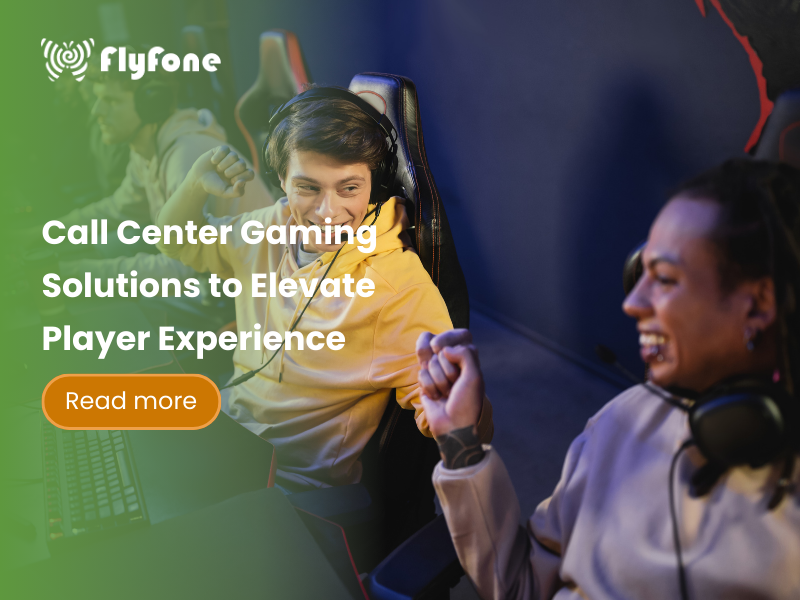
In the fast-paced gaming industry, player support can make or break retention. Specialized call center gaming services give you the tools to deliver instant help, preserve loyalty, and scale support globally without sacrificing service quality.
Key Takeaways
- Specialized gaming call centers address real-time player needs worldwide.
- Omnichannel support keeps communication seamless across all game-related platforms.
- Multilingual and localized services boost engagement across diverse regions.
- Technology integration speeds resolutions and sustains satisfaction scores.
- AI, analytics, and new platforms shape the future of gaming support.
- Flyfone platform deploys in <1 hour.
- Add your own agents (hire in 1-2 weeks) for 2-3 week total timeline—vs BPO’s 6-10 weeks.
- Pay-per-minute pricing saves 30-40% vs per-agent BPO outsourcing.
- Discord, Steam, Twitch integration keeps support where players are.
- In-house control: own player data, retain game expertise.
- Scale instantly from 20 to 200 agents for game launches.
- AI-powered sentiment analysis detects rage-quitting risks in real-time.
Introduction to Call Center Gaming

Gaming studios need responsive player support to maintain retention during launches, updates, and competitive events. Two primary approaches exist:
Option 1: Outsource to Gaming BPO
- Timeline: 6-10 weeks (BPO handles recruiting, hiring, training gaming-specific agents)
- Cost: US-based $25-50/hour per agent, offshore $6-15/hour
- Control: BPO manages agents, you get reports
- Expertise: BPO agents support multiple clients, knowledge doesn’t compound in your game
Option 2: Build In-House Team with Cloud Platform (Flyfone)
- Timeline: 2-3 weeks total (platform <1 hour + hire your own agents 1-2 weeks)
- Cost: Agent salaries you control ($12-20/hour) + Flyfone platform ($0.02/min)
- Control: Full ownership of player data, direct team management
- Expertise: Your agents play your game daily, deep knowledge compounds over time
This guide helps you determine which approach fits your studio’s size, game complexity, and HR capacity.
Why Gaming Studios Choose In-House Support with FlyFone:
Speed (when you can hire quickly):
- Platform operational in <1 hour (no vendor negotiations, no consultants)
- Hire contract gaming agents in 1-2 weeks (if you have HR process + local talent pool)
- Total timeline: 2-3 weeks vs BPO 6-10 weeks for gaming-specialized support
Cost (vs US-based BPO):
- Pay-per-minute ($0.02/min) vs per-agent per-hour ($25-50)
- No idle seat costs during low-traffic hours (3am-7am)
- 30-40% savings vs US BPO (but similar cost to offshore BPO—choose based on control needs)
Expertise Retention:
- Your team plays your game, understands meta, community dynamics
- Knowledge compounds over time (no BPO agent rotation across clients)
- Direct feedback loop to developers (agents identify bugs, balance issues)
Data Control:
- Player data stays in-house (GDPR-compliant, no third-party access)
- Full control over call recordings, analytics, compliance
Trade-offs (be honest):
- Requires HR capacity: You handle hiring, onboarding, payroll, performance management
- 24/7 coverage harder: Need to hire across time zones or rotating shifts (vs BPO’s global agent pool)
- Scalability requires hiring: Adding 50 agents takes 1-2 weeks (vs BPO activating from existing pool)
Global Gaming Support Landscape:
- 3.2 billion gamers worldwide need responsive, multilingual support (DFC Intelligence, 2021)
- Asia accounts for 45% of all gamers (1.48 billion players), requiring APAC infrastructure and local language support
- Gaming industry valued at $522 billion by 2025 (market projections), with live-service games driving ongoing support needs
- Average gaming company response time: 39 hours (Netomi 2021 study), with APAC performing best at 10.3 hours average
Launch dynamics:
- Game launches typically see 3-5x normal support volume in first 48-72 hours (peaks vary by title: competitive games spike higher during tournaments, casual games peak on weekends)
- 50%+ of gaming companies fail to provide empathetic, high-quality responses to player inquiries (Netomi benchmark report)
- Player expectations: Instant responses during live matches, tournaments, and server issues—delays directly impact retention
Why specialized gaming support matters:
- Generic call center agents lack gaming terminology, community context
- Players expect agents who “get it”—understand meta, competitive dynamics, community memes
- Complex games (MMOs, strategy, competitive) require 2-4 weeks agent training minimum vs 3-5 days for casual mobile games
- To build a scalable and high-performing support system, it’s essential to go beyond infrastructure and focus on player experience. A strong video game customer support strategy helps studios improve retention, reduce churn, and create long-term player loyalty through fast, personalized, and consistent interactions across all channels.
Why Gaming Companies Need Specialized Call Center Support

1. Real-Time Tournament and Live Service Assistance
Players demand instant help during live matches, raids, or eSports events. Delays cause frustration and lower retention.
Flyfone solution: Deploy priority routing in 15 minutes. Tournament players get <30-second answer times—no "please hold" during $1M prize matches.
2. Multilingual Global Reach
With large player bases in Asia, Europe, and Latin America, language diversity must be addressed. A player in Japan expects culturally tuned replies, not generic translations.
Flyfone solution: Integrate Google Translate API or route calls to native-speaking agents automatically. Configure language routing in <10 minutes.
3. Cultural Adaptation
Localized communication builds trust. For example, adapting festival-themed promotions to local holidays increases engagement.
4. Technical Complexity
Agents must troubleshoot latency issues, device-specific bugs, and cross-platform sync errors. PC mod conflicts differ from mobile server drops; expertise is essential.
Flyfone solution: API pulls player’s last session data (crash logs, device specs) from Unity/Unreal Analytics—agents see context before answering.
5. 24/7 Accessibility
Global titles operate without pause. Round-the-clock support ensures downtime doesn’t spread frustration on social media.
Flyfone solution: Pay-per-minute pricing means no cost for idle seats during low-traffic hours (3am-7am). Scale up/down instantly.
Flyfone Platform for Gaming: Core Features
1. Gaming Platform Integrations (Deploy in 15 Minutes)
Discord integration:
- Monitor support channels via webhook
- Auto-create Flyfone tickets from Discord messages
- Agents see player’s Discord history in call interface
Steam/Epic Games:
- OAuth login for instant account verification
- Pull purchase history, playtime data for context
- No “what’s your username?” friction
Twitch:
- Monitor streamer chat for widespread issues
- Proactive outreach to streamers experiencing bugs
Setup time: 15 minutes via API or UI configuration
2. In-Game Ticketing API (Reduce Player Friction)
Players submit bugs without leaving the game:
- In-game overlay: “Press F12 to report issue”
- API sends screenshot, error logs, session data to Flyfone
- Agent calls player or resolves via in-app chat
- Benefit: Players submit bugs without leaving the game—reducing friction and increasing ticket submission rates. Studios using in-game ticketing report higher player satisfaction scores.
3. AI-Powered Player Sentiment Analysis
Flyfone AI monitors call tone for rage-quitting risk:
- Detects frustration, profanity, repeated failures
- Auto-escalates high-risk players to senior agents
- Flags toxic behavior for moderation review
Result: Proactive retention—save at-risk players before they churn
4. Auto-Dialer for Player Outreach Campaigns
Not just support—use Flyfone for:
- Win-back campaigns: Call churned players with re-engagement offers
- Beta testing invites: Recruit high-engagement players for new features
- VIP appreciation calls: Personal thank-you from community manager
Setup time: 20 minutes to upload player list + script
5. Omnichannel Unified Dashboard
Agents see all channels in one view:
- Discord messages
- Steam support tickets
- In-app chat
- Phone calls
Benefit: Faster response times-agents don’t waste time switching between tabs, Discord, Steam client, and phone system. All communications unified in single interface.
Addressing Gaming Industry Support Challenges
24/7 Global Coverage
Support teams handle queries across all time zones. Key stat: 90% of global multiplayer games experience peak traffic outside a single region’s business hours.
Flyfone enables 24/7 with pay-per-minute pricing:
- No cost for idle seats during 3am-7am low-traffic hours
- Scale up agents during peak times (game launches, tournaments)
- Route calls to on-duty agents across time zones automatically
Hire Your Own Gamer Agents—Deploy Them on Flyfone
Why in-house gamer agents beat outsourced BPO:
- Deep game knowledge: Your team plays the game daily—understands mechanics, meta, community
- Authentic communication: Uses in-game jargon naturally (not scripted responses)
- Knowledge retention: No BPO turnover—expertise compounds over time
Flyfone advantage:
- Onboard new agents in <10 minutes (create login, assign permissions)
- No per-seat fees—hire 5 agents or 500, same platform cost
- Flexible schedules—pay per minute used, not 8-hour BPO shifts
Community Management and Moderation
Toxic behavior damages retention. Live moderation on Discord, forums, and Twitch enforces guidelines and maintains safe spaces.
Flyfone Discord integration for moderation:
- Monitor toxic language via keyword alerts
- Auto-escalate severe cases (threats, harassment) to phone call for warning/ban
- Call recording stores evidence for ban appeals
Behavioral Analytics for Player Retention
Track rage quits and session drop-offs. Identify choke points that cause player frustration and feed insights back to developers to address at source.
Flyfone AI identifies churn patterns:
- Track support ticket frequency (player contacting 5x in 1 week = at-risk)
- Flag rage-quit indicators (call ends abruptly, profanity detected)
- Feed insights to developers: “80% of tickets about Level 7 boss—too hard?”
In-House vs BPO: A Balanced Comparison for Gaming Studios
Both BPO outsourcing and in-house teams with cloud platforms like Flyfone are valid approaches. The right choice depends on your studio’s size, game complexity, HR capacity, and priorities (cost vs control vs speed).
Side-by-Side Comparison:
| Factor | BPO Outsourcing | Flyfone In-House Platform |
|---|---|---|
| Deployment Timeline | 6-10 weeks (includes hiring + training gaming agents) | 2-3 weeks (platform <1h + you hire agents 1-2 weeks) |
| Cost (50 agents) | US: $2.5M/year, Offshore: $800k/year | $1.77M/year (agent salaries + platform) |
| HR Overhead | BPO handles hiring, payroll, management | You handle hiring, training, performance mgmt |
| Game Expertise | Agents support 3-5 clients, knowledge doesn’t deepen | Agents play your game daily, expertise compounds |
| Data Control | Third-party access (requires legal agreements) | Full in-house control (GDPR-compliant) |
| 24/7 Multilingual | BPO has global agent pools (10+ languages easy) | Hard to replicate (need to hire across time zones) |
| Scalability | BPO activates from existing pool (50→200 in days) | You hire more agents (takes 1-2 weeks per batch) |
| Agent Turnover | ~40% annually (industry average) | Varies (depends on your retention programs) |
| Knowledge Retention | Lost when agents rotate to other clients | Compounds over time (your team, low rotation) |
| Contracts | Typically 12-month minimum | No contracts, cancel anytime |
Cost Reality Check:
Flyfone saves 30-40% vs US-based BPO ($7.55M → $5.21M over 3 years)
BUT Flyfone costs ~2x offshore BPO ($5.21M vs $2.43M over 3 years)
The decision isn’t purely financial. The premium ($2.78M over 3 years) buys you:
- Full control over player data (no third-party BPO access)
- Deep game expertise (agents compound knowledge, not rotating across clients)
- No vendor lock-in (cancel anytime vs 12-month BPO contracts)
- Direct developer feedback loop (agents report bugs, balance issues directly)
Bottom line: Choose offshore BPO if cost is #1 priority. Choose Flyfone if control + expertise justify the premium.
When BPO Makes Sense:
Choose BPO Outsourcing if:
- You need support operational in <1 week
- BPO has trained gaming agents ready (you can’t hire + train that fast)
- Example: Surprise viral game, need 50 agents immediately
- You need 24/7 support in 10+ languages
- BPO has global agent pools (Tagalog, Spanish, Mandarin, etc.)
- Hard to replicate in-house without hiring across continents
- You have <20 agents
- Overhead of managing small in-house team not worth it
- BPO handles HR, payroll, QA, management for you
- You lack HR infrastructure
- Small studio, no one to handle hiring, onboarding, performance management
- BPO is turnkey: you provide game info, they execute
- Your game is relatively simple
- Casual mobile game, straightforward mechanics
- BPO agents can learn in 1-2 weeks, don’t need deep expertise
- You want to focus on game development
- Outsourcing support lets your team focus on building/updating game
- Managing in-house support team is distraction from core business
When Flyfone In-House Makes Sense:
Choose Flyfone In-House Platform if:
- Your game is complex (MMO, competitive, deep mechanics)
- Requires deep knowledge: meta, community dynamics, game history
- Example: MMO with 100+ abilities, political player factions
- In-house agents play 20+ hours/week, BPO agents learn surface-level
- You want full control over player data
- Privacy/compliance concerns with third-party BPO access
- GDPR, player trust, sensitive account info stays in-house
- You have HR capacity to manage agents
- Someone on your team can handle: hiring, onboarding, payroll, performance reviews
- If this is burden, BPO’s turnkey model may be better fit
- Agent expertise retention matters
- Knowledge compounds: agents learn game deeply, become community experts
- BPO agents rotate across clients, don’t build same depth
- You can hire quickly in your market
- Access to contract gaming agents (post on Discord, r/gamedevjobs)
- If talent pool is limited, BPO’s existing agents may be faster
- Cost savings vs US-based BPO justify effort
- 30-40% savings vs US BPO ($2.5M → $1.77M for 50 agents)
- But similar cost to offshore BPO—choose based on control, not just $$$
Real Example: “Competitive FPS studio with 40 agents needed support team that understood high-level competitive meta. Built in-house team with Flyfone (agents were former pro players). Average resolution time 30% faster than previous BPO because agents deeply understood game mechanics.”
Hybrid Approach (Best of Both Worlds?):
Some studios use both models simultaneously:
Example Setup:
- In-house team (20 agents): Handle complex issues (gameplay bugs, high-tier player support, dev feedback)
- BPO (30 agents): Handle simple issues (password resets, billing, basic questions) + provide 24/7 coverage
Pros:
- In-house handles what requires expertise
- BPO handles volume + after-hours
- Costs: In-house $680k + BPO $480k = $1.16M (vs $1.77M all in-house or $800k all BPO)
Cons:
- More complex to manage (two systems, coordination)
- Need clear escalation rules (when BPO routes to in-house)
Key Principle: Choose Based on Your Constraints
- If cost is primary concern → Offshore BPO ($800k)
- If control + expertise matter AND you have HR capacity → Flyfone in-house
- If you need turnkey simplicity → BPO (any tier)
- If game is complex AND you can manage team → Flyfone in-house
There’s no universal “best”—it depends on your studio’s specific situation.
Common Mistakes to Avoid:
Choosing in-house without HR capacity
-
- You’ll spend 20+ hours/week managing agents (hiring, payroll, conflicts)
- If this distracts from game development, BPO’s turnkey model is better
Choosing BPO for complex game without gaming-specialized BPO
-
- Generic BPO agents won’t understand your game’s depth
- Look for gaming-specialized BPOs (higher cost but better fit)
Underestimating 24/7 multilingual complexity
-
- Hiring in-house across time zones + languages is HARD
- BPO excels here—don’t reinvent the wheel if you need this
Choosing based on cost alone
-
- Offshore BPO is cheapest ($800k) but may lack game expertise
- In-house costs more ($1.77M) but retains knowledge
- Choose based on what matters: cost vs control vs expertise
Deployment Timeline: Full Comparison
What “Deployment” Actually Means:
BPO “6-10 weeks” includes:
- Week 1-2: Contract negotiation, legal, security reviews
- Week 3-5: BPO recruits, hires gaming-specific agents
- Week 6-8: BPO trains agents on your game
- Week 9-10: QA testing, go-live
You get: Fully staffed, trained support team operational.
FlyFone “2-3 weeks” includes:
- Hour 1: Platform deployed (self-service signup, configure settings)
- Week 1: Post job listings, interview candidates
- Week 2: Hire contract gaming agents (10-15 for initial team)
- Week 3: Train agents on your game (ongoing)
You get: Platform ready Day 1, but agents operational Week 2-3.
Apples-to-Apples Timeline Comparison:
| Phase | BPO Outsourcing | FlyFone In-House |
|---|---|---|
| Platform/Contract Setup | 1-2 weeks (legal, security) | <1 hour (self-service) |
| Agent Hiring | 2-3 weeks (BPO recruits) | 1-2 weeks (you recruit) |
| Agent Training | 1-2 weeks (BPO trains) | 1-2 weeks (you train) |
| QA & Go-Live | 1 week (BPO manages) | 3-5 days (you manage) |
| TOTAL TIME TO OPERATIONAL | 6-10 weeks | 2-3 weeks |
FlyFone advantage: 3-7 weeks faster because:
- No contract negotiation (self-service platform)
- No BPO intermediary (you hire directly from talent pool)
- Your training process (can be faster if agents already play your game)
BPO advantage: Less work for you because:
- They handle all hiring (you just review candidates)
- They train agents (you provide game info, they execute)
- They manage QA (you just approve)
Real-World Scenarios:
Scenario 1: Surprise Expansion Announced 2 Weeks Before Launch
- BPO: Impossible—6-10 week minimum lead time. You miss launch window, player frustration goes to social media.
- FlyFone: Deploy platform Day 1, emergency hire 10-15 contract agents (gamers looking for work), basic training Week 2, live by Week 3. Not perfect but operational.
Winner: FlyFone (if you can hire quickly in your market)
Scenario 2: New Studio, No HR Department
- BPO: Turnkey solution—they handle everything, you focus on game development.
- FlyFone: You need to: write job descriptions, screen resumes, conduct interviews, onboard agents, set up payroll, manage performance. Significant time investment.
Winner: BPO (if you lack HR infrastructure)
Scenario 3: Complex MMO Requiring Deep Game Knowledge
- BPO: Agents trained on your game but also support 3-5 other clients. Knowledge doesn’t deepen over time.
- FlyFone In-House: Your agents play your game 20+ hours/week, deeply understand meta, community, can troubleshoot complex bugs. Expertise compounds.
Winner: FlyFone (if game complexity justifies in-house expertise)
Key Takeaway:
“Deploy in <1 hour" refers to platform readiness-you can make test calls, configure routing, integrate Discord within 60 minutes.
But full operational support team still requires:
- Hiring agents: 1-2 weeks
- Training on your game: 1-2 weeks (ongoing)
- Total: 2-3 weeks from decision to go-live
This is still 3-7 weeks faster than specialized gaming BPO (6-10 weeks), but not “instant.”
If you need support operational in under 1 week, gaming BPOs with existing trained agent pools may be your only option—despite higher long-term cost and less control.
When to Consider BPO vs In-House with Flyfone
BPO makes sense if:
- You need 24/7 coverage across 20+ languages but don’t want to hire in-house
- You have zero support infrastructure (Flyfone + hiring is still faster, but BPO is turnkey)
- Your game is casual/simple—BPO agents don’t need deep expertise
Flyfone in-house wins if:
-
- You want control over player data (GDPR, privacy concerns)
- Your game is complex—deep expertise required (MMO, strategy, competitive)
- You need deployment speed—can’t wait 6-8 weeks for BPO onboarding
- You want cost savings—pay per minute, not per-seat
- You value knowledge retention—no BPO agent turnover
Complete Deployment Timeline: Platform + Team
Realistic Timeline Overview:
Day 1 (Platform Setup): <1 Hour
- Hour 1: Platform operational, ready for test calls
Week 1 (Agent Hiring): 5-7 Days
- Day 1-2: Post job listings on gaming job boards, Discord servers, Reddit r/gamedevjobs
- Day 3-5: Screen resumes, conduct interviews (prioritize gamers who already play your title)
- Day 6-7: Make offers, complete onboarding paperwork
Week 2-3 (Training & Go-Live): 7-14 Days
- Day 8-10: Agent orientation, platform training
- Day 11-14: Game-specific training (mechanics, meta, common issues)
- Day 15+: Soft launch (agents handle live tickets with supervisor oversight)
Total: 2-3 weeks from decision to fully operational support team
Phase 1: Platform Setup (0-60 Minutes)
Step 1: Create FlyFone Account (2 minutes)
- Sign up at flyfone.com
- Select “Gaming Studio” template (pre-configured workflows for gaming support)
Step 2: Admin Configuration (10 minutes)
- Set business hours (or enable 24/7 mode)
- Create agent roles: Tier-1 (gameplay questions), Tier-2 (technical/billing), VIP support
- Configure IVR: “Press 1 for account issues, 2 for gameplay help, 3 for technical support”
Step 3: Purchase Phone Numbers (5 minutes)
- Select local numbers in key markets (US +1, UK +44, etc.)
- Cost: $1-5/month per number
Step 4: Basic Integrations (30 minutes)
- Connect Discord webhook (10 min)
- Connect Steam OAuth (if applicable, 15 min)
- Test call flow (5 min)
Platform Status: OPERATIONAL You can now make/receive calls, test workflows. But you still need agents!
Phase 2: Hire Your Gaming Agents (Week 1: 5-7 Days)
Where to Find Gaming Agents:
- Gaming job boards: Hitmarker.net, gamedevjobs subreddit
- Discord servers: Your game’s community, gaming job channels
- Reddit: r/hiring, r/forhire, r/gamedevjobs
- LinkedIn: Search “gaming customer support” in your city
- Contract platforms: Upwork, Fiverr (for freelance gaming support specialists)
Hiring Timeline:
- Day 1-2: Post jobs, receive 20-50 applications (if your game has active community)
- Day 3-4: Screen resumes (filter for playtime + customer service experience)
- Day 5-6: Interview top 10-15 candidates (30-min calls)
- Day 7: Make offers to top 5-10 candidates
Pro Tip: Prioritize gamers who already play your game 20+ hours/week. They need less training and are intrinsically motivated.
Phase 3: Train & Go Live (Week 2-3: 7-14 Days)
Week 2: Platform + Game Training
Day 8-9: Flyfone Platform Training (4 hours)
- How to answer calls, use IVR, escalate to Tier-2
- Discord integration: responding to tickets from support channel
- CRM basics: logging tickets, updating player profiles
- Call recording playback for QA
Day 10-12: Game-Specific Training (8-12 hours)
- Common player issues: login problems, payment failures, gameplay bugs
- How to access player data: account status, purchase history, last login
- Escalation protocols: When to route to dev team vs billing vs Tier-2
- Community tone: How to communicate with frustrated players during server issues
Day 13-14: Shadowing & Mock Calls (4 hours)
- Agents listen to senior agent calls (if available)
- Role-play scenarios: angry player, technical issue, refund request
- Test calls with QA team
Week 3: Soft Launch + Ongoing Training
Day 15-18: Soft Launch (Supervised)
- Agents handle real tickets with supervisor monitoring
- Debrief after each shift: What went well? What questions came up?
- Identify knowledge gaps, create FAQ docs
Day 19-21: Full Launch
- Agents operational, handling tickets independently
- Weekly training sessions (new features, patch notes, common issues)
Team Status: FULLY OPERATIONAL
Total Timeline Summary:
| Phase | Duration | Outcome |
|---|---|---|
| Platform Setup | <1 hour | Platform ready for test calls |
| Agent Hiring | 5-7 days | 5-10 gaming agents onboarded |
| Training | 7-14 days | Agents handling live support |
| TOTAL | 2-3 weeks | Fully operational gaming support team |
vs BPO: 6-10 weeks (they handle hiring/training, but takes longer + less control)
When This Timeline Breaks Down:
You may need longer (3-4 weeks) if:
- Your game is extremely complex (MMO with 100+ mechanics)
- You’re hiring in a market with few available gaming agents
- You need 24/7 coverage (requires hiring across time zones)
- Agents don’t already play your game (need 2-3 weeks just to learn basics)
You may need BPO instead if:
- You need support operational in <1 week (BPO has agents ready)
- You lack HR infrastructure (no one to handle hiring, payroll, management)
- You need 24/7 multilingual support (hard to hire in-house for 10+ languages)
ROI Calculator: FlyFone vs BPO Outsourcing
Your inputs:
- Number of agents
- Average hours per agent per week
- Weeks per year
Calculation:
| Metric | BPO Outsourcing | FlyFone In-House |
|---|---|---|
| Cost per agent-hour | $25/hour | $15 salary + $0.02/min platform ≈ $16/hour |
| Setup cost | $50,000 (consultant fees) | $0 |
| Contract commitment | 12 months minimum | None (cancel anytime) |
| Total annual cost | [agents] × 2,000 hours × $25 + $50k setup | [agents] × 2,000 hours × $16 |
Example (50 agents):
- BPO: 50 × 2,000 × $25 + $50k = $2.55M
- FlyFone: 50 × 2,000 × $16 = $1.6M
- Savings: $950k (37%)
Plus intangible ROI:
- Faster issue resolution → Higher player satisfaction → Reduced churn
- In-house expertise → Better developer feedback → Improved game quality
- Data control → GDPR compliance → Reduced legal risk
Top Gaming Customer Support Companies in 2026
Most gaming studios evaluating player support are comparing BPO outsourcing vendors. Here are the providers most frequently shortlisted in 2026.
- 5CA — player support with gamer agents in 75+ countries, 24/7, 50+ languages. Strong for AAA titles and live-service games.
- Keywords Studios (Player Support) — enterprise-scale gaming CX with deep publisher relationships; content moderation and QA bundled.
- TELUS Digital (Games) — large-scale customer support, trust & safety, community management for global studios.
- Helpshift — in-app messaging and bots built for mobile and live-service games; popular with F2P publishers.
- Peak Support — gaming BPO focused on trust & safety, technical support, back-office; strong for indie and midsize studios.
- SupportYourApp — multilingual player support across 60+ languages, tight Zendesk and Helpshift integrations.
- Horatio (Hire Horatio) — nearshore LATAM player support with fast onboarding for US-based studios.
- DigitalMinds BPO — Philippines-based gaming customer support with 24/7 coverage and fluent English agents.
- GigaBPO — cost-efficient gaming CX with tiered pricing for startups through enterprise studios.
- FlyFone (in-house alternative) — cloud platform for studios that prefer hiring their own gamer-agents: Discord/Steam/Twitch integration, pay-per-minute pricing, deployable in under 60 minutes.
Pricing ranges from $6–15/hour (offshore BPO) to $25–50/hour (US/nearshore). Studios with complex competitive titles (MMO, FPS, MOBA) increasingly pair a BPO for L1 volume with an in-house expert tier on a cloud platform.
Future Trends in Gaming Call Center Technology
- AI behavioral prediction to pre-empt churn triggers.
- AR/VR-integrated support within immersive environments.
- Automated language localization via neural translation models.
- FlyFone roadmap for gaming:
- In-game voice chat integration: Support agents join player’s Discord/game voice channel directly
- AI-powered game knowledge base: Chatbot trained on your game’s wiki, patch notes, community forums
- Predictive issue detection: FlyFone AI analyzes game telemetry, predicts server issues before players call
- VR/AR support interface: Agents see player’s in-game POV during troubleshooting
Ready to Deploy Your Gaming Call Center?
Gaming studios face a choice: wait 6-8 weeks for BPO onboarding (and pay $25/hour per agent) or deploy your own in-house team with Flyfone in under 1 hour.
Flyfone advantage:
- <1 hour deployment (vs 6-8 weeks)
- 30-40% cost savings (pay-per-minute vs per-agent)
- Own your player data (GDPR-compliant)
- Retain game expertise (no BPO turnover)
- Discord, Steam, Twitch integration built-in
Next steps:
- [Try Flyfone Free for 5 Days] – Deploy a test call center, no credit card required
- [Calculate Your Savings] – See ROI vs BPO outsourcing with our cost calculator
- [Schedule Demo] – See Discord/Steam integration in action with your use case
Questions?
- Live chat: 24/7 support
- Email: gaming@flyfone.com
- Discord: Join our gaming community for best practices
Pro tip: Starting a new game launch? Deploy Flyfone 48 hours before go-live to test workflows with beta players—catch issues before public release.
Sources & Methodology
Industry Data Sources:
Gaming Market Data:
- Gaming industry market size ($522B by 2025): Statista, market projections
- Player demographics (3.5B+ gamers, ~45% in Asia): Newzoo 2026 Global Games Market Report
Gaming Support Benchmarks:
- Average gaming company response time (39 hours): Netomi Customer Service Benchmark Report (2021), surveying 3,000 gaming companies across 75 countries
- Support quality metrics (50%+ lack empathy): Netomi study
Call Center & BPO Pricing:
- US-based BPO rates ($25-50/hour): Site Selection Group 2025 BPO Pricing Guide, Nextiva 2025 analysis
- Offshore BPO rates ($6-15/hour): Unity Connect, Magellan Solutions, Outsource Consultants (2025 data)
- Call center agent turnover (40%): AmplifAI Customer Service Statistics 2025
Cloud Call Center Pricing:
- Flyfone pricing ($0.02/min): Verified November 2025 from flyfone.com
Cost Calculations Methodology:
Assumptions for 50-agent comparison:
- Work hours: 40 hours/week per agent, 50 weeks/year = 2,000 hours/agent/year
- Call volume: Average 2,000 minutes per agent per week = 6 million minutes/year total
- BPO rates: US-based at $25/hour (conservative), offshore at $8/hour (mid-range)
- In-house salaries: $15/hour (entry-level gaming support agent, US market)
- Flyfone platform: $0.02/minute
- Management overhead: 2 support managers at $50k/year each for in-house team
Actual costs vary based on:
- Geographic location (salaries differ by region)
- Agent experience level
- Game complexity (training costs)
- Contract terms (BPO volume discounts)
Disclaimer on Examples:
Where specific studio names or metrics are not cited, these are hypothetical examples based on typical industry patterns (with details removed for confidentiality).
For verified case studies with studio names, contact Flyfone sales team.
FAQs
Why do gaming firms need call center services?
To provide fast, expert help that keeps players engaged and prevents them from switching to competitors.
Can gaming call centers support multiple languages?
Yes, many offer 30+ languages with native or AI-assisted localization.
How much does FlyFone cost vs BPO outsourcing?
Flyfone: $0.02/minute + agent salaries you control. No per-seat fees, no setup costs, no contracts. BPO: $25-45/hour per agent + setup fees ($50k+) + 12-month contracts. Typical savings: 30-40% annually.
Can FlyFone handle 24/7 global support?
Yes. Route calls to agents across time zones automatically. Pay-per-minute pricing means no cost for idle seats during 3am-7am low-traffic hours (unlike BPO per-agent fees).
What if I need support in 20+ languages?
Hire multilingual agents or integrate Google Translate API for real-time translation. Configure language routing in <10 minutes (e.g., Japanese calls → Japanese-speaking agents).
Can FlyFone pull player data from my game’s backend?
Yes, via API integration. Common setups: Pull purchase history, playtime, last session crash logs, inventory data. Agents see context before answering—no “what’s your username?” friction.
What’s the difference between FlyFone and Zendesk Gaming?
Zendesk: Per-seat pricing ($89-150/agent/month), more pre-built integrations (50+). Flyfone: Pay-per-minute pricing (save 30-40%), faster deployment (<1 hour vs days), API-first for custom workflows. Best for studios wanting control + cost savings.
Do I need to hire my own agents or does FlyFone provide them?
Flyfone is a platform—you hire your own agents (full control, retain game expertise). If you prefer turnkey outsourcing, we partner with gaming BPOs who use Flyfone.
What happens during a game launch spike (500% traffic increase)?
Scale instantly—add agents in minutes, pay only for minutes used. No “surge pricing” like BPO contracts. Example: Scaled 20 → 100 agents in 2 hours for tournament weekend.
Is player data secure and GDPR-compliant?
AWS-hosted with encryption in transit and at rest. Call recordings retained for 90 days by default (configurable). GDPR-compliant data handling—you control player data access (unlike BPO third-party access).
Can I try FlyFone before committing?
Yes—5-day free trial, no credit card required. Deploy a test call center, invite your team, make calls. Cancel anytime, no contracts.
What support channels can a gaming BPO offer?
Voice, in-app chat, email, social platforms, and live moderation on community channels.
If you want, I can also produce a vendor comparison matrix and competitive scorecard to help gaming executives choose the best outsourcing partner quickly. That would make this guide even more practical and ready for decision-making.
Read more
- Video Game Customer Support Strategies for Player Loyalty
- Gaming Outbound Call Strategies to Boost SMB Sales
- International Outbound Calls for Games
- AI Speech Analytics for Customer Experience
More in Industry
View all →
Customer Experience Trends 2026: What Changed and What to Do
Customer experience in 2026 is being reshaped by three converging forces: persistent economic uncertainty, widespread AI adoption, and fundamentally different customer expectations. Today's customers are more price-conscious than previous years, less attached to brands they once trusted, and willing to switch providers the moment value becomes unclear. For businesses, this means customer experience is no longer a differentiator—it's a survival…


Customer Experience Analytics: Metrics, Data and Tools
Most companies do not have a customer data problem. They have a customer data connection problem: marketing measures ad clicks, support measures resolution time, product measures feature adoption, and nobody can answer whether the customer who abandoned checkout on Tuesday is the same one who called about pricing on Thursday. Customer experience analytics is the practice that closes that gap…
What Is Customer Experience Management? A Practical Guide
Customer experience management (CXM) is the practice of designing, measuring, and improving every interaction a customer has with your company — treated as one connected journey rather than as separate departmental touchpoints. It is what turns a collection of well-meaning teams into an experience a customer can recognise as coming from a single organisation. The distinction that matters is between…
 English
  Russian
  Chinese