
Contact centers face an impossible equation: customer expectations demand instant responses 24/7, but support volumes spike unpredictably during product launches, market events, or seasonal peaks. Traditional solutions—hiring more agents—cannot scale fast enough and creates fixed costs during slow periods.
AI contact center solutions break this constraint. Instead of adding headcount linearly, businesses use AI to automate repetitive interactions, assist agents in real time with intelligent suggestions, and analyze 100% of conversations for insights that improve performance. The result: higher volume capacity, faster responses, and lower agent burnout—without proportional cost increases.
Key Takeaways

AI contact center solutions automate repetitive support while keeping humans in control of complex cases.
- AI contact center solutions automate repetitive support while keeping humans in control of complex cases.
- Real-time agent assist improves response accuracy, speed, and compliance during live conversations.
- Chatbots and voice bots provide 24/7 coverage and scale instantly during demand spikes.
- AI-driven analytics analyze 100% of interactions, not just sampled calls.
- Businesses reduce cost per contact while improving customer experience consistency.
- Successful adoption starts with high-volume, repeatable use cases.
Why AI Is Transforming Modern Contact Centers

Why AI Is Transforming Modern Contact Centers
Customer expectations changed faster than contact center models. People want instant answers, 24/7 availability, and consistent service across voice, chat, email, and messaging apps.
At the same time, support volumes keep growing—and volume patterns are increasingly unpredictable. An online gaming platform sees 300% call volume spikes during major tournaments. A crypto exchange handles 10x normal volume when Bitcoin drops 20%. A fintech company experiences 5x demand during tax season.
Fixed staffing models cannot absorb these surges without expensive over-hiring or poor service during peaks. Hiring and training take 4-8 weeks minimum—far too slow when you need capacity today.
Agents also face burnout from repetitive tasks. Industry data shows 40-60% of contact center interactions are routine requests: order status checks, password resets, balance inquiries, or policy explanations. These high-volume, low-complexity interactions consume agent time but create minimal customer value. An agent spending 4 hours daily on status checks has 4 fewer hours for complex problem-solving that requires human judgment
AI changes this equation.
AI-driven contact centers shift teams from reactive firefighting to proactive experience management. Automation absorbs repetitive demand. Agents focus on judgment-heavy conversations. Managers finally see what customers are actually saying, at scale.
Key drivers behind adoption:
- Omnichannel demand with zero tolerance for long wait times.
- Rising labor costs and agent attrition.
- Pressure to improve CX metrics without increasing budgets.
- The need for real-time visibility into customer sentiment and intent.
What Are AI Contact Center Solutions?
What Are AI Contact Center Solutions?
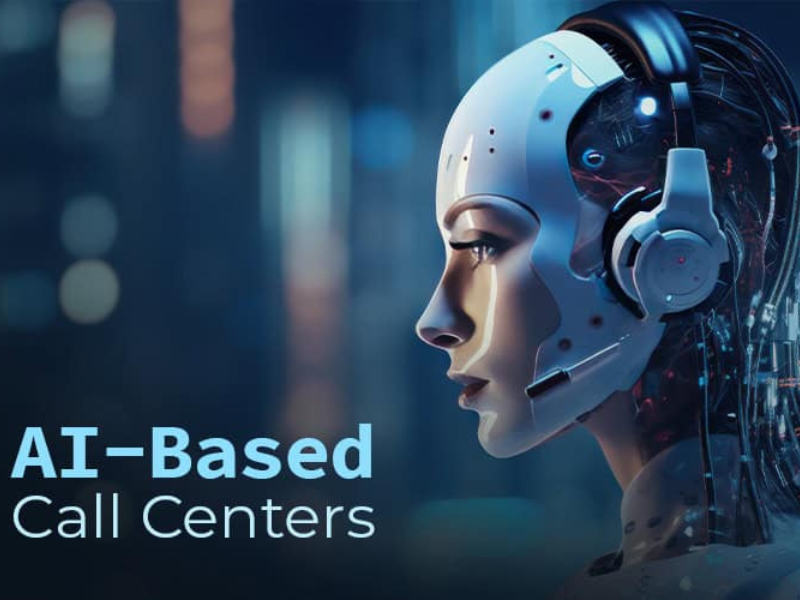
AI contact center solutions are platforms that use artificial intelligence to automate, assist, and analyze customer interactions across channels like voice, chat, email, and messaging.
Unlike traditional rule-based systems that follow fixed scripts, AI systems learn from real conversations. They detect intent (what the customer wants), extract context, and adapt responses over time.
These solutions are also known as:
- AI-powered contact center platforms
- Intelligent call center solutions
- Conversational AI for customer support
Most AI contact center platforms integrate directly with CRMs and ticketing tools. This allows AI to pull order data, account history, and past interactions into every conversation.
What makes them different from legacy systems:
- They handle unstructured language instead of rigid menu trees.
- They improve accuracy as interaction volume grows.
- They support humans instead of replacing them outright.
Core Components of AI Contact Center Technology
- Conversational AI for understanding and responding to customers.
- CRM and system integrations for real-time context.
- Automation and analytics layers for insights and optimization.
Key AI Technologies Used in Contact Centers
Key AI Technologies Used in Contact Centers
Natural Language Processing for Customer Conversations
Natural language processing (NLP) is the technology that allows AI to understand human language as customers actually speak—not rigid menu trees or keyword matching.
Why this matters: Customers do not say “I need billing support, order number 12345.” They say things like “Why was I charged twice for last week’s order?” or “My card got hit again but I only bought this once.” NLP handles this real-world language variation.
In contact centers, NLP performs three critical functions:
1. Intent detection: Identifies what the customer wants, even with varied phrasing.
- Customer says: “I got double-charged” → NLP detects: billing issue, duplicate charge
- Customer says: “Where’s my stuff?” → NLP detects: order tracking, delivery status
2. Entity extraction: Pulls specific data from unstructured language.
- From “I ordered on December 15th and still nothing” → Extracts: order date (Dec 15), issue (delayed delivery)
- From “I was charged $49.99 but I cancelled” → Extracts: amount ($49.99), action (cancellation), issue (incorrect charge)
3. Context handling: Maintains conversation flow across multiple turns.
- Turn 1: “I need help with my order”
- Turn 2: “It was supposed to arrive yesterday”
- Turn 3: “Can you refund the shipping?”
- NLP tracks: order → delivery issue → refund request without repeating information
Business impact: Traditional IVR systems force customers through 4-5 menu layers to reach the right queue. NLP routes correctly from the first sentence, eliminating 2-3 minutes of navigation frustration per call.
Example: A customer says, “I was charged twice for my last order.”
NLP identifies billing as the intent and double charge as the issue, even if those exact words are not used.
This matters because customers do not speak in scripts. NLP allows AI to handle real conversations, not keyword matching.
Modern NLP also supports:
- Multi-turn conversations where context carries forward.
- Multilingual interactions at a practical business level.
- Seamless handoff to agents with full conversation context.
Machine Learning and Predictive Analytics
Machine learning allows AI systems to learn from historical interactions instead of static rules.
In contact centers, this enables:
- Predicting customer intent early in the conversation.
- Identifying sentiment shifts that signal escalation risk.
- Improving routing to increase first-contact resolution.
Over time, predictions become more accurate as the system processes more data.
Chatbots and Voice Bots
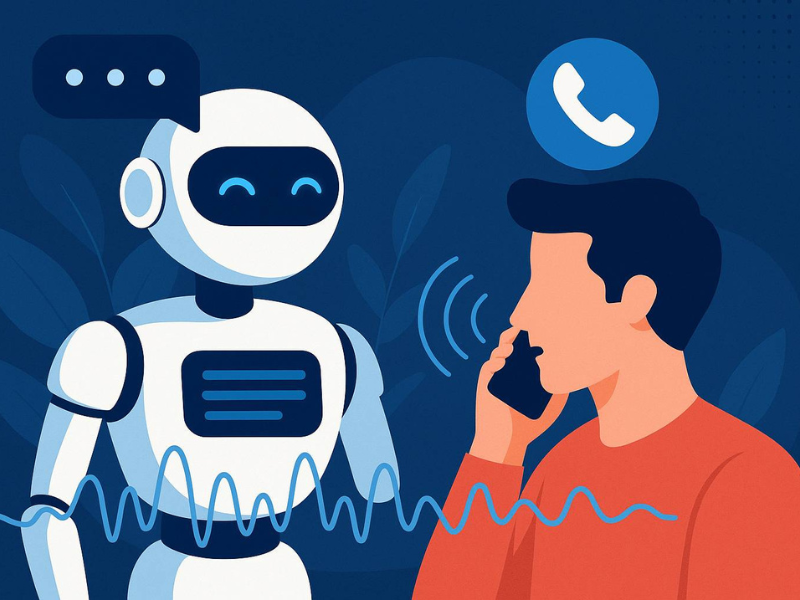
Chatbots handle text-based interactions. Voice bots manage phone calls using speech recognition and text-to-speech.
Both serve the same goal: automate high-volume, repeatable conversations.
Common chatbot and voice bot use cases:
- Order status and delivery updates.
- Account balance and basic changes.
- FAQs and policy explanations.
- Appointment scheduling.
Key differences:
| Feature | Chatbots | Voice Bots |
|---|---|---|
| Channel | Chat and messaging | Phone calls |
| Best for | Quick, silent interactions | Call deflection |
| Complexity | Lower barrier | Higher accuracy needed |
Well-designed bots know their limits. When confidence drops or sentiment turns negative, they escalate to a human agent with full context.
Real-Time Agent Assist Technology
Real-time agent assist acts as an AI co-pilot during live customer conversations. While the agent speaks, AI analyzes the conversation, pulls relevant information, and surfaces suggestions instantly—without the agent needing to search or ask supervisors.
How it works in practice:
Scenario: Billing dispute call at a fintech company
- Live transcription: As customer speaks (“I was charged $149 but my plan is supposed to be $99”), AI transcribes in real-time.
- Intent detection + data retrieval: AI identifies billing dispute and instantly pulls:
- Customer’s current plan ($99/month)
- Recent transactions (charge: $149 on Jan 10)
- Billing history (previous month: $99, correctly charged)
- Refund policy (full refund within 30 days)
- Suggested response displayed to agent:
“I see the $149 charge on January 10th. You’re correct—your plan is $99/month. This appears to be a processing error. I can process a $50 refund immediately, which will appear in 3-5 business days. Would that resolve this for you?”
- Compliance monitoring: If agent forgets required disclosure (“Refunds take 3-5 business days”), AI prompts: “⚠️ Reminder: State refund timeline per policy.”
Measurable impact:
- Handle time reduction: Agents spend 30-40% less time searching knowledge bases and asking supervisors. Average call time drops from 8.5 minutes to 6 minutes.
- Error reduction: Compliance alerts catch 90%+ of missed disclosures before call ends, preventing regulatory issues.
- New agent ramp time: Training period shortens 40-50% because AI guides correct responses during live calls.
- Agent stress reduction: Tenured agents report 30%+ less stress—they feel supported instead of left guessing on complex issues.
Why this matters for operations: For a 100-agent contact center handling 50,000 calls monthly, reducing handle time by 2.5 minutes per call saves 2,083 agent hours monthly—equivalent to 12 full-time agents. That capacity can absorb volume growth without new headcount or improve service levels without overtime costs.
Mini example: During a billing dispute call, AI surfaces the exact refund policy and a compliant response script while the agent speaks.
AI-Driven Interaction Analytics and Quality Assurance
Traditional QA reviews 1–3% of interactions. AI analyzes 100%.
AI-driven QA provides:
- Automated scoring based on defined criteria.
- Sentiment analysis to track emotional trends.
- Auto-generated summaries for every interaction.
Before AI:
- Manual sampling.
- Subjective scoring.
- Delayed feedback.
After AI:
- Complete coverage.
- Consistent evaluation.
- Real-time insights for managers.
Problems AI Contact Center Solutions Solve

Problems AI Contact Center Solutions Solve
AI directly addresses common contact center pain points.
- Long wait times are reduced through automation and better routing.
- Inconsistent service quality improves with real-time guidance.
- Manual QA bottlenecks disappear with full interaction analysis.
- Poor customer visibility is replaced by clear intent and sentiment data.
Key Benefits of AI-Driven Contact Center Solutions
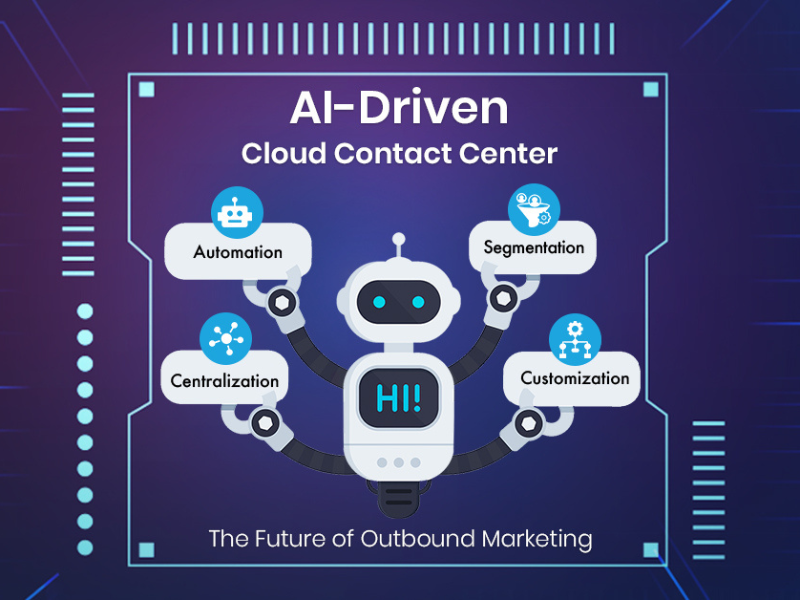
Key Benefits of AI-Driven Contact Center Solutions
Improved Customer Experience
AI reduces friction. Customers get faster answers and fewer transfers.
Benefits include:
- Shorter wait times across channels.
- Personalized responses using customer history.
- Higher first-contact resolution rates.
Consistent experiences build trust, especially during high-stress interactions.
Increased Operational Efficiency
Automation absorbs repetitive demand. Agents handle what matters.
Results:
- Higher agent productivity per shift.
- Fewer manual tasks and errors.
- Faster onboarding with AI guidance.
Efficiency gains show up quickly in daily metrics.
Cost Reduction and Scalability
AI scales without linear staffing increases.
- Lower cost per contact.
- Instant capacity during demand spikes.
- Reduced overtime and outsourcing costs.
Better Insights and Decision-Making
AI turns conversations into data.
Leaders gain:
- Clear voice-of-customer trends.
- Smarter staffing and training decisions.
- Early signals of churn and product issues.
Common Use Cases of AI in Contact Centers
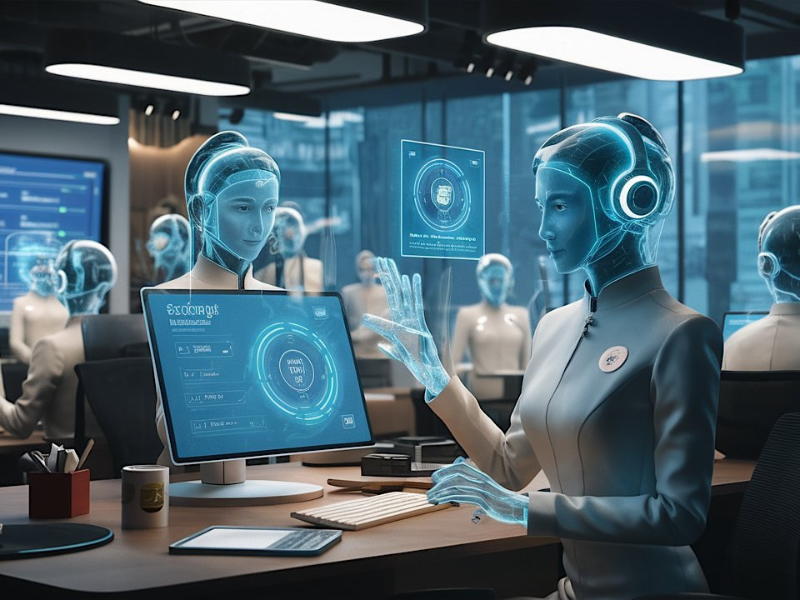
Customer Support Automation
AI handles:
- FAQs and knowledge lookups.
- Order and account status.
- Simple transactions.
This frees agents for complex cases.
Agent Assistance and Coaching
AI supports agents during and after calls.
- Live prompts during conversations.
- Automatic post-call summaries.
- Objective performance feedback.
Quality Assurance and Compliance Monitoring
AI enforces consistency.
- Automated scoring across all interactions.
- Compliance monitoring without manual reviews.
- Faster coaching loops.
Customer Insights and Sentiment Tracking
AI tracks sentiment trends over time and flags risk signals early.
AI vs Traditional Contact Center Systems

| Area | Traditional Systems | AI-Driven Systems |
|---|---|---|
| Automation | Limited scripts | Adaptive conversations |
| QA coverage | Small samples | 100% of interactions |
| Scalability | Linear with staff | On-demand |
AI systems adapt. Traditional systems maintain.
How to Get Started with AI Contact Center Solutions

Identifying the Right Use Cases
Start where AI delivers fast ROI.
Focus on:
- High-volume interactions.
- Repetitive requests.
- Clear success metrics.
Map current contact reasons before deploying automation.
Implementation Considerations
- Ensure clean CRM and knowledge base data.
- Plan agent training and change management.
- Start with pilots before full rollout.
Choosing the Right AI Contact Center Platform
Evaluate platforms based on:
- Accuracy in real conversations.
- Integration depth with your systems.
- Transparency in analytics and reporting.
Market options include platforms from Google, NICE, Genesys, Level AI, and Replicant. Compare based on your use cases, not feature lists.
The Future of AI in Contact Center Operations

AI is moving toward proactive engagement and generative responses. The winning model pairs AI scale with human judgment, not full replacement.
Frequently Asked Questions

How does AI improve customer service?
AI reduces wait times, improves response accuracy, and ensures consistent experiences across channels.
Are chatbots replacing human agents?
No. Chatbots handle repetitive tasks so agents can focus on complex conversations.
How long does implementation take?
Most teams see value within weeks when starting with focused use cases.
Conclusion & CTA

AI contact center solutions improve efficiency, customer experience, and scalability at the same time. They work best as force multipliers for human teams, not replacements.
Start by identifying high-impact use cases. Evaluate platforms with real data. Pilot before scaling.
If you are exploring AI for your contact center, now is the time to test, learn, and move forward with confidence.
FAQ

What are AI contact center solutions?
AI contact center solutions are technologies that use artificial intelligence to automate and enhance customer support operations. They leverage natural language processing and machine learning to understand customer interactions, providing real-time assistance and insights.
How does AI improve customer service in contact centers?
AI improves customer service by reducing wait times, enhancing personalization, and increasing first-contact resolution rates. It provides agents with real-time information and automates routine tasks, allowing them to focus on more complex customer needs.
What is the difference between chatbots and virtual agents?
Chatbots handle routine inquiries using scripted responses, while virtual agents are more advanced, using AI to understand context and intent in interactions. Virtual agents offer more natural communication and can handle complex tasks.
Why is real-time agent assist technology beneficial?
Real-time agent assist technology provides live transcriptions, suggested responses, and compliance alerts during customer interactions. This helps reduce handle times, improve accuracy, and lower agent stress, enhancing overall service quality.
How do AI-driven interaction analytics improve quality assurance?
AI-driven interaction analytics analyze 100% of customer interactions, offering sentiment analysis, automatic scoring, and summaries. This allows managers to gain deep insights and improve quality assurance processes without manual intervention.
Read more:
- Call Center Resume Examples for 2026: ATS-Friendly Templates
- Customer Service Resume Examples: Guide with Metrics & ATS Tips
- What Is a BPO Call Center? Definition, Types, and Benefits


 English
  Russian
  Chinese