
Late payments kill businesses faster than weak sales do. The median US small business runs on a cash buffer of 27 days — the length of time it could cover outflows with nothing coming in — and a quarter of them hold fewer than 13 days. That is the JPMorgan Chase Institute’s finding from 597,000 businesses and 470 million transactions, not a survey of opinions. Against a buffer that thin, an invoice sitting unpaid for 60, 90, or 120 days is not an annoyance. It is the whole margin for error.
When your sales team closes deals but your A/R team can’t collect, growth becomes a liability. More customers mean more outstanding invoices, more follow-up calls, more disputes to resolve. The billing workload grows faster than you can hire.
Accounts receivable outsourcing solves this by handing invoice management, payment reminders, and collections follow-ups to specialists who do this full-time. They enforce consistent processes, track every dollar, and typically get customers to pay 15-30 days faster than in-house teams.
This guide explains what A/R outsourcing actually involves, when it makes financial sense, the risks to watch for, and how to evaluate providers without getting locked into expensive contracts
Key Takeaways

- The gain is consistency, not pressure. Outsourcing works because follow-up runs to a fixed cadence instead of happening when someone has time. That is what moves DSO, and it is why the benefit shows up in the aging profile before it shows up in the headline number.
- The realistic prize is measurable. APQC puts median cross-industry DSO at 38 days against 30 or fewer for top-quartile performers, and The Hackett Group measures an 18-day spread between median and top quartile. Roughly a week to ten days of working capital is the defensible target — not the 20-30% reductions vendors quote without a source.
- Cost savings are smaller than advertised. ISG’s 2024 survey of 368 decision-makers found average realized BPO savings of 15%. Model against that, and against a fully loaded in-house clerk at roughly $70,000 a year rather than base salary alone.
- Three pricing models, each with a distinct trap. Per invoice rewards volume rather than recovery; percentage of collections means paying most on invoices that would have been collected anyway; a dedicated FTE is billed whether or not there is work to fill the seat.
- Volume decides eligibility before anything else. Below roughly 100-150 invoices a month the oversight overhead tends to outweigh the saving. Ask the provider’s minimum monthly fee early; it settles the question faster than an invoice count.
- The risks are contractual, not operational. Loss of visibility, compliance exposure, exit terms, and knowledge accumulating with the provider are all prevented before signing rather than managed afterwards.
What Is Accounts Receivable Outsourcing?

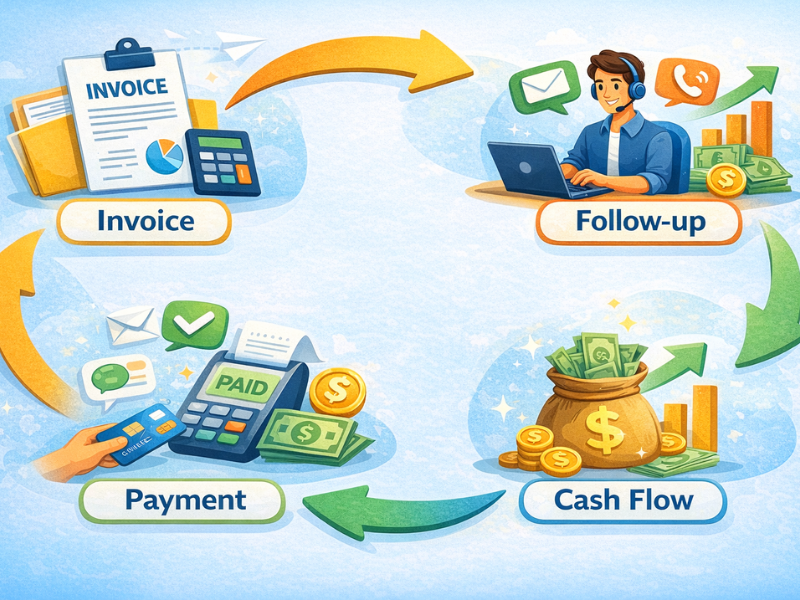
Accounts receivable outsourcing is when you hire a specialized company to handle your invoice-to-payment workflow. Instead of your internal team chasing down late payments, an external provider takes over execution while you maintain strategic control.
Here’s the key difference from in-house A/R:
In-house teams juggle billing with other finance duties. One person handles invoicing, collections, dispute resolution, and month-end close. When volume spikes or someone goes on leave, follow-ups stop.
Outsourced A/R providers do this exclusively. They have dedicated staff, proven workflows, and systems built specifically for payment collection. When your volume doubles, they scale instantly without you hiring or training anyone.
In practice, it works like this:
-
Here’s How the Workflow Actually Operates:
- You close a deal and generate an invoice (still in your accounting system—QuickBooks, NetSuite, Xero, etc.)
- The provider receives invoice data automatically via API integration or secure portal upload. No manual forwarding required.
- They handle the entire payment cycle:
- Deliver invoices via email/portal with payment instructions
- Send reminders at day 15, 30, 45 (or custom schedule)
- Make collection calls for invoices past 60 days
- Coordinate with your team on disputes or special terms
- When payment arrives, they match it to the correct invoice, apply it in your system, and reconcile automatically. You see updated balances in real-time, not weeks later during month-end close.
- You get visibility dashboards showing:
- Which customers are current vs. overdue
- Aging buckets (0-30 days, 31-60 days, 61-90 days, 90+ days)
- Cash flow projections based on payment patterns
- Exception alerts (large invoices unpaid, customers exceeding credit limits)
This is different from debt collection. Outsourced A/R focuses on routine billing and “soft collections” (polite, structured reminders), not aggressive recovery of overdue debt.
Compared to an in-house A/R team, outsourcing shifts execution to experts who already have trained staff, systems, and standardized workflows. Many providers operate as part of a broader BPO (business process outsourcing) model, supporting finance operations at scale.
Most modern A/R providers also integrate with ERP systems (software that centralizes accounting and operations). Integration allows invoices, payments, and reports to sync automatically, reducing manual work without changing your core accounting setup.
Example:
A growing B2B distributor struggles with late payments as customer volume increases. Instead of hiring more staff, they outsource A/R. The provider handles invoicing and reminders, while the finance team focuses on forecasting and vendor payments.
What Tasks Are Typically Included in Accounts Receivable Outsourcing

Routine Execution (Fully Outsourced):
Invoice Delivery & Tracking Providers send invoices via email/portal and track when customers open them. If an invoice sits unopened for 5 days, they resend with a phone call. This alone cuts payment delays by 10-15 days—customers can’t claim “I never got it.”
Payment Reminders on Fixed Schedules Automated reminders at day 15 (friendly), day 30 (firm), day 45 (urgent). Consistency is what in-house teams struggle with. When your A/R person is out sick, reminders stop. Providers never miss a cycle.
Soft Collections (30-90 Days Overdue) Professional phone calls to customers with past-due balances. Tone is polite but persistent: “We show Invoice #4821 is now 45 days past due. Can we process payment today or set up a plan?” This recovers 60-70% of invoices before they need aggressive collections.
Cash Application & Reconciliation When payments arrive (check, ACH, wire, credit card), the provider matches them to invoices and updates your accounting system. Manual reconciliation takes 2-4 hours per week for most finance teams. Providers automate this to near-zero effort.
Aging Reports & Dashboards Real-time visibility into who owes what, how long it’s been outstanding, and which accounts are at risk. Most in-house teams generate these manually in Excel once a week. Providers give you live dashboards updated every hour.
Why Companies Choose Accounts Receivable Outsourcing
Trigger #1: Late Payments Strangle Growth
You’re closing deals, shipping product, delivering services—but cash isn’t arriving. Your accounting system shows $500K in receivables, but only $180K is collectible in the next 30 days. The rest is stuck at 60, 90, even 120+ days overdue.
The real cost: You can’t pay vendors on time. You delay hiring. You pass on growth opportunities because you don’t have the cash, even though you’re “profitable” on paper.
This happens when in-house teams get overwhelmed. They send invoices but don’t follow up consistently. A customer ignores the first reminder, then the second. By day 60, the invoice feels awkward to bring up. By day 90, it’s practically written off.
Outsourced providers enforce discipline. Reminders go out at day 15, 30, 45 like clockwork. Customers learn that paying on time is the path of least resistance. Over 6-12 months, average payment cycles shrink from 60 days to 35-40 days.
Trigger #2: Staffing Breaks the Process
Your A/R person quits, goes on maternity leave, or gets promoted. Suddenly no one is chasing payments. Invoices pile up. Three months later, you realize $200K in receivables went completely ignored.
Hiring and training a replacement takes 6-8 weeks minimum. During that gap, cash flow collapses.
Outsourcing eliminates this single-point-of-failure risk. Providers have teams, not individuals. If someone leaves, coverage continues without interruption.
Trigger #3: Growth Creates Complexity You Can’t Scale
At 50 customers, one person handles A/R comfortably. At 200 customers with varying payment terms, multiple currencies, and regional tax requirements, that same person is underwater.
The breaking point: You realize follow-ups are 2-3 weeks behind schedule. Reports are inaccurate because data entry is backlogged. Your CFO can’t forecast cash flow because receivables data is a mess.
Outsourced providers are built for scale. They handle 1,000+ customer accounts per client routinely, with systems that track every invoice, reminder, and payment attempt automatically.
Trigger #4: Seasonal Peaks Overwhelm Your Team
Retail, eCommerce, and B2B distributors see invoice volume spike 200-400% during peak seasons (Q4 holidays, back-to-school, industry events). Your in-house team can’t keep up.
Hiring seasonal A/R staff is nearly impossible—these aren’t entry-level roles. By the time someone is trained, the season is over.
Outsourcing gives you elastic capacity. Providers scale up during peaks and scale down during slow periods. You pay for actual workload, not idle staff during off-seasons.
Key Benefits of Accounts Receivable Outsourcing
Four benefits account for most of the business case. Cash flow is the one that gets a decision approved; the process gain is usually what makes the arrangement stick.
They are worth separating because they arrive on different timelines and are measured in different places. Cash flow effects show in the aging profile within a quarter and in DSO shortly after. Cost effects only become visible once the ramp period is behind you and both teams are no longer being paid at once. Accuracy gains appear at month-end close, where reconciliation time falls before anyone notices the error rate. And the focus benefit — internal staff moving off rules-based chasing — is real but rarely quantified honestly, because the time recovered gets absorbed rather than reallocated unless someone plans for it.

Improved Cash Flow and Faster Payments
The core problem outsourcing solves is not that invoices are wrong — it is that follow-up is inconsistent. Internal teams chase when they have time, which usually means after the invoice is already overdue. A dedicated A/R team works a fixed cadence: reminder before due date, contact on day one past due, escalation on a schedule that does not depend on who is busy.
That consistency is what moves the number. It is worth being precise about how much, because the figures vendors quote here are not sourced to anything. What is measurable is the size of the gap: APQC’s cross-industry benchmarks put median DSO at 38 days and top-quartile performers at 30 or fewer, and The Hackett Group’s 2025 working capital survey measures an 18-day spread between median and top-quartile companies. That gap is the realistic prize, and most of it comes from earlier contact rather than harder collection. Cash arriving two weeks sooner on the same revenue improves working capital at no cost to margin.
The secondary gain is predictability. When follow-up is systematic, the aging profile stops swinging month to month, which makes cash forecasting materially more reliable.
Cost Savings and Operational Efficiency
An in-house A/R clerk in the US costs roughly $70,000 a year fully loaded — a BLS median base of $49,210 plus benefits and payroll costs of roughly 43% — before the accounting platform, the collections tooling, and the supervisor time. For a company processing a few hundred invoices a month, that is a full salary spent on work that is entirely rules-based.
Outsourcing converts it to a variable cost — commonly a per-invoice rate or a percentage of collections. The saving is real but consistently smaller than headline claims, because you are still paying for oversight. The best available evidence is not encouraging about the big numbers: ISG’s 2024 survey of 368 outsourcing decision-makers found average realized savings of 15% across BPO generally, with labor arbitrage plus process improvement topping out near 20–30%. Budget against those figures, not against a vendor’s 70%.
The efficiency gain is often worth more than the cost gain. Providers run the same process across many clients, so exception handling, dispute workflows, and escalation paths are already built. You are buying a working process, not just cheaper hours.
Better Accuracy Through Automation Tools
Most A/R providers run invoice automation you would otherwise have to buy and configure:
- Automated invoice generation and delivery.
- Payment matching against remittance data.
- Dispute flagging.
- Dunning sequences triggered by aging bucket, not by manual review.
The accuracy benefit is concentrated in two places. Invoice errors fall because generation is templated instead of re-keyed. Cash application improves because payments are matched automatically instead of reconciled by hand at month end — which is where most mismatches are discovered late.
Worth checking before you sign: whether the automation runs inside your accounting system or theirs. If it runs in theirs, confirm what data you get back and in what format, because that determines how hard it is to leave later.
Allows Internal Teams to Focus on Core Business
In most small and mid-sized companies, A/R is not a department — it is a set of tasks bolted onto finance, operations, or the founder. That arrangement works until volume rises, at which point collections quietly become the thing that gets dropped when something urgent appears.
Moving it out does not just free hours. It removes the weekly decision of which overdue accounts are worth chasing. It also separates the collection conversation from the commercial one — which matters when the person chasing payment is also the person selling the next contract.
What should stay in-house: credit policy, decisions on writing off or escalating to legal, and any account where the payment conversation is genuinely a relationship conversation.
Risks and Downsides of Outsourcing Accounts Receivable
A/R programs fail often enough that the risks deserve as much scrutiny as the savings — and all four below are decided at the contract stage, not managed later.
There is a reason they cluster there. Once a provider is live, the leverage shifts: your ledger is running on their process, your team has stopped doing the work, and renegotiating anything material means threatening a transition you are not ready to execute. Every item in this section is cheap to fix in a draft contract and expensive to fix in month nine. Read it as a checklist for the negotiation rather than as an argument against outsourcing.

Reduced Direct Control Over Customer Interactions
An A/R provider talks to your customers about money, which is the most sensitive conversation in the relationship. A tone that works for one market can read as aggressive in another, and you will usually hear about it from the customer, not the provider.
What actually prevents this:
- Agree the escalation script and tone before go-live.
- Define which accounts are off-limits to standard dunning.
- Require call recordings or email threads to be visible to you, not summarized.
Ask to review a sample of real customer communications monthly for the first quarter.
The workable split is that the provider handles routine follow-up and you keep any account where the relationship matters more than the invoice.
Data Security and Compliance Concerns
A/R outsourcing hands over customer contact details, payment history, credit terms, and sometimes bank details. Your obligations under GDPR or equivalent regimes do not transfer with the data.
Look for ISO/IEC 27001 for information security management and SOC 2 Type 2 for whether controls actually worked over a period, not merely that they exist on paper. If card data is involved at any point, PCI DSS applies. Verify certifications with the issuing body; a PDF from the vendor is not verification.
Then pin down the operational detail in the contract:
- The exact countries your data is stored and processed in.
- Any subcontractor in the chain, named.
- How access is limited to the people who actually need it.
- The breach-notification window.
- What happens to your data at contract end.
Finance data carries fraud exposure that customer-support outsourcing does not. Segregation of duties matters most where one external team handles both invoicing and cash application.
Contract Limitations and Cost Risks
The commercial structure causes more problems than the service does. Percentage-of-collections pricing aligns the provider with getting paid, but it also means you pay most on the invoices that would have been collected anyway. Per-invoice pricing is more predictable, but it rewards volume, not recovery.
Watch for minimum monthly commitments that survive a drop in your own volume, automatic renewal without a review point, setup and onboarding fees quoted separately, and change requests priced ad hoc. Ask for a fully loaded twelve-month model including the transition period — the headline rate is rarely the invoice.
Keep the initial term to twelve months or less and require a defined exit clause with transition assistance. Without it, switching costs can exceed the savings that justified the move.
Not Always a Fit for Every Business
Outsourcing A/R makes little sense below roughly 100–150 invoices a month. That is our own threshold rather than a published one — no analyst firm publishes a minimum-volume figure for this — but the mechanism is easy to check: below that volume the oversight overhead outweighs the saving, and the provider cannot justify learning your process. Ask what their minimum monthly fee is; it usually answers the question faster than the invoice count does.
It also fits poorly where the payment conversation is part of the sale. Think of a business with a handful of large accounts, where the person chasing payment is also negotiating the renewal. Handing that to a third party costs more in relationship than it recovers in cash.
Highly bespoke billing is the third exception. If every contract has different terms, milestones, or retentions, the process is not rules-based enough to transfer cleanly — that is a case for automation inside your own system rather than outsourcing.
Accounts Receivable Metrics: DSO and What Good Looks Like
Almost every article on this topic mentions days sales outstanding without saying what a normal figure is. Without a benchmark, “reduce your DSO” is not actionable — so here is where the numbers actually sit.
Days sales outstanding (DSO) measures the average number of days it takes to collect payment after a sale. The overall median across B2B industries is around 56 days, with a broad non-financial market reference closer to 45 days. But the spread by sector is enormous, and comparing yourself to a universal average is misleading.
| Sector | Typical DSO | Why it sits there |
|---|---|---|
| Engineering & Construction | ~100 days | Milestone billing, retentions, and long approval chains |
| Energy Services & Equipment | ~82 days | Large contract values and extended payment terms |
| B2B overall (median) | ~56 days | Standard net-30 to net-60 terms with typical slippage |
| Broad non-financial market | ~45 days | Common reference point across mixed sectors |
| SaaS | 30–45 days | Monthly recurring billing, longer on enterprise contracts |
| Retail & e-commerce | Under 25 days | Card payments settle in 1–3 days; higher figures signal gateway or fraud issues |
| Food & Staples Retail | ~11 days | Fast-moving goods, short terms |
| Homebuilding | ~6 days | Payment typically at or before completion |
Benchmark figures compiled from CreditPulse’s DSO-by-industry analysis and SMB Compass industry averages. Definitions and formulas follow Centime’s DSO guide.
The three metrics worth tracking together
- DSO — average days to collect. Useful as a trend, misleading as a single snapshot, because it moves with sales volume as well as collection performance.
- A/R turnover ratio — net credit sales divided by average accounts receivable. A higher ratio means faster collection. Read it alongside DSO, not in place of it.
- Aging profile — the percentage of receivables in each bucket (current, 1–30, 31–60, 61–90, 90+). This is the one that actually tells you whether a problem is developing, because it moves before DSO does.
The practical caution: benchmark against peers in your own sector, not against a universal figure. A 60-day DSO is poor for e-commerce and excellent for construction. Before setting an outsourcing target, measure your own baseline for a full quarter — otherwise you cannot tell improvement from seasonality.
How Much Does Accounts Receivable Outsourcing Cost?
Almost nobody publishes A/R pricing, so the first real number usually arrives well into a sales conversation. Here are the three structures the market uses, and what moves each one.
| Pricing model | How you are billed | Best when | Watch out for |
|---|---|---|---|
| Per invoice | A unit rate per invoice issued or managed | Volume is steady and invoices are similar in complexity | Agree precisely what counts as one unit; re-issued invoices add up |
| Percentage of collections | A share of what is recovered | Aging debt and recovery-focused engagements | You pay most on invoices that would have been collected anyway |
| Dedicated FTE | A monthly rate per assigned analyst | High volume or process complexity needing continuity | The seat is billed whether or not there is work to fill it |
The largest cost driver is delivery location, on the same pattern as other finance and back-office outsourcing: roughly $8–18 per hour offshore, $14–28 nearshore, and $28–45 onshore. Rates rise with regulatory burden, language requirements, and how much judgment each account needs.
For comparison, a fully loaded in-house A/R clerk in the US runs about $70,000 a year before tooling and supervision — BLS median base pay plus benefits, not base pay alone, which is where most published comparisons understate the in-house side.
What the quoted rate usually excludes: setup and onboarding, system integration work, training hours, minimum monthly commitments, volume-band pricing that changes at a threshold, and ad hoc change requests. Ask for a twelve-month cost model with the ramp period priced in — that is the only figure worth comparing between providers.
When Does Accounts Receivable Outsourcing Make Sense?
Four questions settle this faster than a general argument, and each one rules something out.
Is the problem consistency or capability? If invoices go out correctly and the follow-up is what slips, outsourcing addresses the actual failure. If invoices are wrong, terms are unclear, or disputes take weeks to resolve internally, you are exporting a broken process and will pay a provider to discover the same problems more expensively. Fix the invoice before outsourcing the chase.
Does the volume clear the threshold? Below roughly 100-150 invoices a month, oversight tends to cost more than the arrangement saves, and the provider cannot justify learning your process. Above it, smaller companies often gain proportionally more than large ones, because the realistic alternative is a founder or office manager collecting between other work. The provider’s minimum monthly fee usually answers this before an invoice count does.
Is the payment conversation part of the sale? In a business with a handful of large accounts, the person chasing payment is frequently the person negotiating the renewal. Handing that to a third party costs more in relationship than it recovers in cash. The same applies where a late payment is a signal about account health that your sales team needs to hear directly.
Is the billing rules-based enough to transfer? Standard terms with predictable cycles transfer cleanly. Milestone billing, retentions, and contract-specific terms on every account do not — that is a case for automation inside your own system rather than for outsourcing, because the exceptions are the work.
The pattern behind all four: outsourcing multiplies whatever process it inherits. Where the process is sound and the constraint is capacity, that multiplication is worth paying for. Where the process is the problem, it is not.
Whichever way the answers point, start partially. A defined slice — invoices over 60 days, or one business unit, or a single region — produces a real performance sample on your own receivables within a quarter, and costs a fraction of a full transition to unwind if the provider disappoints.
Accounts Receivable Outsourcing vs In-House vs Automation
| Factor | In-House A/R | Outsourcing | Automation |
|---|---|---|---|
| Control | High | Medium | High |
| Cost predictability | Medium | High | High |
| Scalability | Low–Medium | High | High |
| Setup effort | Low | Medium | Medium |
The table flattens a distinction worth stating plainly: these three options do not solve the same problem, so comparing them on cost alone produces the wrong answer.
In-house keeps the customer conversation and the judgment internal, which matters most where payment discussions carry commercial weight. Its weakness is not skill but single-point-of-failure risk — one person on leave, and follow-up stops entirely for weeks. It also scales badly: doubling customer count roughly doubles the workload, and A/R headcount is difficult to hire seasonally because the role is not entry-level.
Outsourcing buys a working process rather than cheaper hours. The provider already has dunning sequences, dispute workflows, escalation paths, and coverage that survives someone resigning. What you give up is direct visibility of how your customers are spoken to about money — recoverable through call recordings, reporting, and communication rules agreed before go-live, but only if you ask for them in the contract.
Automation removes manual work while leaving the relationship entirely with you. It is the right answer when the process is sound and the bottleneck is re-keying, reconciliation, and reminder scheduling. It is the wrong answer when the real gap is that nobody picks up the phone on day 45, because software does not make judgment calls about a customer who has stopped responding.
The hybrid is what most companies converge on: automation inside your own accounting system for invoice generation, delivery, and cash application, with an outsourced team handling structured follow-up and soft collections above a defined aging threshold. That split keeps the data and the customer record internal, so switching providers later does not mean rebuilding the process — which is the single most common reason a first outsourcing arrangement becomes permanent by default rather than by choice.
One sequencing note. If you are considering both, automate first. Automation makes the process visible and measurable, which is exactly what you need to write a brief a provider can quote against accurately. Outsourcing an unmeasured process guarantees a re-price at month three.
How to Choose an Accounts Receivable Outsourcing Provider
The common failure in A/R vendor selection is testing the pitch instead of the collections function. A polished sales process tells you the provider is good at selling; none of it predicts how a junior analyst will speak to your largest customer about a 75-day invoice.
Five areas test delivery rather than presentation. Work through them in order — the first two disqualify providers quickly, and there is no point negotiating terms with a vendor who fails either.

Industry experience that actually matches yours
Payment behavior differs sharply by sector — construction retentions, healthcare claim cycles, and SaaS monthly billing are three different problems with three different failure modes. A provider fluent in one will make predictable mistakes in another: chasing a construction retention as though it were a late payment damages a relationship over money that was never due.
Ask which of their current clients most resembles you in sector, invoice volume, and average invoice value, and ask to speak to that client directly rather than to a reference the account team selected. Ask also for a client who left, and why. A provider who cannot name one is either very new or not being straight with you, and both are informative.
Scale is a poor proxy here. A large provider may assign a modest account to a junior team, while a smaller specialist gives it senior attention because it represents a meaningful share of their revenue. Ask what percentage of their book an account your size represents.
Security and compliance, verified independently
Request ISO/IEC 27001 and SOC 2 Type 2 evidence and verify it with the issuing body rather than accepting a PDF. Certificates expire, scopes are narrower than the logo suggests, and a SOC 2 covering a different business unit is common enough to be worth checking every time.
Then confirm four things in writing before contracting: exactly where data is stored and processed, which subcontractors touch it, what access individual analysts have, and the breach-notification window. Finance data carries fraud exposure that customer-support outsourcing does not, so segregation of duties matters — if one external team both issues invoices and applies cash, ask how that is controlled.
Your regulatory obligations do not transfer with the work. If a provider mishandles customer payment data, the liability stays with you, which is why this is a disqualifying check rather than a negotiating point.
Contract terms that let you leave
Twelve months or less on the initial term, and no automatic renewal without a review point. Longer terms are usually presented as a discount, and the discount is rarely worth the loss of leverage in month eight when performance is drifting.
Require transparent pricing as a full twelve-month model with the ramp period included, not a headline rate. Setup fees, integration work, training hours, minimum monthly commitments, and volume-band thresholds all belong in that model — those are the components that make an invoice diverge from a quote.
Insist on a defined exit and transition-assistance clause, and on owning the customer data and communication history throughout. Without those, switching costs can exceed the savings that justified the move, and the arrangement becomes permanent for reasons that have nothing to do with performance.
Reporting you can actually query
Ask what you receive, how often, and whether you can query the underlying data or only view a rendered dashboard. The distinction matters more than it sounds: a dashboard answers the questions the vendor anticipated, and the useful questions in A/R are usually the ones nobody anticipated.
At minimum you want the aging profile, DSO trend, promise-to-pay kept rate, and dispute volume broken down by reason. That last one is the tell. A provider who cannot report why disputes arise is collecting without diagnosing, which means the same disputes recur every cycle and the root causes — an unclear PO reference, a delivery estimate that keeps slipping, a pricing term nobody documented — never reach the team that could fix them.
Ask whether reporting is available in your own system or only in theirs, and in what format data is exported. That answer determines how hard it is to leave, which is why it belongs in the evaluation rather than in the offboarding conversation.
Communication rules agreed in advance
Define escalation tone, contact frequency, which accounts are excluded from standard dunning, and the point at which a case returns to you. Strategic accounts, customers in an active renewal negotiation, and anyone in a live dispute usually belong on an exclusion list from day one.
Agree this before go-live. Renegotiating tone after a customer complaint is a far harder conversation, and by then the damage is with the customer rather than with the provider. Ask to hear recorded calls from a comparable client — how a provider sounds at day 60 past due tells you more than any process document.
Finally, agree who signs off on exceptions: payment plans, partial settlements, and holds. Providers work to a cadence, and the cadence is what produces the result, but a rigid cadence applied to a customer with a legitimate reason for delay converts a recoverable account into a lost one.
Who the Providers Are
The market splits into four groups, and the right one depends far more on your invoice volume and billing complexity than on any published ranking. The categories below describe how providers are structured, not an endorsement of any firm.
Finance and accounting BPO firms handle A/R as one process inside a wider order-to-cash or record-to-report engagement. They suit companies already outsourcing accounts payable or general ledger work, and they price for programmes of meaningful scale. The advantage is one provider across the finance function; the trade-off is that A/R is rarely their most senior team.
Order-to-cash specialists do collections and cash application as their primary business. They tend to have the strongest dunning process, the best dispute-reason reporting, and staff who have worked a receivables ledger rather than a generic back office. For a company whose main problem is DSO rather than finance headcount, this group usually fits best.
Commercial collections agencies come from the debt-recovery side and are built for aged and disputed balances rather than routine follow-up. Pricing is typically a percentage of what they recover. They are the right call for a backlog and the wrong call for current receivables, where percentage pricing means paying most on invoices that would have arrived anyway.
Offshore and nearshore finance teams supply dedicated analysts at an FTE rate, usually from the Philippines, India, Latin America, or Eastern Europe. They give the lowest cost per hour and the most direct control over process, since the team works your system to your instructions. The trade-off is that you are buying capacity rather than a ready-made collections process, so the process has to already exist.
Published “top provider” lists are compiled on very different bases — some on headcount, some on client reviews, some on commercial relationships — and none of them knows your invoice volume, sector, or billing complexity. Use them to assemble a shortlist, then evaluate against the five areas above.
Key Takeaways for Business Decision-Makers
Outsourced A/R improves cash flow through consistency rather than pressure, and that distinction sets realistic expectations. The measurable prize is the gap between median and top-quartile DSO — roughly a week to ten days of working capital on a typical starting point — not the 20-30% reductions that appear in vendor material without a source behind them.
Cost reduction is a secondary benefit and a smaller one than advertised. Model it against ISG’s measured 15% average rather than against rate arithmetic, and compare it to a fully loaded in-house clerk at about $70,000 a year, counting benefits rather than base pay alone. Where outsourcing usually pays for itself is in removing the single-point-of-failure risk that stops follow-up entirely when one person is unavailable.
The risks concentrate in the contract rather than in the service: visibility of how customers are spoken to about money, compliance exposure that remains your liability, exit terms that are harder to leave than to enter, and process knowledge accumulating with the provider. All four are prevented before signing.
Three checks decide the outcome. Verify that the problem is consistency rather than a broken invoicing process, because outsourcing multiplies whatever it inherits. Confirm the volume clears roughly 100-150 invoices a month. And start on a defined slice — invoices past 60 days, one business unit, one region — so you get a real performance sample on your own receivables before moving the whole ledger.
FAQ – Common Questions About Accounts Receivable Outsourcing
The questions buyers ask most often before a first A/R engagement, answered against published benchmarks where one exists and flagged as an operating estimate where it does not. Figures quoted here are sourced in the relevant sections above rather than repeated inline.
What is the main goal of accounts receivable outsourcing?
To get paid faster and more predictably by handing invoicing and follow-up to a team working a fixed cadence instead of chasing when time allows. The measurable outcomes are a lower DSO, a cleaner aging profile, and cash forecasting you can rely on. Cost reduction is usually a secondary benefit, not the primary one.


How much does accounts receivable outsourcing typically cost?
Three structures are common: per invoice, a percentage of collections, or a dedicated FTE rate. Delivery location is the largest driver — roughly $8–18 per hour offshore, $14–28 nearshore, and $28–45 onshore. Compare against a fully loaded in-house A/R clerk at about $70,000 a year in the US, counting benefits rather than base pay alone. Ask for a twelve-month model including setup, integration, and ramp; the headline rate is rarely the invoice.
How does outsourcing accounts receivable improve cash flow?
Mostly through consistency rather than pressure. A dedicated team contacts before the due date, again on day one past due, then escalates on a fixed schedule. Internal teams typically start chasing only once an invoice is already overdue. Vendors commonly quote DSO reductions of 20–30%, but that figure has no published source behind it. The defensible version is the benchmark gap: median cross-industry DSO is 38 days against 30 or fewer for top-quartile performers (APQC), so on a typical starting point the realistic prize is roughly a week to ten days of working capital.
What is a good DSO to aim for?
It depends heavily on your sector. The B2B median sits around 56 days, with a broad market reference nearer 45. Construction typically runs near 100 days, SaaS 30–45, and e-commerce under 25. Benchmark against peers in your own industry rather than a universal figure, and measure your own baseline for a full quarter before setting a target.
What are the biggest risks of outsourcing A/R management?
Four in practice:
- Losing visibility of how your customers are spoken to about money.
- Data security and compliance exposure, which stays your liability regardless of who handles it.
- Contract terms that are harder to exit than to enter.
- Process knowledge accumulating with the provider rather than with you.
All four are contract problems, not service problems. They are prevented before signing, not managed afterwards.
Is accounts receivable outsourcing suitable for small businesses?
As a working rule, below roughly 100–150 invoices a month the oversight overhead usually outweighs the saving. Above that, smaller companies often gain proportionally more than large ones, because the alternative is a founder or office manager doing collections between other work. If your billing is highly bespoke — different terms, milestones, or retentions on every contract — automation inside your own system tends to fit better than outsourcing.
Is automation better than outsourcing accounts receivable?
They solve different halves of the problem. Automation removes manual work while keeping control and process knowledge in-house, but somebody still has to handle disputes and difficult conversations. Outsourcing supplies that capacity but moves the knowledge outside. Many companies end up hybrid: automate invoice generation, delivery, and payment matching internally, and outsource the follow-up and collections cadence.
Who keeps the customer relationship when A/R is outsourced?
You do, and the contract should make that explicit. The workable split: the provider handles routine follow-up, and any account where the payment conversation is also a commercial conversation stays with your team. Define the excluded accounts before go-live, agree the escalation tone in writing, and require visibility of real customer communications, not summaries — monthly at least through the first quarter.
Read more:
- Bangladesh Call Center Services for US Businesses: Complete Guide
- Customer Service BPO: Benefits, Definition & Selection Guide
- What Is a BPO Call Center? Definition, Types, and Benefits
- Top Enterprise Contact Center Solutions for Scalable Support
- Pay-As-You-Go Call Center Solutions for Flexible Support
- Reliable Global Outbound Call Solutions to Boost Sales
More in How to
View all →
Call Center Analytics: 15 Key Metrics & KPIs to Track (2026)
Call centers live in data: call volumes, handle times, survey scores, staffing reports. But without a clear framework, that data turns into noise. Call center analytics is how you turn that noise into actions that cut wait times, improve agent performance, and make customers actually want to call you back. This guide walks you through what call center analytics is…


Outbound Dialer Software: Types, Features & Top Tools (2026 Guide)
Outbound dialers help sales teams and contact centers make more calls in less time—without manual dialing. If you're evaluating outbound dialer software, this guide explains what it is, how it works, the main types, benefits, use cases, compliance risks, and how to choose the right system for your team. You’ll get a practical, decision-focused overview—no technical overload. Key Takeaways An…

30 Call Center Script Examples & Templates (2026 Guide)
This guide gives you 80+ ready-to-use call center script examples and 4 full call flow templates across 9 real-world scenarios — greetings, problem discovery, technical support, billing, angry customers, transfers, closings, and follow-ups. Every script is copy-paste ready. Just replace the placeholders with your details and hand them to your agents. Use these call center scripts to train new hires…



 English
  Russian
  Chinese