
Late payments kill businesses faster than poor sales. A study by U.S. Bank found that 82% of small businesses fail due to cash flow problems—not lack of customers. The culprit? Invoices that sit unpaid for 60, 90, even 120 days while internal teams struggle to follow up consistently.
When your sales team closes deals but your A/R team can’t collect, growth becomes a liability. More customers mean more outstanding invoices, more follow-up calls, more disputes to resolve. The billing workload grows faster than you can hire.
Accounts receivable outsourcing solves this by handing invoice management, payment reminders, and collections follow-ups to specialists who do this full-time. They enforce consistent processes, track every dollar, and typically get customers to pay 15-30 days faster than in-house teams.
This guide explains what A/R outsourcing actually involves, when it makes financial sense, the risks to watch for, and how to evaluate providers without getting locked into expensive contracts
Key Points You’ll Learn in This Guide

-
What You’ll Learn in This Guide:
- What A/R outsourcing actually covers – and what tasks stay in-house
- The real cost breakdown: pricing models, hidden fees, and break-even points
- When outsourcing makes sense – and when it wastes money (many companies outsource too early)
- How to evaluate providers – the 5 questions that expose weak vendors
- Hybrid models that work: combining automation tools with outsourced collections for best ROI
What Is Accounts Receivable Outsourcing?

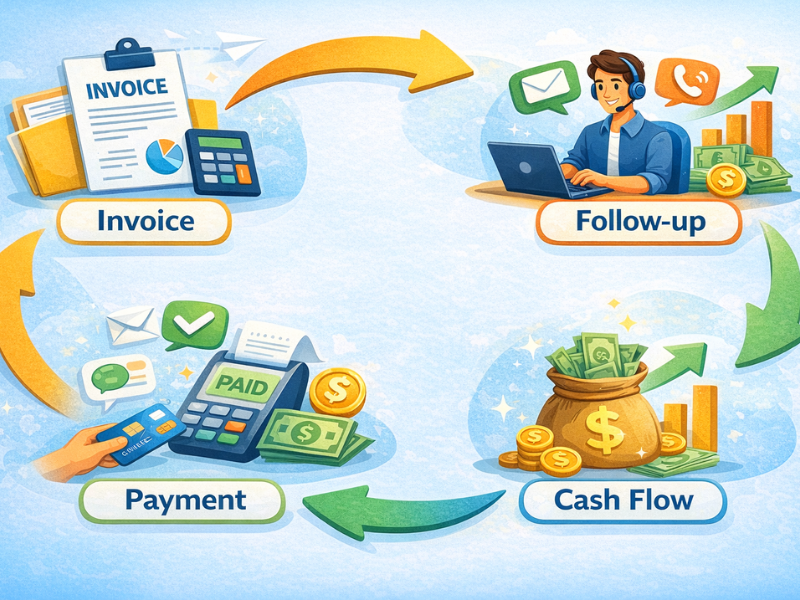
Accounts receivable outsourcing is when you hire a specialized company to handle your invoice-to-payment workflow. Instead of your internal team chasing down late payments, an external provider takes over execution while you maintain strategic control.
Here’s the key difference from in-house A/R:
In-house teams juggle billing with other finance duties. One person handles invoicing, collections, dispute resolution, and month-end close. When volume spikes or someone goes on leave, follow-ups stop.
Outsourced A/R providers do this exclusively. They have dedicated staff, proven workflows, and systems built specifically for payment collection. When your volume doubles, they scale instantly without you hiring or training anyone.
In practice, it works like this:
-
Here’s How the Workflow Actually Operates:
- You close a deal and generate an invoice (still in your accounting system—QuickBooks, NetSuite, Xero, etc.)
- The provider receives invoice data automatically via API integration or secure portal upload. No manual forwarding required.
- They handle the entire payment cycle:
- Deliver invoices via email/portal with payment instructions
- Send reminders at day 15, 30, 45 (or custom schedule)
- Make collection calls for invoices past 60 days
- Coordinate with your team on disputes or special terms
- When payment arrives, they match it to the correct invoice, apply it in your system, and reconcile automatically. You see updated balances in real-time, not weeks later during month-end close.
- You get visibility dashboards showing:
- Which customers are current vs. overdue
- Aging buckets (0-30 days, 31-60 days, 61-90 days, 90+ days)
- Cash flow projections based on payment patterns
- Exception alerts (large invoices unpaid, customers exceeding credit limits)
This is different from debt collection. Outsourced A/R focuses on routine billing and “soft collections” (polite, structured reminders), not aggressive recovery of overdue debt.
Compared to an in-house A/R team, outsourcing shifts execution to experts who already have trained staff, systems, and standardized workflows. Many providers operate as part of a broader BPO (business process outsourcing) model, supporting finance operations at scale.
Most modern A/R providers also integrate with ERP systems (software that centralizes accounting and operations). Integration allows invoices, payments, and reports to sync automatically, reducing manual work without changing your core accounting setup.
Example:
A growing B2B distributor struggles with late payments as customer volume increases. Instead of hiring more staff, they outsource A/R. The provider handles invoicing and reminders, while the finance team focuses on forecasting and vendor payments.
What Tasks Are Typically Included in Accounts Receivable Outsourcing

Routine Execution (Fully Outsourced):
Invoice Delivery & Tracking Providers send invoices via email/portal and track when customers open them. If an invoice sits unopened for 5 days, they resend with a phone call. This alone cuts payment delays by 10-15 days—customers can’t claim “I never got it.”
Payment Reminders on Fixed Schedules Automated reminders at day 15 (friendly), day 30 (firm), day 45 (urgent). Consistency is what in-house teams struggle with. When your A/R person is out sick, reminders stop. Providers never miss a cycle.
Soft Collections (30-90 Days Overdue) Professional phone calls to customers with past-due balances. Tone is polite but persistent: “We show Invoice #4821 is now 45 days past due. Can we process payment today or set up a plan?” This recovers 60-70% of invoices before they need aggressive collections.
Cash Application & Reconciliation When payments arrive (check, ACH, wire, credit card), the provider matches them to invoices and updates your accounting system. Manual reconciliation takes 2-4 hours per week for most finance teams. Providers automate this to near-zero effort.
Aging Reports & Dashboards Real-time visibility into who owes what, how long it’s been outstanding, and which accounts are at risk. Most in-house teams generate these manually in Excel once a week. Providers give you live dashboards updated every hour.
Why Companies Choose Accounts Receivable Outsourcing
Trigger #1: Late Payments Strangle Growth
You’re closing deals, shipping product, delivering services—but cash isn’t arriving. Your accounting system shows $500K in receivables, but only $180K is collectible in the next 30 days. The rest is stuck at 60, 90, even 120+ days overdue.
The real cost: You can’t pay vendors on time. You delay hiring. You pass on growth opportunities because you don’t have the cash, even though you’re “profitable” on paper.
This happens when in-house teams get overwhelmed. They send invoices but don’t follow up consistently. A customer ignores the first reminder, then the second. By day 60, the invoice feels awkward to bring up. By day 90, it’s practically written off.
Outsourced providers enforce discipline. Reminders go out at day 15, 30, 45 like clockwork. Customers learn that paying on time is the path of least resistance. Over 6-12 months, average payment cycles shrink from 60 days to 35-40 days.
Trigger #2: Staffing Breaks the Process
Your A/R person quits, goes on maternity leave, or gets promoted. Suddenly no one is chasing payments. Invoices pile up. Three months later, you realize $200K in receivables went completely ignored.
Hiring and training a replacement takes 6-8 weeks minimum. During that gap, cash flow collapses.
Outsourcing eliminates this single-point-of-failure risk. Providers have teams, not individuals. If someone leaves, coverage continues without interruption.
Trigger #3: Growth Creates Complexity You Can’t Scale
At 50 customers, one person handles A/R comfortably. At 200 customers with varying payment terms, multiple currencies, and regional tax requirements, that same person is underwater.
The breaking point: You realize follow-ups are 2-3 weeks behind schedule. Reports are inaccurate because data entry is backlogged. Your CFO can’t forecast cash flow because receivables data is a mess.
Outsourced providers are built for scale. They handle 1,000+ customer accounts per client routinely, with systems that track every invoice, reminder, and payment attempt automatically.
Trigger #4: Seasonal Peaks Overwhelm Your Team
Retail, eCommerce, and B2B distributors see invoice volume spike 200-400% during peak seasons (Q4 holidays, back-to-school, industry events). Your in-house team can’t keep up.
Hiring seasonal A/R staff is nearly impossible—these aren’t entry-level roles. By the time someone is trained, the season is over.
Outsourcing gives you elastic capacity. Providers scale up during peaks and scale down during slow periods. You pay for actual workload, not idle staff during off-seasons.
Key Benefits of Accounts Receivable Outsourcing

Improved Cash Flow and Faster Payments
DSO (days sales outstanding, the average number of days it takes to get paid) directly affects liquidity. Outsourced A/R improves DSO through disciplined follow-ups.
- Customers receive reminders on predictable schedules.
- Fewer invoices fall through the cracks.
- Payment behavior improves over time.
Better consistency also improves cash flow forecasting. Finance leaders gain clearer visibility into expected inflows.
Cost Savings and Operational Efficiency
Outsourcing reduces or avoids several cost categories:
- Salaries, benefits, and training for A/R staff.
- Investment in billing and collections software.
- Time spent fixing errors and chasing exceptions.
Providers spread technology and expertise across many clients. This economy of scale makes advanced systems affordable without large upfront costs.
Better Accuracy Through Automation Tools
Most providers rely on automation tools to manage invoices and payments.
- Fewer manual data entry errors.
- Faster reconciliation between invoices and payments.
- Real-time reporting instead of delayed spreadsheets.
ERP integrations keep records aligned without duplicating work.
Allows Internal Teams to Focus on Core Business
Chasing payments is time-consuming and low leverage. When A/R is outsourced:
- Finance teams focus on analysis and planning.
- Operations focus on delivery and growth.
- Leadership spends less time managing exceptions.
This shift often delivers more value than cost savings alone.
Risks and Downsides of Outsourcing Accounts Receivable

Reduced Direct Control Over Customer Interactions
Outsourcing inserts a third party into customer communication. Tone and timing matter.
- Poorly handled reminders can damage relationships.
- Escalation paths must be clear.
Strong SLAs (service-level agreements) and approval rules help maintain control.
Data Security and Compliance Concerns
A/R involves sensitive financial and customer data.
- Invoices, payment details, and account histories are shared.
- Weak controls increase fraud and breach risks.
Providers should offer strict access controls, audits, and clear security standards.
Contract Limitations and Cost Risks
Some agreements lock businesses into long terms.
- Volume minimums can increase costs during slow periods.
- Fees may rise with complexity or customization.
Transparent pricing and exit options matter.
Not Always a Fit for Every Business
Outsourcing may not suit:
- Very small companies with simple billing.
- Businesses where billing is deeply personal or relationship-driven.
In these cases, in-house or automated tools may work better.
When Does Accounts Receivable Outsourcing Make Sense?
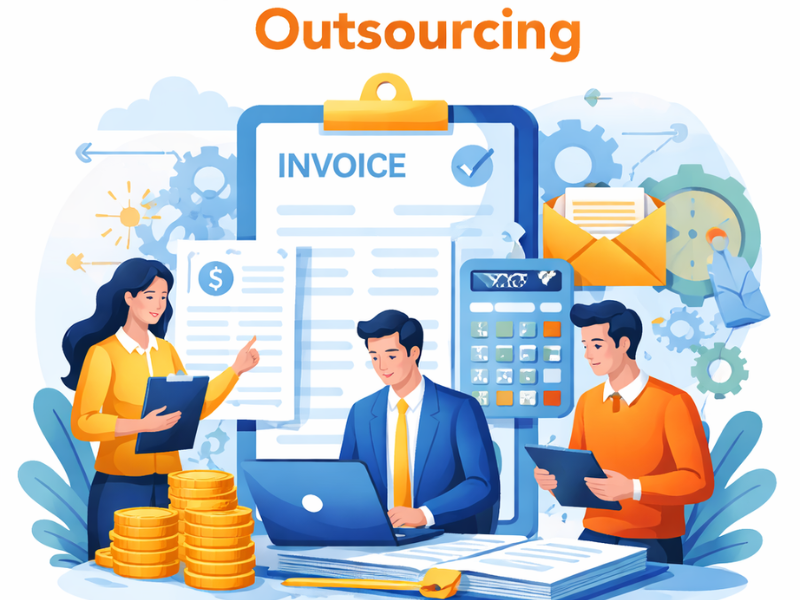
Outsourcing is usually a good fit when:
- Payments are frequently late despite strong sales.
- A/R workload is growing faster than the team.
- Cash flow forecasts are unreliable.
- Manual processes cause errors or delays.
- Hiring specialized staff is difficult or expensive.
It makes less sense when:
- Invoice volume is low and predictable.
- Customer relationships require direct handling.
- Budget flexibility is limited.
A short trial or partial outsourcing often helps test the fit.
Accounts Receivable Outsourcing vs In-House vs Automation
| Factor | In-House A/R | Outsourcing | Automation |
|---|---|---|---|
| Control | High | Medium | High |
| Cost predictability | Medium | High | High |
| Scalability | Low–Medium | High | High |
| Setup effort | Low | Medium | Medium |
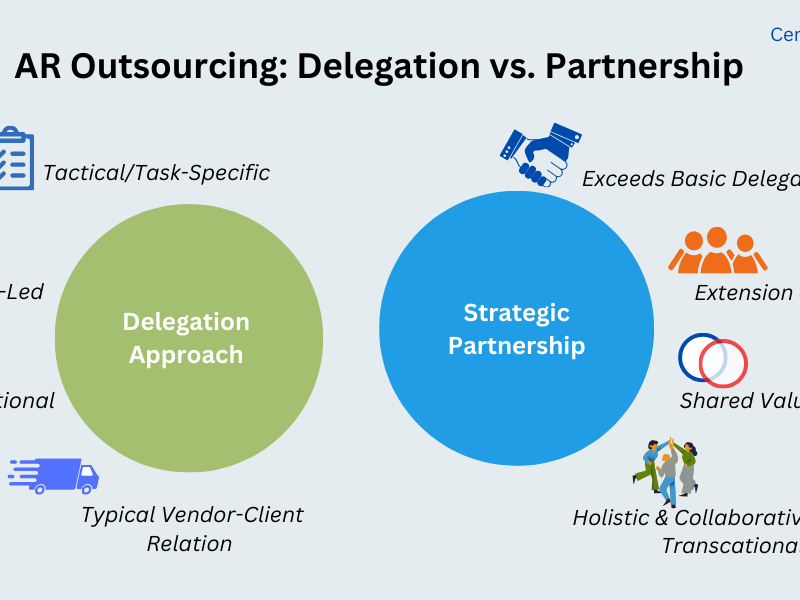
In-house teams offer control but struggle to scale. Outsourcing adds expertise and capacity but reduces direct oversight. Automation keeps control internal while reducing manual work.
Many businesses choose a hybrid model: automation tools internally, with outsourced support for collections and reporting.
How to Choose an Accounts Receivable Outsourcing Provider

- Proven experience in your industry.
- Clear security and data protection standards.
- Flexible contracts without heavy lock-ins.
- Transparent reporting and dashboards.
- Defined communication tone and escalation rules.
Key Takeaways for Business Decision-Makers
- Accounts receivable outsourcing improves cash flow through consistency.
- The biggest gains come from faster payments and better visibility.
- Risks center on control, security, and contract structure.
- Outsourcing is a tool, not a default answer.
- The best choice balances cost, control, and scalability.
If cash flow feels unpredictable, outsourced A/R is worth evaluating alongside automation and in-house options.
FAQ – Common Questions About Accounts Receivable Outsourcing
What is the main goal of accounts receivable outsourcing?
The main goal is to get paid faster and more consistently by handing billing and follow-ups to specialists while improving cash flow visibility.
Is accounts receivable outsourcing suitable for small businesses?
Yes, especially for small businesses with growing invoice volume or limited staff. It works best when late payments hurt cash flow more than the outsourcing cost.
How does outsourcing accounts receivable improve cash flow?
Outsourcing enforces consistent invoicing and reminders. This reduces DSO, improves customer payment behavior, and makes incoming cash more predictable.
What are the biggest risks of outsourcing A/R management?
The biggest risks are reduced control over customer communication, data security concerns, and inflexible contracts that raise costs over time.
Is automation better than outsourcing accounts receivable?
Automation keeps control internal and reduces manual work. Outsourcing adds expertise and capacity. Many companies combine both for best results.
How much does accounts receivable outsourcing typically cost?
Pricing usually follows a flat monthly fee or a percentage of invoices collected. Costs vary by volume, complexity, and service scope.
Câu Hỏi Thường Gặp

What is the main goal of accounts receivable outsourcing?
The main goal of accounts receivable (A/R) outsourcing is to streamline payment collection, reduce operational costs, and improve cash flow. By leveraging third-party expertise, businesses can ensure timely invoice management and focus on core activities.
Is accounts receivable outsourcing suitable for small businesses?
Yes, A/R outsourcing can benefit small businesses by reducing overhead costs and improving efficiency. However, it’s essential to assess cost-effectiveness and find a provider offering scalable services tailored to SMEs.
How does outsourcing accounts receivable improve cash flow?
Outsourcing A/R streamlines invoice processing and payment collection, reducing delays and improving cash flow predictability. Advanced automation ensures faster invoice reconciliation and follow-up, directly impacting day sales outstanding (DSO).
What are the biggest risks of outsourcing A/R management?
The main risks include reduced control over customer relationships, data privacy concerns, and rigid contract terms. Choosing a reputable provider with robust security measures and clear communication standards can mitigate these risks.
Is automation better than outsourcing accounts receivable?
Automation and outsourcing serve different needs. Automation retains control while increasing efficiency, whereas outsourcing combines technology with expert management. A hybrid approach may work best for businesses seeking flexibility and scalability.
How much does accounts receivable outsourcing typically cost?
Costs for A/R outsourcing vary, often based on a percentage of revenue collected, a flat fee, or per-invoice pricing. Factors such as the provider’s expertise, service scope, and automation tools impact pricing.
Read more
- Top Enterprise Contact Center Solutions for Scalable Support
- Reliable Global Outbound Call Solutions to Boost Sales
- Pay-as-you-go Call Center Solutions for Flexible Support



 English
  Russian
  Chinese