
Worried your carrier might be recording your private calls?
If you have ever wondered whether phone companies record phone calls, the short answer is usually no, not by default. Most carriers keep call logs and network records, not full recordings of private conversations. In this guide, you’ll learn the difference between call content and metadata, when legal access may happen, what privacy standards apply in the US, and what you can do if you want more private voice communication.
Key Takeaways
- Phone companies do not normally record the content of private phone calls by default.
- Carriers usually collect call metadata such as phone numbers, time, duration, and network records instead of voice recordings.
- In limited situations, call content may be accessed through court orders, wiretap authority, or other lawful requests.
- Regular cellular calls are not the same as end-to-end encrypted calls, but that does not mean carriers are listening to every conversation.
- The more common recording risk is often the other person, a business line, or a call-recording app.
- Viral claims that all long calls are automatically recorded or stored for 30 days are misleading.
- For sensitive conversations, encrypted calling apps like Signal or WhatsApp are usually a better choice.
- The most important distinction is simple: call logs are common, full call recordings are not.
Short Answer: Do Phone Companies Record Your Calls?
Direct answer in plain English
Usually no, phone companies do not record your private phone calls by default. In normal use, carriers are far more likely to keep call logs than full recordings of what you said. That means they may store details about the call, such as the time, duration, and numbers involved, without storing the conversation itself. This is the key point most people need to know when asking whether a phone company records private conversations.
The key nuance readers need to know
The confusion usually comes from mixing up recordings with records. A carrier may keep data about a call without recording the audio.
- Call content means the actual words spoken during the conversation.
- Metadata means the surrounding details, such as who called whom, when the call happened, and how long it lasted.
So when people hear that carriers keep records, they often assume that means voice recordings. In most cases, it does not.
Snippet-ready definition
Call content is what was said during a phone conversation. Metadata is the related call information, such as the phone numbers, date, time, and duration. Carriers usually store metadata, not full recordings of private calls.
What Phone Companies Actually Collect
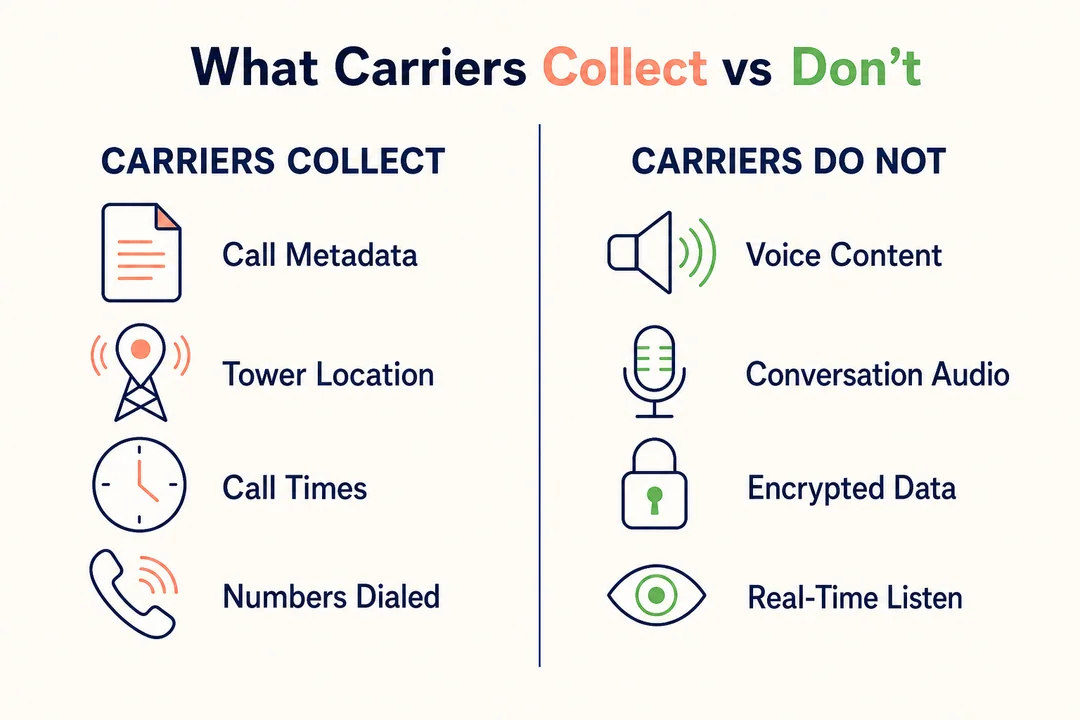
Call metadata vs. call content
Phone metadata is the administrative information around a call. Call content is the conversation itself. This difference matters because carriers commonly process and retain metadata for billing, routing, and service operations, while full conversation recordings are a different category.
A simple example helps:
| Type | What it means |
|---|---|
| Metadata | You called a number at 8:12 PM and the call lasted 14 minutes |
| Call content | What you and the other person actually said |
For everyday users, this is the easiest way to understand the issue: a log is not the same as a recording.
Common records carriers may keep
Carriers may keep records such as:
- The phone numbers involved in the call
- The date and time of the call
- The length of the call
- Billing-related records
- Network or routing records used to complete the call
- In some cases, approximate location-related records tied to service use
Exact practices vary by carrier, service type, and applicable law.
Why metadata still matters for privacy
Even without a recording, metadata can still reveal a lot about your habits and relationships. It may show patterns that are private in their own way.
For example, metadata can suggest:
- Who you contact most often
- When you are usually active
- Whether you follow a routine
- Parts of your social or professional network
That is why privacy experts often treat metadata seriously. It may not reveal your words, but it can still reveal a meaningful picture of your life.
How long do mobile carriers keep call logs?
There is no single answer for every carrier. Retention periods vary.
The length of time call logs may be kept often depends on:
- Carrier policy
- Billing needs
- Regulatory compliance
- Legal obligations
If you want specifics, the best source is your carrier’s privacy policy or customer support documentation.
Can Phone Companies Ever Access or Monitor Call Content?
When legal access may happen
In limited situations, call content may be accessed or monitored under the law. Common examples include:
- Court-ordered interception
- Targeted wiretapping tied to an investigation
- Lawful intercept requirements for telecom providers
- Certain emergency or national security requests under applicable law
These are targeted legal processes, not normal day-to-day treatment of every call.
Why this does not mean all calls are recorded
A carrier having the technical ability to support lawful interception is not the same as routinely recording everyone’s calls. Those are very different things. Legal access is generally targeted, limited, and subject to oversight. So while access can happen in specific cases, that does not mean all users are being recorded by default.
The role of US privacy law and oversight
In the US, call privacy exists within a legal framework that treats call content more sensitively than ordinary logs. Agencies and carriers do not have unlimited freedom to record private conversations whenever they want.
At a high level, the FCC and other legal authorities help shape privacy expectations for telecom services. The broad rule for readers is simple: records about a call and the content of a call are often treated differently. That is part of why carriers commonly retain logs, while call content access usually requires a higher legal threshold.
Real-world takeaway for readers
For most people, the more realistic privacy issue is not default voice recording by the carrier. It is the fact that carriers usually keep metadata, and that call content may only become accessible in limited legal situations. If your question is whether your service provider is routinely monitoring every ordinary call, the answer is generally no.
How Private Are Regular Cellular Phone Calls?
What most people can realistically expect
Regular cellular calls are generally private enough for everyday conversations. In normal circumstances, carriers are not recording the content of those calls by default. That said, regular phone calls are not the highest-privacy option available. They are fine for routine use, but they are not the same as calling through a trusted encrypted app.
Why regular phone calls are not fully private
Standard phone calls travel through telecom infrastructure, including the PSTN (Public Switched Telephone Network, the traditional phone network) or modern mobile voice systems. Because of that, they are not designed like end-to-end encrypted apps, where only the people in the conversation can read or hear the content.
This does not mean normal calls are open for everyone to hear. It means they should not be treated as the strongest privacy option for highly sensitive topics.
Are phone calls encrypted or recorded?
Standard mobile calls may use network protections, but they are usually not end-to-end encrypted in the same way as Signal or WhatsApp. That is the key distinction.
Keep these points in mind:
- Not being end-to-end encrypted does not mean the call is being recorded.
- Network protection is not the same as private app-based encryption.
- A lack of E2EE does not mean someone is listening live to every call.
This is where many privacy fears start. People often hear that cellular calls are not fully encrypted end to end, then assume that carriers must be recording them. That leap is not accurate.
Cellular, landline, VoIP, and app-based calls
| Call type | How the call travels | Typical logging | Is E2EE common? | Privacy level for average users |
|---|---|---|---|---|
| Standard cellular call | Through mobile carrier voice network | Usually yes | No, not typically | Good for everyday use |
| Landline call | Through traditional phone network | Usually yes | No | Basic privacy, but limited |
| VoIP call | Over internet-based voice service | Usually yes | Varies by provider | Depends on provider setup |
| Encrypted app call | Through internet app with app-level protection | Some account and usage data may still exist | Yes, often | Best choice for sensitive calls |
The short version: all calls are not equal. If privacy matters more than convenience, encrypted app calls are usually the better option.
Who Else Might Record a Phone Call Besides the Carrier?
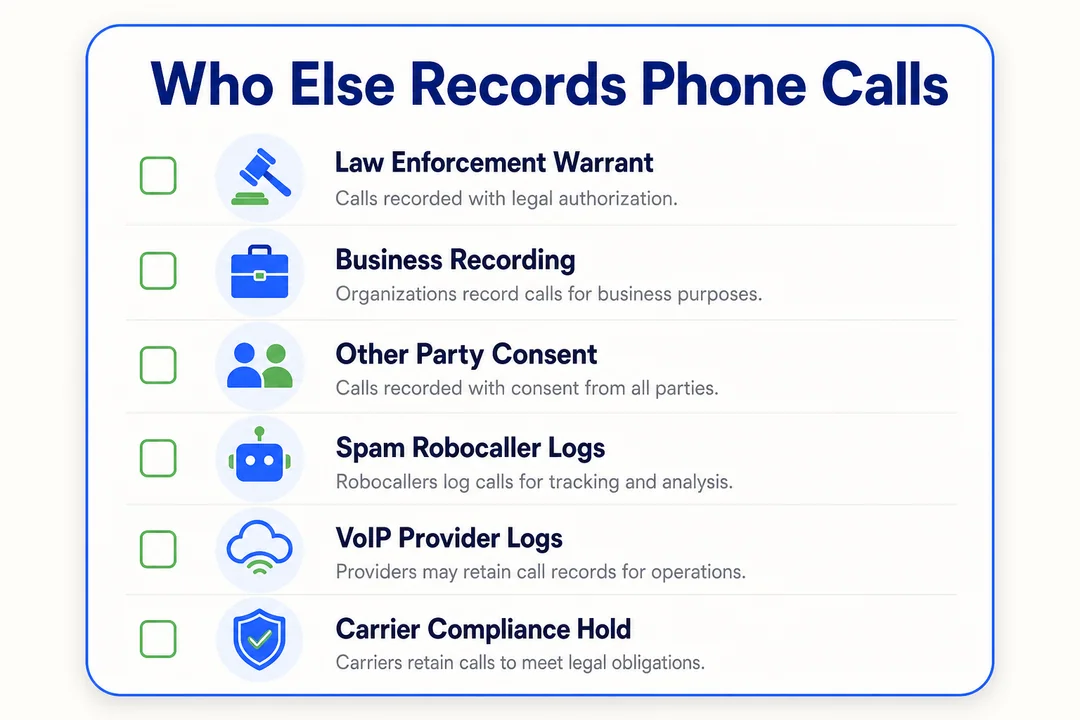
The person on the other end
This is often the most realistic recording risk. The other person may use a built-in recording feature, a second phone, a computer, or an external recorder. Even if a call uses stronger privacy tools, encryption does not stop a participant from recording what they hear on their own device.
Businesses and customer service lines
Businesses often record calls for training, quality assurance, dispute handling, or compliance. This is common, familiar, and usually disclosed at the start of the call.
Examples include:
- Customer support lines
- Bank service centers
- Insurance calls
- Appointment confirmation lines
This kind of recording is far more common than a carrier recording every private consumer call.
Built-in phone features and recording apps
Some phones and apps offer call recording features, but availability varies.
It often depends on:
- Device manufacturer
- Operating system policy
- Region
- App store rules
Legality can vary too, so users should not assume recording is always allowed just because an app or phone offers it.
One-party vs. two-party consent laws
Call recording laws in the US vary by state and situation. In plain English, some places allow recording when one person in the call consents, while others require everyone on the call to agree.
- One-party consent means one participant in the conversation can legally consent to the recording.
- All-party or two-party consent means everyone involved may need to agree, depending on the law.
If you plan to record a call, check the law that applies where you and the other person are located.
Common Myths About Phone Call Surveillance
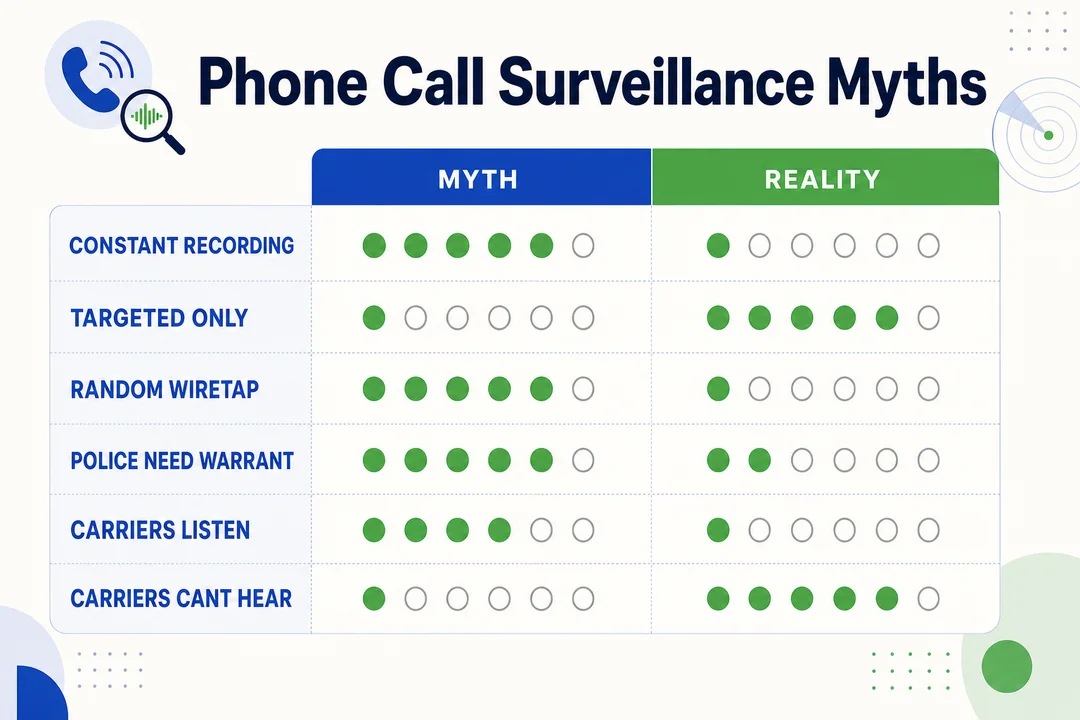
Myth: Calls over 10 minutes are automatically recorded
Myth: Calls longer than 10 minutes are automatically recorded by phone companies.
Fact: No known universal carrier rule requires that. This claim is a recurring rumor, not a standard telecom practice.
Myth: Phone companies store all private conversations for 30 days
Myth: Carriers store every private call for at least 30 days.
Fact: This often confuses call logs with voice recordings. Carriers commonly retain records about calls, but that does not mean they store the full audio of all private conversations.
Myth: Carriers listen to every call
Myth: Phone companies actively listen to all calls.
Fact: Routine human listening to every call is not a normal operating model. It would raise major legal, practical, and operational issues, and it does not reflect normal consumer telecom service.
How to spot misinformation about digital privacy
- Check official carrier privacy policies before trusting a viral claim.
- Look for confirmation from reliable legal, regulatory, or major news sources.
- Be skeptical of screenshots or social posts without context.
- Check whether the claim confuses metadata with call content.
- Watch for vague claims tied to a date but no named policy or source.
This confusion is common, which is why rumors about call recording spread so easily.
How to Make Your Voice Calls More Private
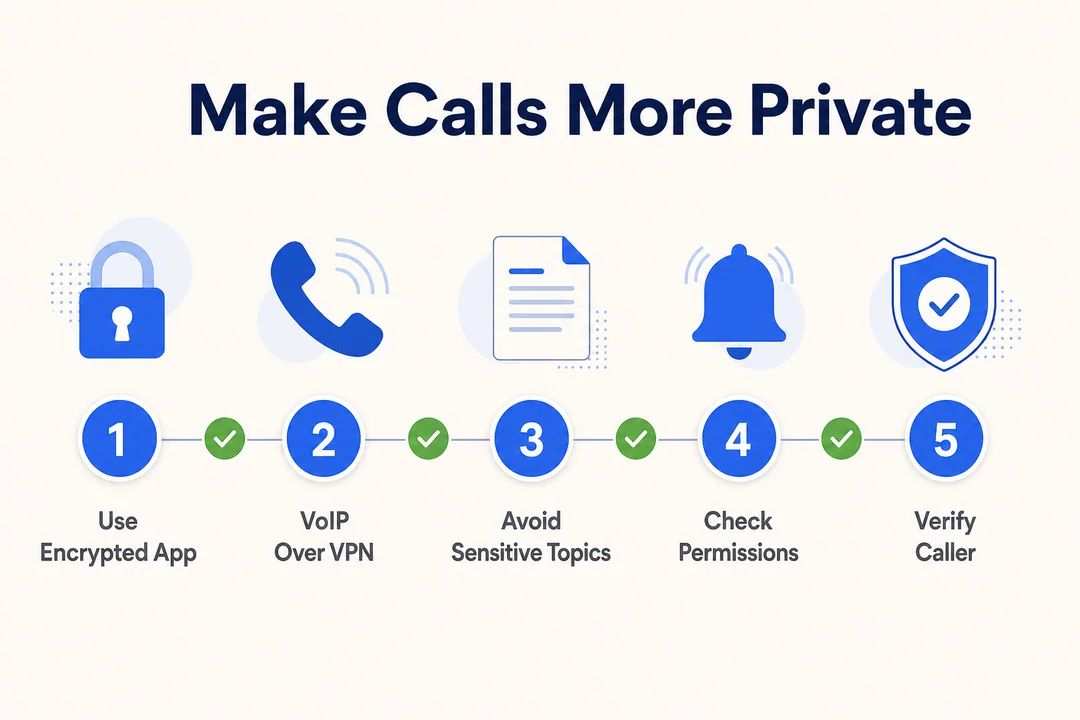
Use end-to-end encrypted calling apps for sensitive conversations
If a conversation is sensitive, use an app with E2EE (end-to-end encryption, meaning only the people in the call can access the content). For most readers, trusted mainstream options are enough.
Good examples include:
- Signal
- Other reputable encrypted calling apps with clear privacy documentation
You do not need this for every casual call. But for legal, medical, financial, or highly personal conversations, it is a smart upgrade.
Know the limits of encrypted apps too
Encrypted apps improve privacy, but they are not magic. They protect the call in transit, not every possible risk around it.
Limits still include:
- The other person can record the call
- A compromised device can expose the conversation
- Linked devices or backups may create extra risk
So yes, encryption helps a lot. It just does not remove every privacy risk.
Simple privacy habits for average users
- Keep your phone software updated.
- Use a strong screen lock.
- Protect important accounts with strong passwords and two-factor authentication.
- Review app permissions and remove apps you do not trust.
- Avoid discussing highly sensitive information on ordinary calls when possible.
- Be careful when using shared or borrowed devices.
For more practical advice, see our related guide on digital safety tips for travelers using public networks.
When regular cellular calling is still fine
For most daily conversations, standard cellular calling is fine. The best privacy tool depends on what is at stake. If the topic is routine, a normal call is usually enough. If the topic is highly sensitive, switch to a trusted encrypted app. That simple habit gives you a practical privacy balance without overcomplicating everyday life.
Phone Companies, ISPs, and Apps: What’s the Difference?
Mobile carriers vs. internet service providers
Mobile carriers provide your cellular voice service and mobile data connection. ISPs usually provide internet access, such as home broadband or office internet. People often mix them up, but they do not always play the same role in a phone call.
Traditional telecom networks vs. app-based communications
Traditional calls and app-based calls run on different systems.
- PSTN is the traditional phone network.
- VoLTE (Voice over LTE, voice service over 4G data infrastructure) is a modern mobile calling method.
- App-based calling uses internet services instead of the traditional phone system.
Because they use different systems, they can also have different privacy models.
Why this affects privacy expectations
Not all calls work the same way. Different systems may follow different logging practices, encryption models, and legal rules. That is why you should not assume a regular cell call, a landline call, a VoIP call, and a Signal call all offer the same privacy.
Why the Difference Between Metadata and Content Matters
A simple example anyone can understand
Metadata means you called someone at 8:12 PM for 14 minutes. Content means what you actually talked about during those 14 minutes.
Why laws often treat them differently
In many legal settings, logs and content are handled under different standards. That is why carriers may be able to retain call records as part of ordinary operations, while access to conversation content usually faces stricter rules.
Why this is the biggest source of confusion
When people hear that a carrier keeps records, they often imagine stored recordings of every call. That is usually the wrong conclusion. In most cases, the records are call details, not full audio.
When Should You Actually Worry About Phone Call Privacy?
Most people’s real-world risk
For most people, default carrier recording is not the biggest threat. More common risks include:
- Scam calls
- Phishing attempts
- Compromised devices
- Recording by the person on the other end
That is where most users should focus first.
Higher-risk situations
Some conversations deserve stronger protection, such as:
- Legal discussions
- Medical details
- Banking or financial matters
- Confidential work conversations
- Activism or investigative communications
In these cases, stronger privacy tools make more sense.
A practical rule of thumb
If a call would be a serious problem if exposed, use a trusted end-to-end encrypted calling app instead of a standard cellular call.
Frequently Asked Questions
Do phone companies record private conversations?
Usually no, not by default. Carriers generally keep call logs and related network records rather than full recordings of private conversations.
Do phone companies listen to phone calls in real time?
Usually no. Real-time access is generally tied to limited lawful situations, such as targeted interception under proper legal authority.
What is the difference between call metadata and call content?
Metadata includes details like the phone numbers involved, the date, the time, and the call duration. Call content is the actual conversation.
Can police get phone call recordings from a carrier?
Sometimes, but not because all calls are routinely stored. It depends on legal authority, the situation, and whether any relevant call content exists or was lawfully intercepted.
How long do phone companies keep call logs?
It varies by carrier. Retention may depend on billing needs, internal policy, compliance requirements, and other legal obligations.
Are mobile phone calls end-to-end encrypted?
Usually not in the same way as Signal or WhatsApp. Standard cellular calls may use network protections, but that is different from full end-to-end encryption.
Can the other person record my call without telling me?
Possibly yes. It depends on local consent law, device capability, and how the recording is made.
Are landline calls and cell phone calls equally private?
Both have privacy limits. Neither should be assumed to offer the same protection as a trusted encrypted calling app.
Is the rumor about long calls being automatically recorded true?
No. There is no known universal carrier rule that automatically records all long calls.
Carriers usually do not record private phone call content by default, but they often do keep call metadata such as numbers, time, and duration. That is the core fact most readers need. Lawful access, targeted interception, and recordings by businesses or other participants are separate issues. For everyday use, standard calls are usually fine. For anything sensitive, use a trusted encrypted calling app. If you want to learn more, explore our related guides on call privacy, encrypted communication apps for travelers, and digital safety best practices.
More in Operations & CX Optimization
View all →
Customer Experience Transformation: Framework and Steps
A telecom customer calls support about a billing error. They explain the problem to the IVR system. Then to the first agent. Then get transferred and explain again. Then escalated—and explain a third time. Forty minutes later, they're exhausted and the problem still isn't solved. This is what broken customer experience looks like. And it's costing you customers. Customer experience…

Web Caller Meaning: JavaScript caller, Calling Tools or Portals
“Web caller” is one of those phrases where the search results and the searcher are frequently talking about different things. Three unrelated audiences use it: developers hitting an error on the legacy JavaScript caller property, buyers evaluating browser-based calling software, and people trying to reach a specific portal or training page whose exact name they cannot recall. That fragmentation is…

Customer Experience Strategy: How to Build One That Works
Customer experience is getting worse, not better. Forrester's 2025 Global CX Index found that 21% of brands declined in CX quality while only 6% improved — and in the US, 25% declined against 7% that improved, the second consecutive year of that pattern. Most of those brands were not neglecting customer experience. They were working on it without a strategy…



 English
  Russian
  Chinese