
US companies face rising customer support costs while quality expectations remain high. Building an in-house call center requires $150,000+ annually for just 10 agents—before accounting for facilities, technology, and management overhead.
The Philippines has emerged as the leading solution, handling millions of customer interactions daily through a mature BPO ecosystem. With 40-60% cost savings, strong English proficiency, and cultural alignment with Western markets, Philippine call centers deliver quality support at a fraction of US costs.
This guide covers why the Philippines dominates global outsourcing, how the model works, what you can expect to pay, and when outsourcing makes strategic sense for your business.
Key Points at a Glance

Why the Philippines leads global outsourcing:
- 15% of global BPO work flows through the Philippines—a $29 billion industry built over 20+ years
- English is an official language with neutral accents and strong communication skills
- Cultural alignment with US business practices and customer expectations
- Government-backed infrastructure supporting 24/7 operations
Economics and cost structure:
- Typical savings: 40-60% compared to US in-house operations
- Agent costs: $1,200-$2,500/month fully-loaded vs $5,000+ US equivalent
- What’s included in pricing and what drives cost differences
Operational capabilities:
- Voice, chat, email, and social media support at scale
- Customer service, technical support, sales, and back-office functions
- 24/7 coverage using Philippine teams working US time zones
By the end of this guide: You’ll understand when Philippine outsourcing makes sense, how to evaluate providers, and what results to expect from a well-managed partnership.
What Is Call Center Outsourcing in the Philippines?
Call center outsourcing in the Philippines means partnering with a Philippine-based service provider to handle customer interactions—voice calls, live chat, email, and social media—instead of building in-house teams.
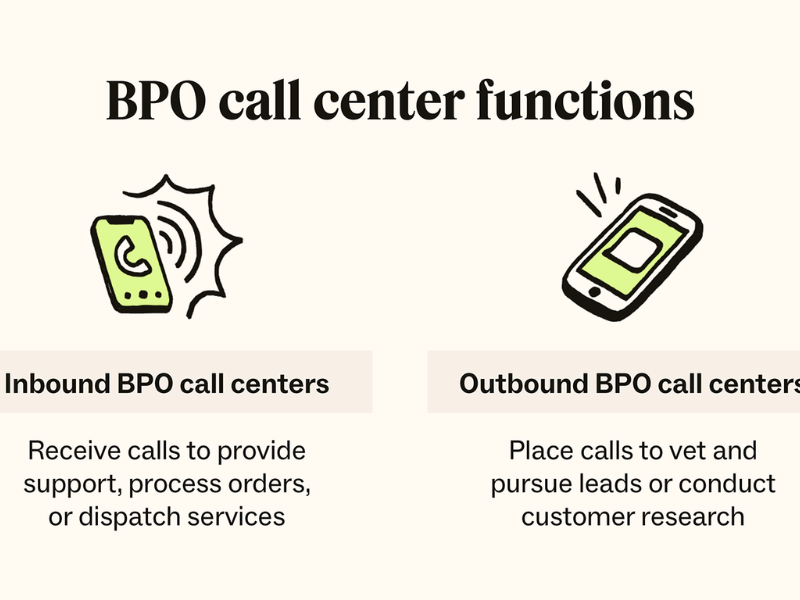
If you’re new to outsourcing, it helps to first understand what a BPO call center is and how it works in different business scenarios.
How it works in practice:
A US ecommerce company needs 24/7 customer support but can’t justify $150,000 annually for 10 US-based agents. They partner with a Philippine BPO that provides:
- Trained agents working US business hours (night shift in Philippines = daytime in US)
- Complete infrastructure including facilities, phone systems, and management
- Predictable costs at $1,200-$2,500 per agent monthly versus $5,000+ for US equivalents
Common engagement models:
| Model | How It Works | Best For |
|---|---|---|
| Dedicated team | Agents work exclusively for your brand with custom training and processes | Companies needing 10+ agents with consistent brand experience |
| Shared team | Agents handle multiple clients during variable volume periods | Businesses with seasonal peaks or testing new support channels |
| Fully managed | BPO handles everything from hiring to QA to reporting | Organizations wanting turnkey solutions with minimal oversight |
Scale and maturity:
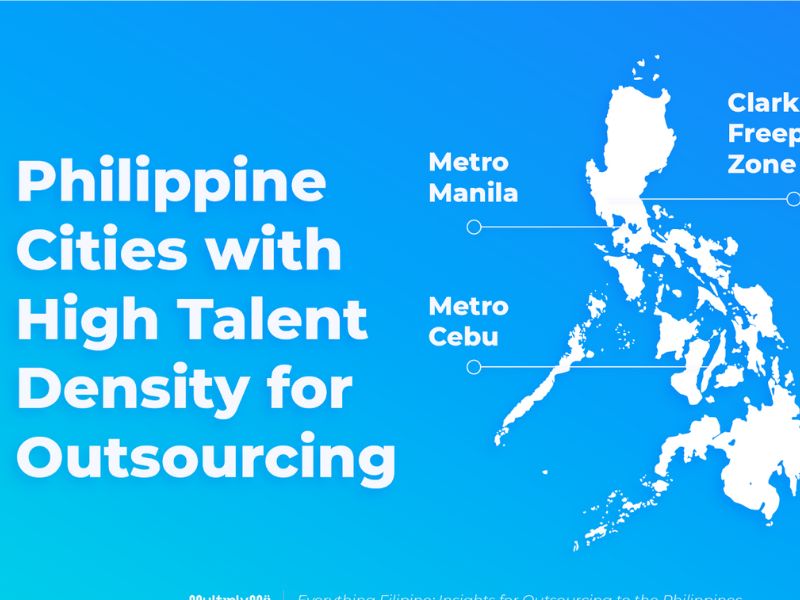
The Philippine BPO industry handles over $29 billion in annual business, supporting millions of customer interactions daily for US companies. Major cities like Manila, Cebu, and Clark host hundreds of call centers with proven operational frameworks built over 20+ years.
Why the Philippines Is a Leading Destination for Call Center Outsourcing
Strong English Proficiency and Communication Skills
English is an official language in the Philippines and the primary medium for education, business, and media. This creates measurable advantages for customer-facing roles.
Impact on key performance metrics:
Philippine agents consistently outperform other offshore regions on communication-dependent KPIs:
| Metric | Philippine Average | Other Offshore Regions | Impact |
|---|---|---|---|
| First Contact Resolution (FCR) | 70-75% | 65-70% | Fewer repeat calls due to clearer communication |
| Average Handle Time (AHT) | 15-20% lower | Baseline | Less time spent clarifying or repeating information |
| Customer Satisfaction (CSAT) | 5-10% higher | Baseline | Better rapport and empathy in conversations |
Why English proficiency matters beyond accent:
Clear pronunciation is just the starting point. Philippine agents understand US communication norms naturally:
- Idiomatic fluency: Agents grasp phrases like “circle back,” “touch base,” or “ballpark figure” without translation delays
- Cultural context: Training focuses on soft skills—empathy, active listening, de-escalation—rather than basic language competency
- Quality assurance: QA teams evaluate nuanced communication quality, not just script compliance
Real-world example:
A US subscription box company moved Tier 1 support from Eastern Europe to the Philippines. Both regions employed “fluent English speakers,” but customer complaints about “not understanding the agent” dropped from 12% of tickets to under 3% within 90 days.
The difference? Philippine agents needed minimal accent training and could focus immediately on product knowledge and customer empathy rather than language fundamentals.
Operational advantages:
- Faster onboarding: New agents reach full productivity 20-30% faster when language isn’t a barrier
- Lower escalation rates: Agents resolve issues independently rather than transferring due to communication gaps
- Stronger brand voice: Agents adapt naturally to your company’s tone—whether casual tech startup or formal financial services
Cultural Alignment With US and Western Markets
Filipino agents grow up immersed in American culture through media, education, and business practices. This isn’t learned in training—it’s embedded in daily life.
How cultural alignment impacts customer experience:
Understanding customer context without explanation:
- Agents recognize US holidays (Thanksgiving, Black Friday, Super Bowl) and adjust expectations accordingly
- They understand seasonal patterns—tax season stress, back-to-school shopping urgency, holiday gift returns
- They naturally grasp US customer behavior: preference for quick resolutions, direct communication, and empathetic service recovery
Service-oriented communication style:
Philippine culture emphasizes hospitality and respect in customer interactions. This translates to:
- Natural empathy: Agents express genuine concern without sounding scripted
- Patience during difficult conversations: Cultural norm prioritizes maintaining calm and politeness even when customers are frustrated
- Rapport-building: Small talk feels natural, not forced—”How’s the weather in Texas?” or “Excited for the game this weekend?”
Faster adaptation to brand voice:
| Aspect | Philippines Advantage | Why It Matters |
|---|---|---|
| Media exposure | Decades of US TV, movies, music create intuitive understanding of American communication norms | Agents match your brand’s casual or formal tone without extensive coaching |
| Service mindset | Cultural emphasis on hospitality (“Filipino hospitality” is globally recognized) | Natural de-escalation skills and willingness to go the extra mile |
| Holiday awareness | Deep familiarity with US calendar (shopping seasons, holidays, major events) | Agents anticipate volume spikes and customer expectations without reminders |
Comparison with other offshore regions:
| Factor | Philippines | Other Offshore Regions | Practical Impact |
|---|---|---|---|
| Accent neutrality | High—minimal accent training needed | Varies—often requires extensive coaching | Faster time to productivity |
| Cultural references | Natural understanding of US context | Requires explicit training on holidays, idioms, customs | Fewer awkward customer interactions |
| Service orientation | Empathy-led approach (“How can I help?”) | Often process-led (“Here’s the policy”) | Higher CSAT and loyalty scores |
Example scenario:
Customer: “I need this order by Thursday—it’s for my mom’s birthday.”
Philippine agent response:
“I completely understand—birthdays are special! Let me check expedited shipping options for you right now. If we can’t guarantee Thursday delivery, I’ll find an alternative so your mom still gets something special on her day.”
Why this works: The agent naturally grasps the emotional importance without scripting. They prioritize solution-finding over policy recitation.
Other regions might respond:
“I see. Our standard shipping is 5-7 business days. Expedited shipping costs $29.99 extra.”
Technically correct, but misses the empathy opportunity that drives customer loyalty.
Mature and Established BPO Ecosystem
The Philippine BPO industry has over 20 years of large-scale outsourcing experience.
What this means for US companies:
- Proven operational frameworks
- Stable talent pipelines
- Built-in redundancy for power and connectivity
Key ecosystem strengths:
- PEZA-accredited facilities (government-regulated economic zones)
- Industry associations like BPAP supporting standards and training
- Established providers serving Fortune 500 and high-growth startups
This maturity lowers onboarding risk and speeds up deployment.
Key Benefits of Call Center Outsourcing in the Philippines
Cost Efficiency Compared to US-Based Operations
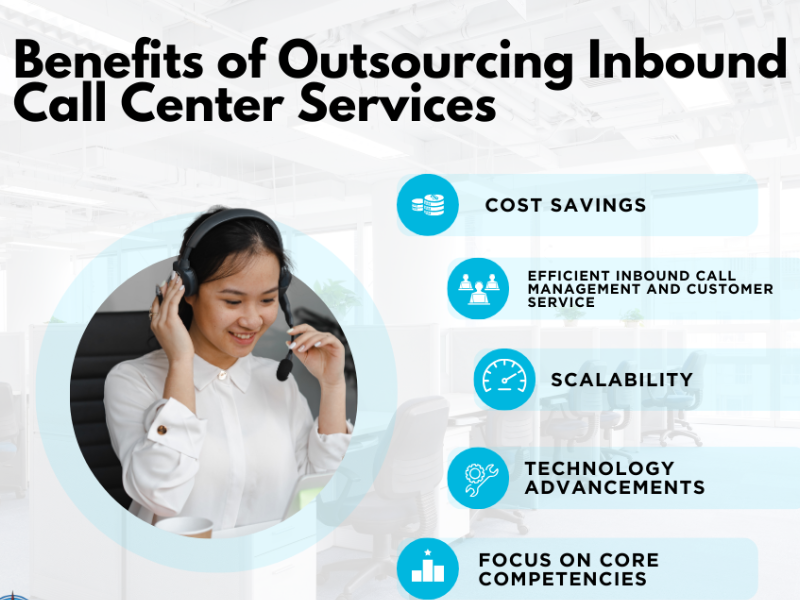
Labor accounts for 60-70% of total call center costs. The Philippines’ lower cost of living creates substantial savings without quality trade-offs.
Detailed cost comparison: 10-agent customer support team
| Cost Category | US In-House (Annual) | Philippine Outsourcing (Annual) | Savings |
|---|---|---|---|
| Agent salaries | $600,000 ($60K per agent) |
$180,000 ($1,500/month per agent) |
$420,000 |
| Benefits & payroll taxes | $120,000 (~20% of salaries) |
Included in agent pricing | $120,000 |
| Facilities & infrastructure | $48,000 (Office space, utilities, internet) |
Included in pricing | $48,000 |
| Technology & software | $24,000 (Phone systems, CRM, quality monitoring) |
$12,000 (Some tools still client-provided) |
$12,000 |
| Management overhead | $80,000 (Supervisor, QA, scheduling) |
Included in pricing | $80,000 |
| TOTAL ANNUAL COST | $872,000 | $252,000 | $620,000 (71%) |
Assumptions: 10 agents, 8-hour shifts, 260 working days/year. Philippine pricing includes fully-loaded costs (salary, benefits, facilities, management). US pricing reflects typical in-house operation costs.
What’s included in Philippine BPO pricing:
When a provider quotes $1,200-$2,500 per agent monthly, this typically covers:
- ✅ Agent salary and government-mandated benefits
- ✅ Physical workspace (desk, computer, headset)
- ✅ Internet and phone infrastructure
- ✅ Facility costs (electricity, security, HVAC)
- ✅ Team leader and quality assurance staff
- ✅ HR administration (payroll, recruitment, training)
- ✅ Basic reporting and performance dashboards
What you still pay for:
- Your CRM or ticketing system licenses
- Specialized software tools unique to your business
- Training materials and onboarding content
- Occasional travel for in-person visits or training
Monthly cost breakdown example:
For a 20-agent team handling ecommerce customer support:
| Item | US In-House | Philippine BPO | Monthly Savings |
|---|---|---|---|
| Core team costs | $120,000 | $36,000 | $84,000 |
| Facilities & overhead | $18,000 | $0 (included) | $18,000 |
| Management & QA | $12,000 | $0 (included) | $12,000 |
| TOTAL MONTHLY | $150,000 | $36,000 | $114,000 |
Annual savings: $1,368,000
ROI beyond direct labor savings:
Cost reduction is just the starting point. Companies also gain:
- Faster scaling: Add agents in weeks vs months (no recruitment, training, onboarding overhead)
- Reduced capital expenditure: No need to invest in facilities, phone systems, or IT infrastructure
- Lower risk: BPO absorbs employee turnover costs—if an agent quits, they replace at no charge
- Management bandwidth: Your internal team focuses on strategy rather than daily operations
When the math works best:
Philippine outsourcing delivers maximum ROI when:
- Team size: 5+ agents (setup costs amortize quickly)
- Duration: 6+ months (sufficient time to recoup onboarding investment)
- Volume: Consistent workload keeps agents productive
- Complexity: Tier 1-2 support with standard processes (lower training overhead)
Large, Skilled, and Scalable Workforce
The Philippines has a deep pool of trained call center professionals.
Operational advantages include:
- Faster hiring for common roles like customer support and sales.
- Ability to scale teams up or down within weeks.
- Access to agents with industry-specific experience.
Seasonal example:
- Ecommerce brands scale during holidays.
- SaaS companies add agents after product launches.
Providers handle recruitment, training, and workforce management.
24/7 and Round-the-Clock Customer Support
The Philippines handles US business hours naturally—when it’s 9 AM in New York, it’s 9 PM in Manila. But timezone overlap is only part of the story.
Why Philippine night shifts work (unlike other regions):
Cultural normalization:
After 20+ years of BPO industry growth, night shift work is fully accepted in Philippine society. It’s not viewed as undesirable—many professionals prefer it for higher pay and career opportunities in global companies.
Infrastructure built around 24/7 operations:
- Transportation: 24-hour public transit, ride-sharing, and company shuttles serve BPO districts
- Food and services: Restaurants, pharmacies, and retail stay open late in major BPO hubs (Manila, Cebu, Clark)
- Safety: BPO facilities in government-designated zones (PEZA) have 24/7 security and well-lit areas
- Healthcare: On-site medical staff and nearby 24-hour clinics serve night shift workers
Government support for BPO night operations:
- PEZA incentives: Tax breaks for companies operating 24/7 in designated economic zones
- Labor law accommodation: Night shift differential pay is standardized and built into BPO pricing models
- Skills training: Government programs specifically train workers for international customer service roles
Operational benefits for US companies:
| Advantage | How It Works | Business Impact |
|---|---|---|
| No overtime premiums | Night shift is standard pricing in Philippines (not an upcharge) | Predictable costs regardless of coverage hours |
| Lower turnover | Night shifts don’t have higher attrition vs day shifts | Consistent team experience and lower retraining costs |
| True 24/7 coverage | Seamless handoffs between Philippine day and night teams | No gaps in coverage during shift changes |
| Faster global response | Support teams cover US, Europe, and Asia time zones | Reduced ticket backlog and improved SLA performance |
How 24/7 coverage works in practice:
Example: US ecommerce company
- 8 AM – 8 PM EST (US daytime): Philippine team handles bulk of customer inquiries during US shopping hours
- 8 PM – 8 AM EST (US nighttime): Smaller Philippine team manages overnight inquiries, urgent issues, and international customers
- Weekends: Full staffing continues (Saturday/Sunday in US = Sunday/Monday in Philippines)
Cost comparison for 24/7 coverage:
| Model | Annual Cost | Notes |
|---|---|---|
| US-based 24/7 | $1,200,000+ | Requires 3 shifts with night/weekend premiums (+30-50% pay) |
| Hybrid (US days + Philippine nights) | $650,000 | Lower-cost Philippine coverage during off-peak hours |
| Full Philippine 24/7 | $400,000 | Flat pricing regardless of shift timing |
Staffing flexibility:
Philippine BPOs easily adjust coverage based on your needs:
- Standard business hours only: 9 AM – 6 PM EST coverage (9 PM – 6 AM Manila)
- Extended hours: 7 AM – 11 PM EST coverage (7 PM – 11 AM Manila)
- True 24/7: Round-the-clock teams with seamless handoffs
Industries that benefit most from 24/7 Philippine support:
- Ecommerce: Peak shopping happens evenings/weekends when customers are home
- SaaS/Tech: Global customer base requires always-on technical support
- Financial services: Trading platforms and payment processors need overnight coverage
- Healthcare: Telemedicine and patient support don’t stop at 5 PM
- Gaming/Entertainment: Users active during evenings and weekends
Real-world example:
A US-based meal kit delivery service needed 24/7 support for order changes, delivery issues, and customer inquiries. They initially used US agents with rotating night shifts—but faced 40% turnover among night staff within 6 months.
After moving to Philippine 24/7 coverage:
- Turnover dropped to 12% (industry standard)
- Night shift costs decreased 60% (no premium pay)
- CSAT scores improved 8% due to consistent, well-rested agents
- Coverage gaps eliminated (Philippines staffs nights as primary shifts, not backup)
Omnichannel Customer Service Capabilities
Philippine call centers handle more than voice.
Typical channels include:
- Phone support
- Live chat
- Email ticketing
- Social media messaging
Agents work inside modern CRM and ticketing systems, ensuring consistent service across touchpoints.
Checklist of capabilities:
- Unified customer view
- Channel switching without context loss
- SLA-driven response tracking
Call Center Services You Can Outsource to the Philippines

Customer Support and Help Desk Services
Common inbound functions:
- Order inquiries and tracking
- Billing and account questions
- Returns and complaints
KPIs typically managed:
- First Contact Resolution
- CSAT
- Average Handle Time
Technical Support
Philippine teams support multiple tiers:
| Tier | Scope |
|---|---|
| Tier 1 | Basic troubleshooting |
| Tier 2 | Product and system issues |
| Tier 3 | Advanced escalation |
Widely used by SaaS, telecom, and device companies.
Sales, Lead Generation, and Telemarketing
Outsourced sales teams handle:
- B2B lead qualification
- Appointment setting
- Upselling and renewals
Providers follow compliance requirements for outbound calling.
Back-Office and Support Functions
Common tasks include:
- Data entry
- Order processing
- Email moderation
- CRM updates
How Much Does Call Center Outsourcing in the Philippines Cost?
Typical Pricing Models and Cost Ranges
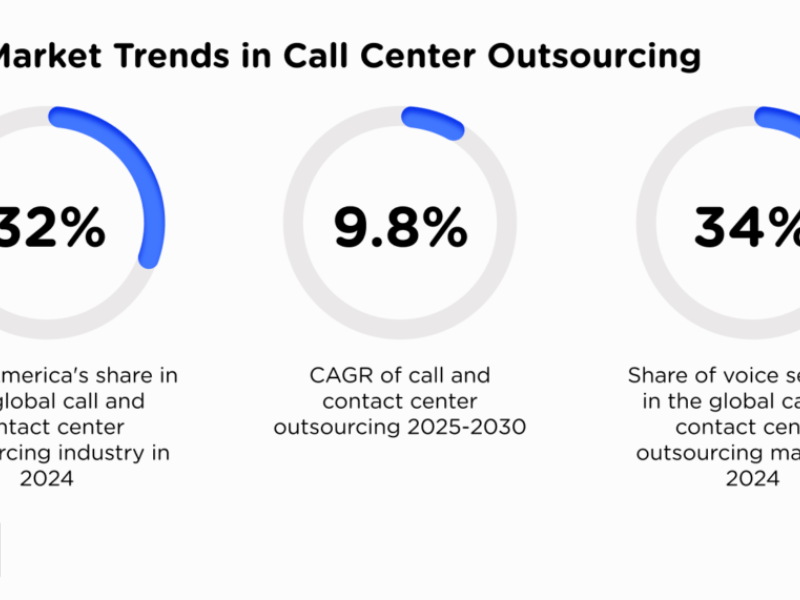
Common models:
| Model | Typical Range |
|---|---|
| Hourly | $8–$14 per hour |
| Per-agent monthly | $1,200–$2,500 |
| Dedicated team | Custom |
Pricing usually includes staffing, facilities, IT, and management.
Factors That Affect Outsourcing Costs
Key variables:
- Agent skill level and experience
- Voice vs non-voice support
- Required tools and software
- SLAs and coverage hours
More complex roles cost more but still undercut US rates.
Philippines vs Other Outsourcing Countries
| Country | Cost | English Quality | Cultural Fit |
|---|---|---|---|
| Philippines | Low–Medium | High | High |
| India | Low | Medium | Medium |
| LatAm | Medium | High | High |
| US | High | High | High |
CRM and Workflow Integration: How Philippine Teams Plug Into Your Stack
For most US companies, the real question is not “can Filipino agents handle calls?” — it is whether they can work inside your existing CRM and ticketing stack without disrupting internal teams. In 2026, mature Philippine BPOs and direct-hire platforms routinely support the following integrations:
- Salesforce Service Cloud: agents work natively inside Salesforce with click-to-dial, automatic case logging, screen pops, and shared knowledge articles. Providers like Concentrix, Alorica, TTEC, and VXI have Salesforce-certified delivery hubs in Manila and Cebu.
- Zendesk: tickets, macros, help center, and side conversations. Most PH-based customer support teams are Zendesk-first because it is the most common platform among US SMB and mid-market clients.
- HubSpot Service Hub: live chat, conversations inbox, ticketing, and knowledge base. Common with US SaaS clients running HubSpot for both sales and support.
- Intercom: chat, Fin AI handoff, Inbox, and Series workflows. Strong fit for mobile-first fintech and SaaS brands outsourcing tier-1 support.
- Freshdesk / Freshworks: tickets, chat, phone, automations. Popular with ecommerce and travel clients.
- Microsoft Dynamics 365 Customer Service: case management, Power Automate flows, and unified routing inside Teams — common in regulated US enterprises.
- Custom CRMs and internal tools: via SSO, VPN access, and IP allowlisting. Expect 1–2 weeks for access provisioning + security review before agents go live.
What to confirm with any Philippine provider before signing:
- Who owns CRM license costs — you or the BPO? Some providers include Zendesk/Freshdesk licenses in their per-seat rate, others bill pass-through.
- Can agents access your CRM via SSO, or do they use shared logins? (SSO is the right answer for compliance.)
- Will dispositions, notes, and recordings sync bidirectionally, so your in-house team can see everything without switching tools?
- What is the escalation path inside your CRM when a case needs US-side attention?
Good Philippine BPOs treat CRM integration as a 2–3 week implementation sprint, not an afterthought. If the provider cannot walk you through their integration playbook for your specific stack, that is a red flag.
Top Philippine Outsourcing Providers Worth Shortlisting in 2026
For US teams starting their shortlist, these providers come up most often in recent RFPs and 2026 buyer guides. This is not a ranking — different providers fit different team sizes, industries, and budgets.
- FlyFone — usage-based cloud platform for building your own Philippine team without BPO markup. Good fit for iGaming, crypto, fintech, and SMBs wanting direct control and predictable per-minute pricing.
- Concentrix — largest BPO workforce in the Philippines (80,000+ agents). Built for Fortune 500 with advanced analytics, AI integration, and strict compliance (SOC 2, ISO 27001, PCI-DSS, HIPAA). Best for 500+ seat operations.
- Teleperformance — global scale and multilingual capability (30+ languages) across 22 PH facilities. Strong for enterprises needing business continuity and regulated-industry expertise.
- Alorica — empathy-driven CX specialist with 90%+ CSAT. Strong fit for healthcare, insurance, and fintech teams where relationship-building matters more than pure cost.
- TaskUs — digital-native BPO favored by tech unicorns, SaaS, and social platforms. Known for content moderation, trust and safety, and modern CX tooling.
- Helpware — mid-market choice with strong design-forward CX and flexible contracts. Common pick for US SaaS companies in the 20–200 agent range.
- SupportYourApp — SaaS-first secure support provider with SOC 2, PCI, and HIPAA capability. Good match for fintech, healthtech, and data-sensitive SaaS.
For deeper vendor reviews with pricing ranges, see our Philippines call center guide with top 10 providers and cost breakdowns.
Onboarding Timeline: What to Expect in Your First 90 Days
A realistic transition plan for a US company launching a Philippine customer service team looks like this:
- Weeks 1–2: Scoping and contracting. Finalize SLAs, compliance requirements (HIPAA / PCI / GDPR), seat count, channels, and CRM stack. Sign MSA + SOW. Provision data access with your security team.
- Weeks 3–4: Recruitment and profile match. BPO sources candidates based on your ICP and language/tech requirements. You interview team leads and 20–30% of agents. Pre-screening and background checks complete.
- Weeks 5–6: Training and CRM integration. Product, brand voice, and systems training (2–3 weeks). CRM access, SSO, VPN, and recording compliance validated. Agents shadow live calls.
- Weeks 7–8: Nesting. Agents take real calls under supervision with reduced volume. QA scorecards run daily, knowledge base gaps are closed, scripts tuned.
- Weeks 9–12: Full ramp and KPI alignment. Team goes to full volume. Weekly business reviews with account director. Baseline KPIs (CSAT, FCR, AHT) locked in. First optimization sprint starts.
Most US companies see stable performance from a Philippine team by day 75–90. Plan your internal timeline accordingly — do not promise stakeholders “lift and shift in 30 days” unless the BPO explicitly commits to an accelerated ramp with a smaller seat count.
Pros and Cons of Outsourcing Call Centers to the Philippines

Advantages
- Significant cost savings without quality loss.
- Strong English communication and empathy.
- Scalable teams with fast ramp-up.
- Proven outsourcing infrastructure.
Potential Challenges and Risks
| Challenge | Mitigation |
|---|---|
| Quality control | Clear KPIs and QA processes |
| Time zone coordination | Overlap hours and reporting |
| Vendor dependency | Start with pilot programs |
| Data security concerns | Choose compliant providers |
Data Privacy, Security, and Government Support
Data Protection and Compliance Standards
The Philippines enforces the Data Privacy Act, aligned with international standards.
Many providers maintain:
- ISO-certified processes
- SOC-aligned controls
Government Support for the BPO Industry
Government agencies support outsourcing through:
- PEZA incentives
- Skills training programs
- Infrastructure development
This stability benefits long-term partnerships.
Is Call Center Outsourcing in the Philippines Right for Your Business?
Best Fit for These Types of Businesses
- US startups needing fast, affordable support
- Ecommerce brands with high inquiry volumes
- SaaS companies offering 24/7 assistance
- Enterprises seeking cost optimization
When Outsourcing May Not Be Ideal
- Highly confidential or regulated-only workflows
- Very small volumes needing hands-on founders
- Short-term, one-off support needs
Key Takeaways for US Companies Considering Philippine Call Centers

- The Philippines combines cost efficiency with strong customer experience.
- English fluency and cultural alignment reduce friction with US customers.
- Mature BPO infrastructure lowers operational risk.
- Outsourcing works best with clear goals and performance metrics.
- Starting with a pilot program builds confidence before scaling.
Frequently Asked Questions About Call Center Outsourcing in the Philippines
What are the main benefits of outsourcing to a call center in the Philippines?
Outsourcing to a call center in the Philippines provides cost-efficiency, a large pool of skilled English-speaking agents, cultural alignment with Western markets, and 24/7 customer support capabilities. These advantages ensure high-quality service and better ROI for businesses.
How much does it cost to outsource to a Philippine call center?
The cost to outsource to a call center in the Philippines typically ranges from $8 to $14 per hour per agent. Factors like the type of service, agent experience, and technology requirements can affect pricing.
Why is the Philippines a top outsourcing destination for call centers?
The Philippines excels due to its high English proficiency, cultural compatibility with Western businesses, strong government support for the BPO industry, and a well-established infrastructure. It’s also known as the “call center capital of the world.”
What types of services can be outsourced to a call center in the Philippines?
You can outsource inbound customer support, help desk services, technical support, telemarketing, sales, lead generation, back-office tasks, and omnichannel customer service in the Philippines.
How secure are call center services in the Philippines?
The Philippines adheres to strict data privacy regulations, such as the Philippine Data Privacy Act, and international standards like ISO and SOC. Leading providers implement robust security protocols to protect data and ensure compliance.
Is call center outsourcing in the Philippines suitable for small businesses?
Yes, Philippine outsourcing solutions are scalable, making them suitable for both startups and enterprises. Small businesses can access cost-efficient services, flexibility to scale staff, and technology support without heavy upfront investments.
What are the potential challenges of outsourcing to the Philippines?
Challenges include occasional time zone misalignment, cultural nuances, or infrastructure issues in rural areas. However, partnering with experienced providers helps mitigate these risks effectively.
How quickly can a call center in the Philippines scale operations?
Philippine call centers excel in scalability. They can quickly adapt to seasonal demands or growth spikes, thanks to their large workforce and expertise in onboarding and training agents.
Are Filipino call center agents trained to handle complex customer inquiries?
Yes, agents in the Philippines undergo specialized training for technical support, crisis resolution, and other complex processes. Their training is designed to meet high customer service standards and achieve business goals.
What industries benefit most from call center outsourcing in the Philippines?
Industries like e-commerce, healthcare, technology, telecommunications, retail, travel, and financial services gain the most value from outsourcing to Philippine call centers due to their need for high-quality, scalable customer support.
Read more:
- Call Center Metrics and KPI: Guide to Performance Measurement
- Unlock Efficiency with Bangladesh Call Center Services
More in Industry
View all →
Customer Experience Trends 2026: What Changed and What to Do
Customer experience in 2026 is being reshaped by three converging forces: persistent economic uncertainty, widespread AI adoption, and fundamentally different customer expectations. Today's customers are more price-conscious than previous years, less attached to brands they once trusted, and willing to switch providers the moment value becomes unclear. For businesses, this means customer experience is no longer a differentiator—it's a survival…

Customer Experience Analytics: Metrics, Data and Tools
Most companies do not have a customer data problem. They have a customer data connection problem: marketing measures ad clicks, support measures resolution time, product measures feature adoption, and nobody can answer whether the customer who abandoned checkout on Tuesday is the same one who called about pricing on Thursday. Customer experience analytics is the practice that closes that gap…
What Is Customer Experience Management? A Practical Guide
Customer experience management (CXM) is the practice of designing, measuring, and improving every interaction a customer has with your company — treated as one connected journey rather than as separate departmental touchpoints. It is what turns a collection of well-meaning teams into an experience a customer can recognise as coming from a single organisation. The distinction that matters is between…


 English
  Russian
  Chinese