
Key Takeaways AI Speech Analytics

The gap between what CX teams know and what actually happens on calls is massive.
Most contact centers review 5-10% of calls manually. The other 90-95%? Invisible. Customer frustration builds. Agents repeat mistakes. Systemic issues hide in blind spots.
AI speech analytics closes this gap by analyzing every conversation—turning voice from a cost center into your most reliable source of CX intelligence.
What you’ll learn:
-
- How AI analyzes 100% of calls vs. small manual samples
- What sentiment analysis reveals that surveys miss
- Real-world use cases: from QA automation to churn prevention
- When AI speech analytics delivers measurable ROI
Why Customer Calls Still Matter for Customer Experience

Despite the rise of chat, email, and self-service, voice calls carry the strongest predictive signals for customer satisfaction and churn.
Here’s why:
Customers self-select voice for high-stakes moments. When an issue is complex, emotional, or time-sensitive, customers pick up the phone. These are the interactions that most impact CSAT and retention—yet they’re often the least analyzed.
Tone reveals what words alone cannot. A customer saying “I guess it’s fine” in text looks neutral. On a call, hesitation in their voice signals dissatisfaction. Pauses, word choice, and vocal stress expose frustration before it becomes a formal complaint.
Escalations start on calls, not in surveys. By the time a customer rates you 1-star or threatens to cancel in writing, the problem is advanced. Voice interactions surface these risks earlier—when they’re still recoverable.
Example: A customer calls about a billing error. The words are straightforward: “Can you explain this charge?” But voice analysis detects rising frustration in their tone. An alert goes to the supervisor. Issue resolved in 3 minutes. Without that signal, the customer might have disputed the charge and churned.
Bottom line: Voice isn’t just another channel—it’s where customer sentiment is most transparent and CX impact is most measurable.
What Is AI Speech Analytics in Customer Experience?

To fully understand how AI speech analytics fits into the bigger picture, it helps to look at the broader foundation of call center performance. This is where call center analytics comes in—providing the core metrics, operational insights, and data framework that speech analytics builds upon.
AI speech analytics uses artificial intelligence to analyze customer calls and turn them into structured CX insights. It focuses on understanding how customers feel, why they call, and where experiences break down.
Key CX-focused outputs include:
- Call transcripts that are searchable and reviewable.
- Customer sentiment and emotional trends.
- Topics, intents, and recurring issues across calls.
AI Speech Analytics vs. Traditional Call Monitoring
| Traditional Call Monitoring | AI Speech Analytics |
|---|---|
| Reviews a small sample of calls | Analyzes 100% of calls |
| Manual and time-consuming | Automated and scalable |
| Subjective scoring | Consistent, data-based insights |
| Reactive feedback | Proactive CX improvement |
How AI Speech Analytics Works at a High Level
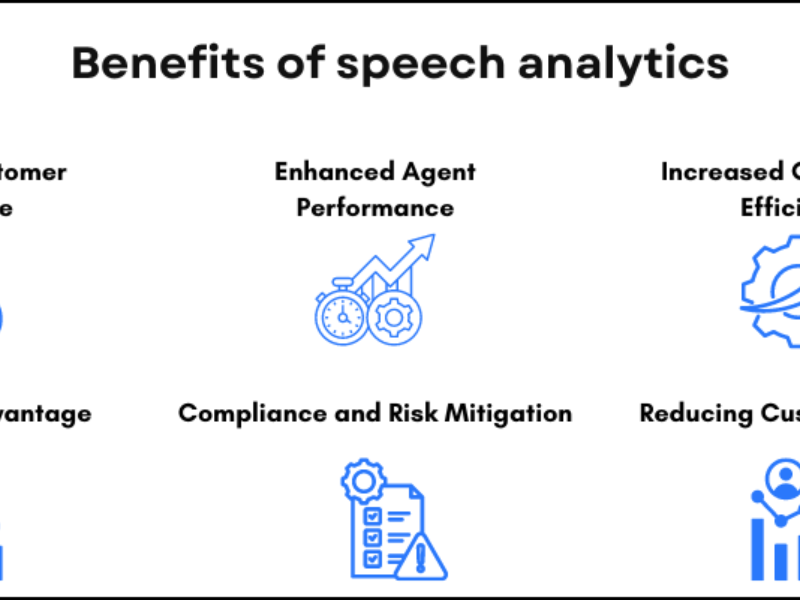
- Calls are recorded and transcribed automatically.
- AI analyzes language, tone, and patterns.
- Insights surface through dashboards, alerts, and summaries.
- CX teams act on trends, not isolated anecdotes.
Call Transcription and Speech Recognition: Making Voice Data Searchable
Speech recognition converts spoken language into text with 95%+ accuracy—even in noisy contact center environments with background chatter, accents, and audio quality issues.
Why this matters for CX teams:
Before transcription:
- QA teams must listen to entire calls to find specific moments
- Searching for “what did the agent say about refunds” requires hours of manual review
- Compliance audits involve listening to hundreds of calls hoping to catch violations
After AI transcription:
- Search entire call libraries in seconds: “Show me all calls where customers said ‘cancel subscription'”
- Jump directly to the moment a competitor is mentioned or a policy is explained
- Run compliance checks automatically across 100% of calls, not random samples
Business impact: A contact center handling 10,000 calls per month generates 300,000+ minutes of audio. Without transcription, that data is locked in unsearchable recordings. With transcription, it becomes a structured database revealing:
- Most common customer questions (build better FAQs)
- Where agents get stuck (improve training)
- Which policies confuse customers (simplify messaging)
Technical capabilities:
- Supports 30+ languages including English, Spanish, Mandarin, Russian, Arabic
- Handles diverse accents and industry-specific terminology
- Maintains speaker separation (agent vs. customer)
- 95%+ accuracy in typical call center audio conditions
Natural Language Processing and Sentiment Analysis
Natural language processing (NLP) helps AI understand what customers say and what they mean. Sentiment analysis detects emotional signals like frustration, confusion, or satisfaction based on language and tone.
In plain terms, this is how AI “reads the room” on every call.
How it works in CX:
- The system tracks emotional shifts during a conversation, not just a final score.
- It identifies stress signals such as repeated complaints, raised voice, or negative phrasing.
- It distinguishes neutral questions from high-risk interactions that may escalate.
Example from real contact center use:
Two customers ask about the same billing issue. One sounds calm and curious. The other shows rising frustration and mentions canceling. Sentiment analysis flags the second call as high risk, even though the topic is identical.
Direct CX impact:
- Supervisors get alerts when negative sentiment spikes.
- Agents receive guidance to slow down, clarify, or escalate appropriately.
- CX leaders see sentiment trends tied to products, policies, or processes.
Turning Conversations Into Actionable Insights
Speech analytics only creates value when insights lead to action. Modern platforms focus on both real-time and post-call use cases.
Real-time insights
- Detect negative sentiment while the call is happening.
- Prompt agents with reminders or recommended next steps.
- Alert supervisors before an escalation occurs.
Post-call insights
- AI-generated summaries reduce after-call work.
- Calls are automatically tagged by topic and outcome.
- Trends reveal systemic CX issues, not isolated mistakes.
Mini case:
A supervisor receives an alert that hold-time frustration is spiking across calls. Investigation shows a backend system delay. Fixing the issue reduces repeat calls within days.
The result is faster feedback loops and fewer CX blind spots.
How AI Speech Analytics Improves Customer Experience

AI speech analytics connects voice data directly to CX outcomes like CSAT and first call resolution.
Instead of relying on surveys or anecdotes, teams see:
- What customers actually say, at scale.
- Where experiences break down across journeys.
- Which changes have real impact on satisfaction.
This shifts CX from reactive problem-solving to proactive improvement.
Understanding Customer Sentiment and Intent at Scale
Analyzing thousands of calls reveals patterns no human team could catch manually.
CX teams can:
- Identify top reasons customers contact support.
- See how intent changes across channels or time periods.
- Prioritize fixes based on emotional impact, not volume alone.
For example, a low-volume issue that triggers extreme frustration may deserve immediate attention.
Identifying Friction Points and Recurring Issues
Speech analytics surfaces where customers get stuck.
Common friction points include:
- Confusing policies or unclear pricing.
- Repetitive authentication steps.
- Long holds or frequent transfers.
| Issue Detected | CX Impact |
|---|---|
| Policy confusion | Lower CSAT |
| Process gaps | Higher AHT |
| Repeated explanations | More repeat calls |
Fixing these issues improves efficiency and customer trust at the same time.
Delivering More Consistent Service Across Agents
AI-driven insights reduce performance gaps between agents.
- Coaching is based on real conversations, not assumptions.
- Best practices are identified and shared quickly.
- Customers receive a more consistent experience, regardless of who answers.
Consistency is a key driver of perceived service quality.
Top 7 CX-Focused Use Cases of AI Speech Analytics

-
1. Customer Sentiment Tracking Across Every Interaction
What it is: Continuous monitoring of emotional trends across all calls, not just survey responses or manager-selected samples.
How it works: AI scores sentiment for every call (scale of 1-10) and tracks trends by:
- Time of day (are customers more frustrated during peak hours?)
- Agent or team (performance consistency)
- Topic or product line (which offerings trigger confusion?)
- Customer segment (VIP vs. standard support experience)
Business impact: A crypto exchange tracked sentiment across 15,000 support calls during a market volatility spike. They discovered:
- Sentiment dropped 40% specifically around KYC verification calls (not withdrawal delays as assumed)
- Root cause: one document requirement was unclear
- Fix: clarified instructions in agent script
- Result: Negative sentiment decreased 45% within 5 days, support ticket volume dropped 30%
Who uses this: CX directors tracking service quality trends, operations managers identifying coaching needs, product teams validating feature changes.
2. Root Cause Analysis: From Symptoms to Systemic Fixes
What it is: Grouping similar customer complaints automatically to reveal underlying problems that random sampling misses.
How it works: AI analyzes thousands of call transcripts and clusters them by topic and issue type:
- “Password reset” calls mentioning “confusing email” → groups 200 calls with same friction point
- “Billing question” calls with high frustration → identifies specific invoice line item causing confusion
Traditional QA: Review 50 calls, see 2-3 complaints, assume isolated issues. AI analysis: Review 5,000 calls, see 300 complaints about the same thing, recognize systemic problem.
Business impact: A SaaS company’s manual QA found occasional complaints about their password reset flow. No urgent action taken.
AI speech analytics revealed: 12% of all support calls involved password reset struggles—780 calls per month. Further analysis showed the reset email was landing in spam folders for certain email providers.
Fix: Updated email authentication (SPF/DKIM records) Result: Password reset calls dropped 70% in 2 weeks, saving 500+ agent hours monthly
Who uses this: Operations leaders fixing recurring issues, product teams prioritizing UX improvements, training managers identifying knowledge gaps.
3. Escalation Prevention Through Early Warning Signals
What it is: Detecting when calls are heading toward escalation and intervening before customers demand supervisors.
How it works: AI monitors real-time sentiment and keyword triggers:
- Frustration score rising above threshold
- Customer mentions “manager,” “complaint,” “lawyer,” “cancel”
- Agent handle time exceeding target on routine issue
Alerts go to supervisor dashboard with:
- Current call sentiment score
- Key phrases customer has said
- Call context (reason, history)
Supervisor can listen live and decide whether to join immediately or coach agent after the call.
Business impact: Before AI escalation detection:
- Supervisor learns about escalations when customer explicitly demands manager (often after 5-10 minutes of frustration)
- By then, customer is already highly negative
After AI escalation detection:
- Supervisor alerted when sentiment drops below 4/10, even if customer hasn’t requested escalation yet
- Intervention happens earlier, when resolution is still possible
Real numbers from a collections agency:
- Escalation rate: 15% → 9% (40% reduction)
- Average escalation handle time: 12 minutes → 7 minutes
- Customer satisfaction on escalated calls: 45% → 68%
Who uses this: Supervisors managing live call floors, QA teams reducing complaint volume, CX leaders improving NPS.
4. Quality Assurance Automation: From 5% to 100% Coverage
What it is: Automated scoring of every call using consistent criteria, eliminating sampling bias and reviewer subjectivity.
How it works: AI evaluates each call against defined criteria:
- Was greeting protocol followed?
- Did agent verify customer identity?
- Was required disclosure provided?
- Did agent ask if customer had additional questions?
- Was call resolved (no callback needed)?
Each criterion scored automatically. Calls below threshold flagged for human review.
Comparison:
Manual QA AI-Powered QA Review 5-10 calls/agent/month Review 100% of calls Subjective scoring varies by reviewer Consistent scoring across all calls 2-4 weeks to spot trends Real-time performance dashboards “Agent seems friendly” “Agent used empathy phrases in 85% of calls” Business impact: A 200-agent BPO manually reviewed 1,600 calls per month (8 per agent) = 2% coverage.
After implementing AI QA:
- 100% of 120,000 monthly calls analyzed
- Revealed: 15% of agents consistently skipped verification step (missed in random sampling)
- Targeted coaching for those agents reduced compliance violations 80%
Who uses this: QA managers scaling quality programs, compliance officers auditing regulatory adherence, training teams identifying coaching priorities.
5. Agent Coaching Based on Real Performance Data, Not Guesses
What it is: Targeted coaching using specific call examples and objective performance metrics instead of manager intuition or limited samples.
How it works: AI generates individual performance profiles:
- Agent A: Excellent on billing calls (CSAT 4.8/5), struggles on technical issues (CSAT 3.2/5, long handle times)
- Agent B: Strong opening/closing, but skips verification steps 40% of the time
- Agent C: Handles high call volume efficiently but shows 25% higher customer frustration scores than team average
Managers can search: “Show me all calls where Agent A handled technical issues with negative sentiment” and listen to specific examples for coaching sessions.
Business impact: Traditional coaching:
- Based on 5-10 randomly sampled calls per month
- Manager says “You need to improve customer service” (vague feedback)
- Agent doesn’t know which specific behaviors to change
AI-driven coaching:
- Based on analysis of all 400 calls agent handled last month
- Manager says “You’re excellent at de-escalation (here are 3 examples), but you’re missing authentication steps in 35% of calls (here are specific instances)”
- Agent receives concrete, actionable feedback
Real results from a fintech support team:
- Agent performance variance (gap between top and bottom performers): Decreased 40%
- Time to bring new agents to target performance: 6 weeks → 3 weeks
- Manager coaching efficiency: Can coach 12 agents vs. 6 in same time (better targeting)
Who uses this: Training managers designing agent development plans, team leads conducting 1-on-1s, HR evaluating performance fairly.
6. Compliance and Risk Detection at Scale
What it is: Automated monitoring for regulatory violations, prohibited language, and legal risk—across 100% of calls, not just random audits.
How it works: AI flags calls containing:
- Missing required disclosures (TCPA, GDPR, financial regulations)
- Prohibited phrases (“guaranteed returns,” “risk-free,” unauthorized medical claims)
- Aggressive or inappropriate language
- Competitor mentions (possible poaching or information leaking)
Compliance teams receive alerts with:
- Exact timestamp of violation
- Transcript excerpt showing context
- Agent and customer information for follow-up
Business impact: Compliance risk before AI monitoring:
- Manual audit of 2-5% of calls quarterly
- Violations detected months after occurrence
- Regulatory penalties based on sampled findings extrapolated to full call volume
Compliance with AI monitoring:
- 100% of calls monitored for violations
- Issues detected within hours, not months
- Immediate corrective action before regulators discover problems
Real scenario – collections agency: TCPA requires “mini-Miranda” disclosure on debt collection calls. Manual audits showed 95% compliance.
AI analysis of 100% of calls revealed actual compliance was 78%—violations happening in specific situations that random sampling missed (early morning calls, certain agent shifts).
Action: Retrained agents on disclosure requirements Result: Compliance increased to 97%, avoiding $500,000+ in potential TCPA violations ($500-1,500 per violation × thousands of calls)
Who uses this: Compliance officers managing regulatory risk, legal teams preventing lawsuits, contact center directors protecting company reputation.
7. Voice of the Customer Insights for Product and CX Teams
What it is: Extracting customer feedback, pain points, and feature requests directly from support calls—no surveys needed.
How it works: AI identifies and groups recurring themes:
- Product complaints (“The mobile app crashes when I try to upload photos”)
- Feature requests (“I wish I could export my data to Excel”)
- Competitive mentions (“Your competitor offers overnight shipping”)
- Confusing policies (“Why is this fee not mentioned on your website?”)
Product teams get direct access to:
- Call transcripts mentioning specific features
- Sentiment analysis around product launches
- Unfiltered customer language (how they actually describe problems)
Business impact: Traditional voice-of-customer:
- Post-call surveys (5-10% response rate, biased toward extremes)
- Focus groups (expensive, small sample, artificial environment)
- Support ticket themes (only written complaints, missing nuance)
AI-powered voice-of-customer:
- Every call is a voice-of-customer data point
- Captures feedback from customers who don’t fill out surveys
- Reveals emotional intensity behind issues (surveys show “problem exists,” calls show “customers are furious”)
Example – SaaS company product team: Survey data: 85% satisfaction with new dashboard redesign Call analysis: 400+ calls mentioned “can’t find the export button” with frustration Reality: Redesign moved frequently-used feature, causing daily friction
Fix: Restored export button to prominent location Result: Calls about “can’t find export” dropped 90%, product team learned to validate designs against actual usage patterns
Who uses this: Product managers prioritizing roadmap, UX designers validating changes, CX strategy teams understanding customer journey friction.
Why These Seven Use Cases Matter
Each use case addresses a different operational gap:
- Sentiment tracking = Know how customers feel in real time
- Root cause analysis = Fix systemic problems, not symptoms
- Escalation prevention = Intervene before damage is done
- QA automation = Scale quality without adding headcount
- Agent coaching = Improve performance with specific feedback
- Compliance monitoring = Avoid regulatory penalties
- Voice-of-customer = Product improvements based on real conversations
Together, they transform voice from an operational cost into strategic intelligence that improves every part of the customer experience.
Key Benefits for Customers, Agents, and CX Teams

For customers
- Faster resolutions and fewer repeat contacts.
- Feeling heard and understood during complex issues.
For agents
- Clear guidance during difficult conversations.
- Less after-call work and more confidence.
For CX teams
- Reliable data to prioritize improvements.
- Stronger link between voice insights and CX metrics.
Why AI Speech Analytics Is Becoming Essential for Modern CX Teams

Customer expectations keep rising, while contact centers face higher volume and complexity. AI speech analytics gives teams visibility they cannot achieve manually.
It turns voice into a strategic CX asset, not just a cost center.
AI Speech Analytics and CX Technology Ecosystems

Integration With CRM and CX Management Platforms
- Call insights sync directly into customer records.
- Teams get a unified view of history, sentiment, and outcomes.
- Follow-ups are informed by real conversation context.
Data Security, Privacy, and Compliance Considerations
- Sensitive data is automatically redacted.
- Access is controlled by role.
- Platforms support regulatory compliance requirements.
The Future of AI Speech Analytics in Customer Experience

- More real-time guidance during live calls.
- Predictive insights that flag churn risk earlier.
- Smarter routing based on sentiment and intent.
Voice will remain central, but insight will arrive faster.
Frequently Asked Questions (FAQ)

What is AI speech analytics used for in contact centers?
It is used to analyze customer calls, understand sentiment and intent, and improve customer experience at scale.
Is AI speech analytics real-time or post-call?
Most platforms support both, allowing live guidance and post-call analysis.
Does speech analytics replace human QA?
No. It enhances QA by covering all calls and highlighting where human review matters most.
How does speech analytics improve CSAT?
By identifying friction points and emotional drivers, teams can fix issues that directly impact satisfaction.
Conclusion & Call to Action
AI speech analytics helps contact centers listen better, act faster, and improve customer experience with confidence. By turning every call into insight, CX teams gain clarity where it matters most.
If you’re evaluating ways to improve CX through voice, now is the time to explore AI speech analytics and see its impact firsthand.
Frequently Asked Questions (FAQ)

What is AI speech analytics in a contact center?
AI speech analytics refers to the use of artificial intelligence to analyze customer-agent conversations in real-time. It captures, transcribes, and processes spoken interactions to extract insights such as sentiment, intent, compliance, and recurring issues, transforming voice data into actionable CX intelligence.
How does AI speech analytics improve customer experience?
AI speech analytics enhances CX by identifying customer sentiment, recurring pain points, and inefficiencies at scale. It enables customer-centric adjustments, reduces average handle time (AHT), improves first call resolution (FCR), and ensures consistent service quality across agents.
What is the difference between AI speech analytics and traditional call monitoring?
AI speech analytics automates transcription, sentiment analysis, and insight generation, offering real-time feedback and comprehensive call coverage. Traditional call monitoring relies on manual sampling and lacks scalability, often missing key customer insights.
How can speech analytics help with agent training?
AI speech analytics provides measurable insights on agent performance, including sentiment trends and quality metrics. These insights allow managers to offer tailored coaching, share best practices via scorecards, and enhance consistency in customer interactions.
Does AI speech analytics work with multiple languages?
Yes, modern AI speech analytics tools support multilingual capabilities, enabling accurate transcription and analysis across diverse languages. This makes it ideal for global contact centers serving multilingual customers.
Is speech analytics software secure for handling sensitive customer data?
Yes, reputable speech analytics platforms prioritize data security with features like transcription redaction, role-based access control, encryption, and compliance with regulations such as GDPR and SOC 2.
What are the key features to look for in an AI speech analytics tool?
Important features include real-time transcription and sentiment analysis, keyword identification, AI-generated conversation summaries, CRM integration, predictive analytics, and compliance safeguards.
How do companies implement AI speech analytics effectively?
Successful implementation involves defining CX goals, selecting user-friendly software, training agents to leverage insights, and regularly analyzing data to refine processes. Integration with existing tools, such as CRM platforms, ensures smooth adoption and maximized value.
Read more:
- How to Build the Best Customer Success Team: The Ultimate Guide
- Customer Success Playbooks: The Ultimate Guide for SaaS Success
- How Customer Success Operations Improves Customer Service at Scale
More in AI & QA
View all →
AI for Customer Success: 10 Use Cases That Actually Work
Customer success has never been more demanding. Your teams process mountains of data, manage multi-channel conversations, and meet customers who expect instant, personalized responses at every touchpoint. Sound familiar? Here's the good news: AI for customer success helps teams scale intelligently without losing the human connection that drives loyalty. When implemented correctly, AI detects churn signals weeks before customers disappear,…

10 Best Accounts Receivable Collection Software Tools (2026)
Finance teams waste 15-20 hours per week chasing late payments. Manual follow-ups get forgotten, customers claim they never received invoices, and cash flow forecasts change weekly without explanation. Accounts receivable collection software eliminates this chaos. It automates payment reminders, tracks every invoice status in real-time, and gives finance teams complete visibility into incoming cash—without adding headcount or complexity. This guide…
First Call Resolution Software: Improve FCR and CSAT Fast
For contact center managers, First Call Resolution (FCR) isn't just another metric—it's the single clearest indicator of whether your operation is working. When customers need multiple calls to solve one issue, they leave. When agents resolve problems completely the first time, satisfaction scores rise and costs drop. This guide explains what drives FCR in modern contact centers, how first call…

 English
  Russian
  Chinese