
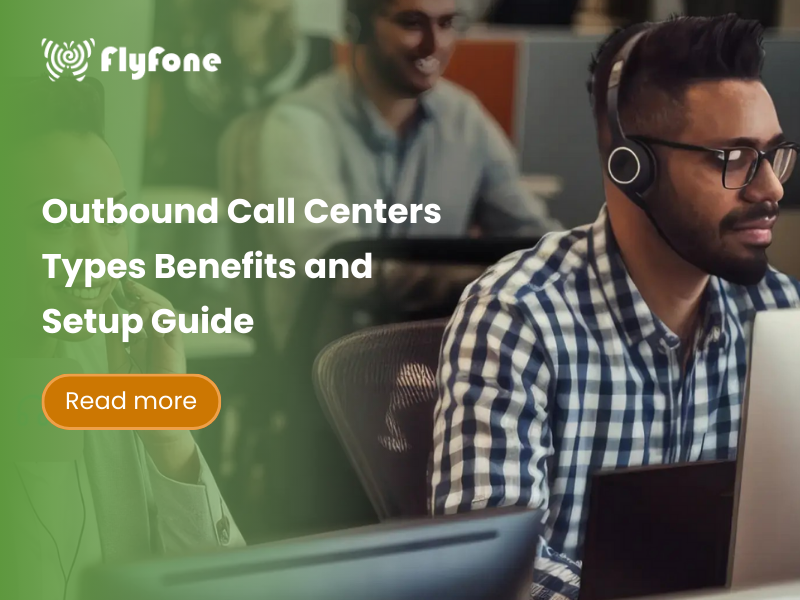
Inbound leads alone rarely fill a modern sales pipeline. Outbound call centers help businesses take control by proactively reaching prospects and customers at the right time, boosting sales and customer relationships. This guide explains what outbound call centers are, what they do, how they work, and the best options for your business.
Key Takeaways
- An outbound call center focuses on proactive outreach, not waiting for customers to call you.
- Businesses use outbound call centers for sales, lead generation, follow-ups, retention, surveys, and collections.
- Outbound operations can be in-house, outsourced, or powered by outbound call center software.
- Modern outbound call centers rely heavily on AI, CRM data, and compliance-friendly dialing.
- The right setup depends on your goals, budget, and need for control or speed.
What Is an Outbound Call Center?
An outbound call center is a team or system that proactively makes outgoing calls to prospects, leads, or existing customers on behalf of a business.
Unlike inbound call centers, which react to customer-initiated calls, outbound call centers are proactive, with agents deciding who to call, when to call, and the reason for the call.
Outbound call centers are not limited to cold calling. In practice, most outbound calls today are data-driven and context-aware.

Common real-world examples include:
- A sales rep calling a lead who downloaded a whitepaper.
- An agent calling a customer before their subscription expires.
- A service team confirming an upcoming appointment.
- A research team running short customer surveys.
Outbound call centers play a direct role across the sales funnel, supporting lead generation and customer retention:
- Top of funnel: Lead generation and qualification.
- Middle of funnel: Appointment setting and follow-ups.
- Bottom of funnel: Closing, upselling, renewals.
- Post-sale: Retention, feedback, payment reminders.
[Sơ đồ: Sales funnel with outbound touchpoints]
What Do Outbound Call Centers Do?
Sales and Telemarketing

Outbound call centers drive revenue through direct sales conversations.
There are two common call types:
- Cold calls: Reaching people with no prior interaction.
- Warm calls: Contacting leads who already showed interest.
Agents handle objections, explain value, and guide prospects toward a decision.
Examples:
- B2B SaaS teams booking demos with IT managers.
- B2C teams selling insurance, home services, or subscriptions.
Key value:
- Phone conversations surface buying intent in ways email can’t — a hesitant prospect might ignore three follow-up emails, but a skilled agent can identify the real objection and address it in the same call. This real-time adaptability is especially valuable in high-stakes sales cycles, where a single conversation can shorten a deal from weeks to days.
- Skilled agents adapt messaging in real time.
Lead Generation and Qualification

Outbound teams don’t just call lists; they qualify leads before sales gets involved.
A typical flow looks like this:
- Build or import a contact list.
- Call to confirm interest and basic fit.
- Qualify using simple criteria (budget, need, timing).
- Pass qualified leads to sales.
This keeps sales teams focused on high-quality opportunities instead of chasing unqualified contacts.
Appointment Setting and Follow-Ups
Many outbound call centers exist for one clear goal: booking meetings.
Use cases include:
- Sales demos.
- Consultations.
- On-site visits.
- Renewal discussions.
Outbound agents handle reminders and rescheduling, thereby reducing no-shows and wasted calendar time.
For sales teams, this means more conversations and fewer empty slots.
Customer Retention and Proactive Engagement
Outbound calls are powerful for retention when done right.
Instead of waiting for complaints, teams reach out early to:
- Check satisfaction.
- Offer help.
- Flag renewal risks.
- Introduce relevant upgrades.
This approach is common in SaaS, telecom, and subscription businesses — where research shows acquiring a new customer costs 5–7× more than retaining an existing one. A single proactive call before renewal can prevent churn that a passive support model would never catch
Surveys, Feedback, and Market Research
Outbound call centers also collect structured feedback.
They are used for:
- Short post-purchase surveys.
- Product feedback.
- Market validation.
Phone-based surveys typically yield richer, more nuanced responses than email — particularly for open-ended questions where a follow-up probe can clarify an ambiguous answer in real time. For product teams validating a new feature or pricing model, this qualitative depth often matters more than volume
Collections and Payment Reminders
Outbound agents contact customers about overdue payments.
The focus is typically:
- Clear communication.
- Respectful tone.
- Compliance with regulations.
Done well, this protects cash flow without damaging customer relationships.
How an Outbound Call Center Works (High-Level)
[Sơ đồ: Outbound call center workflow]
Campaign Planning and Preparation
Every outbound campaign starts with clarity.
Teams define:
- The goal (sales, leads, reminders).
- The target audience.
- The call list.
- Scripts and talking points.
Agents are trained on messaging, objections, and compliance rules before calls begin.
Making Outbound Calls
While outbound call centers define the broader strategy and operations, dialing technology plays a critical role in execution. This detailed outbound dialer guide breaks down the different dialer types, how they impact agent productivity, and how to choose the right system based on your campaign goals and scale.
While outbound call centers define the broader strategy and operations, dialing technology plays a critical role in execution. This detailed guide to outbound dialer explains the different dialer types, how they impact agent productivity, and how to choose the right system based on your campaign goals and scale.
Outbound teams use dialers to improve efficiency:
- Predictive dialers: Automatically call multiple numbers and connect agents only when someone answers.
- Power dialers: Automatically dial one number after another.
- Progressive dialers: Dial one number at a time as agents become available.
The right dialer depends on call volume and how personal the conversation needs to be.
Call Handling and Customer Interaction
During calls, agents rely on CRM data to personalize conversations.
This includes:
- Previous interactions.
- Account details.
- Notes from earlier calls.
Scripts guide the conversation, but agents adjust based on how the customer responds.
Post-Call Follow-Up and Tracking
After each call, outcomes are logged.
Teams track:
- Call results.
- Next steps.
- Conversion rates.
This data is used to refine scripts, lists, and timing for future campaigns.
Outbound vs Inbound Call Centers
Key Differences at a Glance
| Aspect | Inbound Call Center | Outbound Call Center |
|---|---|---|
| Call direction | Customer calls in | Business calls out |
| Trigger | Reactive | Proactive |
| Primary goal | Support and resolution | Growth and engagement |
| Typical metrics | Resolution time | Connect and conversion rates |
When Businesses Use Each Model
- Inbound: Customer support, order processing, technical help.
- Outbound: Sales, lead generation, renewals, reminders.
Most growing companies rely on both.
Blended Call Centers
Blended call centers handle inbound and outbound calls using the same team.
This model works well in retail, healthcare, and financial services, where agents support and sell.
Understanding the difference between inbound and outbound is useful, but the more practical question is: what do you actually gain from running an outbound operation? Here are the core business benefits
Benefits of Using an Outbound Call Center
Proactive Customer Engagement
Outbound calling enables you to reach customers before problems escalate.
This builds trust and shows that your business is attentive, not reactive.
Increased Sales and Lead Generation
Outbound calls create opportunities instead of waiting for them.
Teams control volume, targeting, and timing, which leads to more predictable pipeline growth.
Better Agent Productivity and Efficiency
Dialers, CRM integration, and AI tools reduce manual work.
Agents spend more time talking to real people and less time dialing or logging notes.
Scalability and Flexibility
For businesses looking to scale outreach efficiently across multiple regions, investing in reliable global outbound call solutions can significantly improve connection rates, ensure compliance across markets, and streamline campaign performance.
Outbound call centers scale up or down quickly.
Cloud-based platforms like Flyfone let you scale from 10 agents to 200 in a single afternoon — no hardware provisioning, no IT tickets. This matters most for seasonal campaigns (Black Friday, year-end renewals) or rapid-growth moments where waiting weeks to onboard infrastructure is not an option
The benefits above apply broadly, but how they play out depends on what type of outbound operation you run. Each model is built around a different business goal.
Common Outbound Call Center Challenges (And How to Address Them)
Running an outbound call center is not without friction. Understanding these challenges upfront helps you build a more resilient operation from day one.
High Call Rejection and Low Connect Rates
For businesses operating across multiple countries or targeting global users, implementing effective international outbound calls strategies can help overcome timezone differences, improve answer rates with local caller IDs, and ensure compliance with regional regulations.
Even well-targeted outbound campaigns regularly see answer rates between 15–30%. Customers screen unknown numbers, and oversaturation in many markets has made cold outreach harder than it was five years ago. The most effective counterweight is combining local caller ID — using phone numbers that match the recipient’s region — with smart dialing schedules that avoid peak rejection windows (typically early mornings and late evenings). Platforms with dynamic caller ID rotation and timezone-aware dialing reduce this friction significantly.
Compliance and Regulatory Risk
Outbound calling is one of the most regulated business activities in most markets. In the US, the TCPA and Do Not Call Registry carry substantial penalties for violations. In Europe, GDPR governs how contact data is stored and used. For industries like fintech and crypto, additional layers of KYC and data handling requirements apply. Teams that treat compliance as an afterthought — rather than building it into their dialing workflow and contact list management — expose the business to legal and reputational risk.
Agent Burnout and High Turnover
Outbound agents face consistent rejection, making role satisfaction harder to maintain than in inbound roles. Without clear performance targets, real-time coaching, and structured break cadences, burnout accelerates. High turnover then creates a compounding problem: campaigns lose institutional knowledge mid-flight, and onboarding new agents eats into productivity gains. The fix is operational — well-defined KPIs per campaign, regular script feedback loops, and supervisors who monitor dashboards in real time rather than reviewing recordings after the fact.
Data Quality and List Decay
A calling list degrades faster than most teams expect. Phone numbers change, job roles shift, and contacts who were warm six months ago may now be with a different company. Operating on stale data inflates your dialing volume while deflating your connect and conversion rates. Sustainable outbound operations build list hygiene into the campaign cycle — scrubbing lists before each campaign run, retiring contacts that have not engaged after multiple attempts, and continuously refreshing data from CRM activity.
Common Types of Outbound Call Centers
- Sales-focused call centers: Drive direct revenue.
- Lead generation centers: Qualify prospects.
- Customer retention centers: Reduce churn.
- Market research centers: Collect insights.
- Collections centers: Manage payments.
Each type is designed around a specific business outcome.
Outbound Call Center Options for Businesses
In-House Outbound Call Centers
You hire, train, and manage your own team.
Pros:
- Full control over messaging and quality.
- Deep product knowledge.
Cons:
- Higher fixed costs.
- Slower to scale.
Best for businesses with steady call volume and strict brand requirements.
Outsourced Outbound Call Center Services (BPO)
You partner with a third-party provider.
Pros:
- Fast setup.
- Lower upfront cost.
- Easy scaling.
Cons:
- Less control.
- Quality varies by vendor.
Outsourcing works well for short-term campaigns or rapid expansion.
Outbound Call Center Software
Cloud-based outbound call center software lets you run your own operation without building on-premise infrastructure. You bring the agents; the platform handles dialing, routing, recording, and analytics.
For businesses in fast-moving or compliance-sensitive industries — iGaming, crypto, fintech, and BPO — platforms like Flyfone are purpose-built for this model. Flyfone offers pay-as-you-go pricing with no seat minimums, global number coverage across 200+ countries, and deployment in under an hour. This makes it particularly well-suited for teams that need to launch quickly or scale campaign volume without committing to long-term contracts.
Pros:
- Flexible SaaS pricing.
- AI-powered dialing and analytics.
- Supports remote teams.
Cons:
- Requires internal agents.
- Results depend on execution.
This option suits SMBs and mid-market teams that want control without heavy infrastructure.
[Bảng: In-house vs Outsourced vs Software]
Key Features of Outbound Call Center Software
- Predictive and power dialers.
- CRM integration.
- Call recording and analytics.
- AI call summaries and agent assist.
- Local and branded caller ID.
These features improve efficiency without adding complexity. When evaluating platforms, look for one that combines these capabilities with transparent, usage-based pricing — especially if your call volume fluctuates by campaign or season. Flyfone’s AI-powered QA layer adds an additional advantage here: automated call scoring and sentiment analysis reduce the manual review burden on supervisors, making quality assurance scalable even as team size grows
Compliance and Regulations for Outbound Call Centers
Outbound calling in the US must comply with rules such as:
- TCPA (limits calling methods and consent).
- Do Not Call Registry (restricted numbers).
- STIR/SHAKEN (caller ID authentication).
Modern software helps manage compliance automatically, reducing legal risk.
Is an Outbound Call Center Right for Your Business?
Businesses That Benefit Most
Outbound call centers work best for businesses that rely on conversations to sell or retain customers.
Examples include SaaS, insurance, real estate, healthcare, and B2B services.
Signs You Should Consider Outbound Calling
- Inbound leads are inconsistent.
- Sales reps spend time chasing unqualified leads.
- Renewals or follow-ups are missed.
- Growth depends on proactive outreach.
When Other Channels May Be Better
Outbound calling is not ideal if:
- Your product is low-touch and self-serve.
- Your audience strongly prefers digital-only communication.
- You lack clean contact data.
In these cases, email or self-service channels may lead.
Industries That Commonly Use Outbound Call Centers
- SaaS and technology.
- For industries like gaming and SMB-focused platforms, applying tailored gaming outbound call strategies can significantly improve player engagement, reactivation rates, and lifetime value.
- Financial services.
- Healthcare.
- Real estate.
- Retail and e-commerce.
- Education and nonprofits.
-
Outbound Call Center Best Practices
- To execute these best practices effectively, teams often rely on proven call center script examples that help standardize conversations, handle objections more confidently, and improve overall conversion rates.
- The difference between an outbound operation that generates consistent pipeline and one that burns through budget without results usually comes down to execution discipline, not technology alone. These practices apply whether you run a 5-agent team or a 500-seat BPO.
-
Build Your Call List Before You Build Your Script
- A great script delivered to the wrong audience produces nothing. Before any campaign launches, define the contact criteria precisely — industry, company size, role, previous interaction history, and recency of data. A focused list of 500 well-qualified contacts will consistently outperform a broad list of 5,000. Remove numbers on Do Not Call registries before the first dial, not after a complaint arrives.
-
Match Your Dialer Type to Your Campaign Goal
- Not every outbound campaign needs a predictive dialer. High-volume lead generation benefits from predictive dialing, which maximizes the number of connections per agent hour. However, high-value accounts — enterprise prospects, renewal conversations, or collections on large balances — are better served by preview dialers that give agents 30–60 seconds to review account context before the call connects. Using the wrong dialer for the campaign type leads to either wasted agent capacity or damaged relationships.
-
Run Tight Feedback Loops Between QA and Scripts
- Call scripts that were written at campaign launch are almost never the best version by week two. Listen to calls weekly, identify the specific objections agents are failing to handle, and update scripts in real time. Outbound teams that treat scripting as a living document — not a one-time setup task — consistently improve conversion rates over the course of a campaign without changing anything else. AI-powered call monitoring tools can accelerate this process by automatically flagging calls where sentiment drops or key objections appear.
-
Set Campaign-Level KPIs, Not Just Agent-Level KPIs
- Individual metrics like calls per hour and talk time are necessary but not sufficient. Each campaign should have its own conversion benchmarks: what connect rate is acceptable given the list quality? What is the target cost per qualified lead? What is the minimum acceptable follow-up rate? When agents understand the campaign goal — not just their personal quota — they make better judgment calls during live conversations about when to push and when to qualify out.
-
Protect Agent Experience as Deliberately as Customer Experience
- Outbound agents who feel set up to fail will leave. Realistic targets, regular coaching that focuses on skill development rather than just performance criticism, and clear escalation paths for difficult calls all contribute to lower turnover. A stable, experienced outbound team outperforms a larger but constantly rotating one — not just in quality of conversation, but in the institutional knowledge that makes every subsequent campaign more efficient.
Frequently Asked Questions
What is an outbound call center?
An outbound call center is a business operation where agents proactively initiate outgoing calls to customers and prospects. This proactive outreach is used for various purposes, including sales, lead generation, appointment setting, and customer retention.
How does an outbound call center work?
Outbound call centers operate through campaign planning, call list and script preparation, and by using dialing technology to connect agents with contacts. Agents engage in conversations, gather information, and follow up as needed, with all activities tracked for analysis and optimization.
What do outbound call centers do?
Outbound call centers perform various activities, such as making sales calls, generating and qualifying leads, setting appointments, reminding customers about payments, conducting market research, and proactively engaging existing customers to improve retention.
What’s the difference between an inbound and outbound call center?
Inbound call centers handle incoming calls from customers, typically for support or inquiries. Outbound call centers, conversely, initiate outgoing calls to prospects or customers for sales, marketing, or other proactive outreach.
What are some common types of outbound call centers?
Common types include sales call centers focused on revenue generation, lead generation centers that identify potential customers, customer service centers for proactive support, and market research centers for data collection.
What are the main benefits of using an outbound call center?
Key benefits include driving sales and lead generation, enhancing proactive customer engagement, increasing agent productivity through efficient dialing, and offering scalability and flexibility to adapt to business needs.
What are the core features of outbound call center software?
Essential features include various dialer tools (predictive, power, progressive), CRM integration for customer data, call recording for quality assurance, performance analytics, and compliance tools to adhere to regulations.
Is an outbound call center right for my business?
Consider an outbound call center if you need to proactively generate leads, drive sales, improve customer retention, or conduct market research. Businesses in sales-driven industries, or those looking to expand their reach, often benefit significantly.
What regulations must outbound call centers follow?
Outbound call centers must comply with regulations such as the Telephone Consumer Protection Act (TCPA) and adhere to the Do Not Call (DNC) Registry to protect consumer privacy and avoid legal penalties.
How do I set up an outbound call center?
To set up an outbound call center, define your goals, recruit and train agents, invest in appropriate technology and software, develop call scripts, establish performance metrics, and strictly adhere to all relevant regulations.
Read more:
Gaming Outbound Call Strategies to Boost SMB Sales
Outbound Dialer Guide Types Benefits and How to Choose
Video Game Customer Support Strategies for Player Loyalty
Conclusion
Outbound call centers give businesses control over growth that inbound alone cannot provide. Whether the goal is pipeline generation, customer retention, or market research, the fundamentals are consistent: a clean contact list, the right dialer for the campaign type, agents equipped with real-time data, and a QA process that improves scripts faster than the competition.
The right model — in-house, outsourced, or software-powered — depends on how much control you need, how fast you need to move, and how predictably your call volume behaves. For teams that prioritize speed to launch and cost flexibility without locking into per-seat contracts, a cloud-based platform built for high-volume, compliance-aware industries is often the most practical starting point.
Flyfone is built for exactly this use case — supporting outbound operations in iGaming, crypto, fintech, and BPO with rapid deployment, pay-as-you-go pricing, and AI-powered quality assurance. Most teams go from signup to first live call in under an hour.
Ready to see how it works? [Request a Free Trial] or [Contact Flyfone] to discuss your outbound setup.
More in Operations & CX Optimization
View all →
Customer Experience Transformation: Framework and Steps
A telecom customer calls support about a billing error. They explain the problem to the IVR system. Then to the first agent. Then get transferred and explain again. Then escalated—and explain a third time. Forty minutes later, they're exhausted and the problem still isn't solved. This is what broken customer experience looks like. And it's costing you customers. Customer experience…

Web Caller Meaning: JavaScript caller, Calling Tools or Portals
“Web caller” is one of those phrases where the search results and the searcher are frequently talking about different things. Three unrelated audiences use it: developers hitting an error on the legacy JavaScript caller property, buyers evaluating browser-based calling software, and people trying to reach a specific portal or training page whose exact name they cannot recall. That fragmentation is…
Customer Experience Strategy: How to Build One That Works
Customer experience is getting worse, not better. Forrester's 2025 Global CX Index found that 21% of brands declined in CX quality while only 6% improved — and in the US, 25% declined against 7% that improved, the second consecutive year of that pattern. Most of those brands were not neglecting customer experience. They were working on it without a strategy…

 English
  Russian
  Chinese